
Case Background
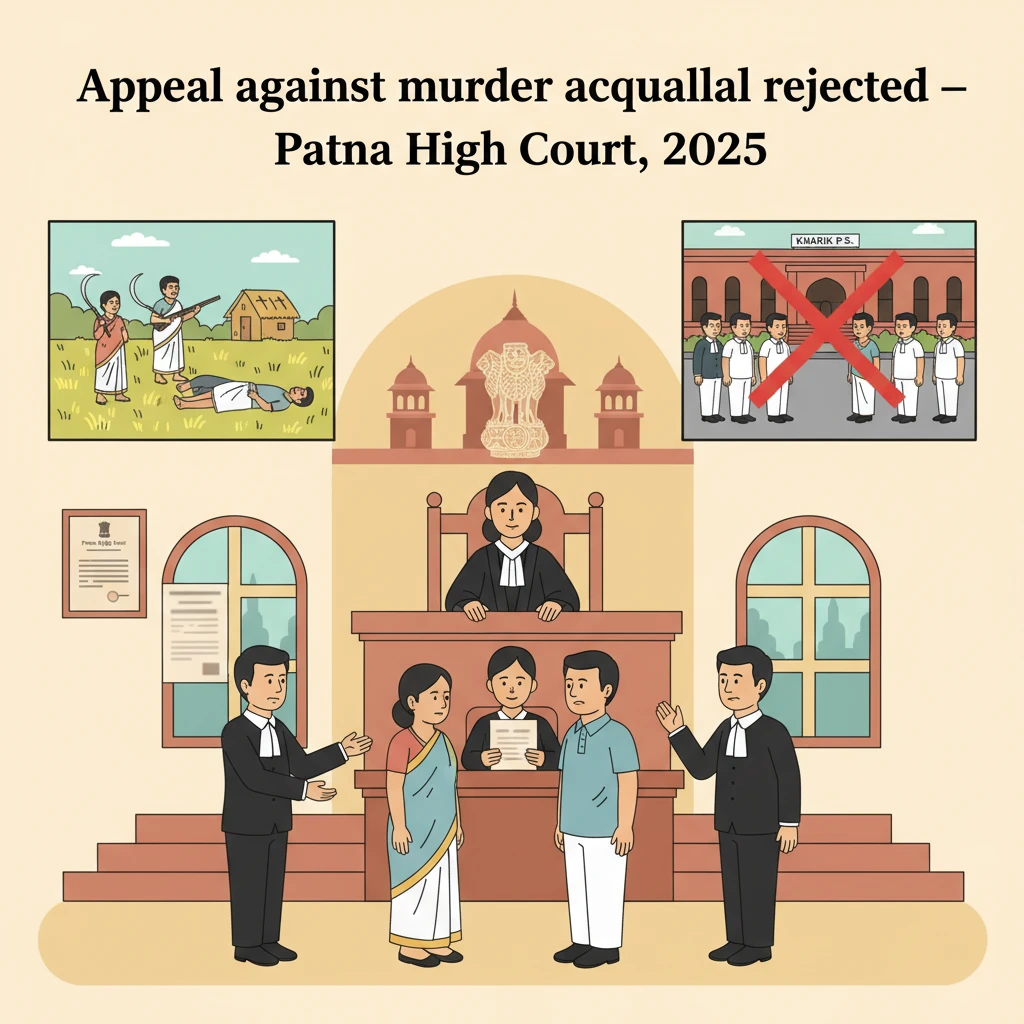
This case arises from a village incident dated 12.03.1993 in Telghi, under Kharik Police Station, District Bhagalpur. According to the written complaint, the informant had gone with his two brothers and two cousin brothers to the western field for cutting grass around noon.
The informant and one cousin were plucking arandi leaves in the field of one Pramod Choudhary. The other brother and cousin, along with Pramod Choudhary and another person, were moving towards the “basa” (field hut) of Pramod Choudhary.
At that time, as per the FIR, a group of accused persons allegedly came armed with different weapons – rifle, pistol, sickle, axe, “three-nut”, lathi and musket. Respondent no. 2 (Bharat Singh) was alleged to be armed with a rifle and other co-accused with various weapons.
The prosecution version was that respondent no. 2 fired and chased away the informant’s brothers. One brother, Shankar Rai, allegedly fell on the road and was caught by accused persons including respondent no. 2. One co-accused allegedly cut his neck from behind with a sickle while another allegedly held him. It was claimed that Shankar Rai died on the spot.
The complaint further stated that the other brother, Niro Rai, was chased, caught by several co-accused, and that respondent no. 2, along with others, went to another field where Niro was assaulted with a sickle and “pasiyani”, and his neck was cut, leading to his death.
On this written report, Kharik P.S. Case No. 53 of 1993 was registered under Sections 147, 148, 149, 302 of the Indian Penal Code and Section 27 of the Arms Act. After investigation, the police submitted a charge-sheet only against respondent no. 2, Bharat Singh. Cognizance was taken and the case was committed to the Court of Sessions.
In Sessions Trial No. 336 of 2002, charges were framed against respondent no. 2 under Sections 302/34 IPC and Section 27 of the Arms Act, to which he pleaded not guilty and sought trial. The trial extended over many years. The statement of the accused under Section 313 Cr.P.C. was recorded on 09.06.2017.
Ultimately, on 06.11.2023, the learned 1st Additional Sessions Judge, Naugachiya, acquitted respondent no. 2 of all charges. The present criminal appeal (DB) No. 244 of 2024 was filed in the Patna High Court under Section 372 Cr.P.C. challenging this acquittal.
What the Court Examined and Decided
The Division Bench of the Patna High Court, comprising Hon’ble Mr. Justice Sudhir Singh and Hon’ble Mr. Justice Alok Kumar Pandey (authoring the judgment), had to decide whether the acquittal of respondent no. 2 by the trial court was so wrong or perverse that it should be overturned in appeal.
First, the Court noted the prosecution evidence. During the trial, the prosecution examined ten witnesses: PW1 Subhash Singh, PW2 Navin Singh, PW3 Pankaj Kumar Rai, PW4 Subhash Mandal, PW5 Radhey Mandal @ Radhwa, PW6 Lal Mistri, PW7 Sanjay Kumar Singh, PW8 Mukesh Singh, PW9 Shiv Nandan Rai and PW10 Janardan Prasad Singh.
Crucially, none of these witnesses supported the prosecution story at trial. All ten were declared hostile. They stated that they did not know who killed the deceased, and some denied that their earlier statements were recorded by police in the manner claimed.
The High Court particularly noted that as per the FIR, PW3 and PW6 were projected as eye-witnesses. However, when they came to the witness box, they retracted from their earlier versions and did not support the case. They too were declared hostile.
No documentary evidence was adduced by the prosecution. Further, two key witnesses – the doctor who conducted the post-mortem and the Investigating Officer – were not examined at all. The defence led no evidence of its own.
After prosecution evidence was closed and the accused’s Section 313 Cr.P.C. statement recorded, the trial court concluded that the prosecution had failed to prove its case beyond reasonable doubt, and acquitted respondent no. 2.
In the appeal, counsel for the appellant (informant) attacked this acquittal. He argued that the trial court had not applied its judicial mind and passed a wrong judgment. He stressed that although ten witnesses were examined and all turned hostile, the informant himself had not been examined and that the non-examination of the doctor and Investigating Officer caused serious prejudice.
He pointed out that an application under Section 311 Cr.P.C. for recalling or summoning witnesses was moved during trial. The trial court rejected this application on the ground that the informant was physically present in court, watching the proceedings, but was intentionally avoiding entering the witness box. This order was challenged before the High Court and, thereafter, before the Supreme Court, but both courts declined to interfere.
The High Court in the present appeal began by restating the settled law on appeals against acquittal. Referring to Surajpal Singh v. State (1952 SCR 193), the Court highlighted that while an appellate court has full power to review the evidence, the presumption of innocence of the accused is strengthened by an acquittal. The trial judge’s findings, having seen and heard the witnesses, can be reversed only for “very substantial and compelling reasons.”
Relying on Ghurey Lal v. State of Uttar Pradesh, (2008) 10 SCC 450, the Court emphasised that the appellate court should be slow to disturb an acquittal unless it is “totally perverse or wholly unsustainable.” It then referred to a line of recent Supreme Court judgments – including H.D. Sundara v. State of Karnataka, (2023) 9 SCC 581; Chandrappa v. State of Karnataka, (2007) 4 SCC 415; Murugesan v. State, (2012) 10 SCC 383; Hakeem Khan v. State of M.P., (2017) 5 SCC 719; and Babu Sahebagouda Rudragoudar v. State of Karnataka, 2024 SCC OnLine SC 561 – which all reaffirm that:
- Acquittal further strengthens the presumption of innocence.
- The appellate court may reappreciate evidence but cannot substitute its own view if the trial court’s view is a “possible” one.
- Interference is justified only if the trial court’s judgment is perverse, based on misreading/omission of material evidence, and where no two reasonable views are possible.
Based on these principles, the High Court framed the central question: whether the prosecution had proved the case beyond the shadow of reasonable doubt, and whether the trial court’s view was perverse or not.
The Court then carefully looked at the factual matrix. All ten prosecution witnesses turned hostile and did not support the FIR version. The so-called eye-witnesses (PW3 and PW6) also denied the prosecution story. In such a situation, there was no substantive, trustworthy evidence on record linking respondent no. 2 to the murders in the manner alleged.
The Court also addressed the complaint about non-examination of the informant, doctor and Investigating Officer. It noted the long chronology: the occurrence was on 12.03.1993, the case was committed to the Sessions Court on 22.04.2002, the accused’s statement under Section 313 Cr.P.C. was recorded on 09.06.2017, and the acquittal was finally delivered on 06.11.2023.
Thus, more than two to three decades had passed since the FIR was lodged, and yet the prosecution did not choose to produce all material witnesses. Importantly, the trial court recorded a finding that the informant was physically present in court, observing the proceedings, but did not voluntarily come forward to depose as a witness.
The Section 311 Cr.P.C. application, by which the appellant later sought to recall or summon witnesses, was rejected by the trial court on this very ground. That order had already been upheld by both the High Court and the Supreme Court. The Division Bench held that the appellant could not now seek to take advantage of his own failure, especially when ten witnesses had already been examined and adequate opportunity existed during the long trial.
The High Court described it as “unfathomable” and “beyond perception” to keep seeking remedies indefinitely when the prosecution had had sufficient time since 1993 to marshal its evidence but failed to do so. It found that the appellant had not given any reason why the remaining witnesses, including himself, were not examined during the trial despite being available.
Ultimately, the Court held that the trial court’s view – that the prosecution failed to prove its case beyond reasonable doubt due to hostile witnesses and lack of supporting evidence – was a “plausible” and “possible” view based on the record. It was neither perverse nor illegal.
Since, under the law governing appeals against acquittal, the High Court can only interfere where no reasonable view except guilt is possible, the Bench concluded that no ground for interference was made out.
Accordingly, the criminal appeal against acquittal was dismissed at the admission stage itself, and the acquittal of respondent no. 2 in Sessions Trial No. 336 of 2002 stands confirmed.
Why This Judgment Matters
This judgment is important for families of victims and for complainants in old criminal cases. It shows that once a trial court has acquitted an accused, it becomes very difficult to get that acquittal reversed in appeal, unless the findings are clearly unreasonable or against the evidence.
The Patna High Court has underlined that prosecution witnesses must support their own case at trial. If key witnesses turn hostile and even the informant does not enter the witness box despite being present in court, the prosecution’s case will almost certainly fail.
The decision also highlights that courts look at the conduct of the informant and the prosecution. If they sleep over their rights for years and fail to produce available witnesses, they cannot later blame the system and hope to revive the case through appeals and applications. Long delay and missed opportunities weigh heavily against them.
For lawyers and litigants, especially in Bihar, the ruling reinforces that appeals against acquittal are not meant to be a second full trial. The appellate court will not interfere if the trial court’s conclusion is a reasonable one, even if another view is also possible. This protects accused persons from endless litigation and underlines the need for a strong, timely prosecution at the trial stage.
Legal Issues and Answers
-
Issue: Whether the prosecution had proved the charge of murder against respondent no. 2 beyond reasonable doubt so as to justify overturning the trial court’s acquittal in an appeal under Section 372 Cr.P.C.
Answer: No. The Patna High Court held that all prosecution witnesses turned hostile, key witnesses were not examined, and the informant himself avoided testifying despite being present. The trial court’s acquittal was therefore a plausible view based on the evidence, not perverse. -
Issue: Whether non-examination of the informant, doctor and Investigating Officer, coupled with a rejected Section 311 Cr.P.C. application, provided a valid ground to interfere with the acquittal.
Answer: No. The Court held that the Section 311 order had already been upheld up to the Supreme Court, the informant had ample opportunity to depose but chose not to, and the prosecution could not take advantage of its own failures after nearly 30 years of proceedings. -
Issue: Whether the High Court was justified in dismissing the criminal appeal against acquittal at the admission stage.
Answer: Yes. Since the trial court’s view was a reasonable and possible one on the evidence, and the appellate interference in acquittal orders is limited to cases of perversity or gross illegality, no case for admission or interference was made out.
Cases Cited by the Court
- Surajpal Singh & Ors. v. The State, 1952 SCR 193
- Ghurey Lal v. State of Uttar Pradesh, (2008) 10 SCC 450
- H.D. Sundara and Others v. State of Karnataka, (2023) 9 SCC 581
- Chandrappa v. State of Karnataka, (2007) 4 SCC 415
- Murugesan v. State, (2012) 10 SCC 383
- Hakeem Khan v. State of M.P., (2017) 5 SCC 719
- Babu Sahebagouda Rudragoudar v. State of Karnataka, 2024 SCC OnLine SC 561
Case Details
Case Number: Criminal Appeal (DB) No. 244 of 2024
Trial Case: Sessions Trial No. 336 of 2002 arising out of Kharik P.S. Case No. 53 of 1993
Case Title: Rajeev Kumar Ray v. The State of Bihar & Anr.
Citation: 2025(4) PLJR 68
Court: High Court of Judicature at Patna
Coram: Hon’ble Mr. Justice Sudhir Singh and Hon’ble Mr. Justice Alok Kumar Pandey
Date of High Court Judgment: 18.08.2025
Date of Trial Court Acquittal: 06.11.2023
Date of Occurrence (as per prosecution): 12.03.1993
Police Station Case: Kharik P.S. Case No. 53 of 1993, District Bhagalpur
Sections Involved: Sections 147, 148, 149, 302, 302/34 of the Indian Penal Code; Section 27 of the Arms Act; procedural references to Sections 311, 313, 372, 378 Cr.P.C.
Advocates:
- For the Appellant: Mr. Vikram Singh, Advocate; Mr. Rahul Kumar Singh, Advocate
- For the Respondents/State: Mr. Bipin Kumar, APP
Nature of the Case: Criminal appeal (victim/informant appeal) against a judgment of acquittal in a sessions trial for murder and allied offences.
Link to Judgment: View full Patna High Court judgment
If you found this explanation helpful and wish to stay informed about
how legal developments may affect your rights in Bihar,
you may consider following Samvida Law Associates for more updates.







