

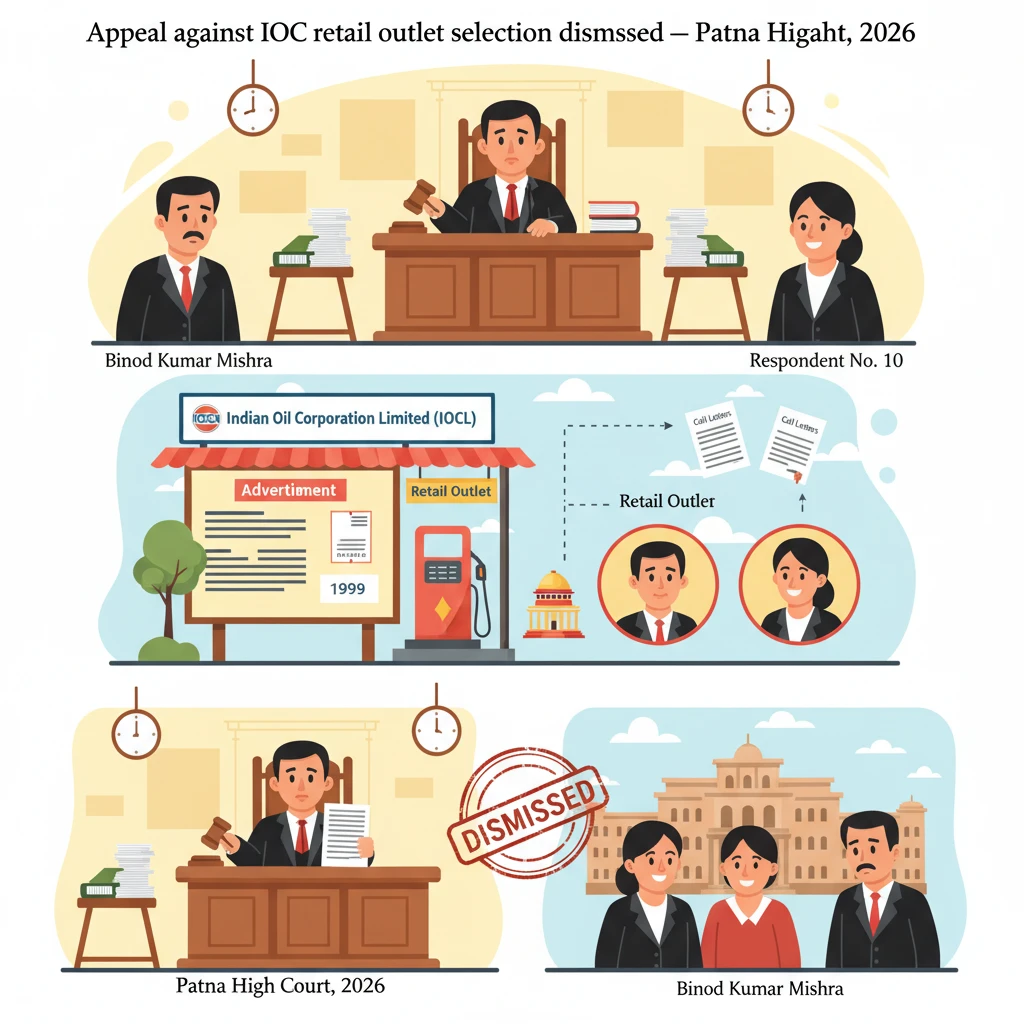
Case Background
The dispute arises from an advertisement dated 31.10.1999 inviting applications for an SKO/LDO dealership at Brahmpur in District Buxar. This advertisement was a re-advertisement of an earlier notification dated 18.05.1998 (published on 30.05.1998 in Employment News). Applicants, including the present appellant and Respondent No. 10, applied under this advertisement.
As per the scheme, applications were evaluated and interviews were held by the Dealer Selection Board. A merit panel was prepared based on marks awarded under prescribed parameters. Respondent No. 10 obtained the highest marks and was placed at Rank No. 1; she was accordingly appointed as the retail outlet dealer after verification of documents. The outlet was commissioned and she invested in statutory permissions and infrastructure. She has run the outlet for nearly twenty‑five years, except for a short disruption due to court proceedings.
The initial selection was challenged earlier by another candidate, Jai Prakash Pandey, who was second in the first merit list. His challenge reached the Supreme Court. By order dated 21.04.2008, the Supreme Court directed IOCL to reconsider the matter through the District Selection Committee on the basis of materials already on record and such further material as the parties might place.
Following this direction, IOCL summoned candidates by letter dated 04.07.2008 to file fresh affidavits and produce the original documents they had earlier filed. Fresh interviews were conducted in July 2008, and a revised merit panel dated 25.07.2008 again placed Respondent No. 10 at Rank No. 1 and the present appellant at Rank No. 2. The dealership in favour of Respondent No. 10 was revived.
In 2009 the present appellant filed CWJC No. 10224 of 2009, alleging that Respondent No. 10 had a pending criminal case and therefore was ineligible. That writ petition was disposed of on 30.01.2015. The Court did not interfere with the selection but granted liberty to the appellant to approach IOCL authorities and try to satisfy them about any alleged disqualification.
Pursuant to that liberty, the appellant submitted a representation on 24.02.2015, and after a large gap sent a reminder on 09.09.2017. On 20.12.2017, the Deputy General Manager (Retail Sales), IOCL, passed a reasoned order rejecting the appellant’s allegations, holding that no charges had been framed against Respondent No. 10 on the relevant dates and therefore the affidavit was not false.
The appellant then filed CWJC No. 12241 of 2018 to challenge IOCL’s order dated 20.12.2017 and to seek cancellation of Respondent No. 10’s dealership. On 13.12.2024, a learned Single Judge of the Patna High Court dismissed the writ petition. The present Letters Patent Appeal No. 140 of 2025 was filed against that dismissal order and has now been decided by the Division Bench on 20.02.2026.
What the Court Examined and Decided
The main complaint of the appellant in the Letters Patent Appeal was that Respondent No. 10 had suppressed the fact of a criminal case and misrepresented her status in the application and in an affidavit dated 23.07.2008. According to the appellant, this violation of the advertisement and the selection guidelines should have led to her disqualification and termination of the dealership.
The appellant relied on Clause 4 of the advertisement and Paragraph 20 of the application form. According to him, these provisions mandated disclosure of (i) any pending criminal case, (ii) framing of charges, and (iii) conviction. He argued that the eligibility guidelines declared ineligible any candidate convicted of offences involving moral turpitude or economic offences and any person against whom charges had been framed. The conditions also stated that incorrect or false information would justify rejection of candidature and termination of dealership.
The appellant pointed to Buxar Town P.S. Case No. 197 of 1989, which had resulted in submission of a chargesheet in 1990 and cognizance by the court. He claimed that charges had been framed against Respondent No. 10 on 16.03.2007 and that she had been declared an absconder, yet in her application and affidavit dated 23.07.2008 she declared that no criminal case was pending and no charges had been framed. This, according to the appellant, was a clear and deliberate suppression.
He further argued that the learned Single Judge wrongly considered only the question of conviction and ignored the broader requirement to disclose any pending case or framing of charges. He said that furnishing a false affidavit pursuant to the Supreme Court’s order cut at the root of the process. He also tried to add a new angle: that even if Clause 4 did not technically disqualify Respondent No. 10, the non‑disclosure meant her application was incomplete, violating Clause 10 of the advertisement which required the application and enclosures to be complete in all respects.
On the other side, Respondent No. 10 and IOCL presented a different narrative. They emphasised that the advertisement was a re‑advertisement of 1998 and that eligibility had to be tested as on the last date of application in 2000. Clause 11 of the Selection Brochure and Clause 4 of the advertisement were said to create disqualification only in two situations: where the candidate had been convicted for offences involving moral turpitude or economic offences, or where charges had been framed by a competent court.
They clarified that Buxar P.S. Case No. 197 of 1989 was registered when Respondent No. 10 was a juvenile. Though a chargesheet was filed in 1990 and cognizance taken, the matter was later transferred to the Juvenile Justice Board. According to them, charges against her were actually framed only on 05.07.2018, long after the application in 2000 and even after the reconsideration in 2008. Ultimately, she was exonerated by order dated 06.03.2020 passed by the Juvenile Justice Board. Thus, on all the relevant dates, no charge had been framed and she had not been convicted.
They addressed the wording of Paragraph 20 of the application form. There was a difference in the Hindi version printed in the form. It appeared to ask about whether any criminal case was pending or charges had been framed. Respondent No. 10 explained that she had been advised to follow the Brochure and advertisement, which referred only to conviction or framing of charges. She therefore answered “Aisa Nahi Hai” (it is not so) and submitted the required affidavit, as no court had framed charges against her nor had she been convicted.
IOCL also highlighted that after the Supreme Court’s remand order of 21.04.2008, the corporation treated the process as starting afresh. Fresh affidavits were sought in a specific format which referred only to conviction and framing of charges, not to mere “pendency”. Respondent No. 10’s affidavit dated 23.07.2008 followed this format. IOCL argued that any alleged defect in the earlier 2000 affidavit lost relevance after this fresh round.
Importantly, IOCL stressed that the governing documents were the Selection Brochure and the advertisement, not the application form. In their view, any extra or mistaken wording in the form could not expand or change the eligibility conditions in Clause 4. They relied on the Supreme Court decision in Caretel Infotech Ltd. v. HPCL, (2019) 14 SCC 81, to say that the “author of the document” is best placed to interpret its requirements and courts should normally not substitute their own interpretation unless the decision is arbitrary or perverse.
On delay, IOCL and Respondent No. 10 pointed out that the re‑selection and fresh merit list were made on 25.07.2008, while the appellant challenged it only in August 2009 and then allowed long gaps to occur between different steps. Meanwhile, Respondent No. 10 continued to run the outlet and make investments. They relied on judgments such as Kaushal Kishore v. Union of India, 2000 (2) PLJR 475 and Ramana Dayaram Shetty v. International Airport Authority, (1979) 3 SCC 489 to argue that courts may decline to disturb selections when delay has created an irreversible position and large investments have been made.
The Division Bench framed five issues. On Issue No. 1, it analysed Clause 4 of the advertisement dated 01.09.2000 and the meaning of “pendency of a criminal case”. The Court held that disqualification clauses have to be strictly construed. It agreed with the Single Judge that the clause did not require automatic rejection merely because an FIR was registered or cognizance taken, when no charge had yet been framed. Pendency at a very early stage does not, by itself, show such culpability as to mandate disqualification unless the text clearly says so.
The Bench noted that IOCL had considered the status of the criminal case, including the fact that charges had not been framed on the relevant dates, before concluding that disqualification was not attracted. The Court distinguished the case laws cited by the appellant (such as Ramchandra Singh v. Savitri Devi, Krishnamoorthy v. Sivakumar, Mohinder Singh Gill v. Chief Election Commissioner, and Kunwar Pal Singh) on the ground that they dealt with proven fraud or statutory violations, whereas here no clear foundation of fraud or deliberate suppression was established.
On Issue No. 2, concerning conflict between the advertisement and the application form, the Court held that the advertisement is the governing instrument. It sets the “rules of the game” and is binding on both the selecting authority and the candidates. The application form is only a procedural tool and cannot independently modify or enlarge disqualifications. If there is any inconsistency, the advertisement must prevail. The Court found that the learned Single Judge had correctly appreciated this hierarchy.
On Issue No. 3, the Bench examined IOCL’s order dated 20.12.2017 disposing of the appellant’s representation. Relying on Tata Cellular v. Union of India principles of judicial review, it held that the Court’s role was limited to examining legality, rationality and procedural propriety. It found that IOCL had considered the relevant clauses, the status of the criminal case, and the timeline, and had given reasons. There was thus no arbitrariness, illegality, or non‑application of mind.
On Issue No. 4, regarding delay, investments and equity, the Court upheld the Single Judge’s approach. It noted the long period for which the outlet has been operational and the substantial and irreversible investments by Respondent No. 10. Even assuming there was a debatable point on eligibility, granting relief after such delay would cause manifest inequity and disturb a settled commercial arrangement. The Court found no misuse of discretion.
On Issue No. 5, about raising a new plea based on Clause 10 of the advertisement, the Court held that this ground was not clearly pleaded earlier and was being developed for the first time in the appeal. Applying principles analogous to constructive res judicata and finality of pleadings, the Court ruled that the appellant could not raise this new and independent ground at this late stage.
After examining all issues, the Division Bench concluded that the learned Single Judge had correctly appreciated the facts, properly interpreted the eligibility conditions, and applied the settled principles of judicial review. It therefore dismissed the Letters Patent Appeal with no order as to costs.
Why This Judgment Matters
This judgment is important for people interested in petroleum dealership selections and other public allotments. The Patna High Court has made it clear that disqualification rules in advertisements will be read strictly. Mere pendency of an old criminal case, without charges being framed on the crucial date, will not automatically destroy eligibility if the advertisement does not clearly say so.
The decision also shows that, in such selection processes, the advertisement and selection brochure are the main rulebooks. The application form cannot silently expand or change the rules. This protects both applicants and authorities from confusion created by printing or drafting errors in forms.
Another important point is delay. When a retail outlet or similar dealership has been running for many years and the dealer has invested heavily, courts are reluctant to cancel it unless there is a clear, fundamental illegality. People who feel aggrieved must act promptly and clearly state all their grounds from the very beginning. Keeping grounds in reserve for later rounds can be barred by principles similar to constructive res judicata.
Legal Issues and Answers
- Issue: Does mere pendency of a criminal case, without framing of charge by the relevant date, make a candidate ineligible under Clause 4 of the 01.09.2000 advertisement?
Answer: No. The Court held that Clause 4 must be strictly construed and does not create automatic ineligibility at the pre‑charge stage; since no charge was framed on the cut‑off dates, disqualification was not attracted. - Issue: If there is a difference between the advertisement and the application form about criminal disclosure, which governs?
Answer: The advertisement and selection brochure govern. The application form is only supplemental and cannot expand or modify disqualifications; any inconsistency must be resolved in favour of the advertisement. - Issue: Was IOCL’s order dated 20.12.2017 rejecting the appellant’s representation arbitrary or illegal so as to warrant interference?
Answer: No. The Court found that IOCL considered relevant materials and clauses, applied its mind, and gave reasons. In writ and intra‑court appeal jurisdiction, such a considered decision is not to be interfered with. - Issue: Could the appellant, at the LPA stage, newly rely on Clause 10 of the advertisement about completeness of the application?
Answer: No. Since this ground was not properly pleaded before, raising it now was barred by principles akin to constructive res judicata and the finality of pleadings.
Cases Cited by the Court
- Ramana Dayaram Shetty v. International Airport Authority of India, (1979) 3 SCC 489
- Caretel Infotech Ltd. v. HPCL, (2019) 14 SCC 81
- Tata Cellular v. Union of India, (1994) 6 SCC 651
- Kaushal Kishore v. Union of India, 2000 (2) PLJR 475
- State of Maharashtra v. Digambar, (1995) 4 SCC 683
- Ramchandra Singh v. Savitri Devi & Ors, (2003) 8 SCC 319
- Krishnamoorthy v. Sivakumar & Ors, (2015) 3 SCC 467
- Mohinder Singh Gill v. Chief Election Commissioner, (1978) 1 SCC 405
- Kunwar Pal Singh (Dead) by LRs v. State of U.P. & Ors, (2007) 5 SCC 85
- Monarch Infrastructure (P) Ltd. v. Commissioner, Ulhasnagar Municipal Corporation, (2000) 5 SCC 287
Case Details
Case Number: Letters Patent Appeal No. 140 of 2025 in Civil Writ Jurisdiction Case No. 12241 of 2018
Case Title: Binod Kumar Mishra v. The Indian Oil Corporation Ltd. & Ors.
Citation: 2026 (3) PLJR 35
Court: High Court of Judicature at Patna
Coram: Hon’ble the Chief Justice (Sangam Kumar Sahoo, CJ) and Hon’ble Mr. Justice Alok Kumar Sinha
Date of Judgment: 20.02.2026
Nature of Case: Letters Patent Appeal against dismissal of writ petition challenging allotment of SKO/LDO retail outlet dealership
Advocates for Appellant: Mr. Y.V. Giri, Senior Advocate; Mr. Pranav Kumar, Advocate; Ms. Dimpal Kumari, Advocate
Advocates for Respondents: Mr. Additional Solicitor General (for Union of India); Mr. Anil Kumar Jha, Senior Advocate; Mr. Ankit Katriar, Advocate; Mr. Mithlesh Kumar Gupta, Advocate; Mr. Sanat Kumar Mishra, Advocate; and others as noted in the judgment
Link to Judgment: Official Patna High Court judgment
If you found this explanation helpful and wish to stay informed about
how legal developments may affect your rights in Bihar,
you may consider following Samvida Law Associates for more updates.







