

Case Background
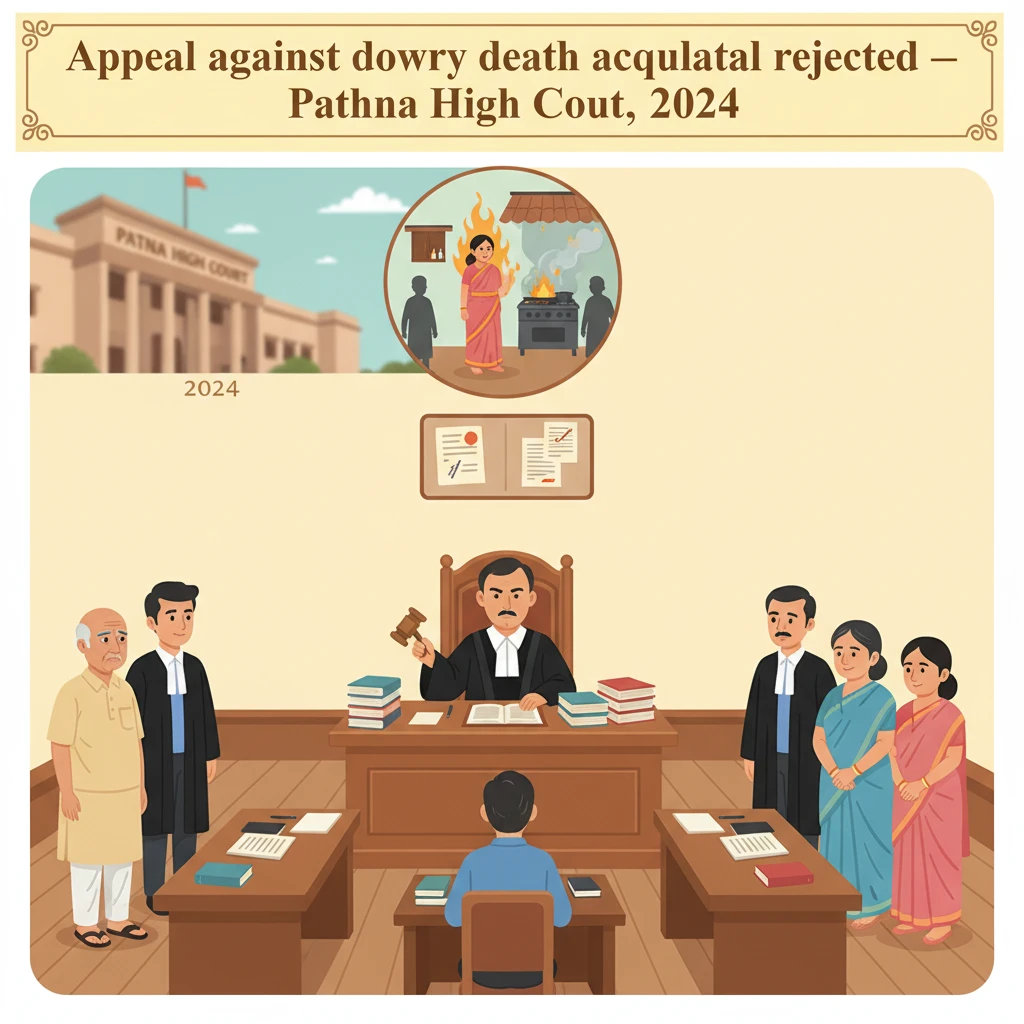
This criminal appeal arose from the tragic death of a young married woman, Gudiya Devi, who suffered 100% burn injuries in July 2003 in District Madhubani, Bihar.
Her father, the informant, alleged that after her marriage in 1998 to Pankaj Kumar Jha, she was harassed and assaulted by her husband and in-laws for dowry. He stated that demands were made for items like scooter, colour TV, fridge, washing machine, VCR and motorcycle.
Due to this alleged harassment, Gudiya had earlier filed a criminal case against her husband and in-laws at RS Camp Police Station (Case No. 123 of 2002). That case was subsequently settled through a compromise, and an affidavit of compromise was filed before the trial court.
A few months after the compromise, an unknown caller allegedly informed the informant that his daughter had been burnt to death by her husband and in-laws. The informant and other relatives went to her matrimonial home and found her dead body. An FIR was then lodged at Madhepur Police Station as P.S. Case No. 169 of 2003 under Sections 498A, 304B and 34 of the Indian Penal Code.
After investigation, the Investigating Officer first submitted a chargesheet under Sections 498A and 304B IPC against the husband Pankaj Jha and the father-in-law Shyamji Jha. Subsequently, supplementary investigation was conducted against four other in-laws – the mother-in-law and three married sisters-in-law. Sessions Trial No. 264 of 2011 (G.R. Case No. 556 of 2003) was conducted before the Court of the Additional District and Sessions Judge-III, Jhanjharpur.
On 25.01.2024, the Sessions Court acquitted these four relatives (Respondent Nos. 2 to 5) of all charges. Aggrieved by this acquittal, the informant filed the present Criminal Appeal (DB) No. 355 of 2024 under Section 372 of the Code of Criminal Procedure before the Patna High Court, seeking reversal of their acquittal.
What the Court Examined and Decided
The Division Bench of the Patna High Court, comprising Hon’ble Mr. Justice Vipul M. Pancholi and Hon’ble Mr. Justice Ramesh Chand Malviya, heard the appeal. The oral judgment was delivered by Hon’ble Mr. Justice Ramesh Chand Malviya on 02.09.2024.
Counsel for the appellant placed before the Court the depositions of prosecution witnesses and the FIR. He argued that all witnesses had consistently supported the prosecution version and specifically named the four acquitted in-laws as participants in the dowry harassment and in the killing of Gudiya Devi.
He further submitted that as a matter of law, in dowry death cases under Section 304B IPC, in-laws often play a vital role. He relied on Section 113B of the Indian Evidence Act, which raises a presumption against the accused in certain dowry death situations, and cited Supreme Court decisions in Sandeep Kumar v. State of Uttarakhand, Maya Devi v. State of Haryana and Bansi Lal v. State of Haryana. According to him, the essential ingredients of dowry death were satisfied, and the trial court had mechanically ignored settled law while acquitting Respondents 2 to 5.
The Court then closely examined the evidence of all five prosecution witnesses, the postmortem report and the investigation record, particularly regarding the role attributed to the four acquitted respondents.
PW-1, the younger brother of the informant, testified that Gudiya was married in 1998. He stated that the husband, father-in-law, mother-in-law and sisters-in-law (including Respondents 2 to 5) used to physically torture and harass her over dowry demands. He also claimed that on the night of the incident, Gudiya was murdered by her husband, father-in-law, mother-in-law and the three named sisters-in-law for dowry.
However, in cross-examination, PW-1 admitted that he had not seen the murder with his own eyes and was not an eyewitness. He said that he received information of the incident from his brother, the informant, and that when they reached the matrimonial house the next morning, they found Gudiya’s body but got no information about the incident from anyone present. He further stated that except the persons he named as accused, he had not found any other family members in the in-laws’ house, but he did not know which members were actually living there at that time and he did not know the families of the sisters-in-law.
PW-2, the informant’s son, also deposed that after marriage the in-laws harassed Gudiya for dowry, and that her in-laws demanded a scooter, washing machine and colour TV. He stated that on the night of occurrence she was burnt to death by her husband and his family members. But like PW-1, PW-2 candidly admitted that he had never visited Gudiya’s matrimonial home prior to the incident, that he did not know where the husband’s sisters were married, and that he was not an eyewitness to the occurrence.
PW-3, the informant and father of the deceased, described repeated dowry demands and physical and mental harassment. He described how Gudiya was beaten and thrown out of the house on 07.03.2002, leading to registration of Case No. 123 of 2002, which was later compromised. He testified that an unknown caller informed him that Gudiya had been burnt to death by her husband and in-laws, after which he went to her in-laws’ village and saw her dead body and lodged the FIR. He clearly admitted that he was not an eyewitness to the incident.
Significantly, PW-3’s own evidence showed that one of the sisters-in-law, Prabha Thakur, was married and that her husband was posted in Andhra Pradesh in Sulabh Shauchalaya, and that the in-laws’ family was financially well-off. The judgment records that, according to PW-3, it was not the case that Prabha lived in Hyderabad and that Archana lived in Dibrugarh and Shyamji lived in Jhanjharpur, but the later investigation evidence clarified their actual residence at the time of the incident.
PW-4, the doctor who conducted the postmortem on 17.07.2003 at Sadar Hospital, Madhubani, found the body of a woman identified as Guriya Devi, wife of Pankaj Kumar Jha, with ante-mortem superficial to deep 100% burns with blackening of skin. Internal organs showed congestion, stomach was empty, and rigor mortis was present. The doctor opined that death had occurred within 24 hours and was due to shock caused by thermal burns/dry heat. In cross-examination, he stated that he could not say whether the death was suicidal or homicidal and that he did not find smell of kerosene on the body.
PW-5, the Investigating Officer, was a crucial witness for the Court’s analysis. He explained that earlier a chargesheet had been filed under Sections 498A and 304B IPC against Pankaj Jha and Shyamji Jha. He was then entrusted with supplementary investigation against Respondents 2 to 5. He recorded statements of many witnesses and sought permission from senior officers to go to Delhi and Hyderabad for further inquiry.
In his cross-examination, PW-5 stated that during the investigation he found that in 2003 Shyamji Jha was living with his wife and an unmarried daughter in Laheriyaganj, Jhanjharpur. Importantly, he found that on the date of Gudiya’s death, Respondent No. 4, Archana Jha, was in Delhi for medical treatment. He obtained details of her treatment from Satyabhama Hospital.
He further deposed that he visited Hyderabad and recorded the statement of Alok Jha, Chairman of Sulabh International, who confirmed that Krishna Madhav Thakur (husband of Respondent No. 3) had been working there as Executive Engineer since 1996 and was living in Hyderabad with his family, including children studying there. Krishna Madhav Thakur told the IO that he had brought his wife Prabha Thakur and their two children to Hyderabad in February 2003 and had been living with them in a rented house. On receiving news of his brother-in-law’s wife’s death by burn injuries, he travelled with his family to Madhubani.
The IO also examined the landlord Ranjit Singh and another resident, Rampravesh Singh, in Hyderabad. Both supported the version that Krishna Madhav Thakur and his family, including Prabha Thakur, had been living there since February 2003. Thus, the investigation indicated that these two sisters-in-law were residing in Delhi and Hyderabad respectively, away from the matrimonial home, at the time of the incident.
After reviewing all this, the Patna High Court concluded that there were no clear, specific and credible allegations directly connecting Respondents 2 to 5 with either the dowry harassment immediately before Gudiya’s death or the act of burning. All material witnesses had admitted that they were not eyewitnesses and had received information from unknown sources. Their statements about the presence and involvement of each in-law were general and not based on direct knowledge.
The Court then turned to guidance from the Supreme Court on misuse of dowry laws against distant relatives. It cited Kans Raj v. State of Bihar (2000) 5 SCC 207, where the Supreme Court warned against the tendency of “roping in” all relatives of the husband in dowry death cases without specific proof of overt acts. The Supreme Court had held that mere conjectures and implications cannot make such relatives liable; overt acts must be proved beyond reasonable doubt.
The High Court also relied on Monju Roy v. State of West Bengal (2015) 13 SCC 693, where the Supreme Court reiterated that while harassment for dowry may be established against the husband and close family, omnibus allegations against all family members, especially distant relations, cannot be accepted in the absence of tangible material. Courts must be careful in summoning such relatives.
Further, the Court cited Chandralekha v. State of Rajasthan, 2013 (1) UC 155, where the Supreme Court quashed proceedings against relatives against whom only vague and general allegations were made after long delay, holding that continuation of such proceedings amounts to abuse of process.
Applying these principles, the Patna High Court held that distant family members of the husband cannot be implicated in a dowry death case unless there is solid material to support the allegations. Simply putting their names in the FIR or fardbeyan, without concrete proof of their presence, participation or specific acts of cruelty, is not sufficient to sustain a criminal case.
The Court observed that in this case, the investigation itself showed that some of the sisters-in-law were living in Delhi and Hyderabad with their husbands and children at the time of the incident. There was no eyewitness, no independent local witness of the occurrence, and no direct evidence tying these respondents to the burns or to any immediate cruelty.
The Bench further noted that a person cannot be implicated solely on suspicion without cogent and substantial evidence. From the depositions and the IO’s findings, no case was made out against Respondents 2 to 5. Therefore, drawing any adverse inference against them would be unjustified.
The Court examined the reasoning of the trial court and found no error. It held that the trial court had rightly acquitted Respondents 2 to 5 and that there was no ground to interfere with that acquittal. Accordingly, the criminal appeal was dismissed at the admission stage itself.
Why This Judgment Matters
This judgment is significant for families involved in dowry death cases in Bihar and beyond. It shows that while death of a married woman due to burns is taken very seriously, courts will still insist on clear evidence against each accused person.
The Patna High Court has reaffirmed that relatives cannot be convicted merely because they are in-laws. For a mother-in-law, sister-in-law or other relation to be punished, there must be solid proof that they demanded dowry or harassed the woman, or that they were present and involved at the time of the incident.
The decision also underlines the importance of proper investigation. Here, the IO’s travel to Delhi and Hyderabad and recording of independent statements proved that two sisters-in-law were living far away at the relevant time. This helped the Court separate genuine suspects from those named only on suspicion.
For victims’ families, the ruling is a reminder to focus on specific, provable allegations and to assist investigation with concrete facts. For accused relatives, it highlights that courts will protect them from false implication if there is no specific evidence against them.
Legal Issues and Answers
- Issue: Whether the acquittal of the deceased woman’s mother-in-law and three married sisters-in-law in a dowry death case under Sections 498A, 304B and 34 IPC should be reversed on appeal.
Answer: No. The Patna High Court held that there were no clear, specific or credible allegations or evidence against these four relatives, and the trial court had rightly acquitted them. - Issue: Can distant or married relatives of the husband be convicted for dowry death solely on the basis of general allegations and their relationship to the husband?
Answer: No. Relying on Supreme Court precedent, the Court held that distant relatives cannot be implicated without tangible material showing their specific role; mere naming in the FIR or omnibus allegations are insufficient.
Cases Cited by the Court
- Kans Raj v. State of Bihar, (2000) 5 SCC 207
- Monju Roy v. State of West Bengal, (2015) 13 SCC 693
- Chandralekha and Others v. State of Rajasthan and Another, 2013 (1) UC 155
Case Details
Case Number: Criminal Appeal (DB) No. 355 of 2024; arising out of Madhepur P.S. Case No. 169 of 2003; Sessions Trial No. 264 of 2011 (G.R. No. 556/2003)
Case Title: Shyamanand Jha v. The State of Bihar & Others
Citation: 2024 (4) PLJR 140
Court: High Court of Judicature at Patna
Coram: Hon’ble Mr. Justice Vipul M. Pancholi; Hon’ble Mr. Justice Ramesh Chand Malviya
Date of Judgment: 02.09.2024
Advocates: Mr. Vikas Ratan Bharti, Advocate for the appellant; Mr. Dilip Kumar Sinha, APP for the State (Respondents)
Nature of the Case: Criminal appeal under Section 372 of the Code of Criminal Procedure, 1973 against an order of acquittal in a dowry death case under Sections 498A, 304B and 34 IPC.
Link to Full Judgment: Patna High Court Judgment
If you found this explanation helpful and wish to stay informed about
how legal developments may affect your rights in Bihar,
you may consider following Samvida Law Associates for more updates.







