

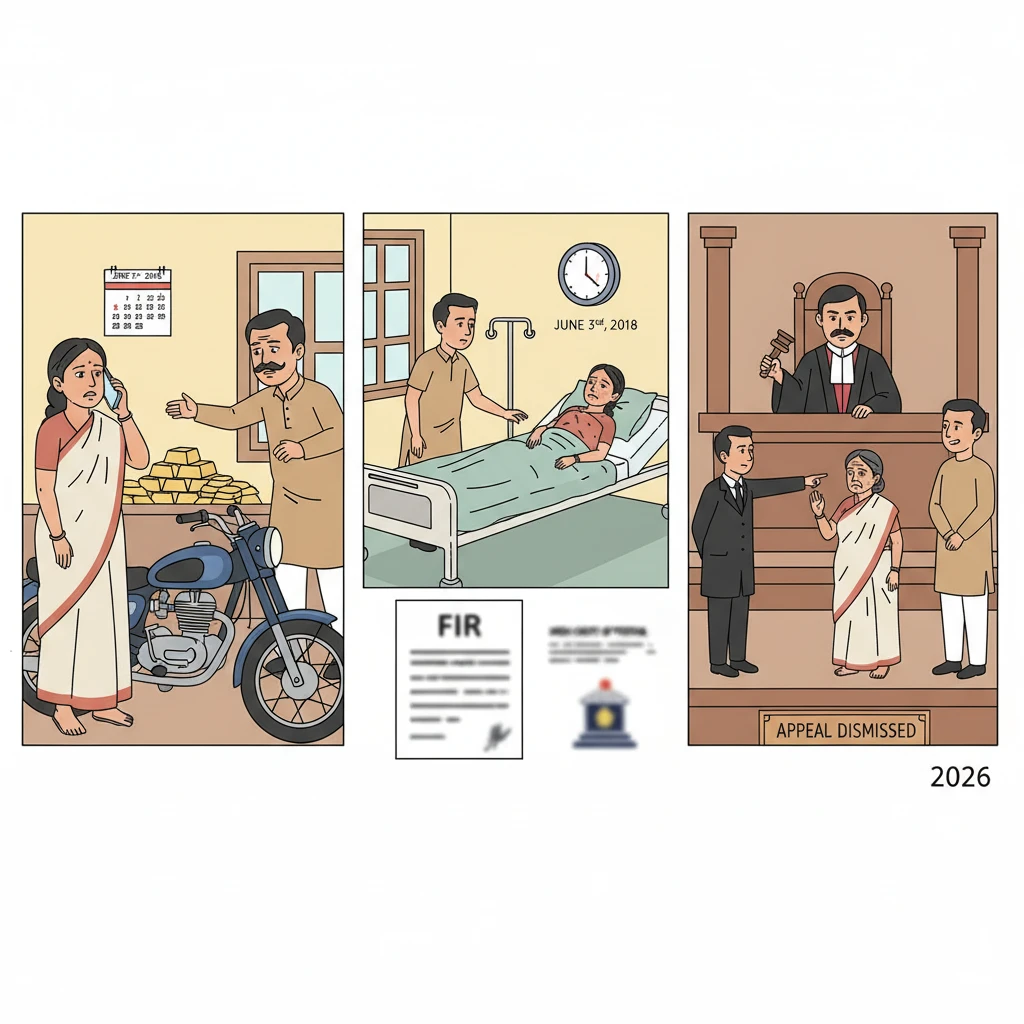
Case Background
The case arose from the death of a married woman, Juli Kumari, who suffered burn injuries at her matrimonial home and later died during treatment at Jawaharlal Nehru Medical College and Hospital, Bhagalpur.
On 03.06.2018 at about 1:15 PM, her mother, Manjila Devi, gave her fardbeyan at the hospital. She stated that her daughter had married Manish Kumar in 2014 as per Hindu rites. According to the fardbeyan, after about two months of marriage, the in-laws began demanding a Bullet motorcycle and two bhar of gold. It was also alleged that about two years earlier the in-laws had assaulted the daughter, causing injuries to her head and ear, after which a panchayat was held.
The mother further alleged that on 01.06.2018 her daughter called and said that if the demands for gold and motorcycle were not met, the accused persons were planning to kill her. On 03.06.2018, the son-in-law informed that the daughter was being treated for burns at Mayaganj Hospital and asked the family to come quickly. When the mother reached, she found her daughter under treatment. During treatment, the daughter died. The mother accused the in-laws of burning her to death over dowry.
On the basis of this fardbeyan, Nayaram Nagar P.S. Case No. 135 of 2018 dated 21.06.2018 was registered under Sections 304B/34 IPC against Manish Kumar and five of his family members. After investigation, the police submitted Charge Sheet No. 327 of 2018 dated 30.11.2018 only against Manish Kumar, keeping investigation pending against the others. The trial court took cognizance on 13.12.2018.
On 13.08.2019, charges under Sections 304B/34 IPC were framed against Manish Kumar. He pleaded not guilty and claimed trial. The prosecution examined nine witnesses and produced documents, including the post-mortem report and the formal FIR. The accused, in his statement under Section 313 CrPC, claimed innocence and said his wife died while she was cooking. The defence did not lead any evidence.
After trial, the Additional Sessions Judge-IV, Munger, acquitted Manish Kumar on 25.01.2020, holding that the prosecution had failed to prove the charge beyond reasonable doubt. Against this acquittal, the mother of the deceased filed the present criminal appeal (DB) before the Patna High Court under Section 378 CrPC.
What the Court Examined and Decided
At the hearing of the appeal on 22.01.2026, no one appeared on behalf of the appellant-mother. The Division Bench heard only the learned Additional Public Prosecutor, Mr. Ajay Mishra, and examined the trial court records.
The core grievance in the memorandum of appeal was not about specific errors in appreciation of evidence but mainly about the manner in which the trial had been conducted. The appellant alleged that:
- After framing of charges, all prosecution witnesses were examined in a hurried and “managed” way.
- The trial court quickly completed evidence, Section 313 CrPC examination and judgment in a short span, despite the seriousness of a Section 304B case.
- The deceased had left behind two minor children, staying with their paternal grandparents, and the appellant’s side was allegedly pressured that if they gave truthful evidence the children’s lives would be put in danger, whereas if they helped the accused he would ensure “cooperation and security” for the children.
- Because of such pressure and conditions, the witnesses supposedly did not tell the truth. The appellant requested that the High Court direct the trial court to re-hear and re-examine the witnesses.
The State, through the Additional Public Prosecutor, strongly opposed these allegations. He pointed the Court to the actual trial dates:
- PW-1 was examined on 27.08.2019.
- PW-2 and PW-3 were examined on 17.12.2019.
- PW-4 and PW-5 were examined on 19.12.2019.
- PW-6 and PW-7 were examined on 20.12.2019.
- PW-8 was examined on 07.01.2020.
- PW-9 was examined on 13.01.2020.
The Section 313 CrPC statement was recorded on 20.01.2020 and judgment was delivered on 25.01.2020. On this basis, the State argued that the evidence stage ran over about four and a half months, so there was no undue haste. The trial court had not rushed through the case.
More importantly, the State highlighted that the appellant herself, the mother of the deceased, was examined as PW-4 at the trial and did not support the prosecution version she had earlier given in the fardbeyan. She was declared hostile at the prosecution’s request.
In her cross-examination, PW-4 denied that the husband or his relatives had demanded a motorcycle or two bhar gold. She also said the relationship between her daughter and the accused was good. In other words, she totally resiled from the dowry allegation. This directly weakened the prosecution’s case.
The State also referred to the testimony of PW-2, the brother of the deceased. He stated that his sister’s mother-in-law and father-in-law had informed him late at night (between 12:00–1:00 AM) that his sister had suffered burns. He went to Mayaganj Hospital, and his sister died about an hour after his arrival. In cross-examination, PW-2 stated:
- His sister and brother-in-law had a good relationship.
- His brother-in-law had never demanded any money, motorcycle or gold.
- His sister had never complained against her husband.
- He came to know that while his sister was boiling milk for the children, fire flared up from the gas, she got burnt and died during treatment.
Similarly, PW-3, described as an independent witness, did not support the prosecution case and was also declared hostile. PW-5, the father of the deceased, took the same stand and was likewise declared hostile.
In addition, the trial court had considered the evidence of the doctor (PW-1). In cross-examination, the doctor said that the injuries could be accidental. This medical opinion, read along with the family witnesses speaking of accidental burns while cooking, made it difficult to treat the death as a dowry death beyond reasonable doubt.
The High Court looked at these facts and accepted the State’s submissions. It agreed with the trial court’s finding that all prosecution witnesses, while supporting the occurrence of burning and death, spoke in “one voice” that:
- The relationship between the deceased and accused was cordial.
- Neither the accused nor his family members had demanded motorcycle or gold as dowry.
Therefore, the necessary chain of circumstances for a dowry death was not proved.
The Bench then explained the legal position under Section 304B IPC (dowry death) and Section 113B of the Evidence Act (presumption as to dowry death). It reproduced both provisions in full. The Court emphasised that the presumption of dowry death is not automatic merely because a married woman dies within seven years of marriage in abnormal circumstances. The prosecution must first prove certain essential ingredients:
- The woman’s death was caused by burns, bodily injury, or occurred otherwise than under normal circumstances.
- The death occurred within seven years of marriage.
- She was subjected to cruelty or harassment by her husband or his relatives.
- Such cruelty or harassment was for, or in connection with, demand for dowry.
- She was subjected to such cruelty or harassment soon before her death.
To show how these principles have been applied, the Court referred to Supreme Court judgments such as Kans Raj v. State of Punjab, Satvir Singh v. State of Punjab and Baljeet Singh v. State of Haryana.
The Patna High Court paid particular attention to the decision in Sher Singh @ Partapa v. State of Haryana, (2015) 3 SCC 724. Quoting paragraph 16 of that judgment, it noted that:
- The word “shown” in Section 304B IPC effectively means “proved”.
- The word “presume” in Section 113B Evidence Act must be read along with “deemed”.
- The prosecution must first prove a dowry death by at least preponderance of probability before the presumption of guilt arises.
- Only after that does the burden shift heavily to the accused to dislodge the presumption beyond reasonable doubt.
- The expression “soon before” does not refer to a fixed time frame but means that the dowry demand must be a continuing cause, not a stale event.
Applying this law to the facts, the High Court held that the prosecution had failed even at the first stage. The informant and close relatives, instead of proving cruelty or dowry demand soon before death, positively stated that:
- There was no dowry demand.
- The relationship between the couple was cordial.
- The burning happened while cooking.
In this situation, no presumption of dowry death under Section 113B could arise. The basic foundation itself was missing.
The Bench then turned to the law on appeals against acquittal. Referring to the Supreme Court decisions in H.D. Sundara v. State of Karnataka, (2023) 9 SCC 581 and Babu Sahebagouda Rudragoudar v. State of Karnataka, (2024) 8 SCC 149, it recalled the settled principles:
- Acquittal further strengthens the presumption of innocence.
- An appellate court may reappreciate the evidence, but
- If the trial court’s view is a possible view based on the evidence, the appellate court should not substitute its own merely because another view is also possible.
- Interference is justified only if the evidence admits of only one conclusion, namely guilt beyond reasonable doubt, and no other view is possible.
Considering the hostile testimony of the informant and other material witnesses, the medical evidence allowing for accidental burns, and the lack of proof of dowry demand, the Division Bench concluded that the trial court’s acquittal was clearly a “possible view” – and indeed the only reasonable one.
As a result, the Court held that there was no ground to interfere with the impugned judgment. The appeal was found to be without merit and was dismissed.
Why This Judgment Matters
This judgment is important for families and lawyers dealing with dowry death allegations. It shows that even in tragic cases where a young married woman dies in suspicious circumstances, courts will still demand clear evidence of dowry-related cruelty before convicting.
The Patna High Court underlines that:
- The law creates a presumption in dowry death cases, but that presumption arises only after basic facts are proved.
- If key witnesses, including the complainant and close relatives, deny dowry demand and speak of cordial relations and accidental death, courts cannot ignore that and convict only on the basis of suspicion.
- In an appeal against acquittal, the High Court will be slow to interfere unless the trial court’s view is clearly unreasonable.
For ordinary readers, the message is that complaints in dowry death cases must be supported in court by consistent and reliable evidence. If witnesses later change their statements or turn hostile, it becomes very difficult to secure a conviction.
Legal Issues and Answers
-
Issue: Whether the trial in the dowry death case was conducted in an unfair, hurried or “managed” manner justifying a direction for re-hearing and re-examination of witnesses.
Answer: No. The Patna High Court held that the evidence spanned about four and a half months and there was no haste. The allegation of a “managed” trial was not supported by the record. -
Issue: Whether the prosecution had proved the ingredients of Section 304B IPC so as to raise a presumption of dowry death under Section 113B of the Evidence Act against the accused husband.
Answer: No. Because the informant, her family members and independent witnesses did not support any dowry demand or cruelty and spoke of cordial relations and possible accidental burning, the essential conditions for dowry death were not proved and no presumption could arise. -
Issue: Whether the High Court, in an appeal against acquittal, should overturn the trial court’s decision and convict the accused.
Answer: No. Applying Supreme Court precedents, the Court held that the trial court’s view was clearly a possible view on the evidence, and there was no basis to disturb the acquittal. The appeal was dismissed.
Cases Cited by the Court
- Kans Raj v. State of Punjab & Ors., AIR 2000 SC 2324 : (2000) 5 SCC 207
- Satvir Singh and Ors. v. State of Punjab and Anr., 2001 (8) SCC 633
- Baljeet Singh v. State of Haryana and Ors., AIR 2004 SC 1714
- Sher Singh @ Partapa v. State of Haryana, (2015) 3 SCC 724
- State of West Bengal v. Mir Mohammad Omar and Ors., (2000) 8 SCC 382
- Subramaniam v. State of Tamil Nadu, (2009) 14 SCC 415
- H.D. Sundara and Ors. v. State of Karnataka, (2023) 9 SCC 581
- Babu Sahebagouda Rudragoudar and Ors. v. State of Karnataka, (2024) 8 SCC 149
Case Details
Case Number: Criminal Appeal (DB) No. 127 of 2021; arising out of Nayaram Nagar P.S. Case No. 135 of 2018; Sessions Trial No. 56 of 2019.
Case Title: Manjila Devi v. The State of Bihar & Anr.
Citation: 2026 (2) PLJR 262
Coram: Hon’ble Mr. Justice Rajeev Ranjan Prasad; Hon’ble Mr. Justice Praveen Kumar
Date of Judgment: 22.01.2026 (Uploading/Transmission Date: 30.01.2026)
Advocates: For the appellant – None; For the State – Mr. Ajay Mishra, Additional Public Prosecutor.
Nature of the Case: Criminal appeal (Division Bench) against judgment of acquittal under Section 304B/34 IPC.
Relevant Statutory Provisions: Section 304B IPC; Section 34 IPC; Section 113B of the Indian Evidence Act, 1872; Section 313 CrPC; Section 378 CrPC.
Link to Judgment: Click here to read the full judgment of the Patna High Court
If you found this explanation helpful and wish to stay informed about
how legal developments may affect your rights in Bihar,
you may consider following Samvida Law Associates for more updates.







