

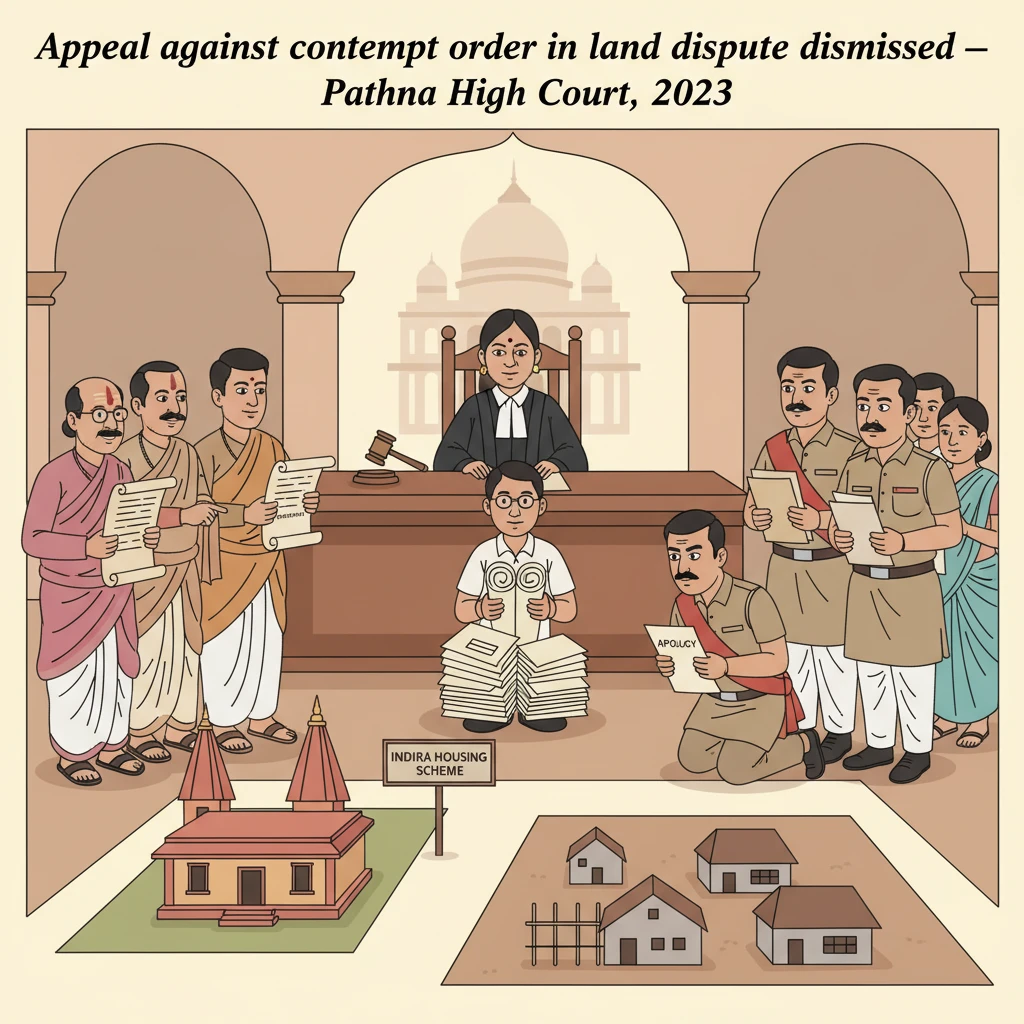
The Court held that there was no violation of its earlier directions and that no appeal lies from such a contempt order.
The District Magistrate is free to proceed against alleged fraudulent land records, and the school may challenge those proceedings separately.
The land dispute itself will have to be decided in proper legal proceedings, not in contempt.
Case Background
The dispute began when a Sanskrit school in Madhubani district claimed rights over certain lands in village Deep, Madhubani. The school said that these lands belonged to it, but government authorities were treating the land as State land.
The school filed a writ petition before the Patna High Court, registered as C.W.J.C. No. 20820 of 2012. In this writ, the school complained that its documents about ownership were not being considered and that the same land was being allotted to weaker sections of society for houses under the Indira Housing Scheme.
On 07.11.2012, a learned Single Judge of the Patna High Court directed the Circle Officer, Lakhnaur, to look into the documents submitted by the school and others in light of a notice dated 02.02.2012. The Circle Officer was asked to pass a reasoned order within two months. The Single Judge further directed that, if the Circle Officer found that the land really belonged to the school, he should ensure that the school’s land was not used by any other authority or agency for any other purpose and that it should be restored to the school.
Following this, the Circle Officer, Lakhnaur passed an order on 06.08.2013 in favour of the school. However, people already occupying the land challenged this and the administration also raised objections. Several connected cases followed, including C.W.J.C. No. 5049 of 2014 filed by persons occupying the disputed land, and C.W.J.C. No. 6667 of 2013 where the Headmaster of the school was arrayed as respondent no. 6.
While these court battles were going on, the school filed a contempt petition, M.J.C. No. 2502 of 2013, alleging that the authorities were not obeying the Single Judge’s order dated 07.11.2012. On 12.03.2014, that contempt case was disposed of, giving the school liberty to file a fresh contempt petition if C.W.J.C. No. 5049 of 2014 was dismissed.
Later, the school filed another contempt petition, M.J.C. No. 3132 of 2017, which led to the order now challenged in the present Letters Patent Appeal No. 1417 of 2019.
What the Court Examined and Decided
The Letters Patent Appeal was filed against an order passed by a learned Single Judge in the contempt case. The Single Judge had closed the contempt proceedings and did not punish any official for contempt. Instead, the Judge recorded certain important facts placed before the Court by the district administration.
When the fresh contempt matter came up, the District Magistrate, Madhubani appeared and tendered an unconditional and unqualified apology for passing an order closing some proceedings earlier. The Court also viewed a short video recording which showed that the encroachments on the disputed land had been removed.
The District Magistrate filed a show-cause reply, which was examined by the Single Judge. In that reply, the District Magistrate alleged that the school had managed to get a jamabandi (land record entry) created and registered in its favour by playing fraud. This was said to be evident from the insertion of a separate page in Register-2 without any legal basis.
The District Magistrate further informed the Court that departmental proceedings would be initiated against the officers who had allegedly committed such fraud. This included the Anchal Adhikari, Lakhnaur, who was then posted as Block Development Officer, Khutauna. The District Magistrate also categorically stated that, according to the administration, the land belonged to the State.
The learned Single Judge noted that the encroachments had been removed and that only the school’s claim to ownership remained in dispute. Since the District Magistrate had taken a clear stand that the settlement in favour of the school was based on fraudulent jamabandi entries, the Single Judge observed that such settlement would have to be examined and acted upon in accordance with law. The Court also reiterated the settled principle that fraud vitiates any action.
Against this backdrop, the contempt case was closed. No punishment for contempt was imposed on any official. The school, however, felt aggrieved and filed the present Letters Patent Appeal. In paragraph 17 of the appeal, the school specifically argued that the Single Judge should have simply dropped the contempt case and should not have allowed the official contemnor (the District Magistrate) to proceed against the school’s settlement in the revenue records.
The Division Bench, consisting of Hon’ble the Chief Justice and Hon’ble Mr. Justice Rajiv Roy, examined whether such an appeal was maintainable at all under Section 19 of the Contempt of Courts Act, 1971. The Bench first explained the basic legal position regarding contempt appeals.
The Court held that, in a contempt case, the role of the petitioner is only to bring to the court’s notice any alleged violation of its order. It is for the court to decide how to proceed. In this case, the original writ order had only directed the Circle Officer to consider the school’s claim and pass a reasoned order. That direction had been complied with once the Circle Officer passed the order dated 06.08.2013 in favour of the school. Hence, there was, in fact, no violation of the original writ order.
Later, when contempt was again alleged, the claims of the encroachers were also directed to be considered before taking any action on the Circle Officer’s order. In the meantime, the district administration discovered that the Circle Officer’s order itself was based on jamabandi entries allegedly created by fraud. The administration therefore took steps to question those entries.
In these circumstances, the Division Bench agreed with the Single Judge that there was no contempt of court. There was compliance with the direction to “consider” the school’s claim. What now remained was a genuine dispute about the correctness and legality of the jamabandi itself, which had to be processed in appropriate legal proceedings.
The key legal question before the Division Bench was whether an appeal lay against an order that simply closed the contempt proceedings and did not punish anyone. The appellant relied on a Division Bench judgment in Union of India v. Mukesh Kumar Sah, (2019) 3 PLJR 558, where appeals were considered maintainable when, in contempt, the Court issued fresh directions under Article 226 that went beyond the original writ.
The Division Bench held that the present case was different. The Single Judge had not issued any fresh substantive direction in the contempt order. The Judge merely recorded the stand of the District Magistrate and directed that the proceedings against the allegedly fraudulent jamabandi be carried on in accordance with law. This, according to the Bench, could not be treated as a new Article 226 direction.
The Bench then referred to and relied upon three Supreme Court decisions on the scope of appeals in contempt matters: D.N. Taneja v. Bhajan Lal, (1988) 3 SCC 26; State of Maharashtra v. Mahboob S. Allibhoy, (1996) 4 SCC 411; and Midnapore Peoples’ Coop. Bank Ltd. v. Chunilal Nanda, (2006) 5 SCC 399.
From D.N. Taneja, the Division Bench highlighted that the right of appeal under Section 19(1) of the Contempt of Courts Act exists only when the High Court, in exercise of its power under Article 215 of the Constitution, imposes punishment for contempt. In contempt proceedings, there are essentially two parties: the court and the alleged contemnor. Once the matter is brought to the court’s notice, the petitioner’s role ends. If the court acquits or drops proceedings, there is normally no appeal for the petitioner, though Article 136 of the Constitution may be available in special cases.
From Mahboob S. Allibhoy, the Court noted that the words “in order” in Section 19 must be read with “decision”, so that only final orders imposing punishment for contempt can be appealed, not interlocutory or intermediate orders.
In Midnapore Peoples’ Coop. Bank, the Supreme Court summarised the legal position. The Division Bench reproduced paragraph 11 of that judgment, which clearly states, among other points, that:
- An appeal under Section 19 is maintainable only against an order imposing punishment for contempt.
- Orders refusing to start contempt proceedings, initiating them, dropping them, or acquitting the alleged contemnor are not appealable under Section 19, though they can sometimes be challenged under Article 136.
- Directions on the merits of the parties’ underlying dispute made during contempt proceedings are not given in exercise of the “jurisdiction to punish for contempt” and are therefore not appealable under Section 19, except where they are inextricably linked to an order punishing for contempt.
- If a High Court, in contempt, decides issues on the merits of a dispute, the proper remedy may be an intra-court appeal or special leave under Article 136, depending on the situation.
The Division Bench held that the present appeal did not fall under any of the categories where an appeal is permitted under Section 19. The contempt case here was simply closed, without any punishment. The orders only declined to initiate or continue contempt action.
The Bench observed that if the school was unhappy with the proceedings started by the District Magistrate to question the jamabandi, it was free to challenge those proceedings separately in appropriate legal forums. The proceedings of the District Magistrate were not taken in pursuance of the contempt order but were cited only to explain why the Circle Officer’s earlier order in favour of the school could not be implemented.
The Court clarified that those proceedings could continue in accordance with law, and any prejudicial order passed thereunder could be challenged by the school in proper proceedings. However, using a Letters Patent Appeal against the contempt order was not the correct remedy.
In the end, the Division Bench rejected the appeal both on the ground of non-maintainability and on the ground that it lacked merit. The Letters Patent Appeal was dismissed.
Why This Judgment Matters
This judgment is significant for anyone thinking of using contempt proceedings as a way to force the government to accept their claim over land. The Patna High Court has made it clear that contempt is not the place to resolve complex land title disputes, especially where questions of fraud in land records are raised.
For ordinary citizens and institutions like schools, the decision clarifies that once a court directs an authority to “consider” a claim and that authority passes a reasoned order, non-acceptance of the claim does not automatically mean contempt. The right remedy is usually to challenge the administrative order or the revenue proceedings themselves, not to seek punishment for contempt.
The judgment also reminds litigants that appeals under Section 19 of the Contempt of Courts Act are a very limited remedy. Unless the High Court actually punishes someone for contempt, a normal appeal will usually not lie. This helps prevent misuse of contempt law as a general appeal mechanism or as a tool to pressure officials.
Legal Issues and Answers
Issue: Can a Letters Patent Appeal be maintained under Section 19 of the Contempt of Courts Act against an order closing contempt proceedings without punishing anyone?
Answer: No. The Patna High Court held that Section 19 permits an appeal only where punishment for contempt is imposed. Orders declining to initiate or dropping contempt proceedings are not appealable.
Issue: Did the authorities commit contempt of the Single Judge’s order dated 07.11.2012 in C.W.J.C. No. 20820 of 2012 by not restoring the land to the school?
Answer: No. The Court held that the original order only required consideration of the school’s claim, which was done by the Circle Officer on 06.08.2013. Later disputes about alleged fraudulent jamabandi entries and State ownership are to be dealt with in separate legal proceedings, not as contempt.
Issue: Did the Single Judge issue any fresh directions in contempt that could be treated as writ directions appealable in intra-court appeal?
Answer: No. The Single Judge merely recorded the District Magistrate’s stand and permitted the already-initiated proceedings against the jamabandi to continue in accordance with law. This was not treated as a new or independent writ direction.
Cases Cited by the Court
- D.N. Taneja v. Bhajan Lal, (1988) 3 SCC 26
- State of Maharashtra v. Mahboob S. Allibhoy, (1996) 4 SCC 411
- Midnapore Peoples’ Coop. Bank Ltd. v. Chunilal Nanda, (2006) 5 SCC 399
- Union of India v. Mukesh Kumar Sah, (2019) 3 PLJR 558
Case Details
Case Number: Letters Patent Appeal No. 1417 of 2019 in Miscellaneous Jurisdiction Case No. 3132 of 2017
Case Title: Deodhira Sanskrit Uchcha Vidyalaya Deep, Madhubani through its Present Headmaster Govind Nath Jha v. The State of Bihar & Ors.
Citation: 2024 (1) PLJR 756
Coram: Hon’ble the Chief Justice K. Vinod Chandran and Hon’ble Mr. Justice Rajiv Roy
Advocates: Mr. Shashi Nath Jha, Advocate for the appellant; Mr. Md. Khurshid Alam, AAG-12 for the respondents
Nature of the Case: Letters Patent Appeal arising from an order in a contempt (Miscellaneous Jurisdiction) case relating to implementation of a writ order on land rights.
Date of Judgment: 11-12-2023
Link to Judgment: Full text of Patna High Court judgment
If you found this explanation helpful and wish to stay informed about
how legal developments may affect your rights in Bihar,
you may consider following Samvida Law Associates for more updates.







