
Case Background
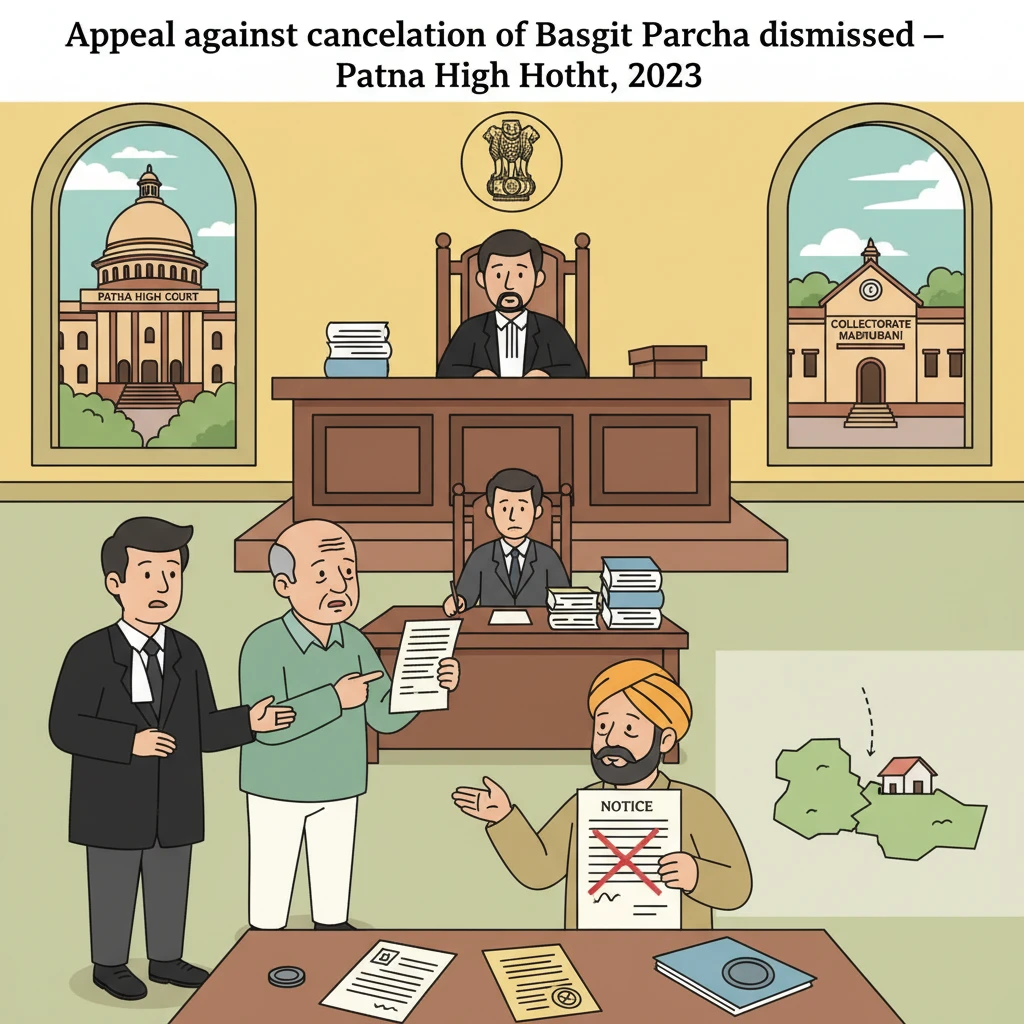
This case arose from a dispute over a Basgit Parcha (homestead tenancy certificate) relating to land in village Gandwar, district Madhubani, Bihar.
The land originally belonged to one Mahanth Madan Mohan Das. The writ petitioner before the Single Judge, late Uday Kant Jha, was an employee of this original landholder. The present appellant is the nephew of Uday Kant Jha and has pursued the matter after the death of his uncle and aunt.
At some point, a Basgit Parcha was granted in favour of Uday Kant Jha by the Circle Officer. Later, the Collector, Madhubani, in Miscellaneous (Basgit Parcha) Case No. 25 of 2006-07 / 07 of 2007-08, cancelled this Basgit Parcha by order dated 28.08.2006.
That cancellation order was first challenged by the writ petitioner in CWJC No. 526 of 2007, not on the merits of entitlement, but on the narrow ground that no notice was given to him before the parcha was cancelled. The High Court then set aside the Collector’s cancellation order only for want of notice and remitted the matter to the Collector, Madhubani, to decide afresh after giving due notice to all parties.
On remand, the Collector again held that the writ petitioner was not entitled to Basgit Parcha. The Collector found that the land belonged to the Government and not to any Zamindar and that there had been no settlement of the land by the ex-landlord in favour of the writ petitioner during the period when Zamindari existed.
The writ petitioner then approached the High Court in CWJC No. 6008 of 2009, challenging the Collector’s fresh order. On 11.08.2015, a learned Single Judge dismissed the writ petition and affirmed the Collector’s cancellation of the Basgit Parcha.
Aggrieved by the Single Judge’s decision, the present Letters Patent Appeal No. 1660 of 2016 was filed before a Division Bench of the Patna High Court.
What the Court Examined and Decided
The Division Bench, comprising Hon’ble Mr. Justice Ashutosh Kumar and Hon’ble Mr. Justice Satyavrat Verma, heard the appeal on 12.01.2023. They considered the legality of the cancellation of the Basgit Parcha and the reasoning of the Single Judge.
The Single Judge had recorded that the land in question originally belonged to one Mahanth Madan Mohan Das. The writ petitioner, late Uday Kant Jha, was an employee of this landholder. The possession of the land with the ancestor of the appellant was thus explained by this employer–employee relationship, and not by any legal tenancy.
A key admitted fact noted by the Single Judge, and accepted by the Division Bench, was that there was no settlement in favour of the writ petitioner by the ex-landlord. This absence of settlement was admitted by the writ petitioner himself in the writ petition.
With the abolition and vesting of Zamindari in the State, in the absence of any prior settlement by the ex-landlord in favour of the writ petitioner, there was no landlord–tenant relationship between the writ petitioner and any landlord. The Court treated this as crucial in assessing whether the Bihar Privileged Persons Homestead Tenancy Act, 1947 (the Act) could apply.
The Single Judge had examined the provisions of the Act. The Court noted that the Act was intended to protect “privileged tenants” from being ejected from their homestead land except on limited grounds mentioned in Section 8. These grounds included:
(1) The tenant using the holding or any part of it in a manner that rendered it unfit for the purposes of the tenancy, and
(2) The tenant failing to pay rent for two years.
Section 8 also provided that a privileged tenant could not be ejected except in execution of an order of ejectment passed by the Collector. Furthermore, an order passed on the ground of failure to pay rent was not to be executed if the tenant deposited the full arrears, with interest or decree amount, within three months of the order.
However, the requirement in Section 8 regarding execution proceedings before the Collector for passing an ejectment order was later deleted by Amendment Act 11 of 1989.
The Single Judge held that for the Act to apply, the status of the person had to be that of a “privileged tenant.” Since the land in question had vested in the State of Bihar, and there had been no settlement in favour of the writ petitioner by the ex-landlord, there was no jural relationship of landlord and tenant. Therefore, the writ petitioner did not have the status of a privileged tenant.
On that basis, the Single Judge concluded that the Basgit Parcha originally issued in favour of the writ petitioner was illegal. Any government land, in the absence of a specific lawful settlement, could not be brought under the beneficent provisions of the Bihar Privileged Persons Homestead Tenancy Act, 1947/1948 for issuance of a Basgit Parcha.
In the appeal, counsel for the appellant focused on Section 21 of the Act. Section 21, which gives power to the Collector of the district to call for and examine records, was introduced by Amendment Act 11 of 1989, effective from 25.09.1989. Counsel argued that because this power was introduced later, it could only be invoked for transactions occurring after 25.09.1989, and that therefore the Collector could not have used Section 21 to cancel the Basgit Parcha.
To support this line of argument, reliance was placed on a judgment of the Patna High Court in Om Prakash Singh v. The State of Bihar & Others, 2004 (2) PLJR 621. The Court noted that in Om Prakash Singh, the same type of argument about the applicability of Section 21 post-amendment was raised and considered, but that case was ultimately decided on other grounds.
The Division Bench looked into the sequence of events. It noticed that, earlier, when the Basgit Parcha granted to the writ petitioner had been cancelled by the District Collector on 28.08.2006, the writ petitioner had challenged that order only on the ground that no notice was given to him. No challenge was made at that time to the power or jurisdiction of the Collector under the Act.
After remand from CWJC No. 526 of 2007, the Collector, Madhubani, re-examined the matter and held that the writ petitioner was not entitled to Basgit Parcha because:
(a) The land belonged to the Government, not to any Zamindar, and
(b) Even when the ex-Zamindar held rights, there was no settlement in favour of the writ petitioner.
The Division Bench accepted that, as a matter of law, Section 21 could only be invoked for transactions occurring after the 1989 amendment. However, it held that this point did not help the appellant in this case.
The Court reasoned that the Basgit Parcha granted to the ancestor of the appellant was “non-est in the eyes of law” from the very beginning because there was no existing landlord–tenant relationship with anybody. It is a settled principle that government land cannot be appropriated by any person without a specific lawful settlement in their favour.
Importantly, the Court noted that the Collector did not need to rely upon Section 21 of the Act to cancel such an illegal and void parcha. The Collector had rightly found that the order of the Circle Officer granting the Basgit Parcha itself was bad in law, since it purported to confer homestead tenancy rights over government land without any legal foundation. Therefore, the parcha was treated as non-existent in law.
The Bench also recorded that subsequently the same land was settled with private respondent no. 5 by issuance of a parcha. The appellant had not challenged this later parcha granted in favour of respondent no. 5 in any proceeding.
The appellant’s mere statement that he did not have knowledge of the parcha issued to respondent no. 5 was held to be of no assistance. Given that the original Basgit Parcha in favour of the appellant’s ancestor was void and that the later settlement in favour of respondent no. 5 remained unchallenged, the Court found no reason to interfere with the Single Judge’s order.
The Division Bench, therefore, held that there was no merit in the Letters Patent Appeal. The appeal was dismissed, without any order as to costs.
Why This Judgment Matters
This judgment underscores that a Basgit Parcha cannot be used as a backdoor method to claim rights over government land where no lawful settlement or landlord–tenant relationship exists.
For people in Bihar living on homestead land, it clarifies that protection under the Bihar Privileged Persons Homestead Tenancy Act, 1947 is available only to genuine “privileged tenants.” Simply being in possession, or working for a former landholder, does not by itself create such a status.
The Patna High Court also made it clear that when a homestead parcha is fundamentally illegal—because it rests on non-existent tenancy rights—it can be treated as non-est in law, and its cancellation will be upheld.
The decision further shows that if land is later lawfully settled in favour of another person and that settlement is not challenged, earlier defective claims based on invalid parchaa will not be entertained by the Court.
Legal Issues and Answers
- Issue: Whether the Basgit Parcha granted in favour of the appellant’s ancestor could be legally sustained under the Bihar Privileged Persons Homestead Tenancy Act, 1947, especially in view of Section 21 introduced in 1989.
Answer: No. The Court held that there was no landlord–tenant relationship and the land was government land. The original parcha was non-est in law, and its cancellation by the Collector was valid, independent of Section 21. - Issue: Whether the subsequent settlement of the land with private respondent no. 5 could be indirectly questioned in this appeal.
Answer: No. The parcha in favour of respondent no. 5 had not been challenged in any proceeding, and mere lack of knowledge claimed by the appellant was of no help. The Court declined to interfere with that settlement.
Cases Cited by the Court
- Om Prakash Singh v. The State of Bihar & Others, 2004 (2) PLJR 621 – referred to in argument regarding Section 21 of the Act; the Court noted that in that case the issue was considered but the decision turned on other grounds.
Case Details
Case Number: Letters Patent Appeal No. 1660 of 2016 in Civil Review No. 247 of 2015; arising from CWJC No. 6008 of 2009 and earlier CWJC No. 526 of 2007
Case Title: Mithilesh Jha v. The State of Bihar & Others
Coram: Hon’ble Mr. Justice Ashutosh Kumar and Hon’ble Mr. Justice Satyavrat Verma
Citation:
| 2023 (1) PLJR 753 |
Advocates: Ms. Anju Mishra, Advocate for the appellant; Mr. Anisul Haque, AC to AAG 5 for the State; Mr. B.N. Tiwari, Advocate for respondent no. 5
Nature of the Case: Letters Patent Appeal against the judgment of a Single Judge in a writ petition concerning cancellation of Basgit Parcha under the Bihar Privileged Persons Homestead Tenancy Act, 1947
Date of Judgment: 12.01.2023
Link to Judgment: https://patnahighcourt.gov.in/viewjudgment/MyMxNjYwIzIwMTYjMSNO-HsUjnjrCIGA=
If you found this explanation helpful and wish to stay informed about
how legal developments may affect your rights in Bihar,
you may consider following Samvida Law Associates for more updates.







