

Case Background
The case arises from Phulwarisharif P.S. Case No. 827 of 2022, relating to alleged extremist activities in Patna. The Bihar Police received information about a plan by certain persons to cause disturbance during the proposed visit of the Prime Minister of India to Bihar.
Acting on this information, on 11.07.2022 the Phulwarisharif Police raided the house of one Jalaluddin Khan @ Md. Jalaluddin. The upper floor of this house had been given on rent to another accused, Athar Parwez. From the rented floor, the police state that they recovered documents said to relate to unlawful activities aimed at disrupting the sovereignty of India, causing disaffection against the country and establishing Pan-Islamic rule in India by subverting the Constitution of India. The documents were described as propagating armed struggle and violent means for this agenda.
Jalaluddin Khan @ Md. Jalaluddin and Athar Parwez were arrested from the spot. Based on their statements, the police named about 25 more persons allegedly involved in these unlawful activities. An FIR was registered as Phulwarisharif P.S. Case No. 827 of 2022.
Considering the nature and gravity of the allegations, the Government of India, Ministry of Home Affairs, by order dated 22.07.2022 directed the National Investigation Agency (NIA) to take over the investigation. The NIA re-registered the matter as R.C.-31/2022/NIA/DLI dated 22.07.2022 for offences under Sections 120, 120B, 121, 121A, 153A, 153B and 34 of the Indian Penal Code. Section 13 of the Unlawful Activities (Prevention) Act, 1967 (UAPA) was also invoked later.
The present appellants were shown as accused in this NIA case: one as accused no.18, one as accused no.24, one as accused no.7, one as accused no.3, and two others as accused nos.14 and 15. Apprehending arrest, each of them filed separate applications for anticipatory bail in Special Case No. 02 of 2023/R.C. No. 31 of 2022 before the Special Judge, NIA, Patna.
The Special Judge, NIA, Patna rejected all the anticipatory bail applications. Aggrieved, the accused filed these five criminal appeals under Section 21(4) of the National Investigation Agency Act, 2008 before the Patna High Court. A Division Bench heard all five matters together and delivered a common oral judgment on 02.05.2024.
What the Court Examined and Decided
On behalf of the appellants, it was argued that they had been falsely implicated only on the basis of statements by the two arrested co-accused. Counsel pointed to a seizure list to say that the two persons found at the place of occurrence had not signed it, and that another seizure list signed by accused Athar Parwez was dated 13.07.2022 although, according to the defence, the seizure had occurred on 11.07.2022. The appellants claimed the signature was taken later under duress and that nothing was genuinely recovered from the house of Jalaluddin Khan @ Md. Jalaluddin or the rented premises of Athar Parwez.
The appellants also highlighted that the main document allegedly recovered was a seven-page booklet titled “India 2047, Rule of Islamic India, Internal Document”, which they claimed was freely downloadable from the internet. They argued that mere possession of such literature could not make them criminals or terrorists.
A further line of defence was that Popular Front of India (PFI), which surfaced in the investigation, was not a banned organisation in July 2022 when the FIR was lodged. According to the appellants, PFI was registered under the Societies Registration Act, 1860 and claimed to promote national integration, communal amity, social harmony, democratic and secular values. The ban on PFI was imposed only on 28.09.2022, after the FIR, so membership or association at the earlier date could not automatically be treated as unlawful.
Individually, some appellants claimed respectable positions: one said he was a government technician, another stated he was President of the Social Democratic Party of India, recognised by the Election Commission, and an active social worker. Counsel argued that they were neither members of PFI nor of any proscribed organisation, and that even if they had been members of a then-legal organisation, this would not amount to an offence under UAPA.
They specifically challenged the applicability of IPC Sections 120, 120B, 121, 121A, 153A, 153B, 34 and Section 13 of UAPA, claiming the factual allegations did not satisfy the ingredients of these offences. From this, they submitted that the special bar on bail in Section 43D(4) of UAPA would not apply, so anticipatory bail should be considered in the normal way. Reliance was placed on Supreme Court decisions in Vernon v. State of Maharashtra & Anr. (AIR 2023 SC 3926) and the order dated 05.04.2024 in Shoma Kanti Sen v. State of Maharashtra & Anr., to argue that mere possession of literature and weak material could not justify continued detention.
On the other side, the Additional Solicitor General for India, appearing for the NIA, opposed the appeals. He referred extensively to counter affidavits and the charge-sheet already filed against arrested co-accused Jalaluddin Khan @ Md. Jalaluddin and Athar Parwez. The ASG pointed out that a Coordinate Bench of the Patna High Court, by order dated 28.11.2023 in Criminal Appeal (DB) Nos.514 and 516 of 2023 filed by these co-accused, had already examined similar arguments and rejected their bail appeals after holding that a prima facie case was made out under UAPA.
The ASG emphasised Section 43D(4) of UAPA, which clearly states that Section 438 CrPC (anticipatory bail) “shall not apply in relation to any case involving the arrest of any person accused of having committed an offence punishable under this Act”. On this basis, he argued that anticipatory bail was statutorily barred in UAPA cases. He relied on Bombay High Court’s decision in Anand Teltumbde v. State of Maharashtra and Others (2020 SCC OnLine Bom 1692), where anticipatory bail under UAPA was held not maintainable, and noted that the Supreme Court had dismissed the SLP against that judgment.
The ASG also cited Kerala High Court’s decision in Ahammedkutty Pothiyil Thottiparambil v. Union of India (2023 SCC OnLine Ker 5501), particularly on the need for custodial interrogation and the permissibility of further investigation even after a charge-sheet is filed. In addition, he referred to the Supreme Court’s ruling in Gurwinder Singh v. State of Punjab & Anr. (2024(1) PLJR(SC) 417) which explains the strict “prima facie true” test under Section 43D(5) UAPA for bail and shows that bail is to be rejected as a rule if the material supports the accusation.
The Division Bench examined the record, including the charge-sheet and materials earlier scrutinised by the Coordinate Bench in the co-accused’s bail appeals. The Court noted that the Coordinate Bench had already, after seeing police papers and statements of protected witnesses, recorded detailed findings. Those findings, reproduced in this judgment, include:
First, during investigation it was disclosed that there was a definite plan to disturb the Prime Minister’s visit to Bihar. During the raid, five sets of documents titled “India 2047 towards Rule of Islamic India, Internal Document; not for circulation” and pamphlets of PFI dated 20.02.2021 in different languages were recovered. These documents were found to propagate and urge participation in PFI activities.
Second, it had been admitted that the first floor of Jalaluddin’s house was rented to Athar Parwez specifically for imparting training to PFI cadre on 6th and 7th July 2022. Persons from outside Bihar were said to have attended this training. Athar Parwez admitted to earlier active association with Student Islamic Movement of India (SIMI), now a banned terrorist organisation, and to providing legal help to SIMI members in jail. Investigators concluded he was preparing a secret group of ex-SIMI members, aiming to take revenge for alleged atrocities on Muslims and to attack persons who had made derogatory remarks against Islam, citing incidents at Amravati and Udaipur as examples.
Third, from the recovered documents it was found that they discussed how, if 10% of the Muslim population rallied behind PFI, the majority community could be subjugated. Four stages were described for establishing “rule of Islam in India”: uniting Muslims and giving weapon training; selective violence to show strength and terrorise opponents; alliance with Scheduled Castes and Scheduled Tribes to divide Hindus; and infiltration into police, army and judiciary. The final stage envisaged PFI declaring a new constitution based on Islamic principles with external support, using references such as Babri Masjid for radicalisation and collecting information on extremist Hindu organisations for selective revenge.
Fourth, seized mobile phones, SIM cards and digital devices were sent for forensic analysis to Thiruvananthapuram. The extracted data contained numerous communally objectionable videos circulated to spread religious animosity and hatred. This data also confirmed participation of the accused in various protests organised by PFI and allied organisations.
Protected witnesses X, Y and Z stated that they had been lured to join PFI on promises of scholarships and then drawn into a “nefarious vortex of hate”, with the purpose of furthering “Muslim empowerment” and executing future PFI plans.
Building on this record, the present Bench held that prima facie the conspiracy was not limited to a single incident but part of a larger design. It observed that the alleged conspiracy to disrupt the Prime Minister’s visit, if not foiled, could have had a “disastrous cascading effect on the public order in the country”. The materials, including the “India 2047” documents and digital data, “speak volumes about the nefarious design of the accused”, according to the Court.
The Bench pointed out that the present appellants had initially been named on the basis of statements of the co-accused, but the subsequent investigation and documents prima facie indicated their complicity in the alleged unlawful activities. It also noted that the appellants were evading arrest. On this basis, the Court concluded that there was material to say that the appellants had prima facie committed offences punishable under UAPA, and therefore their appeals for anticipatory bail were not maintainable in law.
The Court then discussed the case law cited by both sides. It agreed with the Bombay and Kerala High Courts and the Supreme Court that Section 43D(4) of UAPA creates a bar against anticipatory bail under Section 438 CrPC in UAPA cases. It noted that the Supreme Court had refused to interfere with the Bombay High Court’s view in Anand Teltumbde.
Regarding Vernon and Shoma Kanti Sen, the Court distinguished those decisions. In Vernon, the Supreme Court granted regular bail to an accused who had been in custody for nearly five years, after analysing the weak nature of the evidence and considering Articles 14 and 21 of the Constitution. In Shoma Kanti Sen, bail was granted on grounds including advanced age, ailments, delay in framing charges and period of detention already undergone. The Patna High Court held that these were cases of regular bail after long custody, whereas the present case concerned anticipatory bail at the investigation stage, with ample material collected and the need for custodial interrogation. Therefore, those precedents did not assist the appellants.
Ultimately, the Court held that a prima facie case under UAPA had been made out, the statutory bar in Section 43D(4) applied, custodial interrogation of the appellants was required, and the Special Judge, NIA, Patna had not committed any error. All five criminal appeals were dismissed, and anticipatory bail was refused.
Why This Judgment Matters
This judgment is important for anyone facing or advising on UAPA cases in Bihar, especially where NIA is involved. The Patna High Court has made it clear that when UAPA sections are invoked, anticipatory bail under Section 438 CrPC is not available at all because of Section 43D(4) of the Act.
The Court also showed that once there is material suggesting a larger conspiracy involving documents like “India 2047, Rule of Islamic India”, training camps, and digital evidence of hate content, the threshold of “prima facie true” is easily met. When that happens, courts will generally refuse bail, and even more so anticipatory bail.
For ordinary citizens, the message is that in serious national security cases, courts give strong weight to the investigation record and earlier decisions in the same case. If co-accused have already been denied bail on the same material, it becomes much harder for others to secure pre-arrest protection.
The judgment also underlines that questioning the authenticity of seizure lists or saying a document is available on the internet may not, by themselves, be enough at this stage. Such arguments are usually treated as matters for trial, not for anticipatory bail.
Legal Issues and Answers
- Issue: Are anticipatory bail applications maintainable when a person is accused of offences punishable under the Unlawful Activities (Prevention) Act, 1967 and investigated by NIA?
Answer: No. The Court held that Section 43D(4) of UAPA expressly bars the application of Section 438 CrPC, so anticipatory bail in such cases is not maintainable. - Issue: Did the investigation materials create a prima facie case linking the appellants with the alleged unlawful and terrorist-related activities?
Answer: Yes. Relying on the charge-sheet, seized documents, digital evidence, and witness statements already examined in co-accused bail orders, the Court found a prima facie case against the appellants and held that they appeared to have committed offences under UAPA and IPC. - Issue: Did precedents like Vernon and Shoma Kanti Sen justify granting anticipatory bail to the appellants?
Answer: No. The Court distinguished those decisions as relating to regular bail after long incarceration and particular personal circumstances, whereas here the appellants sought anticipatory bail at the investigation stage with significant material against them.
Cases Cited by the Court
- Anand Teltumbde v. State of Maharashtra and Others, 2020 SCC OnLine Bom 1692 (Bombay High Court)
- Order of the Supreme Court dated 16.03.2020 in SLP (Crl.) No. 1916 of 2020 (challenging Anand Teltumbde decision)
- Ahammedkutty Pothiyil Thottiparambil v. Union of India, 2023 SCC OnLine Ker 5501 (Kerala High Court)
- Gurwinder Singh v. State of Punjab & Anr., 2024(1) PLJR(SC) 417 (Supreme Court)
- Vernon v. State of Maharashtra & Anr., AIR 2023 SC 3926 (Supreme Court)
- Order dated 05.04.2024 in Shoma Kanti Sen v. State of Maharashtra & Anr., Criminal Appeal No. 2595 of 2023 (Supreme Court)
- National Investigation Agency v. Zahoor Ahmad Shah Watali (cited within other judgments; referred to by the Court)
Case Details
Case Numbers: Criminal Appeal (DB) No. 914 of 2023; Criminal Appeal (DB) No. 810 of 2023; Criminal Appeal (DB) No. 811 of 2023; Criminal Appeal (DB) No. 890 of 2023; Criminal Appeal (DB) No. 917 of 2023; all arising out of PS Case No. 31 of 2022, NIA, District Patna (re-registered from Phulwarisharif P.S. Case No. 827 of 2022; R.C.-31/2022/NIA/DLI).
Case Title:
Criminal Appeal (DB) No. 914 of 2023 – Manzer Parwez @ Manzar Perwez v. The Union of India through the National Investigation Agency Bihar
Criminal Appeal (DB) No. 810 of 2023 – Abdur Rahman @ Abdul Rahman v. The Union of India through the National Investigation Agency Bihar
Criminal Appeal (DB) No. 811 of 2023 – Mahboob Alam @ Mahboob Nadwi v. The National Investigation Agency Bihar
Criminal Appeal (DB) No. 890 of 2023 – Shamim Akhtar v. The Union of India through the National Investigation Agency India
Criminal Appeal (DB) No. 917 of 2023 – Md. Khaliquzzaman @ Khaliquzzaman @ Khalikur Aman and Md. Amin @ Md. Amin Alam v. The Union of India through the National Investigation Agency New Delhi
Coram: Hon’ble Mr. Justice Vipul M. Pancholi; Hon’ble Mr. Justice Ramesh Chand Malviya
Date of Judgment: 02-05-2024
Citation: 2024(2) PLJR 770
Advocates:
For the appellants (in all appeals): Mr. Syed Masleh Uddin Ashraf, Advocate
For the respondent Union of India / NIA:
– Dr. Krishna Nandan Singh, Additional Solicitor General (A.S.G)
– Mr. Manoj Kumar Singh, Advocate
– Mr. Ankit Kumar Singh, Advocate
– Mr. Arbind Kumar, Advocate
– Mr. Shivaditya Dhari Sinha, Advocate
Nature of the Case: Criminal appeals under Section 21(4) of the National Investigation Agency Act, 2008, challenging rejection of anticipatory bail in a UAPA and IPC case investigated by NIA.
Link to Full Judgment: Patna High Court Judgment – 02.05.2024
If you found this explanation helpful and wish to stay informed about
how legal developments may affect your rights in Bihar,
you may consider following Samvida Law Associates for more updates.
Meta Description: Patna High Court refuses anticipatory bail to five accused in an NIA UAPA case, holding such bail barred and finding a strong prima facie case.
Focus Keyword: UAPA anticipatory bail Patna High Court
Permalink: uapa-anticipatory-bail-nia-patna-high-court
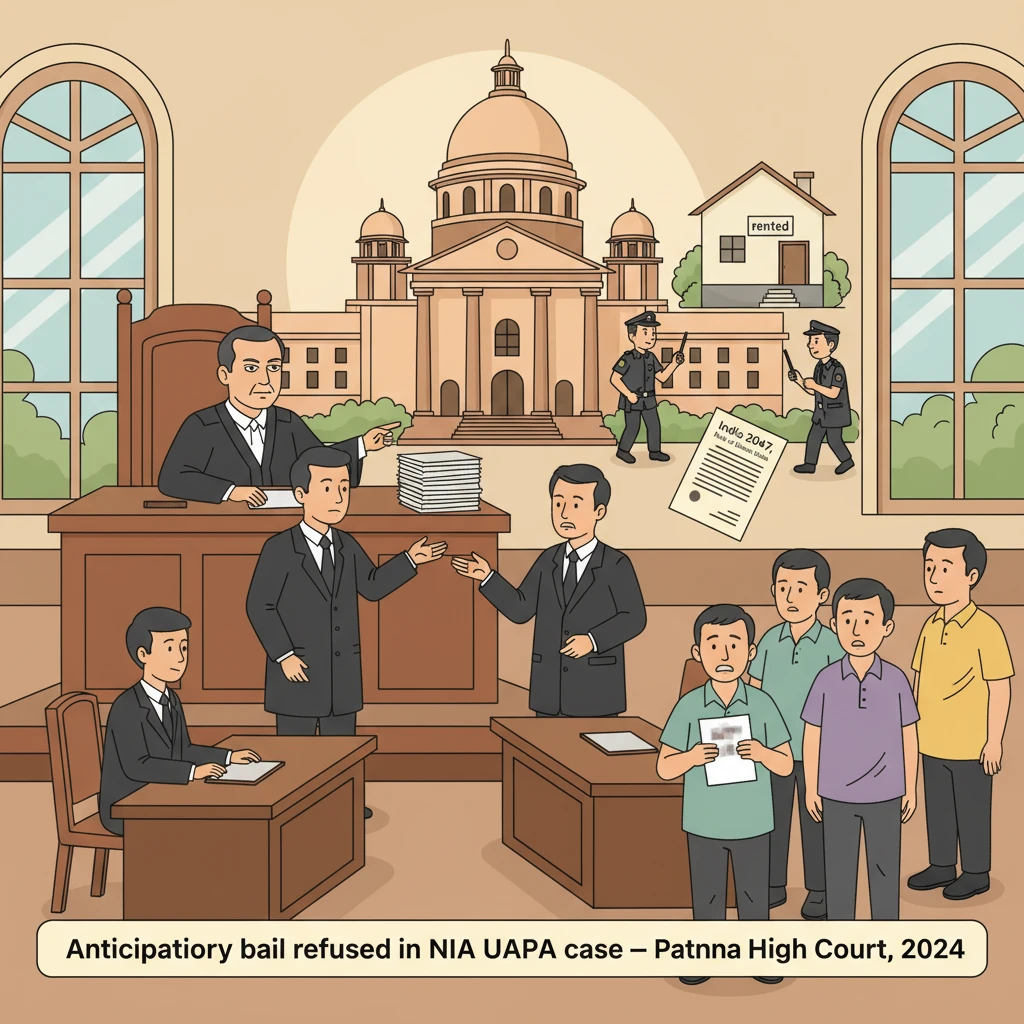
Image Alt Text: Inside view of Patna High Court building during hearing of NIA UAPA case.
Image Caption: Patna High Court dismissed anticipatory bail appeals in an NIA case involving UAPA allegations from Phulwarisharif, Patna.







