
Case Background
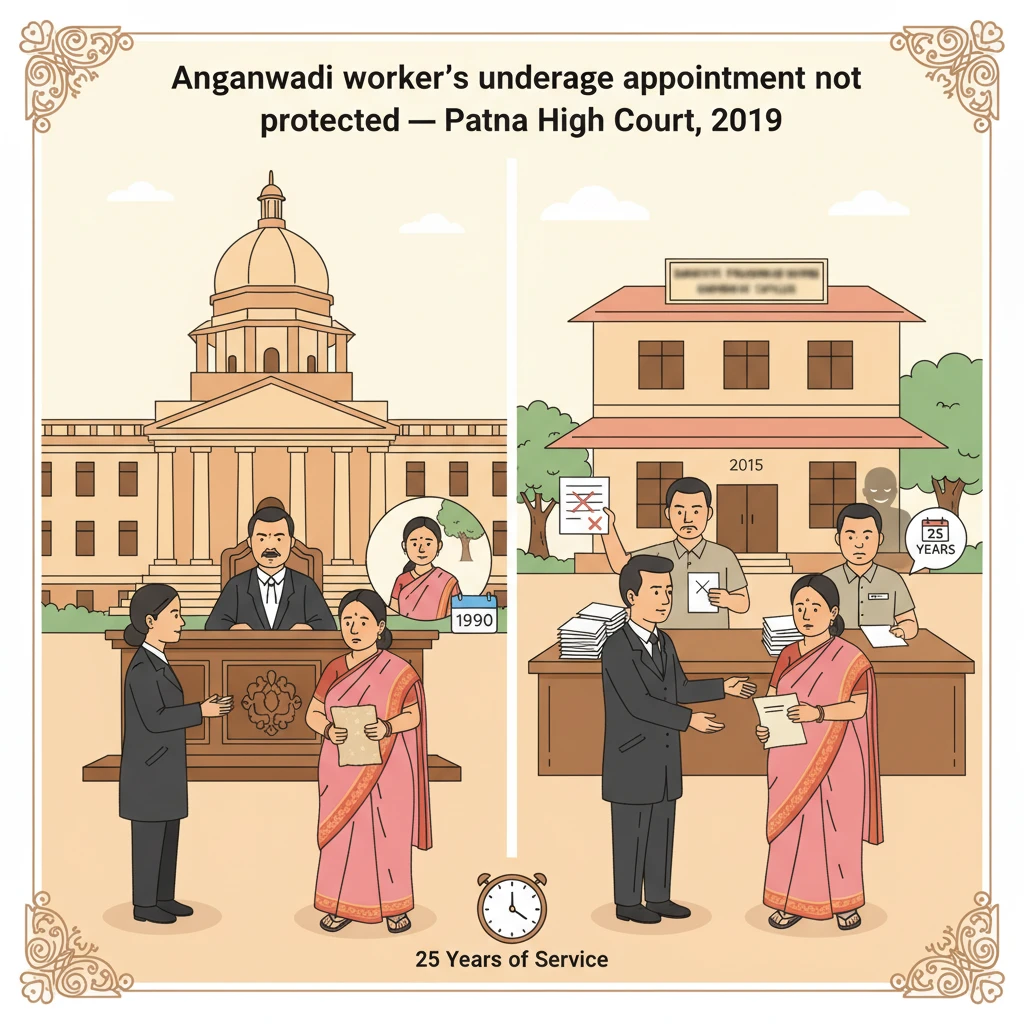
The petitioner was selected as Anganwari Sewika for Bageshwari Sheikh Tola, Centre No. 182, in District Araria, by an Aam Sabha held on 24.04.1990. Her recorded date of birth was 25.05.1977.
Much later, a complaint was made against her by an agnate of her husband, allegedly arising out of family feud. Acting on this complaint, the District Programme Officer (DPO), Araria, passed an order on 17.04.2015 cancelling her selection as Anganwari Sewika.
On the basis of this cancellation order, the Child Development Project Officer (CDPO), Jokihat, issued a communication dated 07.07.2015 directing the petitioner to hand over charge of the Anganwari centre to her successor.
Aggrieved, the petitioner approached the Patna High Court under Article 226 of the Constitution in Civil Writ Jurisdiction Case No. 18372 of 2015. She challenged the communication dated 07.07.2015 and the underlying order of cancellation, and she sought reinstatement as Anganwari Sewika.
What the Court Examined and Decided
Justice Madhuresh Prasad heard the matter, with arguments advanced by senior counsel for the petitioner and Government counsel for the State.
The core allegation against the petitioner was that she was underage at the time of her initial selection. According to the authorities, on 24.04.1990, the date of the Aam Sabha, she was only 12 years, 10 months and 21 days old. On this basis, the DPO held that her selection was illegal from the very beginning and could not be allowed to continue.
The petitioner’s side did not dispute the dates. Instead, her senior counsel tried to place the selection in its social context and to argue equity in her favour.
He submitted that in 1990, it was difficult to find women willing to work as Anganwari Sewika for a very small honorarium of about Rs. 100 per month. Because of this, the Aam Sabha consciously selected the petitioner even after knowing her date of birth as 25.05.1977. In other words, they knowingly selected someone technically underage to ensure that the Anganwari centre could function.
The petitioner’s counsel further pointed out that she had continuously served as Anganwari Sewika since 1990. By 2015, she was about to complete 25 years of service. Under the scheme, 25% of posts of Lady Supervisor are to be filled by promotion from experienced Anganwari Sewikas, and the petitioner’s long service made her eligible for consideration in that promotional quota.
The petitioner argued that just a few days before she was to complete 25 years of service and become eligible for consideration as Lady Supervisor, her selection was cancelled. She claimed that this was done due to a complaint made by a relative of her husband, allegedly motivated by family dispute. On this basis, she pleaded that it was unfair and arbitrary to remove her after she had given such a long span of service.
To support her plea, the petitioner relied on two earlier decisions of the Patna High Court:
First, Ful Kumari @ Ful Kumari Devi vs. State of Bihar, arising out of C.W.J.C. No. 3211 of 2011, decided on 10.05.2012; and second, Sunita Kumari vs. State of Bihar, arising out of C.W.J.C. No. 13952 of 2011, decided on 01.12.2011.
According to the petitioner, in both these judgments, women who had been selected as Anganwari Sewika below the legal age for employment were later sought to be deprived of the benefits of their employment. The Court had intervened and protected them from arbitrary action by the State on the ground that, after such a long lapse of time, and in the absence of any misrepresentation or fraud on their part, the authorities were estopped from denying them the fruits of their past service.
The petitioner therefore sought similar relief and argued that, on the same analogy, she should be reinstated as Anganwari Sewika and allowed to continue.
The State’s counsel took a firm stand against this. He pointed out that, at the time of initial selection, the petitioner was admittedly about 12 years and 11 months old. She was still a “child” within the meaning of applicable laws. He referred to the Child and Adolescent Labour (Prohibition and Regulation) Act, 1986 and similar earlier laws, which barred employment of children.
In the State’s view, any appointment made in violation of such a prohibition was void and could not be enforced. The petitioner’s selection, therefore, could not be described as a “legal selection” under any stretch of imagination.
On the judgments cited by the petitioner, the State’s counsel drew a clear distinction. He submitted that in Ful Kumari and Sunita Kumari, the Court had not ordered reinstatement of the petitioners. The only benefit granted there was recognition of their past service as experience, so that they could count it for eligibility to be considered for appointment to the post of Lady Supervisor against the 25% promotional quota.
In those cases, the limited issue was whether their experience as Anganwari Sewika could be recognised for promotional consideration. In the present case, the petitioner sought a much broader and different relief – reinstatement to a post secured through an admittedly illegal appointment at a time when she was a child. Thus, the State argued that the earlier decisions did not apply.
Justice Madhuresh Prasad agreed with the stand of the State. The Court first emphasised that the petitioner’s initial selection at the age of less than 13 years was illegal. She was, in law, a child, and child labour prohibitions created a direct bar to her employment as Anganwari Sewika.
The Court observed that merely because the respondent authorities had failed at the outset to exercise due care and allowed her appointment, that initial mistake could not give the petitioner any enforceable right to continue in that post. A wrong act at the beginning does not become right just because it was allowed to go on for a long time.
The Court then addressed the argument based on long years of service. It held that the continuation of an illegal appointment for many years cannot, by itself, create any legal right in favour of the employee. Therefore, the petitioner could not demand that the writ court quash the communication dated 07.07.2015 or order her reinstatement, as such an order would have the effect of restoring an illegality.
The Court reminded that under Article 226 of the Constitution, the High Court cannot be used to revive or perpetuate an illegal act. It referred to three Supreme Court decisions to reinforce this principle:
First, Gadde Venkateswara Rao vs. Government of A.P., reported in AIR 1966 SC 828; second, Mohd. Sawalker vs. III ADJ, reported in (1988) 1 SCC 40; and third, Maharaja Chintamani Saran Nath Shahdeo vs. State of Bihar & Ors., reported in (1999) 8 SCC 16.
Relying on these authorities, the Court held that it was “trite law” that a writ cannot be issued to restore an illegal appointment.
At the same time, the Court took note of the reliefs granted in Ful Kumari and Sunita Kumari. It held that, on a similar footing, the petitioner in this case would be entitled to claim the benefit of her experience as Anganwari Sewika for the limited purpose of consideration for appointment as Lady Supervisor against the 25% promotional quota, in accordance with law.
Thus, while the Court refused reinstatement, it did not wipe out the value of her past service completely. It only declined to validate or continue an appointment made in violation of child labour laws.
Finally, the Court dismissed the writ petition and declined to quash the communication dated 07.07.2015 issued by the CDPO, Jokihat, or to order reinstatement of the petitioner as Anganwari Sewika.
Why This Judgment Matters
This judgment clearly tells Anganwadi workers and other government scheme workers that if the initial appointment itself is illegal, the High Court will not protect it merely because it has continued for long years.
For people appointed as minors, the decision confirms that courts will not use their writ powers to restore such appointments. However, where a worker has served for many years without any fraud on her part, her experience may still be recognised for limited purposes such as eligibility for promotion, if similar schemes permit.
For government authorities, the Patna High Court’s decision serves as a reminder to strictly follow child labour prohibitions and age requirements in recruitment, and that later discovery of such illegality allows cancellation, even after long service.
Legal Issues and Answers
Issue: Can the Patna High Court, under Article 226, restore an Anganwari Sewika’s appointment that was made when she was a child below 13 years of age?
Answer: No. The Court held that the initial selection was illegal due to child labour prohibitions, and Article 226 cannot be invoked to revive or perpetuate such illegality.
Issue: Is long continuation of service under an illegal appointment sufficient to create a right to reinstatement after cancellation?
Answer: No. Long continuation cannot create a legal right to continue in an illegal appointment; reinstatement would amount to restoring an illegality.
Issue: Can experience gained under an illegal initial appointment still be considered for promotional eligibility to the post of Lady Supervisor?
Answer: Yes, following earlier judgments, the Court held that the petitioner may claim the benefit of her experience for consideration against the 25% promotional quota, in accordance with law.
Cases Cited by the Court
- Ful Kumari @ Ful Kumari Devi vs. The State of Bihar, C.W.J.C. No. 3211 of 2011, judgment dated 10.05.2012 (Patna High Court).
- Sunita Kumari vs. The State of Bihar, C.W.J.C. No. 13952 of 2011, judgment dated 01.12.2011 (Patna High Court).
- Gadde Venkateswara Rao vs. Government of A.P., AIR 1966 SC 828 (Supreme Court of India).
- Mohd. Sawalker vs. III ADJ, (1988) 1 SCC 40 (Supreme Court of India).
- Maharaja Chintamani Saran Nath Shahdeo vs. State of Bihar & Ors., (1999) 8 SCC 16 (Supreme Court of India).
Case Details
Case Number: Civil Writ Jurisdiction Case No. 18372 of 2015
Case Title: Imrana Tarannum @ Bibi Imrana Tarannum vs. The State of Bihar & Ors.
Court: High Court of Judicature at Patna
Coram: Hon’ble Mr. Justice Madhuresh Prasad
Date of Judgment: 17.04.2019
Citation: 2019 (2) PLJR 1152
Advocates:
- For the petitioner: Mr. Rajendra Narain, Senior Advocate; Mr. Umesh Kumar Roy, Advocate.
- For the State: Mr. Dhurjati Kumar Prasad, GP 14.
Nature of the Case: Writ petition under Article 226 of the Constitution of India challenging cancellation of selection and seeking reinstatement as Anganwari Sewika.
Impugned Orders:
- Order dated 17.04.2015 of District Programme Officer, Araria, cancelling the petitioner’s selection as Anganwari Sewika.
- Communication dated 07.07.2015 of Child Development Project Officer, Jokihat, directing handover of charge to successor.
Final Outcome: Writ petition dismissed; cancellation and direction to hand over charge upheld. Petitioner allowed to claim benefit of past experience for consideration against 25% promotional quota for Lady Supervisor, in accordance with law.
Link to Judgment: Click here to read the full judgment of the Patna High Court
If you found this explanation helpful and wish to stay informed about
how legal developments may affect your rights in Bihar,
you may consider following Samvida Law Associates for more updates.







