
Case Background
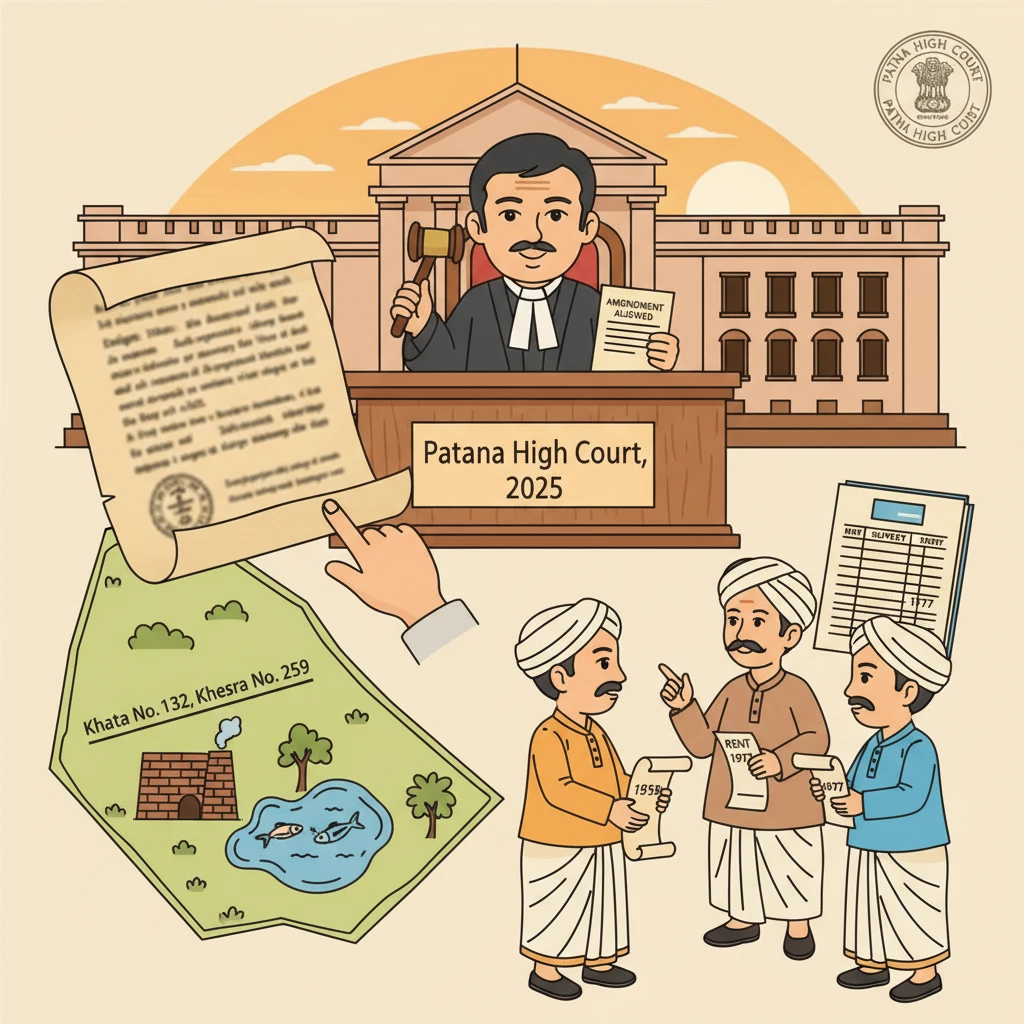
The dispute concerns 90 decimals of land in village Mirachak, P.S. Barari, Khata No. 132, Khesra No. 259, in Bhagalpur district. The land is described in the plaint with fixed boundaries on all sides.
According to the plaintiff’s case, the land was originally the property of an ex-landlord, Naresh Mohan Thakur. He is said to have sold this land on 04.09.1959 to the mother of plaintiff no. 1. The mother allegedly purchased the land in the name of one Chunchun Tanti, who was then a minor. The plaintiff claims that this purchase was from joint family income.
The plaintiffs further allege that on 17.06.1960, after Chunchun Tanti became major, the mother of plaintiff no. 1 and Chunchun executed a “fake” sale deed, without consideration, in favour of one Mantri Mandal, a family friend. It is said that later, Mantri returned all lands except the present disputed land.
The plaintiffs say that the mother of plaintiff no. 1 died, and Chunchun Tanti also died. Relations between Chunchun’s family and the plaintiffs turned sour. The plaintiffs claim to be in use and possession of the suit land and to be paying rent to the State of Bihar.
However, in the survey records, the suit land is recorded in the name of one Fata Mandal, son of Gholtan Mandal, who is stated to be the father of Mantri Mandal. The plaintiffs say this survey entry is wrong and baseless, and that the defendants have no true interest in the land, though they dispute the plaintiffs’ title.
The plaintiffs also averred that a sale deed dated 17.09.1960 was executed by Chunchun Tanti in favour of Mantri Mandal, and that later, by another sale deed dated 10.10.1977, Mantri sold the land to respondent no. 1, Raj Kumar Mandal. The plaintiffs claim both sale deeds are not binding on them and that the defendants have neither title nor possession. When the defendants allegedly obstructed their possession, the plaintiffs filed Title Suit No. 175 of 1995 seeking declaration of title, correction of survey entry, and injunction.
The defendants, on entering appearance, denied the plaintiffs’ case. They asserted that they purchased the land on 17.09.1960, got mutation done in their names, and paid rent. They stated that the survey entry was made in their favour and that the plaintiffs never challenged it when the khatiyan was finally published.
The defendants further pleaded that they sold the land to Raj Kumar Mandal by a registered sale deed dated 10.10.1977. They claimed that the nature of the land had changed over time: from being used for brick manufacture with a brick-kiln running for about 15 years, to becoming a ditch and later a pond used for fish rearing.
After pleadings were complete, the trial court framed issues and directed both sides to lead evidence. Arguments of the defendants were completed on 22.06.2019. The plaintiffs then began their arguments.
On 15.07.2019, during the plaintiffs’ arguments, the plaintiff/petitioner filed one amendment petition under Order VI Rule 17 of the Code of Civil Procedure, which was allowed, subject to costs of Rs. 5,000/-. Thereafter, on 09.09.2019, the plaintiff/petitioner filed another amendment application under Order VI Rule 17 read with Section 151 CPC. The defendants opposed this second amendment.
By order dated 16.09.2019, the learned Sub Judge-X, Bhagalpur, rejected the amendment application dated 09.09.2019. Aggrieved, the plaintiff filed the present civil miscellaneous petition before the Patna High Court seeking to set aside that order.
What the Court Examined and Decided
The core question before the Patna High Court was whether the trial court was right in refusing the plaintiffs’ second amendment application filed on 09.09.2019 in a suit instituted in 1995.
The plaintiff/petitioner argued that the trial court had gone into the merits of the case while deciding the amendment application. According to the petitioner, at the amendment stage, the court should confine itself to whether the amendment is necessary for proper adjudication, not to final merits.
The trial court had held that allowing the amendment would change the nature of the suit and reopen the trial. The petitioner disagreed, claiming that the amendment would merely add an additional relief that the two sale deeds dated 17.09.1960 and 10.10.1977 are not binding on the plaintiffs. The suit would still remain a title suit about the same land.
The plaintiff also sought to introduce a plea that a family partition took place in 1994, under which the suit land allegedly fell to the share of the plaintiff and his son. Another part of the proposed amendment was to add in the relief clause that “the Kewala dated 17.09.60 and 10.10.77 is not binding to the plaintiff” and, further, that if the plaintiffs are dispossessed, possession be restored to them through court.
The petitioner’s counsel pointed out that the original plaint already claimed right, title, interest, and possession, alleged incorrect survey entry, and challenged the defendants’ sale deeds in the body of the plaint. The amendment, he said, was meant to properly explain how the plaintiffs derived title, including partition between brothers Musai Tanti and Chunchun Tanti, and to convert that challenge into a clear relief prayer.
He stressed that in paragraph 8(a) of the plaint, the plaintiffs had already mentioned the challenge to the sale deeds dated 17.09.1960 and 10.10.1977, and seeking suitable relief was only a natural consequence. The petitioner also assured that, if allowed, he would not lead further evidence and would complete his arguments, so the trial would not significantly delay.
On the question of delay and the proviso to Order VI Rule 17, the petitioner contended that the suit was filed in 1995. The amendment to Order VI Rule 17 by the Code of Civil Procedure (Amendment) Act, 2002, effective from 01.07.2002, introduced a proviso restricting amendments after commencement of trial unless due diligence is shown. However, Section 16(2)(b) of the Amending Act states that the amended provisions of Order VI Rules 5, 15, 17, and 18 do not apply to pleadings filed before commencement of the amendment.
Relying on the Patna High Court decision in Shri Shankar Bhagwan & Ors. v. State of Bihar & Ors., 2008 (2) PLJR 588, the petitioner argued that in suits filed before 01.07.2002, the unamended Order VI Rule 17 applies. Hence, there is no bar on seeking amendment even at the stage of arguments, and the court need not examine “due diligence” under the proviso.
The petitioner also cited Supreme Court and Patna High Court precedents on liberal amendment, including:
- Vasantha (dead) through LR v. Rajalakshimi @ Rajam (dead) through LRs., (2024) 5 SCC 282, where the Supreme Court allowed amendment even at second appellate stage.
- Smt. Bibha Devi v. Smt. Annu Devi, 2024 (5) BLJ 74, where this Court allowed amendment while evidence was being recorded, to determine the real dispute and avoid multiplicity.
- Pankaja and Anr. v. Yellappa (dead) by LRs. and Ors., AIR 2004 SC 4102, where the Supreme Court explained:
- Court’s power to allow amendments is wide and can be exercised even after delay.
- There is no absolute rule that amendment must be refused whenever the claim appears barred by limitation.
- The test is whether allowing amendment will serve the cause of justice and avoid further litigation.
On the other hand, the respondents’ counsel strongly supported the trial court’s order. He pointed out that the plaintiffs had filed the suit in 1995 and waited nearly 24 years before seeking this particular amendment. This, he argued, showed negligence and lack of bona fides.
The respondents argued that the plaintiffs had already filed one amendment application earlier in 2019, which was allowed. Immediately after that, when plaintiffs’ arguments started, they again sought another amendment to fill up lacunae. According to the respondents, this was an attempt to mend weaknesses in the case at the last moment.
They also argued that the proposed relief directly challenged sale deeds of 1960 and 1977, which are clearly decades old. Any relief to set aside or declare such deeds not binding would normally be governed by a three-year limitation period. Thus, permitting this amendment at this stage would allow a time-barred claim.
The respondents further pointed out that the alleged family partition of 1994, if it had actually occurred, ought to have been pleaded in the plaint filed in 1995. Seeking to introduce it only in 2019, they said, was suggestive of mala fide intent. They emphasised that the plaintiffs were aware of the sale deeds and defendants’ claim from the outset, yet did not seek such detailed relief earlier.
After hearing both sides, the Patna High Court examined Order VI Rule 17 CPC and Section 16(2)(b) of the 2002 Amendment Act. The Court confirmed that the proviso to Order VI Rule 17 does not apply to pleadings filed prior to the 2002 amendment. Therefore, the amendment could not be rejected on the ground that the plaintiff had failed to show “due diligence”.
The Court then considered whether, despite the stage of the case and past amendments, the new amendment should be allowed. It relied on the principles laid down by a three-Judge Bench of the Supreme Court in Pirgonda Hongonda Patil v. Kalgonda Shidgonda Patil & Ors., AIR 1957 SC 363, approving Kisandas Rupchand, that:
- All amendments should be allowed if they:
- do not cause injustice to the other side; and
- are necessary for deciding the real questions in controversy.
- Amendments should be refused only when the other side cannot be put in the same position as if the pleading had been correct from the start, and when injury cannot be compensated by costs.
Applying these principles, the High Court noted that:
- The amendment about an oral family partition in 1994, where the plaintiff and his brother allegedly got half share and the suit land went to the plaintiff and his son, essentially clarified facts already in the plaint. It was more in the nature of an explanation, not a wholly new case.
- The plaint already mentioned the sale deeds dated 17.09.1960 and 10.10.1977 and alleged that they were not binding. The proposed relief clause specifically targeting these sale deeds did not introduce a new story but formalised an existing challenge.
- Because the defendants were all along aware of these pleadings about the sale deeds, they could not claim to be taken by surprise.
On the limitation objection, the High Court referred again to Pankaja, where the Supreme Court had held that amendment applications should not be rejected only because the relief appears time-barred. The court must exercise discretion in the interest of justice, and there is no rigid formula.
The Patna High Court underlined that the purpose of courts and procedure is to decide the real rights of parties, not to punish them for mistakes in drafting. It observed that, although the relief against sale deeds of 1960 and 1977 appears time-barred on the face of it, refusing amendment would frustrate the determination of the real controversy and may lead to multiple litigations.
The Court stressed that poor drafting or incompetence of the person who drafted the plaint should not prevent a just decision. A holistic view is needed so that litigation can be given final quietus. However, while allowing the amendment, the other side’s inconvenience should be addressed by costs and by giving them a real opportunity to respond.
In conclusion, the Patna High Court held that the trial court had committed an error of jurisdiction in refusing to allow the amendment application dated 09.09.2019. It set aside the order dated 16.09.2019 and allowed the amendment, but on conditions:
- The plaintiff/petitioner must pay costs of Rs. 25,000/- to the contesting defendant/respondent on the first date before the trial court after this judgment.
- The contesting defendant/respondent must be given ample opportunity to rebut or controvert the amended pleadings, including liberty to file amended or additional written statement.
With these directions, the civil miscellaneous petition was allowed, and the matter goes back to the trial court for continuation of the suit with the amended plaint.
Why This Judgment Matters
This judgment is important for parties involved in long-pending civil suits, especially land disputes in Bihar and elsewhere. Many old suits suffer from incomplete or poorly drafted pleadings, often because parties lacked proper legal advice at the start.
The Patna High Court has clarified that for suits filed before 01.07.2002, the stricter “due diligence” proviso to Order VI Rule 17 CPC does not apply. Even at a late stage, including during arguments, the court can allow amendments if they help in deciding the real dispute and if the other side is protected by costs and opportunity.
The judgment also sends a message that mere delay or the appearance of limitation is not enough to shut out an amendment, particularly where the basic controversy is already on record and the defendants always knew of the core allegations. Courts should aim to settle all issues in one case, instead of forcing parties into multiple litigations.
For villagers and laypersons, this means that if their original plaint did not clearly mention partition or specific relief against sale deeds, they may still seek amendment, subject to the court’s discretion, costs, and fairness to the other side.
Legal Issues and Answers
-
Issue: Can a plaintiff in a suit filed in 1995 seek amendment of the plaint in 2019, during arguments, to add facts of family partition and specific relief against sale deeds of 1960 and 1977?
Answer: Yes. The Patna High Court held that the unamended Order VI Rule 17 applies, the proviso does not, and such amendment can be allowed if it clarifies existing pleadings, does not introduce a wholly new case, and is necessary to resolve the real controversy, subject to costs and opportunity to the defendants. -
Issue: Should an amendment be refused only because the relief proposed appears to be barred by limitation?
Answer: No. Relying on Supreme Court precedent, the Court held that limitation alone is not an absolute bar to amendment. The court has discretion to allow such amendment if it serves the cause of justice and avoids multiplicity of litigation, while compensating the other side appropriately. -
Issue: Did the trial court act correctly in rejecting the amendment application dated 09.09.2019?
Answer: No. The Patna High Court held that the trial court committed an error of jurisdiction in refusing the amendment, and therefore set aside the order dated 16.09.2019 and allowed the amendment with costs and safeguards.
Cases Cited by the Court
- Shri Shankar Bhagwan & Ors. v. The State of Bihar & Ors., 2008 (2) PLJR 588 (Patna High Court).
- Vasantha (dead) through LR v. Rajalakshimi @ Rajam (dead) through LRs., (2024) 5 SCC 282 (Supreme Court).
- Smt. Bibha Devi v. Smt. Annu Devi, 2024 (5) BLJ 74 (Patna High Court).
- Pankaja and Anr. v. Yellappa (dead) by LRs. and Ors., AIR 2004 SC 4102 (Supreme Court).
- Pirgonda Hongonda Patil v. Kalgonda Shidgonda Patil & Ors., AIR 1957 SC 363 (Supreme Court).
Case Details
Case Number: Civil Miscellaneous Jurisdiction No. 1740 of 2019
Case Title: Musay Tanti v. Raj Kumar Mandal & Ors.
Coram: Hon’ble Mr. Justice Arun Kumar Jha
Citation: 2025 (4) PLJR 299
Date of Judgment: 20.08.2025
Court: High Court of Judicature at Patna
Nature of the Case: Civil miscellaneous petition challenging trial court order refusing amendment of plaint in a pending title suit (Title Suit No. 175 of 1995)
Trial Court Order Challenged: Order dated 16.09.2019 passed by Sub Judge-X, Bhagalpur, in Title Suit No. 175/1995
Advocates for Petitioner: Mr. Chandra Kant, Advocate; Mr. Navin Kumar, Advocate; Mr. Sudhanshu Prakash, Advocate
Advocate for Respondents: Mr. Indeshwari Prasad Mandal, Advocate
Link to Full Judgment: Patna High Court Judgment
If you found this explanation helpful and wish to stay informed about
how legal developments may affect your rights in Bihar,
you may consider following Samvida Law Associates for more updates.







