
Case Background
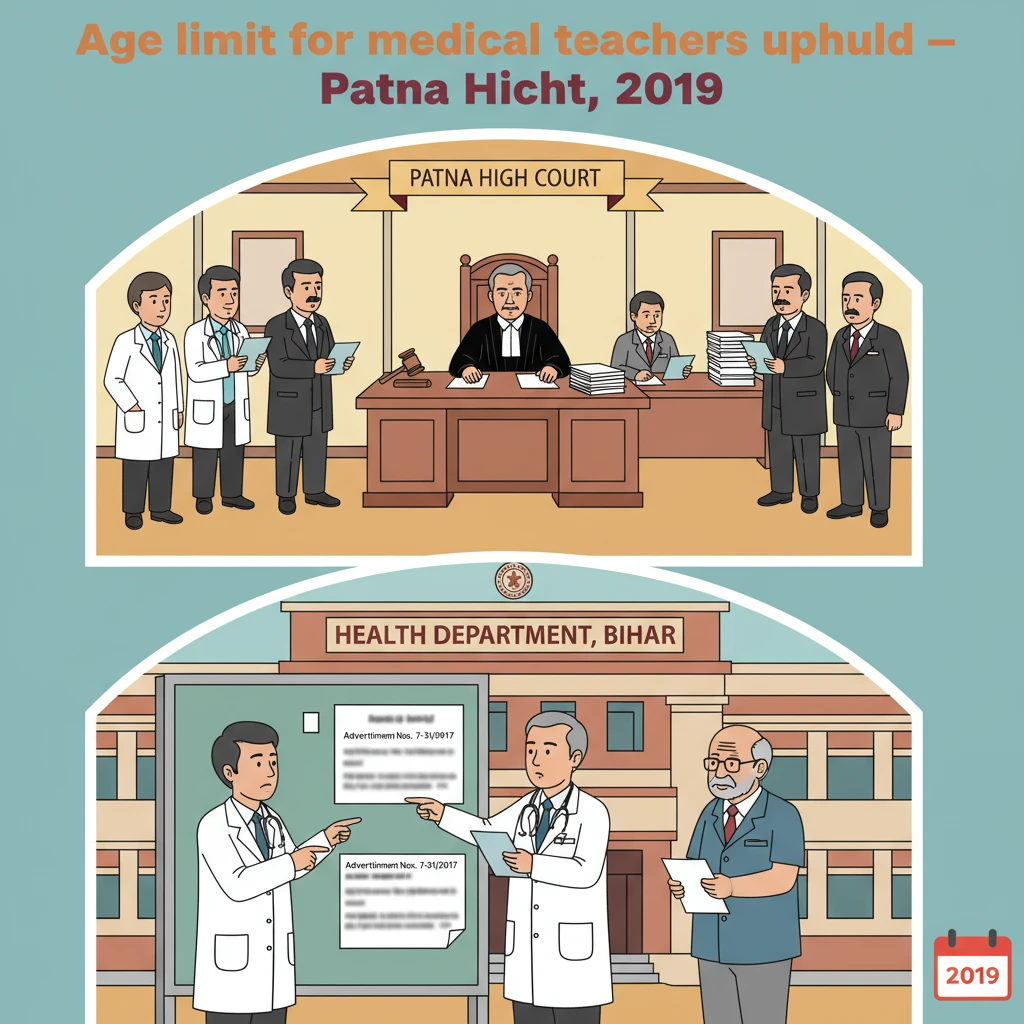
The judgment arises from a large batch of writ petitions and two Letters Patent Appeals heard together by the Patna High Court. All matters concerned recruitment to teaching posts in government medical colleges in Bihar.
The key dispute centred on the Senior Resident, Tutor and Bihar Medical Education Service Cadre Recruitment, Appointment and Promotion Rules, 2008, as amended by the 2013 Amendment Rules. These rules govern recruitment to posts like Assistant Professor, Associate Professor and Professor in the State’s medical colleges.
Originally, under the 1997 Bihar Medical Education Service Cadre and Cadre Post Appointment Rules, entry to the teaching cadre began at Lecturer level and the age limits followed the general rules for government servants. Resident Doctors and Registrars were part of the teaching cadre and designated as Lecturers.
In 2008, the State framed new rules which repealed the 1997 Rules. The 2008 Rules removed Resident Doctors and Registrars from the main teaching cadre and treated Senior Resident and Tutor posts as four-year “tenure teaching posts” outside the regular cadre. The regular cadre started from Assistant Professor upwards. Importantly, Rule 7(D) of the 2008 Rules stated that there would be no upper age bar for doctors already serving in the Bihar Health Service Cadre.
The 2013 Amendment Rules changed this position. A new clause under Rule 6 fixed the age limit for Senior Resident/Tutor in line with the general government age limits, with a five-year relaxation for doctors of the Bihar State Health Service Cadre. Simultaneously, Rule 7(D) was amended to introduce a maximum age for appointment as Assistant Professor: 45 years for unreserved, 48 years for BC/EBC, 48 years for women of all categories, 50 years for SC/ST, and 50 years for serving doctors of the Bihar Health Service Cadre.
In 2017, Bihar Public Service Commission (BPSC) issued Advertisement Nos. 7 to 31 of 2017 dated 24.04.2017, for 1171 posts of Assistant Professor. The advertisement followed the 2013 Rules and prescribed a maximum age of 50 years. A clause initially providing an extra five-year relaxation for Bihar Health Service doctors was later deleted through a corrigendum dated 03.05.2017.
Many petitioners were either serving as Senior Residents/Tutors or Assistant Professors on contract, or were doctors in the Bihar Health Service Cadre. Several had crossed the age of 50 years or would cross it soon. They approached the Court, contending that the 2013 amendment, and its use in the 2017 advertisement, illegally shut them out from regular recruitment.
What the Court Examined and Decided
The Division Bench (Hon’ble the Chief Justice Amreshwar Pratap Sahi and Hon’ble Justice Smt. Anjana Mishra) examined the evolution of rules from 1997 to 2013 in detail. The Court noted that the 1997 Rules had created a unified teaching cadre including Residents, Registrars, Lecturers, Assistant Professors and above, and had tied age limits to general government service rules. The 2008 Rules then restructured this by making Senior Residents and Tutors tenure posts outside the regular teaching cadre. Under these 2008 Rules, there was no upper age limit for Bihar Health Service doctors aspiring to become Assistant Professors.
The 2013 Amendment introduced age limits including the controversial 50-year cap for doctors in the Bihar Health Service Cadre seeking appointment as Assistant Professors. The petitioners attacked this cap as arbitrary, irrational and violative of Article 14 of the Constitution. They argued that:
- The State had itself advertised contractual posts of Assistant Professor in 2014 with a maximum age of 67 years, and many of them were appointed under those advertisements.
- The Medical Council of India allowed service up to 70 years, and therefore prescribing 50 years as entry age for Assistant Professor served no purpose.
- Due to delay in holding regular selections (advertisements having been issued only in 2002, 2011 and then 2017), many eligible doctors had crossed the age of 50. The State’s inaction in timely recruitment should not be used to deprive them of a fair chance.
- Since they had been continuously serving on contract as teachers and had gained the prescribed three years’ teaching experience, they should either be regularised or at least allowed age relaxation to participate in regular recruitment.
- The power of relaxation available to the Government under Article 309-based notifications of 1956, 1959 and 1962 should be exercised to remove the hardship caused by the age cap.
- The age limit created an unreasonable classification between similarly placed Bihar Health Service doctors who happened to be below 50 and those who were above 50 but otherwise equally, or more, qualified.
Some petitioners also alleged that reservation in certain subjects, such as Orthopaedics, had exceeded the 50% ceiling and therefore violated constitutional limits.
On the other side, the State, represented by the Advocate General, defended the 2013 Rules. The State argued that:
- Fixing an upper age limit is a policy decision within the rule-making power of the Government; it is meant to ensure that a new recruit has enough remaining service to progress through ranks—Assistant Professor, Associate Professor, Professor.
- The rules had been in force since 2013 and had not been challenged on grounds of legislative competence or inconsistency with any existing law.
- Delay in holding selections does not make the age cap arbitrary and does not create any vested or legitimate right in contractual appointees.
- Petitioners on contract had accepted specific terms; no promise of regularisation or age relaxation was ever made in their appointment orders.
- The power to relax rules is exceptional and cannot be claimed as a matter of right; no case of “undue hardship” in the legal sense was made out.
The Medical Council of India, which was a respondent in some petitions, filed affidavits stressing that minimum qualification and experience criteria under its regulations must be strictly followed for all appointments. However, it did not prescribe any maximum age for entry to Assistant Professor posts; that decision was left to the State.
The Court then addressed the legal issues step by step.
First, on the use of Heydon’s mischief rule and purposive interpretation (as urged through citations such as R.M.D. Chamarbaugwalla, Ram Krishna Dalmia, Shailesh Dhairyawan and D.S. Nakara), the Bench held that this rule applies where a later law seeks to remove a “mischief” created by an earlier law and where strict interpretation leads to absurdity or contradiction. In this case, there was no such mischief. Earlier there was no age bar, and the 2013 Rules introduced one simply as an eligibility condition. Introducing an age bar, by itself, is neither absurd nor incongruous. The mischief rule therefore had no application.
Second, the Court analysed whether contractual appointments gave the petitioners any enforceable right to regularisation or relaxation. It held that a legal right must be one recognised and protected by law. Contractual appointments in these cases were for fixed tenure, governed by terms agreed upon by both sides. There was no assurance of regular appointment or future relaxation in those contracts. Therefore, no vested or accrued right or even legitimate expectation to regularisation or age relaxation arose. A mere hope or aspiration cannot be equated with a legal right.
Third, on the power of relaxation and “undue hardship”, the Court reproduced the Government notifications under Article 309. It noted that relaxation is meant for very exceptional cases and where no specific relaxation clause exists in the concerned rules. Even then, the Government must consult the Appointment and Finance Departments and obtain approval of the Council of Ministers. Most importantly, the Court held that this power cannot be demanded as of right by individuals; it remains discretionary with the Government.
The Bench then examined whether the petitioners’ situation amounted to “undue hardship”. It held that hardship must be something more than ordinary inconvenience—it must be “that which is hard to bear” and creates an oppressive sense of injustice. The petitioners were not losing their livelihood; they continued as doctors in the Bihar Health Service Cadre. The age cap merely made them ineligible for teaching posts, not for their existing jobs. Thus, their complaint did not rise to the level of “undue hardship”.
Fourth, the Court evaluated the rationality of the 50-year age cap under Article 14. It held that the purpose of an age limit is to ensure that a person entering a service has enough years to render a reasonable period of service and to move up the promotional ladder. For Assistant Professors, the rules already required a minimum three-year teaching experience as Senior Resident/Tutor after post-graduation. A candidate had to acquire this experience before reaching the maximum age. This structure ensured a continuous teaching hierarchy and was not shown to be unreasonable or impracticable.
The fact that someone above 50 might also be a capable teacher did not make the chosen cut-off arbitrary. The Court observed that if such reasoning were accepted, even persons above 70 might claim exclusion as “undue hardship”. Age prescriptions and retirement ages in government service are based on broad policy and cannot be struck down merely because they are inconvenient to some individuals.
Fifth, the Court addressed the argument that delays in holding regular selections should justify relaxing the age bar. It accepted that delay deprived some doctors of an opportunity to seek better posts. But it noted that the rule treated all candidates equally; the State’s inaction in filling posts could not create a right in favour of a particular group to demand relaxation against a valid rule. A valid rule does not become unconstitutional simply because the Government was slow in applying it.
On the contention regarding excess reservation beyond 50%, particularly in Orthopaedics, the Court did not give a detailed ruling but directed that, while preparing the select list, the State must strictly follow reservation rules without crossing constitutional limits and should bear in mind the illustrations pointed out by counsel in CWJC No. 12945 of 2017.
Finally, the Court dealt with the Letters Patent Appeals. In LPA No. 919 of 2017, which challenged a single judge’s order refusing age relaxation to in-service doctors after withdrawal of an earlier five-year relaxation, the Bench found no fault with the single judge’s reasoning and dismissed the appeal.
LPA No. 407 of 2019 arose from CWJC No. 2434 of 2019, where the main challenge was also to the 2013 Rules and the 50-year age cap. Earlier, the Division Bench had already held that this appeal was maintainable. Since the core legal issues in that writ petition were identical to those decided in the present batch, the Bench allowed the appeal and dismissed the underlying writ petition on the same reasoning as in the other cases.
In conclusion, the Court held that the age cap of 50 years in the 2013 Rules did not suffer from lack of legislative competence, was not ultra vires any existing rule, and did not violate Article 14. There was no unreasonable classification or arbitrariness; the hardship pleaded was neither undue nor legally relevant. All writ petitions challenging the vires of the 2013 Rules were dismissed.
Why This Judgment Matters
This judgment is important for doctors in Bihar who wish to enter medical teaching in government colleges. The Patna High Court has clearly said that the upper age limit of 50 years for appointment as Assistant Professor is valid.
Doctors serving on contract as Senior Residents, Tutors or even contract Assistant Professors cannot claim a right to be regularised or to demand relaxation of age simply because they have been teaching for several years. Their contracts do not convert into permanent posts by themselves.
The ruling also warns that delayed recruitment by the Government, though unfortunate, does not by itself give candidates a legal right to bypass eligibility rules. Anyone planning a career in medical education must therefore keep the age limit in mind and plan their qualifications and experience accordingly.
At the same time, the Court has reminded the State to respect constitutional limits on reservation when preparing select lists, and has commented that the present mix of health service experience and teaching cadre rules might require a policy relook by the Government and the Medical Council of India.
Legal Issues and Answers
- Issue: Is the 50-year upper age limit for appointment as Assistant Professor in government medical colleges, as fixed by the 2013 Amendment Rules, arbitrary or violative of Article 14 of the Constitution?
Answer: No. The Court held that the age cap is a valid eligibility condition within the State’s rule-making power, has a rational purpose (ensuring adequate remaining service and promotional avenues), and does not create any unconstitutional classification. - Issue: Do contractual appointments of doctors as Senior Residents, Tutors or Assistant Professors create a right to regularisation or legitimate expectation of age relaxation for regular recruitment?
Answer: No. Contractual appointments are governed by their own terms and contain no promise of regularisation or future relaxation. They do not create any vested right or enforceable legitimate expectation to be absorbed or to receive age relaxation. - Issue: Can the Court compel the Government to exercise its power to relax service rules on the ground of “undue hardship” caused by delay in holding selections and the age cap?
Answer: No. The power of relaxation is discretionary, to be exercised only in exceptional cases by the Government. The Court found that the petitioners were not facing “undue hardship” in the legal sense, and therefore no mandamus could be issued directing relaxation.
Cases Cited by the Court
- R.M.D. Chamarbaugwalla and another v. Union of India and another, AIR 1957 SC 628 (cited by petitioners, discussed by Court).
- Shri Ram Krishna Dalmia v. Shri Justice S.R. Tendolkar and others, AIR 1958 SC 538 (cited on Article 14 and classification).
- Shailesh Dhairyawan v. Mohan Balkrishna Lulla, (2016) 3 SCC 619 (on purposive interpretation).
- D.S. Nakara v. Union of India, (1983) 1 SCC 305 (on classification, distinguished).
- GRIDCO Limited and another v. Sadananda Doloi and others, 2012 (1) PLJR SC 321 (on regularisation; held inapplicable).
- Ramesh Chandra Sankla and others v. Vikram Cement and others, (2008) 14 SCC 58 (cited by petitioners).
- Secretary, State of Karnataka and others v. Umadevi (3), (2006) 4 SCC 1 (relied on to reject claims of regularisation).
Case Details
Case Numbers:
- Civil Writ Jurisdiction Case No. 8149 of 2017 (lead matter)
- Letters Patent Appeal No. 407 of 2019 in CWJC No. 2434 of 2019
- CWJC Nos. 7748, 7531, 16113, 10410, 8413, 8388, 9202, 12397, 7973, 12945 of 2017
- Letters Patent Appeal No. 919 of 2017 in CWJC No. 6948 of 2017
Case Title (lead case): Dr. Kishore Kumar Das & Ors. v. The State of Bihar & Ors.
Citation: 2019 (3) PLJR 534
Coram:
- Hon’ble the Chief Justice Amreshwar Pratap Sahi
- Hon’ble Justice Smt. Anjana Mishra
Advocates:
- For petitioners in CWJC No. 8149 of 2017: Mr. Vinod Kumar Kanth, Sr. Advocate; Mr. Akashdeep, Advocate; Mr. Shyameshwar Kumar Singh, Advocate.
- For other petitioners in batch matters: Mr. Y.V. Giri, Sr. Advocate; Mr. P.K. Shahi, Sr. Advocate; Mr. D.K. Sinha, Sr. Advocate; Mr. Mukesh Kumar, Advocate; Mr. Vikas Kumar, Advocate; Mr. Rajesh Kumar Choudhary, Advocate; Mr. Rohit Mishra, Advocate; Mrs. Veena Kumari Jaiswal, Advocate; Mr. Vikash Kumar, Advocate; Mr. Upendra Prasad, Advocate; Mrs. Gunjita Gupta, Advocate; Mrs. Chandrakala Jaiswal, Advocate; Mr. Krishnakant Singh, Advocate; Mr. Anil Kumar Sinha, Advocate; Mr. Rakesh Kumar, Advocate.
- For the State of Bihar: Mr. Lalit Kishore, Advocate General; Mr. Anjani Kumar, AAG-4; Mr. P.N. Sahi, AAG-6; Mr. S.D. Yadav, AAG-9; Mr. Ramadhar Singh, G.P. 25; Mr. A.B. Sinha, G.A. VIII; Mr. Nagendra Kumar, Advocate; Mr. Shailendra Kumar Singh, Advocate; Mr. Amit Kumar Jha, Advocate; Mr. Ajay Behari Sinha, G.A. 8; Mr. Suryakant Kumar, A.C. to G.A. 8; Mr. Chitranjan Sinha, PAAG-2; Mrs. Ritni Kumari, A.C. to PAAG-2; Mr. Neeraj Kumar Sinha, A.C. to PAAG-2.
- For Bihar Public Service Commission: Mr. Sanjay Pandey, Advocate.
- For Medical Council of India: Mr. Kumar Brijnandan, Advocate; Mr. Tarees Hameed, Advocate.
- For certain respondents: Mr. Akashdeep, Advocate; Mr. Shyameshwar Kumar Singh, Advocate.
- For intervenor: Mr. Chaitanya Swaroop, Advocate; Mr. Anil Kumar Singh, Advocate; Mr. Surinder Kumar, Advocate; Mr. Md. Shamimul Hoda, Advocate.
Nature of Case: Multiple writ petitions under Article 226 of the Constitution challenging the validity of recruitment rules and age limits; connected Letters Patent Appeals against single judge orders in related recruitment disputes.
Date of Judgment: 02-07-2019 (uploaded 15.07.2019)
Link to Judgment: Full text of Patna High Court judgment (2019 (3) PLJR 534)
If you found this explanation helpful and wish to stay informed about
how legal developments may affect your rights in Bihar,
you may consider following Samvida Law Associates for more updates.







