
Case Background
The criminal case arises from Garkha P.S. Case No. 121 of 2018 in District Saran, Bihar. The case was registered under various provisions of the Indian Penal Code, including Section 376D, and under Sections 4 and 6 of the Protection of Children from Sexual Offences Act, 2012.
The allegation relates to commission of gang rape. One of the accused, later petitioner before the Patna High Court, claimed that he was a juvenile on the date of the alleged occurrence, 03.04.2018.
He stated that his date of birth is 08.04.2001. On this basis he asserted that on 03.04.2018 he had not completed 18 years of age and therefore he should be treated as a child in conflict with law under the Juvenile Justice (Care and Protection of Children) Act, 2015.
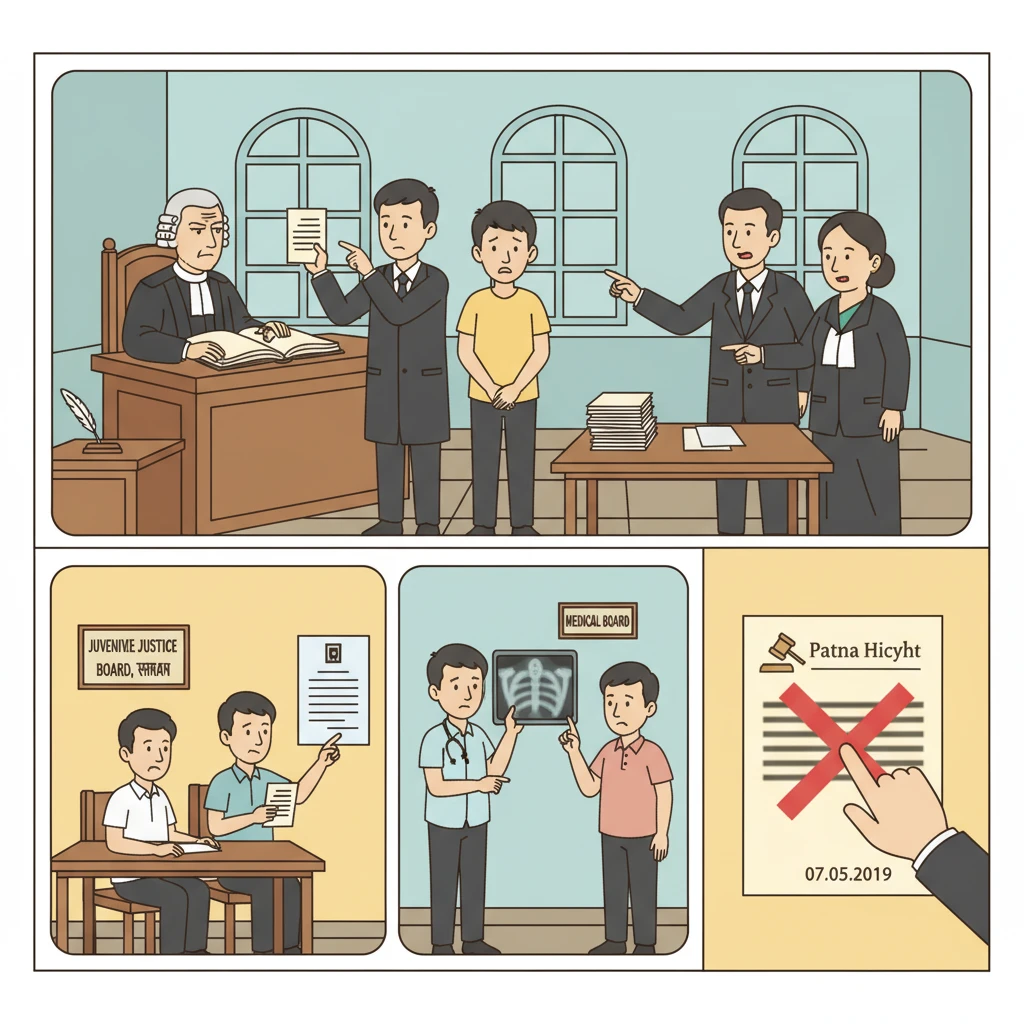
The question of his age first came before the Juvenile Justice Board, Saran, in J.J.B. Case No. 1430 of 2018. The Board passed an order on 11.07.2018 rejecting his claim of juvenility and treated him as an adult. Against this, he filed Criminal (Juvenile) Appeal No. 53 of 2018 before the Sessions Judge, Saran at Chapra. The appeal was heard by the 1st Additional Sessions Judge, Saran at Chapra, who dismissed it by judgment dated 27.10.2018.
Aggrieved, the accused approached the Patna High Court in Criminal Revision No. 1433 of 2018. The revision was heard and decided by Hon’ble Mr. Justice Birendra Kumar on 07.05.2019.
What the Court Examined and Decided
Before the Juvenile Justice Board, the petitioner had produced documents to show that he was below 18 years on the date of occurrence. These included a School Leaving Certificate issued by Primary School, Nagra, where he had studied from Class IV onwards, and the admit card for his 10th standard examination conducted by the Bihar School Examination Board.
According to these documents, his date of birth was 08.04.2001. However, the Juvenile Justice Board doubted the correctness of this entry. The Board’s doubt was mainly on the ground that there was no material on record explaining on what basis this date of birth had been entered in the School Admission Register, particularly when there was no record about the school where the petitioner studied in Class I to IV.
The Board asked the petitioner to produce the School Admission Register of the first school he attended. When he failed to do so, the Board referred him to a Medical Board for age determination. The Medical Board opined that the petitioner was about 22 years of age.
Relying on this medical opinion, the Juvenile Justice Board rejected the claim of juvenility. While doing so, it placed reliance on an earlier order of the Patna High Court dated 02.02.2017 passed in Criminal Revision No. 259 of 2016, Vijay Kumar Singh vs. The State of Bihar. In that earlier case, the High Court had held that when school documents appear to be forged or fabricated, the authorities may resort to medical opinion for age determination.
In Vijay Kumar Singh’s case, the person claiming juvenility had appeared in the matriculation examination more than once and had disclosed different dates of birth each time. Because of this inconsistency, the Court doubted the entry in the matriculation certificate and allowed reliance on medical opinion.
In the present case, the Sessions Court, hearing Criminal (Juvenile) Appeal No. 53 of 2018, agreed with the Juvenile Justice Board. The appellate court also accepted the Medical Board’s opinion and dismissed the appeal on 27.10.2018.
Before the Patna High Court, the petitioner argued that both the Juvenile Justice Board and the appellate court had ignored the clear mandate of Section 94 of the Juvenile Justice (Care and Protection of Children) Act, 2015 regarding determination of age. He submitted that he had passed the Secondary School Examination conducted by the Bihar School Examination Board, Patna and that his date of birth as recorded in the matriculation certificate is 08.04.2001, which matches the entries in the School Leaving Certificate and School Admission Register.
The petitioner further explained that at the time when the Juvenile Justice Board was considering his age, the result of the matriculation examination had not yet been declared. Therefore, the provisional certificate was not available and could not be produced before the Board.
His counsel argued that the School Leaving Certificate and the admit card were genuine documents. Hence, under Section 94 of the 2015 Act, the Board should have relied on them and should not have sent him for medical age determination.
On the other hand, counsel for the informant supported the orders of the courts below. He pointed out that the Headmaster of the Primary School, who appeared before the Board, had specifically stated that he did not know on what basis the date of birth entry in the School Register was made. Because of this lack of knowledge, the Board doubted the correctness of the school record.
He also emphasised that the Medical Board had assessed the petitioner’s age as 22 years – a large gap from the age claimed as that of a juvenile. Therefore, he submitted, the orders of the Juvenile Justice Board and the appellate court could not be faulted.
The Patna High Court examined Section 94 of the Juvenile Justice (Care and Protection of Children) Act, 2015 in detail. Sub-section (2) of Section 94 lays down a clear order of priority for age determination when there is doubt whether a person is a child.
First, the Committee or the Board must seek evidence by obtaining the date of birth certificate from the school, or the matriculation or equivalent certificate from the concerned examination board, if available. Only when such certificates are not available, the authority may look for a birth certificate issued by a corporation, municipal authority or panchayat. It is only in the absence of both types of documentary evidence that age may be determined by an ossification test or other medical tests.
The Court emphasised that, according to the statute, medical examination is a last resort and cannot be the first option when school or matriculation records exist.
Applying this legal framework to the present case, the Court noted that the petitioner had produced a certificate from the school showing his date of birth. This certificate had been verified from the School Admission Register.
The Court held that this certificate should not have been doubted merely because there was no material to show the source of information regarding date of birth. The Court observed that, in usual practice, it is the parents who inform the school about the date of birth of their child. The parents are the most competent persons to disclose such information based on their personal knowledge. It is for the school to record whether the information came from the parents or otherwise.
The Court also took note of the petitioner’s statement that he had meanwhile passed the matriculation examination and was in possession of the provisional certificate issued by the Bihar School Examination Board. The Court held that the Juvenile Justice Board ought to have verified the genuineness of this matriculation certificate.
Once such a matriculation certificate is found to be genuine, Section 94 of the 2015 Act mandates that the Board is bound to accept it for determination of age. In that situation, the Board would have no option but to rely on the date of birth mentioned in the matriculation certificate and cannot go for medical age determination.
On this reasoning, the High Court concluded that the impugned order dated 11.07.2018 passed by the Juvenile Justice Board, Saran in J.J.B. Case No. 1430 of 2018, as well as the order dated 27.10.2018 passed by the 1st Additional Sessions Judge, Saran at Chapra in Criminal (Juvenile Appeal) No. 53 of 2018, were not sustainable in law. Both orders were contrary to the mandatory scheme of Section 94 of the Juvenile Justice Act, 2015.
The Court therefore set aside both orders and remitted the matter back to the Juvenile Justice Board for fresh determination of the petitioner’s age strictly in accordance with law.
The High Court directed that the petitioner shall produce his matriculation certificate before the Juvenile Justice Board. The Board may then verify its genuineness from the Bihar School Examination Board. Only if the Board finds that the certificate is incorrect for any reason may it resort to medical opinion for age determination.
With these observations, the criminal revision was allowed.
Why This Judgment Matters
This judgment is important for anyone accused in a criminal case who claims to be a minor, especially in serious offences like gang rape and cases under the POCSO Act.
The Patna High Court has made it clear that authorities cannot skip school and matriculation records and directly send a person for medical age testing when such documents exist. Medical tests can be used only as a last option.
For juveniles and their families, this decision underlines the value of school records and matriculation certificates. If these documents are genuine, the Juvenile Justice Board has to give them first importance.
For Juvenile Justice Boards and police, the ruling is a reminder that Section 94 of the Juvenile Justice Act, 2015 is mandatory. Ignoring it can lead to their orders being set aside in revision or appeal.
Legal Issues and Answers
- Issue: Whether the Juvenile Justice Board and the appellate court were justified in rejecting the petitioner’s claim of juvenility by relying on medical opinion instead of school and matriculation records.
Answer: No. The Patna High Court held that, under Section 94 of the Juvenile Justice (Care and Protection of Children) Act, 2015, school and matriculation certificates must be considered first. Only if such documents are unavailable or found incorrect after verification can medical opinion be used. - Issue: What procedure should the Juvenile Justice Board follow for fresh determination of the petitioner’s age.
Answer: The petitioner must produce his matriculation certificate; the Board should verify its genuineness from the Bihar School Examination Board. If found correct, the Board must accept the age mentioned therein. Only if the certificate is found incorrect may the Board seek opinion of the Medical Board.
Cases Cited by the Court
- The Court referred to its earlier order dated 02.02.2017 in Criminal Revision No. 259 of 2016, Vijay Kumar Singh vs. The State of Bihar, but held that the facts of that case were different and that decision did not apply here.
Case Details
Case Number: Criminal Revision No. 1433 of 2018; arising out of Garkha P.S. Case No. 121 of 2018, District Saran.
Case Title: Niraj Kumar vs. The State of Bihar & Anr.
Coram: Hon’ble Mr. Justice Birendra Kumar.
Date of Judgment: 07.05.2019.
Citation: 2019 (3) 477.
Advocates: Mr. Nawal Kishore Singh for the petitioner; Mr. Md. Sufiyan for the respondent.
Nature of the Case: Criminal revision against dismissal of juvenile appeal and against order of Juvenile Justice Board on age determination in a case under Section 376D of the Indian Penal Code and Sections 4/6 of the Protection of Children from Sexual Offences Act, 2012.
Link to Judgment: https://patnahighcourt.gov.in/viewjudgment/NyMxNDMzIzIwMTgjMSNO-L6–ak1–zK3y–ak1–ePQ=
If you found this explanation helpful and wish to stay informed about
how legal developments may affect your rights in Bihar,
you may consider following Samvida Law Associates for more updates.







