
Case Background
This case arose from Sasaram Rail P.S. Case No. 84 of 2015, registered on 20.07.2015 under the Narcotic Drugs and Psychotropic Substances Act, 1985 and Section 147 of the Railways Act. The FIR was based on the self-statement of Sub-Inspector Yogendra Kumar (PW-5), posted at Sasaram Railway Police Station.
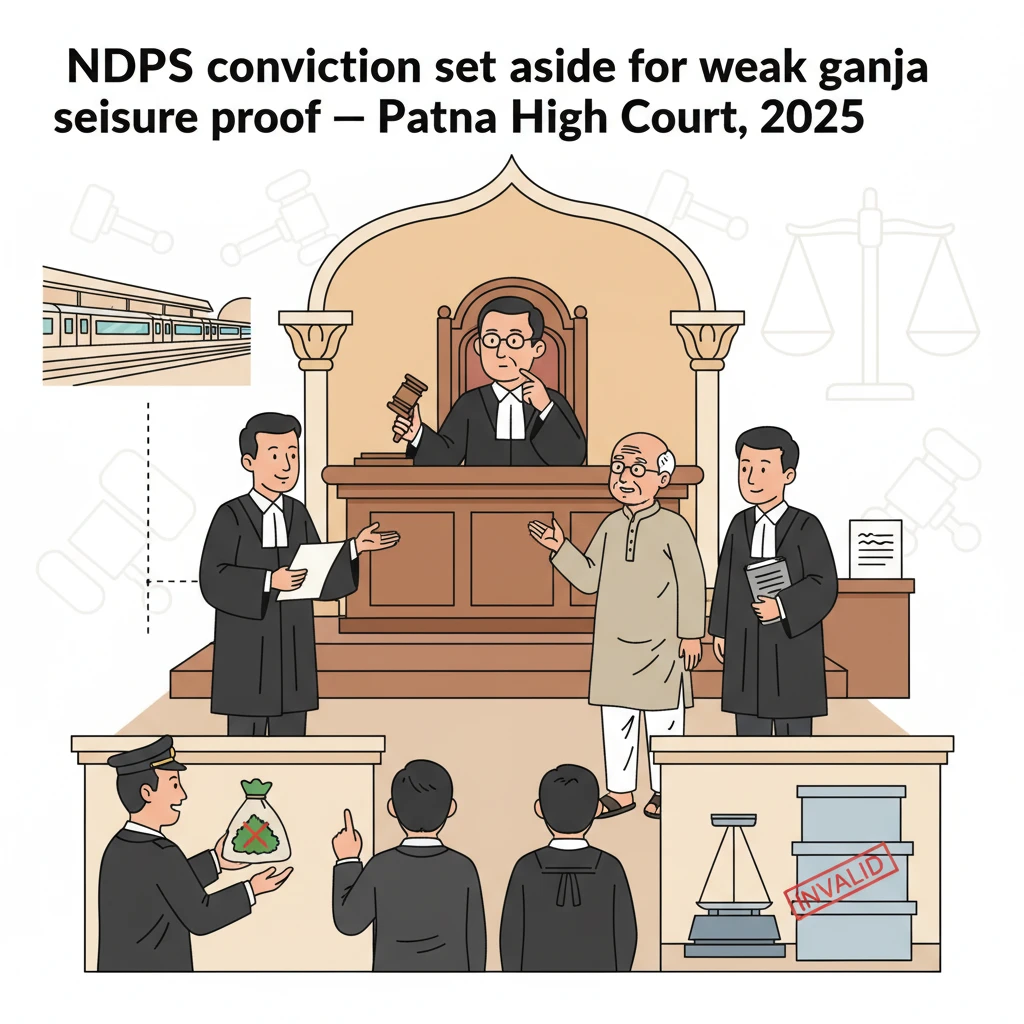
On 20.07.2015, there was a “band” call by political parties. At about 8:30 hours, the informant, other police personnel and a Magistrate were on checking duty at platform nos. 3 and 4 of Sasaram Railway Station. Around 9:45 a.m., train no. 12988 (Ajmer–Sealdah Express) arrived on the down line. From the general bogie, two passengers, one elderly and one young, came out carrying new steel boxes on their heads.
According to the prosecution, both left the boxes on the platform and proceeded towards the north-east side. The police chased and apprehended them. On being stopped, they first said the boxes contained cloth and refused to open them. When pressed, they allegedly admitted that the boxes contained ganja. On opening, ganja wrapped in cloth, kept in several small and big plastic packets and covered with a jute sack, was allegedly recovered.
The police claimed that neither any document for lawful possession of ganja nor any railway ticket was produced by the accused. They were identified as Baijnath Sao and Sonu Kumar (the appellant). A weighing machine was brought from the parcel house, and in presence of Magistrate Veer Bahadur (PW-6) and police personnel, the ganja in the two boxes was weighed. One box was found to contain 15 kg and the other 20 kg of ganja; the 20 kg was attributed to the appellant’s box.
Seizure list was said to have been prepared on the platform itself in presence of the Magistrate, police personnel and two independent witnesses, and signatures of the accused and witnesses were allegedly taken. The accused allegedly disclosed they were bringing ganja from Tundla (Uttar Pradesh) to their house at Dehri for sale.
On this written report, Sasaram Rail P.S. Case No. 84 of 2015 was registered under Sections 21 and 22 of the NDPS Act and Section 147 of the Railways Act. After investigation, charge-sheet no. 101 of 2015 dated 15.10.2015 was submitted under Sections 20 and 22 of the NDPS Act and Section 147 of the Railways Act against both accused. Cognizance was taken on 04.11.2015 by the Sessions Judge, Gaya.
On 18.01.2016, charges were framed under Sections 20 and 22 of the NDPS Act. After the prosecution evidence, the appellant’s statement under Section 313 Cr.P.C. was recorded on 22.11.2017; he denied the prosecution case and claimed innocence. The trial court, in NDPS Case No. 18 of 2015, convicted him and sentenced him to 15 years’ rigorous imprisonment and fine of Rs. 1,00,000/-, with two years’ further R.I. in default, both sentences to run concurrently.
During the pendency of a connected appeal (Cr. APP (DB) No. 259 of 2018) by co-accused Baijnath Sao, he died and that appeal abated on 16.06.2025. The present Criminal Appeal (DB) No. 453 of 2018 by Sonu Kumar came before a Division Bench of the Patna High Court, which delivered judgment on 22.07.2025.
What the Court Examined and Decided
The appellant challenged the conviction primarily on the ground that mandatory and important procedural safeguards under the NDPS Act had not been followed. His counsel argued that the way the samples were collected and sent to the Forensic Science Laboratory (FSL) did not comply with the Act. He also pointed out that no independent witness was examined, although the seizure allegedly took place on a crowded platform of Sasaram Railway Station.
It was argued that there was no reliable evidence regarding weighing of the seized ganja, no railway employee was examined about the weighing at the parcel office, and the prosecution failed to prove beyond reasonable doubt that 20 kg of ganja was recovered from the appellant’s physical possession.
The State’s counsel supported the trial court’s decision, submitting that the court had correctly appreciated oral and documentary evidence and that the conviction should be upheld.
The High Court closely scrutinised the six prosecution witnesses and the documentary exhibits.
PW-1, Investigating Officer Shambhu Narayan Singh, stated that he received the investigation on 20.07.2015, recorded statements, inspected the eastern part of platforms 3 and 4, collected antecedents of the accused, and sent the seized contraband to FSL, Patna. He proved the forwarding letter as Exhibit-1 and said he filed charge-sheet under Sections 20 and 22 of the NDPS Act.
However, in cross-examination, PW-1 admitted that the seized articles were not at the place of occurrence but had been brought to the police station. He was not part of the raiding party. Importantly, he stated that during his entire investigation he did not record the statement of any independent witness. He further stated that he had not received the seized articles in sealed form from the Station House Officer, but received two locked steel boxes with keys. He was unaware about preparation of seizure list copies and admitted that the seizure list bore only the signature of a sipahi, with no independent witness. He also stated that the seized contraband was not produced in court and remained in the malkhana, and no malkhana document was produced.
PW-2, constable Ram Singh, broadly supported the informant’s version. He said that from one box 20 kg and from the other 15 kg of ganja were recovered, and that seizure list was prepared on the platform. He identified his signature on the seizure list as Exhibit-2.
In cross-examination, PW-2 admitted he did not know the appellant earlier, that weighing was done at the parcel department but no voucher was available, and he did not know whether a copy of the seizure list was given to the accused. He acknowledged that only he and another sipahi signed the seizure list, there was no case number on the box, and the seizure took place on a busy platform where other persons were present.
PW-3, Ajay Kumar, also repeated the prosecution version. In cross-examination, he admitted that the seized articles were not before him in court, the parcel office was on platform no. 2, and he himself had not signed anywhere. He confirmed that no document was found in the box to connect it with the appellant, and that samples taken from the contraband did not bear the appellant’s signature. Nothing was recovered from the appellant’s body.
PW-4, Vinay Kumar Rai, said he was on platform duty at 9:54 a.m. on 20.07.2015 and otherwise repeated the informant’s narrative. In cross-examination, he admitted he did not sign the seizure list, that the seized article was not produced in court, that he had not counted the packets of ganja, and that no document was found to show the box belonged to the appellant.
PW-5, informant Yogendra Kumar, supported his self-statement in chief. In cross-examination, he stated that no written consent was taken from the appellant before search. He had not counted the packets of contraband, and the ganja was sealed in the box. He said samples were taken but could not say from how many packets. He admitted that all procedures of seizure and search were said to be complied before the Magistrate but no permission was taken from the Magistrate, and that there was no object in the box linking it to the appellant.
PW-6, Magistrate Veer Bahadur Singh, stated that due to “band” call he was deputed as Magistrate at the railway station, that two people were apprehended by RPF and search was conducted before him, and that 20 kg contraband was recovered from the appellant’s box. In cross-examination, he admitted he did not have with him any authority letter showing he was Magistrate at that time and that all packets were not opened before him; only some were opened and seen.
The Court then examined Section 52A of the NDPS Act, which deals with disposal of seized narcotic drugs and prescribes procedures for inventory, photographs and drawing of representative samples in presence of a Magistrate. It relied on the recent Supreme Court judgment in Bharat Aambale v. State of Chhattisgarh, 2025 INSC 78, which summarises the law on Section 52A and emphasises that:
- Section 52A, though for disposal, also introduces vital procedural safeguards.
- Mere drawing of samples in presence of a gazetted officer is not enough; the mandate of Section 52A(2) must be substantially complied with.
- Non-compliance is not automatically fatal but can lead to adverse inference when it creates doubt about the physical evidence.
- Once the accused shows foundational facts of non-compliance, the burden shifts to the prosecution to show substantial compliance or that non-compliance does not affect its case.
Applying these principles, the High Court listed several serious infirmities in the prosecution case:
- One seizure list witness (Santosh Kumar, also a sipahi) was not examined.
- No independent witness to the seizure, despite the occurrence being on a public platform.
- The seizure list did not mention the number of packets or independent weight of each packet.
- Although the trial court order sheet mentioned that a Magistrate (ACJM, Gaya) was appointed for sample-taking and sealing, no witness clearly proved that sampling was done as per Section 52A procedure.
- Only two samples (marked A and B) in plastic jars were sent to FSL, with no clarity on how many packets were there or from which packets these samples were drawn.
- The seized contraband itself was never produced before the trial court as material exhibit.
- No malkhana records were produced to show safe custody.
- No document or article was found in the box to connect it with the appellant.
The Court then referred to two Supreme Court decisions which stress the importance of producing the seized contraband or properly connecting the sample with what was seized. In Vijay Pandey v. State of Uttar Pradesh, (2019) 18 SCC 215, the Supreme Court held that mere production of a lab report is not sufficient; the sample tested must be correlated with the substance seized from the accused. If the seized material is not produced and no explanation is given, mere oral evidence is not enough.
Similarly, in Gorakh Nath Prasad v. State of Bihar, AIR 2018 SC 704, the Supreme Court held that when the alleged narcotic powder was never produced as a material exhibit and there was no explanation, there was no evidence to connect the forensic report with the substance allegedly seized from the accused.
Following these rulings, the Patna High Court held that in this case too there was no evidence to link the FSL report (Exhibit-6) with the actual substance seized from the appellant. Only two samples were sent, while the alleged recovery involved many packets; the number of packets was not disclosed, and sampling from each packet was not proved. The seized ganja itself was never produced in court. Section 52A procedure was not shown to have been followed.
In view of these gaps, the Court concluded that the prosecution had failed to prove the foundational facts of proper seizure, safe custody and proper sampling. Therefore, the conviction based on presumption and FSL report alone could not stand.
The Division Bench held that the trial court committed a grave error in convicting the appellant under Sections 20 and 22 of the NDPS Act. It set aside the judgment of conviction dated 20.12.2017 and the order of sentence dated 02.01.2018 passed by the Additional District Judge 1st, Gaya, in NDPS Case No. 18 of 2015. The appellant, who was in custody, was directed to be released forthwith if not wanted in any other case. The appeal was allowed, and the trial court records were ordered to be sent back.
Why This Judgment Matters
This judgment is significant for accused persons and investigating agencies in NDPS cases, especially in Bihar. The Patna High Court has made it clear that harsh punishments under the NDPS Act cannot be sustained on weak procedural compliance.
For people facing similar allegations, the decision shows that courts will insist on concrete proof that the substance tested in the lab is the same one seized from the accused. If the seized ganja is never produced in court, if there is no clear record of how many packets were seized, how they were weighed, from which packets samples were drawn, and whether the process involved a Magistrate as required, then benefit of doubt will go to the accused.
For police and prosecution, the case underlines that NDPS investigations must be meticulous. Seizure lists should clearly record number of packets and weight; independent witnesses should be examined where available; malkhana records should be kept and produced; and Section 52A procedures should be substantially followed and proved through evidence.
In practical terms, this Patna High Court ruling protects against wrongful conviction in NDPS matters based only on official versions and unlinked FSL reports. It reinforces that strict law also demands strict proof.
Legal Issues and Answers
-
Issue: Whether the prosecution proved beyond reasonable doubt that 20 kg of ganja was recovered from the appellant and that sampling and seizure procedures under the NDPS Act, particularly Section 52A, were duly followed.
Answer: No. The Court held that the prosecution failed to establish proper seizure, safe custody, lawful sampling and connection between the seized material and the FSL report. Foundational facts were not proved, so the conviction could not be sustained. -
Issue: Whether non-production of the seized contraband in court and absence of independent witnesses vitiated the conviction under Sections 20 and 22 of the NDPS Act.
Answer: Yes. Relying on Supreme Court precedents, the Court held that failure to produce the seized material and non-examination of independent witnesses created serious doubt, entitling the appellant to benefit of doubt. -
Issue: Whether non-compliance with Section 52A of the NDPS Act and related procedures justified interference with the trial court’s conviction.
Answer: Yes. The Court found that Section 52A was not followed and the prosecution could not show substantial compliance. Combined with other infirmities, this required setting aside the conviction and sentence.
Cases Cited by the Court
- Bharat Aambale v. State of Chhattisgarh, 2025 INSC 78
- Vijay Pandey v. State of Uttar Pradesh, (2019) 18 SCC 215
- Vijay Jain v. State of M.P. (referred within Vijay Pandey)
- Ashok (referred within Vijay Pandey)
- Gorakh Nath Prasad v. State of Bihar, AIR 2018 SC 704
Case Details
Case Number: Criminal Appeal (DB) No. 453 of 2018; arising out of Sasaram Rail P.S. Case No. 84 of 2015; NDPS Case No. 18 of 2015
Case Title: Sonu Kumar v. The State of Bihar
Citation: 2025 (4) PLJR 69
Court: High Court of Judicature at Patna
Coram: Hon’ble Mr. Justice Mohit Kumar Shah; Hon’ble Mr. Justice Ashok Kumar Pandey (Oral Judgment by Hon’ble Mr. Justice Ashok Kumar Pandey)
Date of High Court Judgment: 22.07.2025
Trial Court: Court of the Additional District Judge-1st, Gaya
Offences Alleged: Sections 20 and 22 of the NDPS Act, 1985; Section 147 of the Railways Act (as per FIR and charge-sheet)
Trial Court Outcome: Conviction under Sections 20 and 22 of the NDPS Act; sentence of 15 years’ rigorous imprisonment and fine of Rs. 1,00,000/-, with two years’ further R.I. in default; sentences to run concurrently
High Court Outcome: Conviction and sentence set aside; appellant acquitted of all charges; directed to be released forthwith if not wanted in any other case
Advocates:
- For the Appellant: Mr. Suraj Narain Yadav, Advocate; Mr. Chandra Mohan, Advocate; Mr. Masoom Alam, Advocate
- For the State: Mr. Ajay Mishra, Additional Public Prosecutor
Nature of the Case: Criminal appeal (Division Bench) under Section 374(2) Cr.P.C. against judgment of conviction and order of sentence in an NDPS case
Link to Judgment: Patna High Court Judgment – Criminal Appeal (DB) No. 453 of 2018
If you found this explanation helpful and wish to stay informed about how legal developments may affect your rights in Bihar, you may consider following Samvida Law Associates for more updates.







