
Case Background
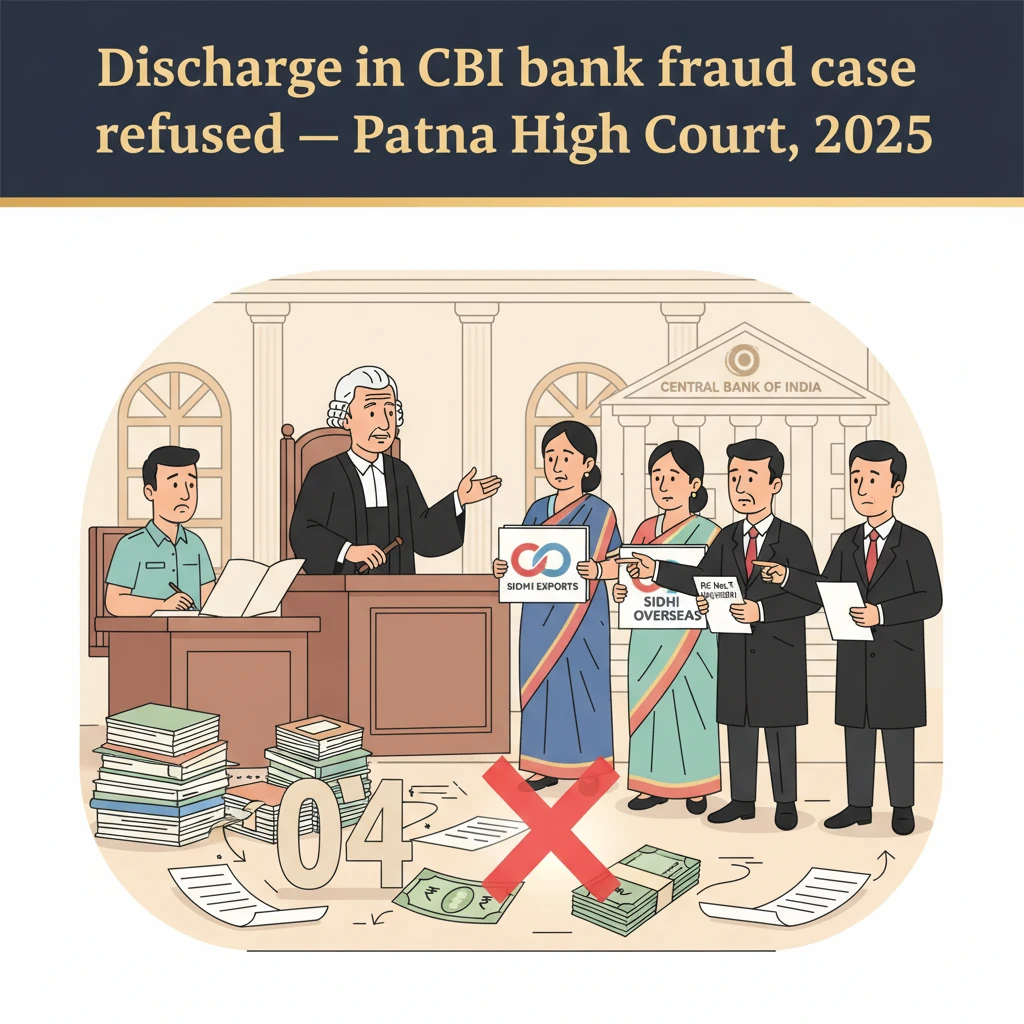
These three connected criminal miscellaneous cases arose from one CBI case: R.C. No.7(A) of 2001 relating to the Central Bank of India, Main Branch, Patna.
The petitioner in Criminal Miscellaneous No.51238 of 2015 is a bank officer of Central Bank of India. The petitioner in Criminal Miscellaneous No.52233 of 2015 is his wife and a Director of M/s. Sidhi Exports Private Limited. The petitioner in Criminal Miscellaneous No.51868 of 2015 is his brother-in-law and a Director of M/s. Sidhi Overseas Private Limited.
A CBI FIR was registered on 29.05.2001 as R.C. No.7(A) of 2001 on the basis of “source information”. It related to transactions between Central Bank of India and two export firms linked to the petitioners.
After investigation, the CBI filed two charge-sheets on 08.07.2004. Charge Sheet No.16/2004 was against the bank officer, the then Branch Manager and two Directors of M/s. Sidhi Overseas Private Limited. Charge Sheet No.17/2004 was against the same bank officer, the Branch Manager and the Director of M/s. Sidhi Exports Private Limited.
The case was numbered as Special Case No.101 of 2011 before the Special Judge, CBI-I, Patna. The petitioners filed discharge petitions, asking the trial court to drop the criminal case at the threshold. On 28.09.2015, the Special Judge rejected those discharge applications.
Aggrieved by that order, all three petitioners approached the Patna High Court under Section 482 of the Code of Criminal Procedure, 1973. Since they all challenged the same discharge order, the High Court heard them together and decided them by a common judgment dated 16.05.2025.
What the Court Examined and Decided
The core allegation in the prosecution case is that the bank officer, while working as Manager/Scale-II officer in Central Bank of India, misused his official position and, in conspiracy with his relatives and a colleague, enabled two related export companies to obtain huge wrongful financial benefits from the bank.
The FIR and investigation alleged that he sanctioned or facilitated pre-shipment and post-shipment advances and other facilities to firms belonging to his wife and brother-in-law, beyond his and the Branch Manager’s powers and against bank norms. The CBI claimed this caused wrongful loss of Rs.368.56 lakhs to the bank in total, with specific components of Rs.148 lakhs, Rs.80.93 lakhs, Rs.91.50 lakhs and Rs.69.13 lakhs mentioned in different transactions.
There were also allegations of forgery and falsification of bank records, such as altering original dates on loan documents and forwarding letters, altering entries in computer records, debiting a non-existent loan account, and accepting or relying on altered G.R. forms for export bills.
One important part of the case relates to an overdraft facility given to M/s. Sidhi Exports Private Limited. According to the CBI’s counter affidavit, this overdraft was sanctioned by the then Branch Manager, Pandey Arun Kumar Srivastava, between 26.10.1999 and 09.09.2000 without power and against the interest of the bank, to a staff-related account operated singly by the bank officer’s wife.
The CBI maintains that:
- The Branch Manager repeatedly allowed withdrawals beyond the sanctioned overdraft limit.
- On 14.03.2000, when debit balance reached about Rs.28.71 lakhs, he enhanced the overdraft limit in the computer to Rs.27.9 lakhs without any formal processing, allegedly to hide earlier illegal overdrawings.
- By 03.07.2000, the debit balance had risen to Rs.46,19,506/-, largely through withdrawals by the bank officer’s wife, with the Branch Manager’s approval.
- To wipe out these fraudulent overdrafts, the bank officer allegedly transferred Rs.148 lakhs from a current deposit nominal account to the firm’s overdraft account and falsified the bank accounts.
With respect to M/s. Sidhi Overseas Private Limited, the CBI alleged that:
- Pre-shipment and post-shipment advances were sanctioned beyond the Branch Manager’s lending powers.
- Heavy overdrawings were allowed in packing credit accounts.
- Foreign outward bill for collection advances were allowed in an unauthorised manner, causing wrongful gain of large amounts to the firm.
- False credit entries, including an entry of Rs.19 lakhs on 16.08.1999 by debiting a non-existent “Other Term Loan” account, were made to conceal overdrawings.
The petitioners, through common and individual submissions, tried to portray the dispute as purely civil, arising from normal debtor–creditor relations between the bank and the firms.
They argued that:
- The bank had entered into regular loan transactions with the firms and there was no real loss to the bank because the dues were later recovered.
- Title Suit No.88 of 2001 had been filed by M/s. Siddhi Export Private Limited representatives against the bank, even before the FIR, alleging that biased bank officers obstructed exports and held up bills.
- The bank itself filed a recovery action (O.A. No.28 of 2003) before the Debts Recovery Tribunal (DRT), Patna, against M/s. Siddhi Overseas Private Limited for Rs.3,56,57,117/- and another case (O.A. No.21 of 2004) against M/s. Siddhi Export Private Limited for Rs.1,69,67,676/-.
- Both DRT cases ended in compromise, with the firms paying the entire due loan amount after adjusting amounts received from foreign buyers, fully satisfying the bank’s loan.
On that basis, they claimed that once the civil disputes were settled and the bank recovered its money, no criminal proceedings should continue on the same facts. They relied on several Supreme Court and Patna High Court judgments where criminal cases arising out of civil or contractual disputes were quashed, especially when parties had settled.
Individually, the bank officer argued that:
- The alleged period of occurrence (August 1999 to December 2000) related to the Main Branch, Patna, whereas he claims he was not posted there at that time.
- He was not the sanctioning authority for the loans, did not stand as guarantor, did not provide collateral, and only processed proposals as per export manual.
- Officers’ Duty Register and some internal communications were not seized or considered by the investigating officer, which could have supported his defence.
The Director-brother-in-law argued that:
- No bank complaint or audit report alleged forgery or fraud in the firm’s accounts.
- There was unexplained delay in lodging the FIR.
- Loan was granted through formal packing credit agreements, and no false documents by him had been identified.
The Director-wife argued that:
- She was not the Director in charge of the firm’s management and had been falsely roped in.
- The export bill alleged to be forged did not contain her writing or signature and no expert examination was done.
- The export business had adequate collateral; the bank had wrongly recalled bills and obstructed realisation of export proceeds.
On the other side, the CBI stressed that:
- Investigations showed a pattern of conspiracy between the bank officers and the firms’ Directors to misuse bank funds.
- The bank suffered wrongful loss of Rs.241.56 lakhs due to these actions.
- Charges have already been framed and the stage of the case has advanced; at this stage, discharge is not appropriate.
The Patna High Court carefully reviewed the law on discharge and the use of Section 482 CrPC. It noted that at the discharge stage, the court is only to see whether there is sufficient ground to proceed, assuming the prosecution material to be true. The court must not conduct a “mini trial”, weigh defence evidence, or deeply analyse probabilities.
The Court relied on Supreme Court decisions including State of Odisha v. Devendra Nath Padhi, CBI v. Aryan Singh, P. Vijayan v. State of Kerala, State of Gujarat v. Dilipsinh Kishoresinh Sao, and others. These cases make it clear that:
- The defence material produced by the accused is not to be considered at the stage of framing charge or discharge.
- The court must proceed on the basis of the prosecution’s case record.
- If on that material, a strong prima facie case is made out, the matter must go to trial.
The Court also examined the petitioners’ argument that compromise in DRT and repayment of loans should result in quashing the criminal case. For this, it discussed Supreme Court judgments like CBI v. Jagjit Singh and Anil Bhavarlal Jain v. State of Maharashtra, and earlier cases like Gian Singh and Parbatbhai Aahir.
The High Court highlighted the Supreme Court’s approach that:
- Economic offences involving bank funds and public money are different from private civil disputes.
- Such offences have a harmful effect on society and involve moral turpitude, particularly when committed by public servants.
- Settlement or compromise with the bank, or recovery of dues through DRT, does not automatically justify quashing of criminal proceedings.
- Offences under the Prevention of Corruption Act or serious economic offences should not be quashed merely because parties have settled.
Applying these principles, the Patna High Court held that the present case involved allegations of cheating, forgery, abuse of official position, and misappropriation of bank funds through conspiracy between bank officers and related borrowers. Merely because the bank recovered its money through DRT compromises could not erase the alleged criminality.
The Court further held that the petitioners had not shown that the allegations were totally groundless. The materials collected by the CBI, if taken at face value, clearly disclosed ingredients of serious offences affecting the financial system.
Thus, the Court concluded that:
- There was no illegality or irregularity in the Special Judge’s order dated 28.09.2015 rejecting discharge.
- The stage for evaluating defence and conducting a detailed appreciation of evidence would come only at trial.
- It would be wrong to use Section 482 CrPC to short-circuit a full trial in such an economic offence case.
Accordingly, the High Court dismissed all three criminal miscellaneous applications and affirmed the impugned order of the Special Judge, CBI-I, Patna. The criminal proceedings and trial against the petitioners will continue.
Why This Judgment Matters
This judgment is important for both bank officials and borrowers, especially those involved in export business and large credit facilities.
First, it clearly shows that even if loan disputes are settled before the Debts Recovery Tribunal and the bank’s financial loss is recovered, criminal cases for alleged fraud, cheating or misuse of official position do not automatically end.
Second, for bank staff, the judgment underlines that staff-related accounts and facilities extended to relatives will be closely scrutinised. Any overdrafts or credit given beyond powers, especially without proper documentation and in violation of bank norms, can lead to CBI investigation and criminal trial, regardless of later civil settlements.
Third, for borrowers, even those who fully repay their loans, if the loan was allegedly obtained through conspiracy with bank officials, forged documents or falsified entries, they may still face prosecution.
Finally, the Patna High Court has reinforced that at the discharge stage, courts will not go into the accused’s side of the story in depth. If the CBI or police have collected material showing a prima facie case of economic offence, the accused will usually have to face trial. This strengthens the message that serious financial crimes affecting banks and public funds will be treated as offences against society, not just as private disputes.
Legal Issues and Answers
- Issue: Should the petitioners be discharged from the CBI case on the ground that the bank loans were civil transactions later settled before the Debts Recovery Tribunal, with full recovery of dues?
Answer: No. The Patna High Court held that alleged cheating, forgery, and abuse of official position in relation to bank funds are serious economic offences with wider public impact, and civil compromise or loan recovery does not wipe out criminal liability. - Issue: Can the High Court, under Section 482 CrPC, examine defence documents and conduct a detailed evaluation of evidence at the stage of discharge?
Answer: No. The Court reiterated that at discharge stage it must assume the prosecution material is true, cannot hold a “mini trial,” and cannot consider defence documents; since the CBI material disclosed a strong prima facie case, discharge was rightly refused. - Issue: Do the allegations in the FIR and charge-sheets disclose only a civil dispute between creditor-bank and debtor-firms, or do they make out criminal offences warranting trial?
Answer: According to the Court, the allegations of fraudulent overdrafts, unauthorised advances beyond powers, falsification of accounts, and conspiracy between bank officials and related borrowers disclose ingredients of criminal offences, not merely a civil dispute, and therefore must go to trial.
Cases Cited by the Court
- Velji Raghavji Patel v. State of Maharashtra, 1964 SCC OnLine SC 185
- Central Bureau of Investigation, New Delhi v. Duncans Agro Industries Ltd. Calcutta, (1996) 5 SCC 591
- G. Sagar Suri & Anr. v. State of U.P. & Others, (2000) 2 SCC 636
- ALPIC Finance Ltd. v. P. Sadashivan & Anr., (2001) 3 SCC 513
- Uma Shankar Gopalika v. State of Bihar & Anr., (2005) 10 SCC 336
- Indian Oil Corporation v. NEPC India Ltd. & Ors., (2006) 6 SCC 736
- Rajwant Singh v. State of Bihar & Anr., 2007 (1) PLJR 406 : 2006 SCC OnLine Pat 463
- Nikhil Merchant v. CBI & Anr., (2008) 9 SCC 677
- R.P. Kapur v. State of Punjab, 1960 SCC OnLine SC 21
- M/s. Pepsi Foods Ltd. & Another v. Special Judicial Magistrate & Others, (1998) 5 SCC 749
- State of Haryana & Ors. v. Ch. Bhajan Lal & Ors., 1992 Supp (1) SCC 335
- Madhavrao Jiwajirao Scindia & Ors. v. Sambhajirao Chandrojirao Angre & Others, AIR 1988 SC 709 : (1988) 1 SCC 692
- Bejai Singh Dugar v. Certificate Officer Bhagalpur & Others, 1965 BLJR 341 (DB)
- Smt. Sarla Devi Agrawal v. State of Bihar, 1979 BBCJ 213 (DB)
- Damodar Prasad Nathani v. State of Bihar & Ors., 1999 (1) PLJR 522
- Kanhya Lal v. State of Bihar, 2002 (2) BBCJ 278
- K.K. Ahuja v. V.K. Vora & Anr., (2009) 10 SCC 48
- State of Odisha v. Devendra Nath Padhi, (2005) 1 SCC 568
- CBI v. Aryan Singh & Ors., (2023) 18 SCC 399
- P. Vijayan v. State of Kerala & Anr., (2010) 2 SCC 398
- Central Bureau of Investigation v. Jagjit Singh, (2013) 10 SCC 686
- Anil Bhavarlal Jain & Anr. v. State of Maharashtra & Ors., 2024 SCC OnLine SC 3823
- Gian Singh v. State of Punjab, cited within Anil Bhavarlal Jain
- Parbatbhai Aahir v. State of Gujarat, cited within Anil Bhavarlal Jain
- State v. R. Vasanthi Stanley, cited within Anil Bhavarlal Jain
- State of T.N. v. N. Suresh Rajan, referred in State of Gujarat v. Dilipsinh Kishoresinh Sao
- State of Gujarat v. Dilipsinh Kishoresinh Sao, (2023) 17 SCC 688
Case Details
Case Number: Criminal Miscellaneous No.51238 of 2015; Criminal Miscellaneous No.51868 of 2015; Criminal Miscellaneous No.52233 of 2015; arising out of R.C. No.7(A) of 2001, Special Case No.101 of 2011
Case Title: Sindhu Ratna Kul Bhaskar v. The State of Bihar through C.B.I.; Vineet Kumar Verma v. The State of Bihar through C.B.I.; Vishakha Sindhu v. The State of Bihar through C.B.I.
Citation: 2025(3) PLJR 159
Coram: Hon’ble Mr. Justice Sandeep Kumar
Advocates:
- For the petitioners (in all three matters): Mr. R.K.P. Singh, Advocate; Mr. Bal Bhushan Choudhary, Advocate
- For the C.B.I.: Mr. Avanish Kumar Singh, Advocate; Mr. Ambar Narayan, Advocate; Mr. Barkha, Advocate; Mr. Mukul Kumar Singh, Advocate
Nature of the case: Petitions under Section 482 CrPC challenging rejection of discharge applications in a CBI special case relating to alleged bank fraud and corruption
Date of High Court Judgment: 16.05.2025
Impugned Order: Order dated 28.09.2015 of the Special Judge, C.B.I.-I, Patna rejecting discharge petitions
Court: High Court of Judicature at Patna
Link to judgment: https://patnahighcourt.gov.in/viewjudgment/NiM1MTIzOCMyMDE1IzEjTg==-7PEywqXGAsY=
If you found this explanation helpful and wish to stay informed about
how legal developments may affect your rights in Bihar,
you may consider following Samvida Law Associates for more updates.







