
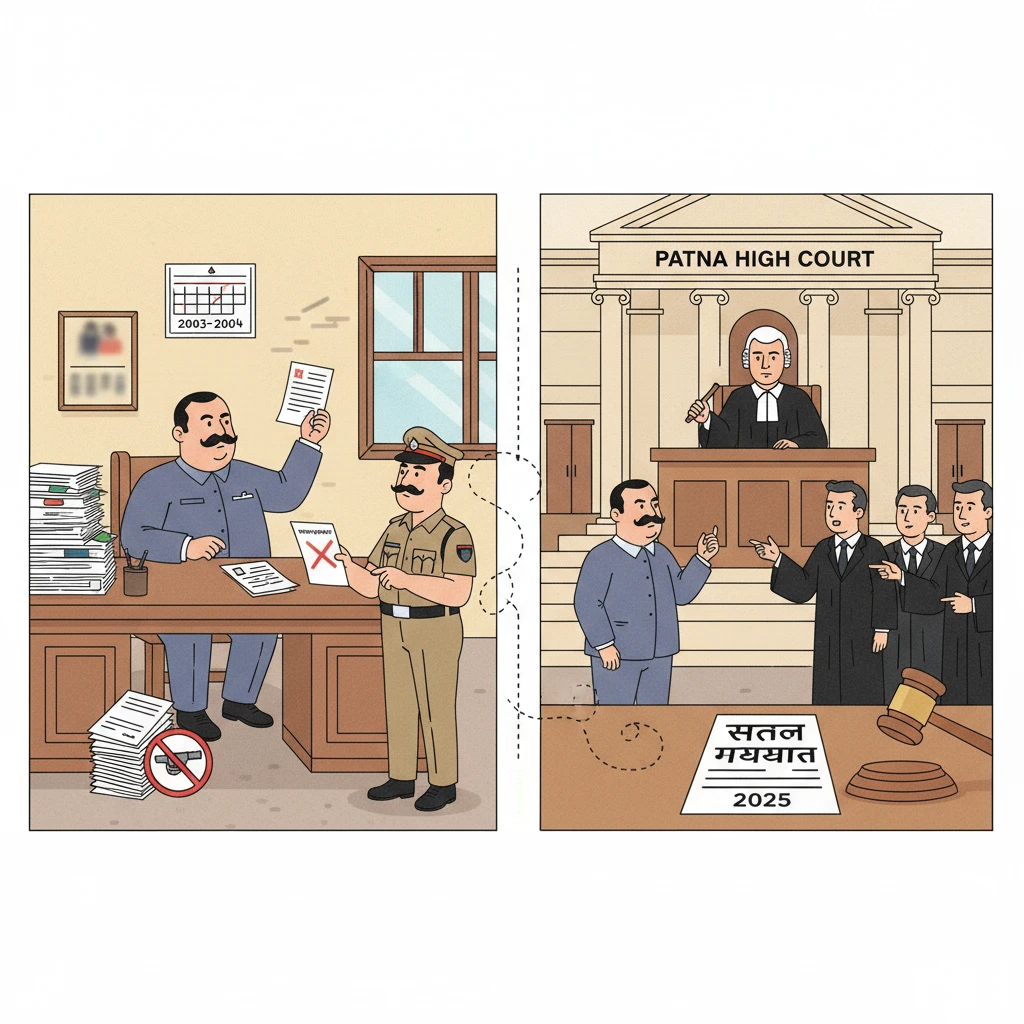
Case Background
This case comes from Saharsa Sadar P.S. Case No. 112 of 2005, registered on 24.04.2005 on the basis of a self-statement of the Station House Officer, Saharsa Sadar.
The SHO stated that, in compliance with Letter No.11026/76/2004 (Arms) dated 29.10.2014 of the Ministry of Home, Government of Bihar, one A.S.I., Bal Krishna Jha, collected a list of arms licence holders for verification.
During this verification, seven licence holders were found to be “unverified”. It was alleged that the then licensing authority had issued those arms licences without obtaining the mandatory police verification.
The SHO referred to Section 13(2) of the Arms Act, 1959, which requires the licensing authority to get a report from the nearest police station and verify that the applicant has been residing for the last three years at the address given in the application. Only after this, a licence can be granted.
According to the FIR, the then licensing authority issued licences without following these legal provisions, allegedly for wrongful gain and corrupt practices. On this basis, the FIR was registered against the petitioner and others, and investigation began.
After investigation, the police first filed Charge-sheet No.124/2005 dated 09.07.2005 under Sections 109, 419, 420, 467, 468, 471 and 120-B of the IPC against only one accused, Om Prakash Tiwary.
A Supplementary Charge-sheet No.118/2006 dated 13.04.2006 was then submitted under the same IPC sections against 14 other persons. At that stage, the investigating agency did not find material against the present petitioner, and the case was closed against him.
On 20.05.2006, after submission of charge-sheet, the Chief Judicial Magistrate issued notice to the informant. The informant appeared and filed a petition stating that he was satisfied with the police final report and had no objection if it was accepted.
Later, the Sub-Divisional Police Officer (SDPO) wrote to the trial court through Letter No.3056 dated 26.11.2007, seeking re-investigation in light of “Gyapank 3547/CR dated 24.11.2007”, alleging that the petitioner was involved in issuing an arms licence to an unverified person, Abhishek Tripathi.
Again, vide Letter No.1773 dated 05.10.2008, the SDPO requested re-investigation on the same ground. On 19.05.2009, the Chief Judicial Magistrate allowed further investigation under Section 173(8) CrPC.
Meanwhile, the State intended to initiate departmental proceedings against the petitioner based on the same arms licence issue. He was asked to show cause regarding the issuance of licence in favour of the named accused in the Saharsa case, allegedly without a police report.
The petitioner submitted his explanation on 25.06.2008, stating that when he was District Magistrate and Licensing Authority, he had called for police verification from the nearest police station, but no report came. A reminder was also sent. He claimed that, as per his authority, he could make an order without further waiting for the report.
Later, in reply to the General Administration Department’s Letter No.17049 dated 10.12.2015, the petitioner again explained that under Section 13 of the Arms Act, if the police station does not send its report within the prescribed time, the licensing authority may, if it deems fit, decide the application without waiting for the report. He also stated that licences are not irreversible, they had been revoked, and there was no record of misuse by the licence holders.
On this explanation, the General Administration Department accepted his defence and, by order dated 25.02.2016, discharged him from departmental charges, with a caution to remain careful in future.
However, pursuant to the court’s permission for further investigation, the police submitted a fresh Charge-sheet No.834/2020 dated 31.08.2020 against the petitioner for offences under Sections 109, 419, 420, 467, 468, 471, 120-B IPC and Section 30 of the Arms Act.
Thereafter, the Law Department, Government of Bihar, by order dated 27.04.2022, granted sanction under Section 197 CrPC to prosecute the petitioner.
On 01.06.2022, the Chief Judicial Magistrate, Saharsa, took cognizance of the offences against the petitioner in Saharsa Sadar P.S. Case No.112 of 2005. The petitioner then approached the Patna High Court in Cr. Misc. No.62048 of 2023 seeking quashing of the cognizance order, the supplementary charge-sheet No.834/2020, and the sanction for prosecution.
What the Court Examined and Decided
The Patna High Court first noted the relief sought: quashing of the cognizance order dated 01.06.2022; quashing of Supplementary Charge-sheet No.834/2020 on the ground that no new material was found after earlier charge-sheets in 2005 and 2006; and quashing of the sanction order dated 27.04.2022 under Section 197 CrPC.
On behalf of the petitioner, senior counsel argued that the sanction order was non-speaking and passed without reasons or proper application of mind. It was submitted that the petitioner acted within the law while granting arms licences, and that the Government had already exonerated him in departmental proceedings.
Counsel argued that the trial court mechanically took cognizance only because sanction was granted. He also submitted that the initial FIR was based on a letter from the Ministry of Home Affairs, which did not direct registration of any FIR, and that the SHO’s action was unwarranted.
The petitioner stressed that the police had already filed two charge-sheets and found no involvement of the petitioner, but after almost fifteen years, a third charge-sheet was submitted against him relying on the same materials, which was said to be an abuse of process.
Another key argument was that, during further investigation, no fresh material was collected. Relying on the same old evidence, the police earlier did not find the petitioner involved, but later found the allegations “true”. According to the petitioner, this change without new evidence was illegal.
The petitioner further contended that the sanction order dated 27.04.2022 was non-speaking, mechanical and violated settled principles. He also attacked the cognizance order as cryptic, passed without proper judicial consideration, and alleged that the case was driven by ulterior motives.
To support his plea for quashing, he relied on several precedents, including State of Haryana v. Bhajan Lal (1992 Supp (1) SCC 335) regarding conditions for quashing, and Madhavrao Jiwajirao Scindia v. Sambhajirao Angre ((1988) 1 SCC 692) about when prosecution can be stopped at an early stage where conviction is unlikely.
He also cited Abhimanyu Singh v. State of Bihar (2008 (2) PLJR 342) and Ganesh Chandra Bhatt v. D.M. Almora (AIR 1993 All 291) to argue that a licensing authority can grant an arms licence if the police do not send their report in time, and that licences for non-prohibited arms should generally be granted.
Relying on decisions such as Indian Oil Corporation v. NEPC ((2006) 6 SCC 736), Krishika Lulla v. Shyam V. Devkatta ((2016) 2 SCC 521) and Md. Ibrahim v. State of Bihar (2009 (4) PLJR SC 99), he argued that the ingredients of cheating and forgery were not made out, and that the petitioner could not be said to have forged documents or cheated the State.
Finally, he referred to Ashoo Surendranath Tewari v. DSP, EOW, CBI (2020 (9) SCC 636) to contend that once the department had exonerated him, there was little chance of criminal conviction on the same set of facts.
On the other side, the learned APP for the State drew attention to the case diary. Statements of the Dealing Assistant and Head Clerk of the General Section, Saharsa Collectorate (in paras 10 and 11 of the case diary) said the then District Magistrate had issued arms licences in 2003-04 ignoring their notes to obtain police verification.
The District Arms Magistrate’s statement recorded that several irregularities had been committed in grant of arms licences earlier, and the succeeding District Magistrate cancelled many licences after finding irregularities.
ASI Balkrishna Jha, who had carried out physical verification of various licence holders, stated that the local addresses of some licencees—including Om Prakash Tiwary, Rani Durgawati, Hariom Kumar, Abhishek Tripathi, Rajesh Kumar, Uday Shankar Tiwary and Madhu Kumar Singh—were found wrong and no one from those localities came forward to identify them.
Pursuant to an order of the High Court dated 05.01.2024 in this very case, the APP obtained a report from the SHO, Saharsa Sadar, through Memo No.452/Legal Cell dated 29.02.2024. The SHO reported that there was no record of receipt of arms applications for police verification in the police station, possibly because the case was old and the police station had shifted buildings in 2012.
During further investigation, the I.O. obtained records of licences granted to several persons, including Kanhaiya Kumar and Chandan Kumar, and found that the petitioner had been District Magistrate, Saharsa from 17.12.2002 to 17.12.2004.
Police verification reports for Kanhaiya Kumar and Chandan Kumar were received on 14.03.2004, showing that both were accused in Pirbahore (Patna) P.S. Case No.296 of 2003 under serious IPC sections (147, 148, 149, 307, 353, 470) and Sections 25(1-B)a, 26, 27 and 35 of the Arms Act, and that charge-sheet had been filed against them.
The Superintendent of Police, Patna, sent a report directly to the then District Magistrate, Saharsa recommending cancellation of their licences. In response, through Memo No.272-1 dated 31.07.2010, the then District Magistrate, Saharsa suspended the licence of Chandan Singh with immediate effect.
The APP argued that these materials showed there was evidence against the petitioner to justify the supplementary charge-sheet and that sanction for prosecution was properly granted. He also relied on strong observations of the Supreme Court on the menace of corruption in Devinder Kumar Bansal v. State of Punjab (2025 SCC OnLine SC 488) and other cases, to stress that courts must take corruption and abuse of public office seriously.
After considering rival submissions, the Patna High Court closely examined the materials. It noted that the supplementary charge-sheet of 31.08.2020 alleged that local addresses of several licencees were found false, some licencees were not even physically capable of carrying arms, and forged documents were created under influence of politicians and other influential persons to secure arms licences.
The Court recorded that these licences were issued without obtaining a police verification report as required, and even the petitioner’s own bodyguard stated that he had obtained licences from the petitioner in favour of his relatives, showing misuse of the process.
The record further showed that the Dealing Assistant had, on 15.07.2003, noted that police verification was required for applicants Kanhaiya Kumar Singh and Chandan Kumar Singh. However, merely two days later, on 17.07.2003, the petitioner, as District Magistrate, ordered issuance of licences to them.
The Court held that, in view of these irregularities and illegalities, several arms licences were issued by the petitioner in a manner that prima facie suggested that he was aware of the illegalities and forged documents, thereby contravening Section 30 of the Arms Act and relevant IPC provisions.
Regarding sanction, the Court noted that, on perusal of evidence and other materials, the Government of Bihar had granted sanction under Section 197 CrPC. It also examined the departmental order (Letter No.2873 dated 25.02.2016) which had discharged the petitioner from departmental proceedings but directed him to remain careful in future.
The Court clarified that this note of caution could not be equated with full exoneration so as to apply the ratio of Ashoo Surendranath Tewari. It rejected the argument that departmental “discharge” automatically meant the criminal case should be quashed.
On the petitioner’s plea that he was authorised to grant licences even without police verification, the Court held that such a defence could not be examined at the stage of considering a quashing petition. At this stage, the Court is not supposed to test the probative value of materials on record.
The Court emphasised that having lawful authority does not mean it can be used arbitrarily or unjustifiably. Lawful authority demands compliance with procedure. The manner in which arms licences were issued by the petitioner, as disclosed by the record, was sufficient to raise serious doubt and justified a full trial.
Consequently, the Court held that the materials on record were sufficient to constitute a prima facie case under Sections 109, 419, 420, 467, 468, 471, 120-B IPC and Section 30 of the Arms Act, and to set criminal law in motion against the petitioner.
The Patna High Court therefore found no illegality in the cognizance order dated 01.06.2022 of the Chief Judicial Magistrate, Saharsa, and declined to interfere. The quashing petition was dismissed as devoid of merit.
Noting the long delay—the case being of 2003, cognizance taken in 2022, and little progress thereafter—the Court directed the trial court to conclude the trial expeditiously, preferably within six months, by taking the matter on board on a day-to-day basis.
Why This Judgment Matters
This judgment is important for public officials, especially District Magistrates and licensing authorities.
The Patna High Court has made it clear that even when the law gives discretion to grant an arms licence without a police report after a certain time, that power cannot be used casually, without proper checking of documents and addresses.
The Court has also underlined that departmental leniency or “discharge” does not automatically wipe out criminal liability. If there is enough material to show a prima facie case, the criminal court must be allowed to hold a full trial.
For ordinary citizens, this decision shows that courts can and will examine allegations of misuse of power in granting arms licences. It also shows that High Courts will not lightly stop criminal cases at an early stage when there is material pointing towards irregularities and possible forgery or cheating.
The direction to complete the trial quickly is also significant. It recognises that very old cases should not drag on indefinitely, and both the accused and the public interest require a speedy conclusion.
Legal Issues and Answers
- Issue: Should the Patna High Court quash the supplementary charge-sheet and cognizance against the petitioner for alleged irregular grant of arms licences, on the ground of no new material, prior departmental discharge, and alleged non-application of mind in the sanction and cognizance orders?
Answer: No. The Court held that the case diary and supplementary charge-sheet contained sufficient material to make out a prima facie case against the petitioner under Sections 109, 419, 420, 467, 468, 471, 120-B IPC and Section 30 of the Arms Act. The sanction for prosecution and the cognizance order did not suffer from such illegality as to justify quashing. - Issue: Does departmental “discharge” or acceptance of explanation by the Government bar or weaken the criminal prosecution on the same facts?
Answer: No. The Court held that the General Administration Department’s order of 25.02.2016, which cautioned the petitioner to be careful in future, could not be treated as a full exoneration so as to apply the principle in Ashoo Surendranath Tewari. It did not prevent criminal proceedings where prima facie material existed. - Issue: Can the petitioner’s defence—that he was empowered under Section 13 of the Arms Act to grant licences even without a police report—be a ground to quash at the initial stage?
Answer: No. The Court held that such a defence cannot be evaluated in a quashing petition. At this stage, the Court only looks at whether there is enough material to proceed, not at whether the defence will ultimately succeed.
Cases Cited by the Court
- State of Haryana v. Bhajan Lal, 1992 Supp. (1) SCC 335
- Abhimanyu Singh v. State of Bihar and Ors., 2008 (2) PLJR 342
- Ganesh Chandra Bhatt v. D.M. Almora, AIR 1993 ALL 291
- Indian Oil Corporation v. NEPC, (2006) 6 SCC 736
- Krishika Lulla v. Shyam V. Devkatta & Ors., (2016) 2 SCC 521
- Md. Ibrahim and Ors. v. State of Bihar & Ors., 2009 (4) PLJR SC 99
- Madhavrao Jiwajirao Scindia & Ors. v. Sambhajirao Chandrojirao Angre & Ors., (1988) 1 SCC 692
- Ashoo Surendranath Tewari v. Deputy Superintendent of Police, EOW, CBI and Anr., 2020 (9) SCC 636
- Devinder Kumar Bansal v. The State of Punjab, 2025 SCC OnLine SC 488
- Manoj Narula v. Union of India, (2014) 9 SCC 1 (quoted in Devinder Kumar Bansal)
- Niranjan Hemchandra Sashittal v. State of Maharashtra, (2013) 4 SCC 642 (quoted)
- Subramanian Swamy v. Manmohan Singh, (2012) 3 SCC 64
- K.C. Sareen v. C.B.I., Chandigarh, (2001) 6 SCC 584
Case Details
Case Number: Criminal Miscellaneous No.62048 of 2023
Arising out of: Saharsa Sadar P.S. Case No.112 of 2005, District Saharsa
Case Title: Robert Lalchungnunga Chongthu @ R L Chongthu v. The State of Bihar
Citation: 2025(3) PLJR 28
Court: High Court of Judicature at Patna
Coram: Hon’ble Mr. Justice Chandra Shekhar Jha
Date of Judgment: 09.05.2025
Nature of Case: Criminal miscellaneous petition seeking quashing of cognizance order, supplementary charge-sheet, and sanction order under Section 197 CrPC
Offences Alleged: Sections 109, 419, 420, 467, 468, 471, 120-B of the Indian Penal Code; Section 30 of the Arms Act, 1959
Advocates:
For the Petitioner: Mr. Mrigank Mauli, Senior Advocate; Mr. Venkatesh Kirti, Advocate
For the State (Opposite Party): Mr. Ram Bilash Roy Raman, APP
Link to Judgment: https://patnahighcourt.gov.in/viewjudgment/NiM2MjA0OCMyMDIzIzEjTg==-NIphGma–am1–qhE=
If you found this explanation helpful and wish to stay informed about
how legal developments may affect your rights in Bihar,
you may consider following Samvida Law Associates for more updates.







