
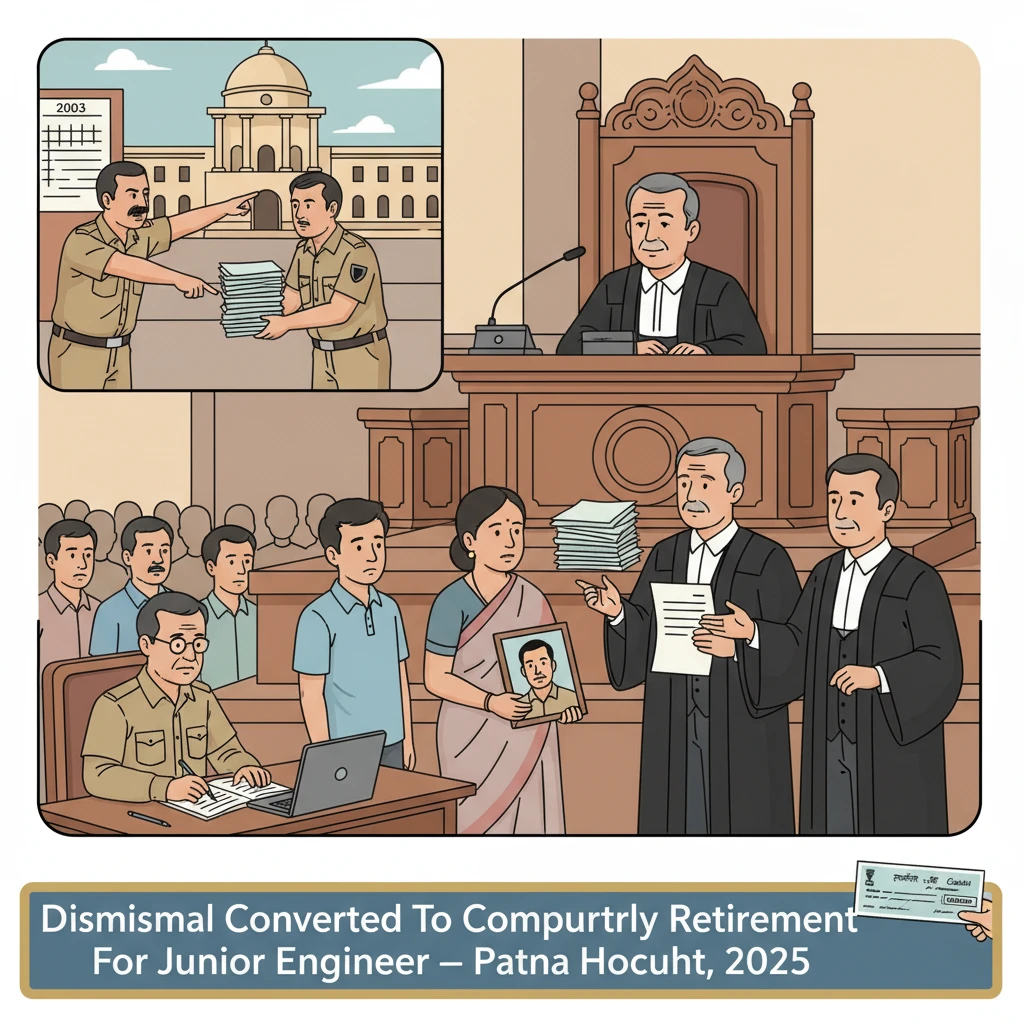
Case Background
The case arose from service proceedings against a Junior Engineer in the Water Resources Department, Government of Bihar.
The employee, late Vijay Kumar Sinha, father of the present appellant, joined as a Junior Engineer in 1979. His services were made substantive on 13 January 1987. He received his first time bound promotion on 17 May 1993. Up to 31 March 2003, no complaint was recorded against his service.
On 24 February 2002, he was transferred to Triveniganj Canal. His joining at the new place was accepted on 9 April 2003. Later, disputes arose regarding acceptance of joining and payment of salary.
The delinquent employee filed C.W.J.C. No. 1807 of 2001 before the Patna High Court for acceptance of his joining and release of withheld salary. That writ petition was allowed on 7 July 2004. The Court directed the concerned authority to pay arrears of Rs. 52,496/- to him, noting that no departmental enquiry was then pending against him.
As the earlier order was not fully complied with, he filed M.J.C. No. 470 of 2005 complaining of incomplete compliance. In that contempt proceeding, the Executive Engineer passed an order on 18 March 2005 for payment of Rs. 3,95,850/-. By letter dated 25 April 2005, the delinquent was directed to give his joining at the Headquarter.
Meanwhile, departmental authorities alleged that he remained absent from duty without authorization from 28 August 2003 while posted as Junior Engineer in Triveni Canal Construction Sub-Division, Kaurewa, Camp Sikta under Triveni Canal Construction Division, Narkatiaganj, during 2003–05. It was also alleged that he did not perform any government work during this period and failed to perform election duty in the 2004 Lok Sabha election in violation of orders of the competent authority.
On this basis, he was placed under suspension by Memo No. 404 dated 30 April 2005, in contemplation of disciplinary proceedings for unauthorized absence since 28 August 2003.
Departmental proceedings under Rule 55 of the Civil Services (Classification, Control and Appeal) Rules, 1930 were initiated by resolution dated 24 May 2005. A copy of this resolution, with charges and evidence, was communicated to him.
According to the record, he neither joined at the Headquarter in response to the Executive Engineer’s letter dated 25 April 2005, nor submitted written defence to the Inquiry Officer despite valid service of notice at his permanent address. Notices were later published in widely circulated newspapers on 26 June 2005 and 25 October 2005.
The Inquiry Officer submitted his report on 30 December 2005 holding the charges proved. A second show cause notice was issued on 25 June 2010. The delinquent submitted his reply on 22 July 2010. Ultimately, by Memo No. 1535 dated 11 October 2010, he was dismissed from service.
The delinquent employee later died. His son, the present appellant, challenged the dismissal before the Patna High Court in C.W.J.C. No. 24188 of 2013. The learned Single Judge, by order dated 22 June 2018, declined to interfere.
The appellant then filed Letters Patent Appeal No. 1507 of 2018 before a Division Bench of the Patna High Court, assailing the Single Judge’s decision and the dismissal order.
What the Court Examined and Decided
The Division Bench, comprising Hon’ble Mr. Justice P. B. Bajanthri and Hon’ble Mr. Justice S. B. Pd. Singh (authoring the CAV judgment), heard the parties and carefully examined the departmental records.
First, the Court noted the service history of the delinquent employee. He had served since 1979, with substantive appointment from 1987 and promotion in 1993. No adverse allegation existed till 31 March 2003. The Court considered this long clean service record as part of the factual backdrop.
The Bench then looked at the sequence of events after his transfer to Triveniganj Canal and the subsequent disputes. The delinquent had approached the Patna High Court earlier in C.W.J.C. No. 1807 of 2001 seeking acceptance of joining and salary. The writ was allowed in 2004, and significant arrears were directed to be paid. When compliance was incomplete, he came back in a contempt petition (M.J.C. No. 470 of 2005), resulting in another order for payment and a direction to join at the Headquarter.
Against this background, the Court examined the initiation of disciplinary proceedings. It was alleged that he remained absent without authorization from 28 August 2003, did not carry out departmental work, and did not perform assigned election duty for Lok Sabha Election 2004.
The Court noted that he was placed under suspension on 30 April 2005 and departmental enquiry under Rule 55 of the CCA Rules, 1930 was commenced by resolution dated 24 May 2005. The record showed that notices and charge memo were sent to his address and also published in newspapers when he did not respond.
However, on perusal of the enquiry report, the Division Bench found that the Inquiry Officer had “hurriedly proceeded” to conclude the enquiry “within few days” and in a “flimsy manner” leading to the dismissal of the appellant’s father. This observation indicated that, in the Court’s view, the enquiry lacked proper depth and fairness.
The dismissal order itself, reproduced in the judgment in Hindi, detailed the charges found proved. These included disobeying departmental and superior officers’ orders, remaining continuously absent from Headquarters and workplace, putting wrongful pressure on officers for salary without working, and not taking part in election duty after being deputed.
The disciplinary authority, relying on the ex parte enquiry, held the charges proved and imposed the major punishment of dismissal from service, treating the conduct as also attracting Rule 76 of the Bihar Service Code relating to desertion-like misconduct.
The Division Bench then turned to whether the departmental proceedings met the legal standards, especially since the punishment was a major penalty. The Court emphasized that for such serious punishment, certain minimum requirements must be met in a departmental enquiry: proper opportunity to adduce evidence, and opportunity to cross-examine witnesses produced against the delinquent.
The Court observed that, in this case, the late father of the appellant was not provided “ample opportunity of adducing evidence” before the Inquiry Officer. It further highlighted that the learned Single Judge had not addressed these issues of lack of opportunity to adduce evidence and cross-examine witnesses. These were identified as crucial legal issues.
The Bench relied on the judgment of the Hon’ble Supreme Court in State of Karnataka v. Umesh, reported in (2022) 6 SCC 563. In paragraph 22 of that decision, which the Patna High Court quoted, the Supreme Court clarified the scope of judicial review in disciplinary matters. A High Court does not reappreciate evidence like an appellate court, but it must examine whether:
(i) rules of natural justice were complied with;
(ii) the finding of misconduct is based on some evidence;
(iii) statutory rules governing the enquiry were observed;
(iv) the findings are not perverse; and
(v) the penalty is not disproportionate to the proven misconduct.
The Patna High Court observed that the appellant’s case “would stand fit into the principles” laid down in State of Karnataka v. Umesh. It noted that the enquiry was conducted ex parte and that the delinquent was effectively denied adequate chance to defend himself.
The Bench also took note of the factual context: the delinquent had earlier filed a writ petition against the department and then a contempt petition. The Court recorded that “since father of the appellant had filed writ petition against the authority concerned, regarding whom, as a retaliatory measure and taking vindictive approach, he was suspended from the service, and without hearing him the Inquiry Officer has found him guilty and ex parte order of major punishment (dismissal) was passed”. This language shows that the Court saw a retaliatory or vindictive element in how the department proceeded.
Considering these infirmities, the Court held that the appellant had made out a case for interference with both the dismissal order and the Single Judge’s order. The dismissal order dated 25 June 2010 (the date of removal, though the memo itself bears date 11 October 2010) and the Single Judge’s judgment dated 22 June 2018 in C.W.J.C. No. 24188 of 2013 were liable to be set aside.
The Bench then considered what relief would follow, given that the delinquent employee had, in any event, crossed the age of superannuation. It noted that if he had been alive and in service, he would have retired on 25 April 2011. Therefore, reinstatement was not possible or meaningful. The Court also rejected the idea of remanding the matter to the disciplinary authority after about 20 years, especially since the enquiry was ex parte and the fundamental procedural defects were already established.
On the question of punishment, the Court found the penalty of removal from service “shocking to conscious” in view of the way charges were proved without providing sufficient opportunity. It reiterated that providing chance to lead evidence and cross-examine witnesses is a mandatory part of departmental enquiry when major penalties are contemplated.
At the same time, the Court acknowledged that there was a charge of prolonged unauthorized absence. It did not fully ignore that misconduct. Balancing these aspects, the Division Bench decided to modify, rather than completely set aside, the punishment.
The Court modified the penalty of removal from service (dated 25 June 2010) to compulsory retirement with effect from 25 June 2010. As a result, the late employee was held entitled to consequential service and monetary benefits from his initial appointment as Junior Engineer up to 25 June 2010, the date of removal which the Court converted into compulsory retirement.
For the intervening period, the Court directed that consequential monetary benefits be calculated and disbursed. It further directed that, if the post held by the delinquent was a pensionable post, the concerned authority must fix his pension with effect from 25 June 2010 and calculate and disburse arrears of pension to the appellant till 15 January 2024. The date 15 January 2024 was taken because the appellant’s mother, the rightful recipient of family pension, had died on that date.
The Court gave the department six months from the date of receipt or production of the order to complete this exercise of calculating and disbursing the amounts.
In the result, the order of the learned Single Judge dated 22 June 2018 was set aside, and the Letters Patent Appeal was allowed in part. The main relief granted was conversion of dismissal into compulsory retirement from 25 June 2010 with corresponding financial and pensionary benefits to the family.
Why This Judgment Matters
This judgment of the Patna High Court is significant for government employees and their families facing departmental action, especially in Bihar.
First, it shows that even where an employee is accused of long unauthorized absence, the department must still follow basic rules of natural justice. The enquiry cannot be rushed or conducted in a “flimsy” manner, particularly when dismissal is proposed.
Second, the Court reinforced that High Courts can interfere in disciplinary matters where there is clear denial of fair opportunity, such as lack of chance to lead evidence or cross-examine witnesses, or where the proceedings appear vindictive after an employee has approached the court.
Third, the judgment demonstrates that even after an employee’s death and post-retirement age, courts can still correct illegal punishments and adjust them to a lesser penalty like compulsory retirement. This can restore service benefits and pension rights for surviving family members.
Finally, the case is a reminder to departments that ex parte enquiries, especially where notices are only published and not effectively served, will be closely scrutinized. Departments must document that they gave reasonable opportunity and handled the case fairly, not as retaliation for prior litigation.
Legal Issues and Answers
- Issue: Whether the departmental enquiry and dismissal of the Junior Engineer for unauthorized absence complied with principles of natural justice and statutory rules.
Answer: The Patna High Court held that the enquiry was hurried, ex parte, and did not provide ample opportunity to adduce evidence and cross-examine witnesses; therefore, the dismissal and the Single Judge’s order were set aside, and the punishment was modified. - Issue: What relief should be granted when the delinquent employee would have superannuated and is no longer alive.
Answer: The Court modified the punishment from removal to compulsory retirement with effect from 25 June 2010 and directed payment of consequential service benefits and pensionary dues to the family up to 15 January 2024. - Issue: Whether High Courts can interfere with disciplinary findings in writ jurisdiction in light of Supreme Court guidance.
Answer: Relying on State of Karnataka v. Umesh, the Court held that it can interfere where rules of natural justice are violated, statutory rules are not followed, or the punishment is disproportionate, all of which were found present here.
Cases Cited by the Court
- State of Karnataka v. Umesh, (2022) 6 SCC 563.
- The Court also referred, through that citation, to State of Karnataka v. N. Gangaraj, (2020) 3 SCC 423; Union of India v. G. Ganayutham, (1997) 7 SCC 463; B.C. Chaturvedi v. Union of India, (1995) 6 SCC 749; R.S. Saini v. State of Punjab, (1999) 8 SCC 90; and CISF v. Abrar Ali, (2017) 4 SCC 507.
Case Details
Case Number: Letters Patent Appeal No. 1507 of 2018 in Civil Writ Jurisdiction Case No. 24188 of 2013
Case Title: Ravi Kumar Sinha v. The State of Bihar & Ors.
Court: High Court of Judicature at Patna
Coram: Hon’ble Mr. Justice P. B. Bajanthri and Hon’ble Mr. Justice S. B. Pd. Singh
Date of Judgment: 05.05.2025
Citation: 2025(3) PLJR 106
Advocates:
- For the Appellant: Mr. Nand Kishore Prasad Sinha, Advocate
- For the Respondents (State): Mr. Deepak Sahay Jamuar, AC to AAG-4
Parties:
- Appellant: Son of the delinquent Junior Engineer, late Vijay Kumar Sinha
- Respondents: State of Bihar through Principal Secretary, Water Resources Development Department; Chief Engineer, Water Resources Department; Executive Engineer, Triveniganj Canal Construction Division, Narkatiaganj, West Champaran; Director-cum-Enquiry Officer, Water Management-cum-Irrigation Availability Reform Directorate; Superintending Engineer-cum-Public Information Officer, Irrigation Monitoring Cell-316, Irrigation Bhawan, Patna
Nature of the Case: Letters Patent Appeal arising out of dismissal of writ petition challenging departmental dismissal order (service/disciplinary matter)
Link to Judgment: https://patnahighcourt.gov.in/viewjudgment/MyMxNTA3IzIwMTgjMSNO-SyCwaVHfLFs=
If you found this explanation helpful and wish to stay informed about
how legal developments may affect your rights in Bihar,
you may consider following Samvida Law Associates for more updates.







