
Case Background
This case arose from Complaint Case No. 5(O) of 2013, linked to Forest Case No. 62/2009 and Bhabua P.S. Case No. 5 of 2013 in District Kaimur (Bhabua), Bihar.
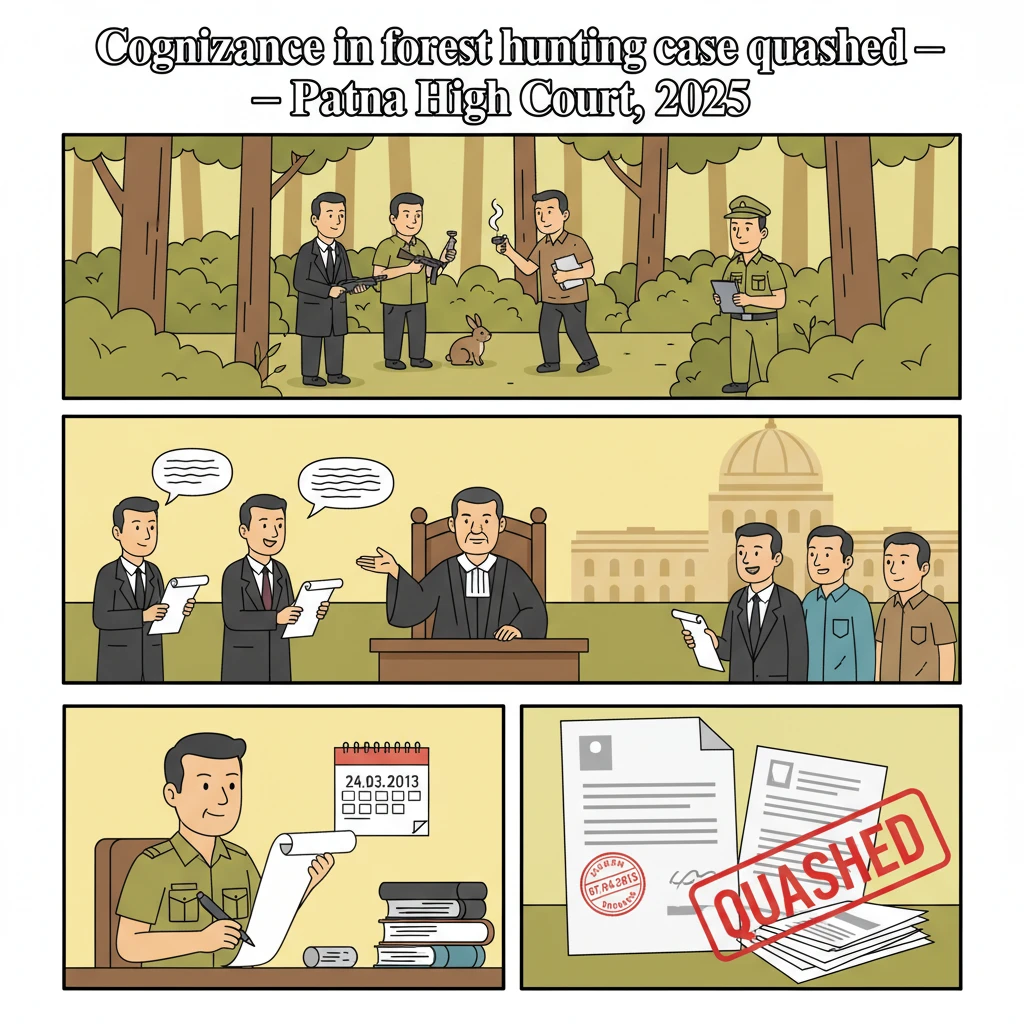
The forest authorities alleged that about 5–6 persons had hunted a rabbit inside a protected forest area using a firearm. On this basis, a complaint was filed before the Chief Judicial Magistrate (C.J.M.), Bhabua.
Earlier, a forester had filed a complaint relating to the same matter, leading to Forest Case No. 62/2009. The petitioners had challenged the cognizance in that earlier forest case by filing Criminal Miscellaneous No. 15622 of 2011 before the Patna High Court.
In that earlier proceeding, the High Court allowed their petition mainly on the ground that the forester who had filed the complaint was not authorised to initiate a criminal case under the Wild Life (Protection) Act, 1972. The Court had, however, given liberty to the concerned authority of the forest department to take proper steps under the Wild Life (Protection) Act.
After this liberty, a fresh Complaint Case No. 5(O)/2013 was lodged on 24.03.2013 by the Forest Range Officer, Bhabua. On 07.04.2015, the C.J.M., Bhabua took cognizance of offences under sections 9, 27, 32 and 51/52 of the Wild Life (Protection) Act, 1972 and under section 33 of the Indian Forest Act, 1927 against the petitioners and others.
The petitioners then approached the Patna High Court by filing Criminal Miscellaneous No. 29080 of 2015 under section 482 of the Code of Criminal Procedure, seeking quashing of the cognizance order dated 07.04.2015.
What the Court Examined and Decided
The Patna High Court, through Hon’ble Mr. Justice Shailendra Singh, heard the petitioners’ challenge to the C.J.M.’s cognizance order. The Court focused on two main aspects: whether rabbit was a protected wild animal under the Wild Life (Protection) Act when the alleged incident occurred, and whether the Forest Range Officer was legally authorised to file the complaint under section 55 of the Act.
The petitioners’ counsel, Mr. Prabhakar Singh, argued that the earlier forest case had already been quashed because the original complainant (a forester) was not authorised to file a case under the Wild Life (Protection) Act. The High Court had then granted liberty only to a properly authorised officer to take fresh steps under the Act.
According to the petitioners, even the fresh complaint filed in 2013 suffered from the same defect. They submitted that under section 55 of the Wild Life (Protection) Act, a complaint must be filed only by specific authorities mentioned there, such as the Chief Wild Life Warden or any other officer authorised in this behalf by the State Government.
The petitioners pointed out that the Forest Range Officer, who filed the 2013 complaint, did not fall into any of the categories mentioned in section 55 at the time of filing. The State Government later issued a notification on 22.01.2014 authorising Rangers (वनों के कृत पदाधिकारी) to take action under sections 27(2)(c), 41(1), 50(1) and 55(b) of the Act. However, this notification came into force on 10.02.2014.
The petitioners emphasised that their complaint was filed on 24.03.2013, much earlier than the notification’s enforcement date. Although the notification’s last lines stated that it would apply retrospectively to all earlier proceedings under the Act, the petitioners argued this kind of retrospective authorisation was illegal and contrary to settled law.
The petitioners further argued that the case related to the hunting of a rabbit. They submitted that rabbit was not listed in any of the Schedules I–IV of the Wild Life (Protection) Act at the time of the alleged offence. They distinguished rabbit from hare, noting that “hare” is included in Schedule IV but rabbit is not.
To support this, they relied on the decision of the High Court of Andhra Pradesh in Mohd Rahamatullah Hussain vs. State of A.P., 2006 SCC Online AP 1548. In that case, the Andhra Pradesh High Court had carefully examined the difference between rabbit and hare using standard encyclopaedia and dictionary definitions. It held that rabbit is not the same as “Hispid Hare” mentioned in Schedule I and that, since rabbit was not in any Schedule, sections 9 and 51 of the Act could not apply.
Relying on this reasoning, the petitioners submitted that the same principle applied here. Since rabbit was not a scheduled wild animal when the alleged hunting took place, the penal provisions of the Wild Life (Protection) Act relating to hunting a scheduled animal could not be invoked.
The petitioners also argued that the C.J.M. had taken cognizance under sections 9, 27 and 32 of the Wild Life (Protection) Act even though these sections do not themselves carry penal provisions. Penal consequences arise through section 51, and the Magistrate appeared to have taken cognizance without properly applying his judicial mind to these aspects.
On facts, the petitioners claimed that they were not apprehended at the spot and were not actually involved in the alleged hunting. They said they were made accused only because a vehicle and a gun allegedly linked to them were found with a co-accused at the place of occurrence. They argued that this indirect link was not enough to prosecute them.
On the other hand, the State’s counsel, Mr. Jitendra Kumar Singh, APP, opposed the petition. He submitted that there was only a slight difference between rabbit and hare and that both could be treated as the same species of mammal, falling within the class of protected wildlife.
Regarding authorisation, he relied on the State Government’s notification dated 22.01.2014 and the counter affidavit’s Annexures R/1 and R/2. He argued that the Range Forest Officer, Bhabua was a competent person to file the complaint, and that he had done so with the sanction of the Divisional Forest Officer, Kaimur. He also relied on the retrospective language in the notification.
The Court examined the statutory provisions. It noted that section 9 of the Wild Life (Protection) Act prohibits hunting of wild animals specified in Schedules I–IV, except as provided in sections 11 and 12. The Court also set out the text of section 27 (restriction on entry in a sanctuary) and section 32 (prohibition on using chemicals, explosives or other substances that may injure or endanger wildlife in a sanctuary). It observed that violation of these provisions is made punishable by section 51 of the Act.
On the first key question, the Court held that, to attract section 9, it must be shown that a wild animal specified in Schedules I–IV has been hunted. It found that rabbit, as a mammal, did not appear in any of these schedules at the time of the alleged offence.
The Court acknowledged that, later, through the Wild Life (Protection) Amendment Act, 2022, rabbit was included in Appendix I of Schedule IV and made a protected wild animal. However, that amendment was not in force when the alleged hunting of rabbit took place. The Court further noted that, in view of the differences in behaviour and style of life between rabbit and hare, they cannot be treated as the same species of mammal for the purpose of the Act.
On this basis, the Court concluded that the allegations of hunting rabbit could not be treated as hunting a protected wild animal under section 9 at the relevant time.
On the second key question, regarding authorisation, the Court turned to section 55 of the Wild Life (Protection) Act. Under this section, only the Chief Wild Life Warden or any other officer authorised in this behalf by the State Government can file a complaint for offences under the Act.
The Court found that neither the Chief Wild Life Warden nor any other officer specifically authorised under section 55 had filed the complaint in this case. Instead, the complaint had been filed by the Range Forest Officer, Bhabua.
The Court noted that the specific post name “Range Forest Officer” does not find place in section 55 as such. While the State relied on the 22.01.2014 notification authorising Rangers to act under certain provisions, the Court emphasised that this notification took effect on 10.02.2014. The complaint here had been filed on 24.03.2013, before the notification came into force.
The State’s attempt to rely on the notification’s retrospective language was rejected by the Court as not acceptable and not in line with the settled position of law. The Court treated the filing of the complaint by the Range Forest Officer, in the absence of proper authorisation at the relevant time, as a violation of the mandatory requirement of section 55.
The Court also considered the cognizance under section 33 of the Indian Forest Act, 1927. It observed that the prosecution had not shown how any provision of section 33 had been violated, either under the Wild Life (Protection) Act or the Indian Forest Act. The impugned order was completely silent on this aspect and was not a speaking order on that count.
At the same time, the Court did recognise that the alleged entry of the petitioners and co-accused into the protected forest area and the use of explosive material there could amount to violation of sections 27 and 32 of the Wild Life (Protection) Act. These violations are punishable under section 51.
However, even for prosecuting these offences, the complaint had to comply with section 55’s requirement about who can file a complaint. Since that requirement was not met, the Court treated the entire cognizance as legally flawed.
Finally, taking all these factors together, the Court held that, at the time of the alleged occurrence, rabbit was not a scheduled protected wild animal; and the complaint filed by the Range Forest Officer was by an officer not competent under section 55 of the Act. The liberty earlier given to the forest department, to file a fresh complaint through a competent authority, had not been properly availed.
On this reasoning, the Patna High Court set aside the C.J.M., Bhabua’s order dated 07.04.2015 taking cognizance in Complaint Case No. 5(O) of 2013. The criminal miscellaneous petition was allowed, effectively quashing the proceedings against the petitioners based on that cognizance order.
Why This Judgment Matters
This judgment is important for people accused in forest and wildlife cases in Bihar and elsewhere. It shows that even if the allegations seem serious, the case cannot continue if basic legal rules are not followed.
First, the Court made it clear that, for a person to be prosecuted for hunting a protected animal, that animal must actually be listed in the Schedules of the Wild Life (Protection) Act at the time of the incident. Later amendments cannot be used to punish acts done earlier.
Second, the judgment stresses that only those officers clearly authorised under section 55 of the Act can file complaints. If a complaint is filed by someone without such authority, the entire case can be thrown out.
Third, the Court did not accept the State’s attempt to use a later notification with retrospective effect to justify an earlier complaint. This protects the rights of accused persons from being dragged into criminal cases on the basis of post-dated authorisations.
For ordinary citizens, this decision underlines that procedural safeguards in criminal law are not mere technicalities. They are mandatory steps that protect against arbitrary or unauthorised prosecutions.
Legal Issues and Answers
- Issue: Can a person be prosecuted for hunting a rabbit under sections 9 and 51 of the Wild Life (Protection) Act when rabbit was not listed in any of the Schedules at the time of the alleged offence?
Answer: No. The Court held that rabbit was not a scheduled wild animal at the relevant time, and differences between rabbit and hare mean they cannot be treated as the same species. Therefore, section 9 could not be invoked on this allegation. - Issue: Was the complaint valid when it was filed by a Range Forest Officer who was not authorised under section 55 of the Wild Life (Protection) Act at the time of filing?
Answer: No. The Court held that section 55 is mandatory and only the Chief Wild Life Warden or a duly authorised officer can file complaints. The Range Forest Officer lacked such authority when the complaint was filed, and a later notification could not retrospectively cure this defect. - Issue: Could cognizance under section 33 of the Indian Forest Act, 1927 be sustained when the impugned order did not explain how that section was violated?
Answer: No. The Court noted that the prosecution had not shown any violation of section 33, and the cognizance order was silent and non-speaking on this point, making it unsustainable.
Cases Cited by the Court
- Mohd Rahamatullah Hussain vs. State of A.P., 2006 SCC Online AP 1548 (High Court of Andhra Pradesh at Hyderabad)
Case Details
Case Number: Criminal Miscellaneous No. 29080 of 2015 (arising out of PS Case No. 5 of 2013, Bhabua, Complaint Case No. 5(O) of 2013, Forest Case No. 62/2009)
Case Title: Rajesh Singh & Anr. vs. State of Bihar & Anr.
Coram: Hon’ble Mr. Justice Shailendra Singh
Citation: 2025(3) PLJR 142
Date of Judgment: 03.04.2025
Advocates:
- For the Petitioners: Mr. Prabhakar Singh, Advocate
- For the State/Opposite Parties: Mr. Jitendra Kumar Singh, APP
Nature of the Case: Petition under section 482 of the Code of Criminal Procedure seeking quashing of cognizance order in a complaint alleging offences under the Wild Life (Protection) Act, 1972 and the Indian Forest Act, 1927.
Link to Judgment: https://patnahighcourt.gov.in/viewjudgment/NiMyOTA4MCMyMDE1IzEjTg==-KyEHL4CiszU=
If you found this explanation helpful and wish to stay informed about
how legal developments may affect your rights in Bihar,
you may consider following Samvida Law Associates for more updates.







