
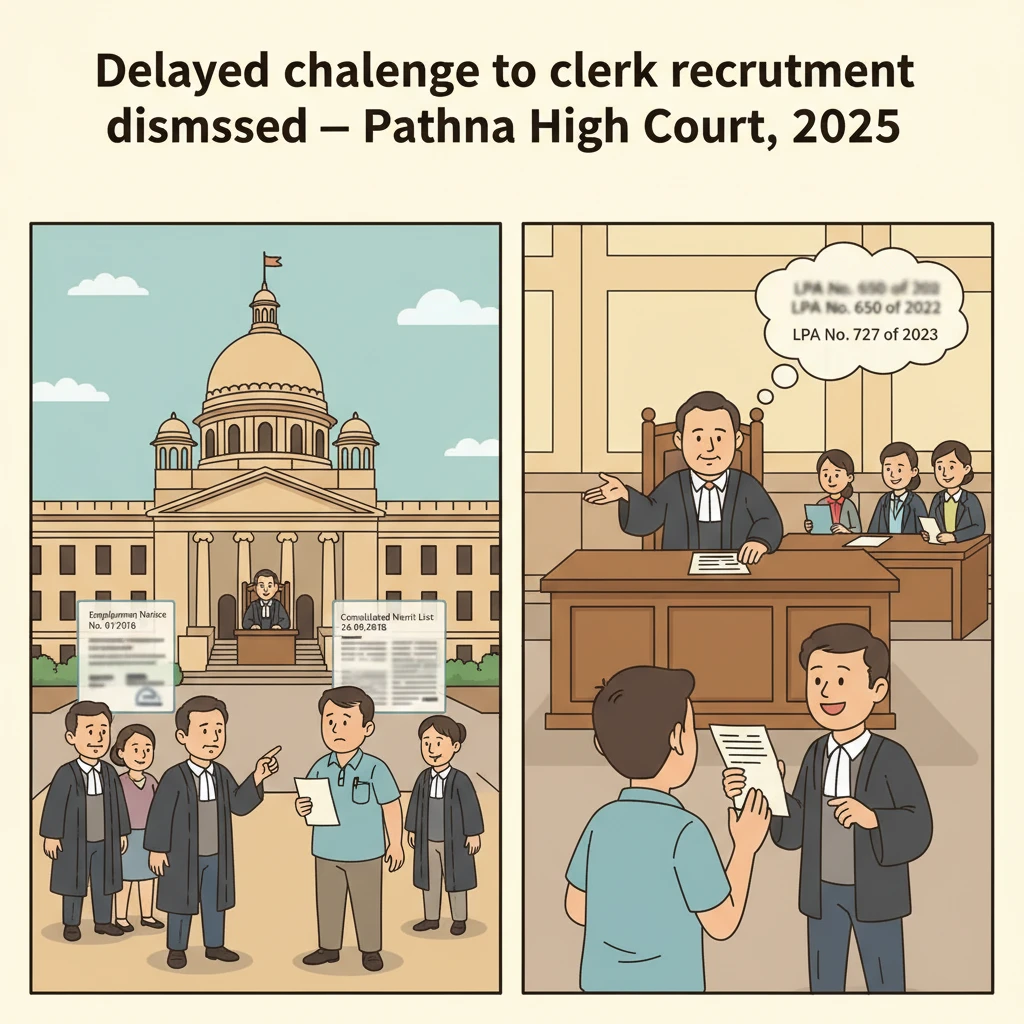
Case Background
The dispute arose from Employment Notice No. 01/2016 issued on 07.02.2016 by the office of the Convenor, Co-ordination Committee, Patna-cum-District and Sessions Judge, Patna.
This advertisement invited online applications for filling up 1681 Grade III (Clerk) posts in the civil courts across Bihar, as per the reservation roster.
After the recruitment process, a select list was published on 26.09.2018.
The writ petitioner belonged to the Backward Caste category. He participated in the selection process and secured 71.50 marks. His name appeared in the panel at Serial No. 1680.
However, despite being empanelled, he was not issued an appointment order. According to him, some other candidates from the same Backward Caste category, with lower marks, were appointed as clerks in the subordinate courts of Bihar.
Some other unsuccessful or aggrieved candidates had already approached the Patna High Court soon after the select list, by filing writ petitions in 2018 and 2019 (including CWJC No. 21219 of 2018, CWJC No. 6259 of 2019 and CWJC No. 1414 of 2019). Their claims were initially rejected by a learned Single Judge, but they succeeded later in Letters Patent Appeals, including LPA No. 650 of 2022 and analogous matters.
In contrast, the present petitioner did not come to Court in 2018–2019. He approached the Patna High Court only in 2024, around six years after publication of the select list, by filing Civil Writ Jurisdiction Case No. 6030 of 2024.
What the Court Examined and Decided
The petitioner sought a writ of mandamus and allied directions primarily on four counts.
First, he asked the Court to direct the authorities to select and appoint him as Clerk in light of the judgment dated 17.04.2023 in LPA No. 650 of 2022 and its analogous cases. He claimed that he fell within the purview of that judgment and had secured higher marks than some of the candidates who were selected and appointed pursuant to Employment Notice No. 01/2016.
Second, he sought a direction to extend all consequential benefits after appointing him and allowing him to join as a clerk in the subordinate courts of Bihar, on the basis of his position in the consolidated merit list prepared by the Co-ordination Committee.
Third, he sought a declaration that he, along with other similarly situated candidates, was entitled to be considered for appointment and joining as clerks in various subordinate courts within Bihar, based on the merit list prepared under the Bihar Civil Court Staff (Class III and Class IV) Rules, 2009 pursuant to Employment Notice No. 01/2016.
Fourth, he requested any other relief to which he might be found entitled in the facts and circumstances of the case.
The key factual plank of the petitioner’s argument was that, as a Backward Caste candidate with 71.50 marks, he had secured higher marks than respondents 8, 9, 10, 20 and 23 (also belonging to Backward Caste category), who were appointed. The marks of those respondents, as recorded, were: 71.33 (respondent 8), 71.33 (respondent 9), 71.28 (respondent 10), 70.00 (respondent 20) and 69.00 (respondent 23).
The petitioner argued that despite this, he was not appointed while they were. To support his claim for similar treatment, he relied heavily on the Patna High Court’s judgment dated 19.04.2023 in LPA No. 650 of 2022. Referring to paragraphs 20, 21 and 22 of that judgment, he claimed “equity” with those candidates who had approached the writ court in 2018 and 2019 and obtained relief in appeal.
On the other side, learned counsel for the Patna High Court (respondent nos. 2 and 3) opposed the petition on several grounds.
He pointed out that the advertisement was of 2016, the merit list was published on 26.09.2018, and aggrieved candidates immediately filed writ petitions in 2018–2019. Those writ petitions were initially dismissed but later succeeded in Letters Patent Appeals, and the appellate judgment directed consideration of the appellants for appointment against unfilled and anticipated vacancies within the relevant two-year period.
He stressed that writ jurisdiction is not meant for “indolent” litigants. In this regard, he relied on the Supreme Court’s decision in State of U.P. & Ors. v. Harish Chandra & Ors., (1996) 9 SCC 309, to argue that a person who sleeps over his rights for years cannot seek discretionary relief under Article 226.
When the Court asked whether posts were still vacant, counsel for the Patna High Court replied that some posts were indeed vacant. However, he clarified that the validity of the panel itself was only for two years. Therefore, even if posts remained, a person whose panel had expired could not claim appointment as of right, nor could he demand parity with those who moved the Court in time.
He further submitted that the judgment in LPA No. 650 of 2022 was in personam, not in rem. In other words, it was meant only for those specific appellants who had pursued their rights diligently, not for all candidates on the panel. To support this, he relied on paragraph 20 of that LPA judgment, which directed the appointing authority to consider “each of the petitioners” in the appeals for appointment against unfilled and anticipated vacancies within the relevant period of two years, and to issue appointment orders or pass speaking orders regarding their ineligibility, if any.
Learned counsel for the State supported this stand. He argued that the law is settled that only those who approach the Court can claim relief, while those who remain “fence sitters” cannot later claim equity. He emphasised that similarly situated candidates had already filed writ petitions in 2018 and 2019, whereas the petitioner moved only after the 2023 LPA judgment, and even then initially only by making a representation to the Registrar General of the Patna High Court.
The Court first considered the preliminary question of delay and laches. The petitioner had waited from 2018 (publication of the select list) until 2024 to file a writ petition, which the Court noted was a gap of about six years.
The Court reaffirmed the settled legal position that if a writ petition is found to be hit by delay and laches, the High Court should dismiss it at the threshold. It referred to the Supreme Court’s decision in State of U.P. & Ors. v. Harish Chandra & Ors. (1996) 9 SCC 309, where the Supreme Court held that litigants must pursue their remedies promptly and not sleep over their rights. The Court quoted the Supreme Court’s observation that delay and laches can justify refusal of discretionary relief even when no third-party rights are affected, because the law expects diligence from those seeking extraordinary relief.
The Court also took note of a co-ordinate Bench’s reliance, in CWJC No. 10450 of 2024, on the Supreme Court decision in Ex. Capt. Harish Uppal v. Union of India, 1994 Supp (2) SCC 195, which discussed the principle of laches and the policy underlying limitation rules.
Further, the Court examined the Supreme Court’s decision in C. Jacob v. Director of Geology and Mining & Ors., (2008) 10 SCC 115. In that case, an employee sought to challenge termination after twenty years and claim consequential benefits. The Supreme Court held that such stale claims are inadmissible and clarified that mere representations to the Government do not revive dead or time-barred claims, nor does a reply to such representation create a fresh cause of action.
The Patna High Court quoted from C. Jacob to underline that stale or time-barred matters can be rejected on that ground alone, without going into merits, and that orders passed on representations pursuant to judicial directions do not extend limitation or revive old claims.
The Court then relied on Chennai Metropolitan Water Supply & Sewerage Board v. T.T. Murali Babu, (2014) 4 SCC 108. In paragraph 16 of that judgment, the Supreme Court had stressed that delay and laches should not be lightly brushed aside, and that a writ court, as a constitutional court, must balance protection of rights with the principle that litigants cannot approach the Court at their own leisure. It emphasised that inordinate delay leads to “disaster” for the litigant and that “law does not permit one to sleep and rise like a phoenix.”
After considering these authorities and the rival submissions, the Court reviewed the background of the recruitment litigation. It noted that the advertisement was issued in 2016, result published in 2018, and several rounds of litigation ensued. Eventually, relief was granted to those candidates who had approached the Court through CWJC No. 6259 of 2019 and CWJC No. 21219 of 2018, as clarified in paragraph 20 of the judgment dated 19.04.2023 in LPA No. 650 of 2022 and the later judgment dated 18.01.2024 in LPA No. 727 of 2023 (arising out of CWJC No. 1414 of 2019).
The Court held that these judgments were specifically in respect of those candidates who had approached the Court “much earlier.” The present petitioner, on the other hand, had remained inactive for years and could only be characterised as not being conscious of his rights or being indolent.
Such indolence, the Court concluded, disentitled him from claiming equity with those who had diligently pursued their remedies and had been granted relief by the appellate court.
In view of this, the Court found no merit in the writ petition and dismissed it.
Why This Judgment Matters
This judgment is important for candidates who participate in government or court recruitment processes and later feel wronged by non-selection or non-appointment.
The Patna High Court has made it clear that even if a candidate has higher marks than others who are appointed, they cannot wait for many years and then expect the Court to grant relief in writ jurisdiction.
The decision reinforces that recruitment panels have a limited life, and once the panel has expired, candidates cannot claim a right to appointment, even if some posts remain vacant.
It also clarifies that when an appellate court grants relief to certain candidates who litigated in time, that benefit does not automatically extend to all similarly placed candidates who remained silent when the dispute was live.
For lay persons, the message is straightforward: if you believe there has been unfairness in recruitment, you must act promptly. Delayed action may completely close the door to judicial relief, regardless of the strength of your claim on merits.
Legal Issues and Answers
-
Issue: Can a candidate who was empanelled in a 2016 clerk recruitment, but did not approach the Court until 2024, claim appointment and parity with candidates who litigated in 2018–2019 and obtained relief in LPA No. 650 of 2022 and analogous cases?
Answer: No. The Court held that the writ petition was barred by delay and laches, the panel had expired after its two-year validity, and the earlier LPA judgment was in personam for those who approached in time; the petitioner, having remained indolent, could not claim equity or appointment.
Cases Cited by the Court
- State of U.P. & Ors. v. Harish Chandra & Ors., (1996) 9 SCC 309
- Ex. Capt. Harish Uppal v. Union of India, 1994 Supp (2) SCC 195
- C. Jacob v. Director of Geology and Mining & Ors., (2008) 10 SCC 115
- Chennai Metropolitan Water Supply & Sewerage Board v. T.T. Murali Babu, (2014) 4 SCC 108
- LPA No. 650 of 2022 (and analogous LPAs, including LPA No. 657 of 2022 and LPA No. 661 of 2022) arising out of CWJC No. 6259 of 2019 and CWJC No. 21219 of 2018
- LPA No. 727 of 2023 (arising out of CWJC No. 1414 of 2019)
Case Details
Case Number: Civil Writ Jurisdiction Case No. 6030 of 2024
Case Title: Deepak Kumar v. The State of Bihar & Ors.
Coram: Hon’ble Mr. Justice Purnendu Singh
Citation: 2025 (2) PLJR 520
Advocates:
For the petitioner: Mr. Manoj Kumar Singh, Advocate
For respondent nos. 2 and 3 (Patna High Court and Convenor, Co-ordination Committee): Mr. Piyush Lall, Advocate
For the State of Bihar: Mr. Kameshwar Kumar, GP 17
Nature of the Case: Writ petition under Article 226 of the Constitution seeking mandamus and consequential reliefs relating to recruitment to the post of Clerk (Grade III) in Bihar civil courts pursuant to Employment Notice No. 01/2016.
Date of Judgment: 26.03.2025
Link to Judgment: Click here to read the full judgment of the Patna High Court
If you found this explanation helpful and wish to stay informed about
how legal developments may affect your rights in Bihar,
you may consider following Samvida Law Associates for more updates.







