
Case Background
This case concerns more than 200 petitioners engaged as Data Entry Operator-cum-Bihar Resource Persons under the Mid Day Meal (MDM) scheme in different districts of Bihar.
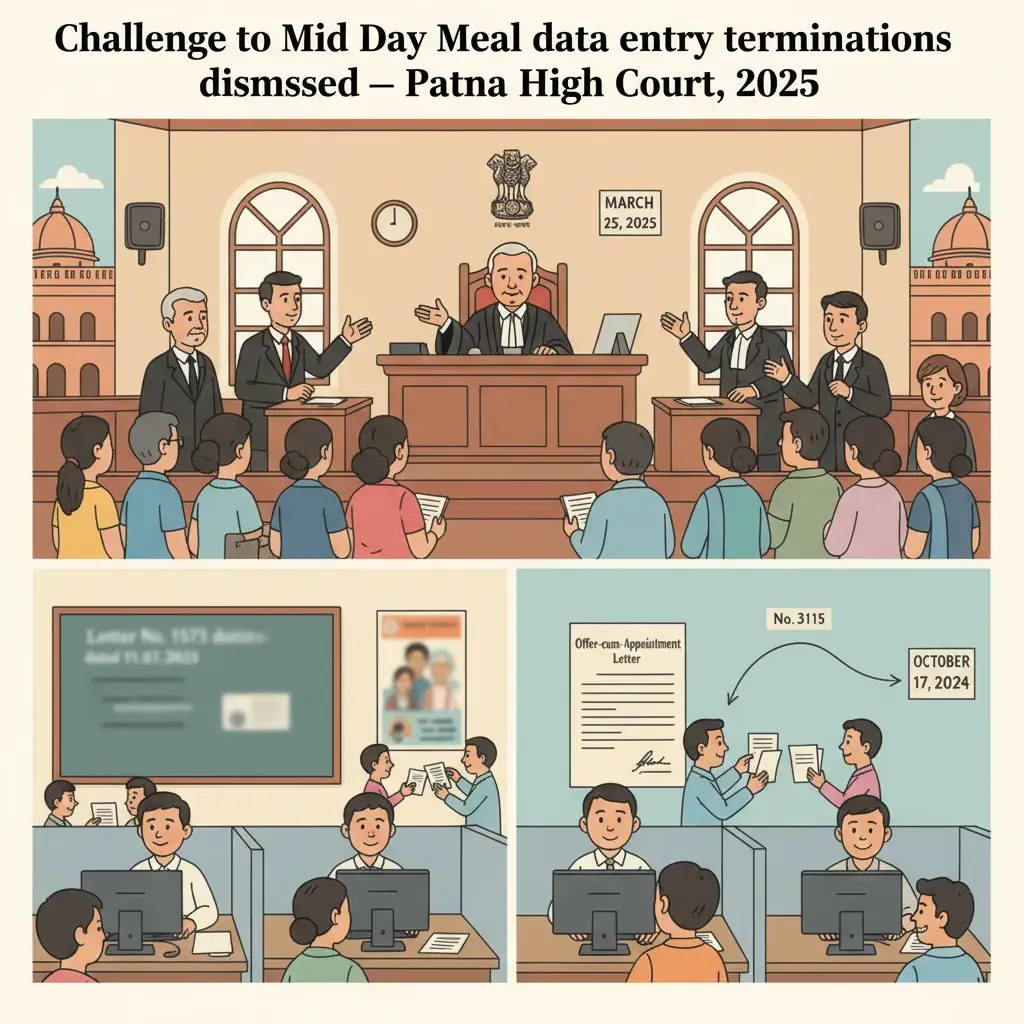
Their engagement came through outsourcing agencies, after a general notice was issued by the Education Department (Mid Day Meal) under Letter No. 1573 dated 11.07.2023. This notice invited different agencies to supply manpower for placement of Data Entry Operators in all blocks of various districts.
Fifteen agencies were selected for different districts. These agencies first conducted a typing competency test and recommended successful candidates to the Directorate, Mid Day Meal, Bihar, Patna. The Directorate itself held another competency test. Only those who passed were recommended for engagement as Data Entry Operator-cum-Bihar Resource Persons.
The District Programme Officers (DPOs), Mid Day Meal, in different districts accepted the joining of these candidates in 2023. Some petitioners were further posted to specific blocks through office orders issued under the signatures of the respective DPOs.
The outsourcing agencies then executed formal agreements with the Education Department (MDM) between August and October 2023. These agreements were initially for three years, with a possible two-year extension if the work was satisfactory.
The petitioners were engaged in September, October and other months of 2023. There were no adverse remarks recorded against them or their agencies. After they completed one year of service, the Director, Mid Day Meal, Bihar, Patna, issued Letter No. 3115 dated 17.10.2024 extending the contractual engagement of Data Entry Operator-cum-Bihar Resource Persons by one more year, i.e., up to around September–October 2025.
The State Project Director, Bihar Education Project Council, Patna, also issued Letter No. 315 dated 17.01.2025, indicating that the services of Data Entry Operators whose term had already been extended by the competent authority would not be disturbed.
However, on 24.02.2025, the Director, Mid Day Meal, issued another letter (Letter No. 491) directing all DPOs not to utilize the services of Data Entry Operator-cum-Bihar Resource Persons beyond 31.03.2025, citing shortage of budget. Based on this, DPOs issued communications to individual petitioners asking them to hand over charge by 5:00 PM on 31.03.2025.
The petitioners submitted a detailed representation on 25.02.2025 to the Director, Mid Day Meal (respondent no. 2), but no decision was taken on it. They then filed this writ petition challenging the letter dated 24.02.2025 and consequential orders.
What the Court Examined and Decided
The core question before the Patna High Court was whether the petitioners, who were engaged through outsourcing agencies as Data Entry Operator-cum-Bihar Resource Persons under the Mid Day Meal scheme, could challenge the discontinuation of their services from 31.03.2025 on the ground that their contracts had already been extended till late 2025.
On behalf of the petitioners, learned Senior Counsel first clarified that they were not pressing prayer no. (iii) of the writ petition and sought permission to delete it, which the Court allowed.
The petitioners attacked the letter dated 24.02.2025 issued by the Director, Mid Day Meal, which ordered that services of Data Entry Operator-cum-Bihar Resource Persons would be terminated with effect from 31.03.2025 due to shortage of budget. They also sought to quash the consequential District Programme Officer’s orders based on the same letter.
The petitioners’ main submissions were:
- They had been appointed against sanctioned vacant posts of Data Entry Operator-cum-Block/Bihar Resource Person after a proper selection process, including competency tests by the agencies and the Directorate.
- Outsourcing agencies had entered three-year agreements (extendable by two years) with the Education Department, under which the petitioners were working without any adverse remark.
- Their services had already been extended for one additional year by Letter No. 3115 dated 17.10.2024, so their engagement was to continue till about September–November 2025.
- Letter No. 315 dated 17.01.2025 from the State Project Director indicated that extended services of Data Entry Operators would not be disturbed.
- Suddenly stopping their services from 31.03.2025 solely on the ground of budget shortage was arbitrary and illegal.
They also argued that the Mid Day Meal scheme is funded 60% by the Central Government and 40% by the State Government. They questioned whether there were unused funds with the Single Nodal Agency or whether any revised budget proposal had been submitted to the Finance Department. They contended that these aspects were not disclosed, and the Director, Mid Day Meal, could not simply cite budget shortage to end their work mid-way.
On maintainability, the petitioners relied on the Supreme Court decision in Shripal and Another vs. Nagar Nigam, Ghaziabad, 2025 SCC OnLine SC 221. They argued that although they were recruited through outsourcing agencies, the actual work was to implement a government policy under the Mid Day Meal scheme. Therefore, the State was the ultimate employer and the writ petition was maintainable against the State.
They further relied on Jaggo vs. Union of India & Ors., 2024 SCC OnLine SC 3826. They cited the observations of the Supreme Court referring to International Labour Organization principles and condemning the misuse of temporary contracts where workers are engaged for long periods for core functions. They argued that abruptly ending their engagement, despite extension, violated fairness and employment stability standards highlighted in that judgment.
On the other hand, counsel for the Mid Day Meal Directorate raised a preliminary objection about maintainability. He argued that:
- The petitioners are employees of private outsourcing agencies, not of the State. Their offer-cum-appointment letters (annexed from page 96 of the writ petition) show that the agencies, and not the government, had appointed them.
- The appointments were purely contractual for 11-month periods, with explicit clauses that the contract could be terminated at any time, especially if the project was terminated due to unavoidable circumstances.
- The fundamental rights or protections the petitioners claimed arose only from their contracts with the agencies, not from any statutory appointment by the State.
Counsel further explained that the Mid Day Meal scheme is a policy-based programme meant to improve nutrition, attendance and social equality among school children by providing free meals. The scheme is funded jointly by the Central and State Governments and continues only as long as funds are available. It is not a permanent cadre-based establishment.
He submitted that after the Directorate received information about shortage of funds, the Director issued the letter dated 24.02.2025 merely to clarify that payments could not be made beyond 31.03.2025. Therefore, the decision to stop using services after that date was a policy and financial decision, not an arbitrary action.
He also pointed to the outsourcing agreement (Annexure P/4), which contains a dispute resolution mechanism. Clause 1.3.1 provides for conciliation and Clause 1.3.3 provides for arbitration between the Department and the agency in case of disputes.
In reply, the petitioners’ Senior Counsel argued that the arbitration clause in the agreement between the State and the agency did not apply to the petitioners, as the current dispute was between citizens (the petitioners) and the State authorities regarding misuse of power, not a contractual dispute between the State and the outsourcing agency.
The Mid Day Meal counsel further referred to earlier Patna High Court decisions in CWJC No. 10761 of 2013 (Asha Kumari & Ors. vs. State of Bihar & Ors.) and CWJC No. 22252 of 2012 (Anju Kumari & Ors. vs. State of Bihar & Ors.). In those cases, persons engaged as Bal Didi/Lok Didi under policies run by the Bihar Education Project Council had approached the Court. The High Court had refused to entertain their grievances, treating their engagement as policy-based and not conferring enforceable service rights.
He distinguished the Supreme Court decisions cited by the petitioners. In Shripal, there were conflicting awards by a Labour Court regarding reinstatement with back wages, later challenged before the High Court and Supreme Court. In Jaggo, the appellants sought regularisation of service arising from a Central Administrative Tribunal decision. Both arose from different statutory regimes (Labour Court/CAT) and were factually distinct.
After hearing both sides and examining the documents, the Patna High Court made key findings.
First, the Court accepted that the arbitration and conciliation clauses in the agreement between the State and the agencies did not directly bind the petitioners in this writ. On that limited point, the Court agreed with the petitioners’ Senior Counsel.
However, the Court held that the petitioners’ rights themselves flowed only from their contracts with the outsourcing agencies. They were, therefore, bound by the terms of those contracts.
The Court specifically referred to Clause 12 of the appointment terms, which clearly stated:
“12. Your Services may be terminated with one month notice and /or without assigning any reason thereof depending on the seriousness as decided by the Client. Failing to serve the notice period of 30 (thirty) days from your side, you will be recovered the losses, damages, expenses incurred on your training and any other penalty/fine as fixed by the agency. You will not claim for any rights or employer employee relationship with the client/agency.”
The Court noted that under this clause, services could be terminated with one month’s notice, and that the petitioners had already agreed that they would not claim any employer–employee relationship with the client (i.e., the Department) or the agency beyond the contract.
On policy and budget aspects, the Court observed that, as per the letter dated 24.02.2025, the Director of the project, after realizing that there was insufficient budget to continue work, decided as a matter of policy that services could not be continued beyond 31.03.2025.
The Court held that it could not direct the Director or the government to change policy decisions, particularly those linked to the availability or non-availability of budget. Whether funds exist or how they should be allocated lies within the domain of the policy administrator, not within judicial review in such contractual setups.
Accordingly, the Court declined to interfere with the Director’s letter dated 24.02.2025 or the consequential orders. The prayer to set aside the termination directions was rejected, and the writ petition was dismissed.
However, the Court gave one important protection to the petitioners. It held that, in light of Clause 12, the petitioners were at least entitled to the benefit of one month’s notice. Therefore, if termination was effected without one month’s notice, the petitioners would be entitled to one month’s salary in lieu of such notice.
Thus, while the Court did not restore their services, it ensured that the contractual protection regarding notice period was honoured.
Why This Judgment Matters
This judgment is important for thousands of contractual workers in Bihar who are engaged through agencies under government schemes like Mid Day Meal.
The Patna High Court has made it clear that such workers are not treated as regular government employees. Their rights mainly come from the contract they sign with outsourcing agencies. Even if they work in government offices and perform core scheme-related work, their engagement can be ended when the project faces a budget crisis, so long as the contractual terms are followed.
For workers, this means that:
- Courts may not force the government to continue a scheme or keep them on contract, especially where funds are exhausted or policy has changed.
- But if the contract says that a one-month notice is required, workers are at least entitled to salary for that notice period if it is not given.
For the administration, the judgment confirms that policy and budget decisions on schemes like Mid Day Meal remain largely within the executive’s domain. However, when agencies and workers have written contracts, the State and agencies must honour basic contractual safeguards, such as the notice period.
Legal Issues and Answers
- Issue: Can Data Entry Operator-cum-Bihar Resource Persons, engaged through outsourcing agencies under the Mid Day Meal scheme, challenge discontinuation of their services through a writ petition and seek continuation till the end of their extended term?
Answer: The Court held that their engagement is purely contractual, their rights arise from their contracts with the outsourcing agencies, and budget and policy decisions of the scheme cannot be interfered with. The Court refused to continue their services, but enforced their limited contractual right to one month’s notice or salary in lieu thereof. - Issue: Is the Director, Mid Day Meal’s policy decision to end utilisation of their services due to shortage of funds justiciable on the ground of alleged arbitrariness?
Answer: No. The Court treated the decision as a policy decision linked to budget constraints, which lies within the administrative domain. It declined to interfere with the letter dated 24.02.2025. - Issue: Are Supreme Court decisions like Shripal and Jaggo, dealing with labour and service disputes, applicable to this case of outsourced contractual workers under a scheme?
Answer: The Court accepted the respondent’s submission that those decisions arose from different statutory frameworks and factual settings (Labour Court and CAT matters seeking reinstatement or regularisation) and did not govern the present case of purely contractual, scheme-based outsourcing.
Cases Cited by the Court
- The judgment records reliance by petitioners on:
- Shripal and Another vs. Nagar Nigam, Ghaziabad, 2025 SCC OnLine SC 221
- Jaggo vs. Union of India & Ors., 2024 SCC OnLine SC 3826
The Court ultimately held that these decisions were not applicable to the present facts.
- Respondents cited Patna High Court decisions in:
- CWJC No. 10761 of 2013, Asha Kumari & Ors. vs. State of Bihar & Ors.
- CWJC No. 22252 of 2012, Anju Kumari & Ors. vs. State of Bihar & Ors.
These were referred to as examples where policy-based scheme workers (Bal Didi/Lok Didi) were denied regular service-type reliefs.
Case Details
Case Number: Civil Writ Jurisdiction Case No. 4556 of 2025
Case Title: Ravi Kumar & Ors. vs. The State of Bihar & Ors.
Citation: 2025 (2) PLJR 787
Court: High Court of Judicature at Patna
Coram: Hon’ble Mr. Justice Dr. Anshuman
Date of Judgment: 25.03.2025
Appearance:
- For the Petitioners: Mr. Y. V. Giri, Senior Advocate; Mr. Dhananjaya Nath Tiwari, Advocate
- For the State: Mr. Kumar Pankaj, AC to SC-5
- For the Mid Day Meal Directorate: Mr. Girijish Kumar, Advocate
Nature of the Case: Writ petition under Civil Writ Jurisdiction challenging termination of contractual engagement under the Mid Day Meal scheme.
Link to Judgement; https://patnahighcourt.gov.in/viewjudgment/MTUjNDU1NiMyMDI1IzEjTg==-LmaIEsGKzpc=
If you found this explanation helpful and wish to stay informed about
how legal developments may affect your rights in Bihar,
you may consider following Samvida Law Associates for more updates.







