
The Patna High Court held that the direction was a final order and could be appealed.
The earlier rejection of the appeal was quashed and the case was sent back to the Board of Revenue.
Now, the Board must hear the school’s appeal on merits.
Case Background
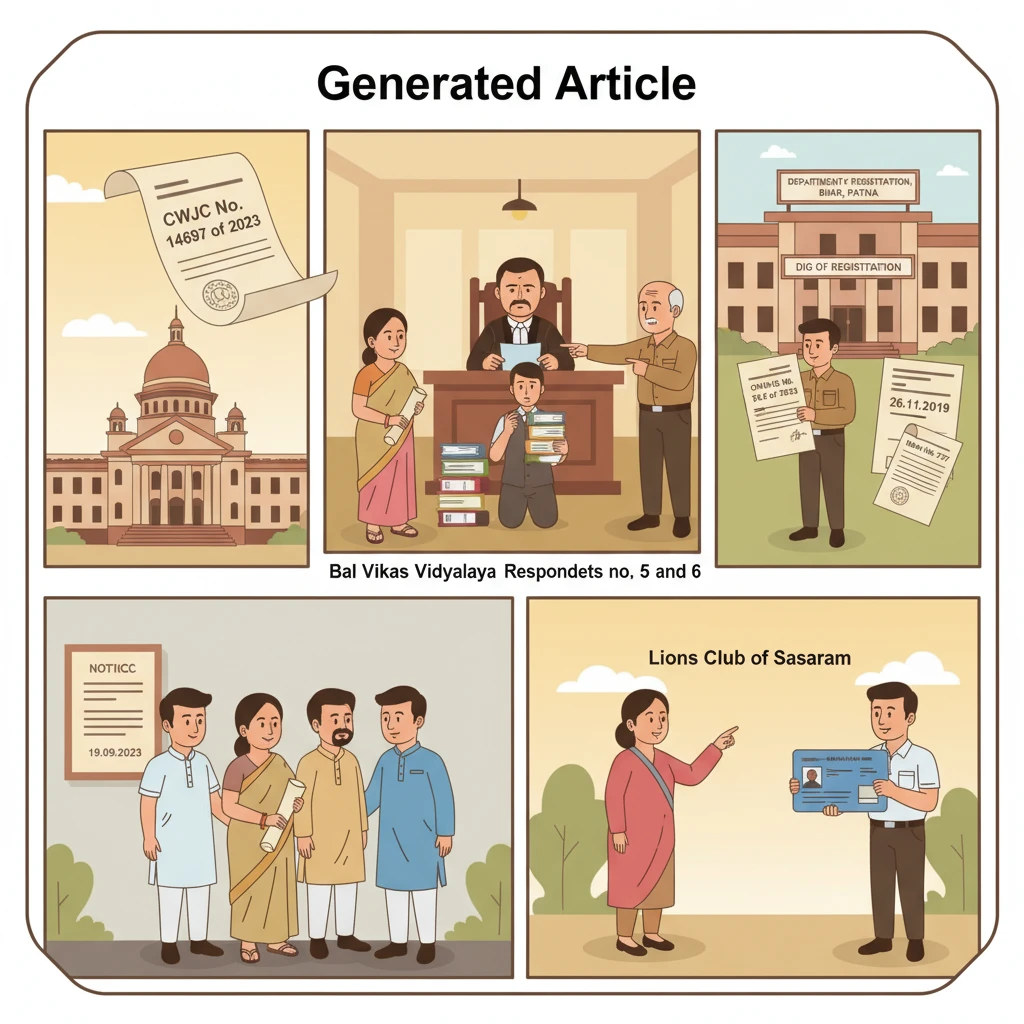
The dispute relates to Bal Vikas Vidyalaya, a co-educational school at Sasaram, run by a registered society called Bal Vikas Vidyalaya Samiti. The society is registered under the Societies Registration Act, 1860 with Registration No. 58 of 1985-86 dated 05.06.1984.
The school’s Managing Director is one of the founder members. Earlier, respondent no. 5 was the Chairman of the Managing Committee. In a meeting dated 09.05.2018, he expressed reluctance to continue. In his place, one L.M. Poddar was made Chairman. This was unanimously confirmed in another meeting dated 15.07.2018.
After this change, respondents no. 5 and 6 objected to the new Managing Committee and the resolutions. Respondent no. 6 lodged complaints on 20.09.2018 before the Inspector General of Registration, and on 15.11.2018 before the Assistant Registrar, Registration Department, Bihar, Patna. He alleged irregularities in the management of the school, including financial irregularities, and sought a government enquiry.
The school (petitioner) filed a detailed reply on 27.02.2019 denying all allegations and challenging the locus of respondent no. 6 to file the complaint, relying on its bye-laws about different categories of members and the role of the Lions Club of Sasaram.
On 18.04.2019, the Assistant Inspector General (AIG), Registration, Patna Division submitted an enquiry report. The Deputy Inspector General (DIG), Registration, then issued a questionnaire on 06.09.2019 to both sides. The petitioner replied on 22.10.2019.
Without granting a personal hearing to the petitioner, the DIG, Registration, issued Memo No. 737 dated 26.11.2019 to the District Magistrate, Rohtas. This communication stated that a decision had been taken to hold elections of Bal Vikas Vidyalaya Samiti, in which only valid members would participate, and requested the District Magistrate to conduct the election.
The petitioner filed an appeal (Registration Case No. 30 of 2019) before the Chairman-cum-Member, Board of Revenue, under Rule 22(ii) of the Bihar Societies Registration Rules, 2018, challenging the letter dated 26.11.2019. On 10.02.2020, the appeal was admitted and the direction to conduct elections was stayed.
Meanwhile, respondent no. 6 filed CWJC No. 7799 of 2023 before the Patna High Court. On 05.07.2023, the High Court directed the appellate authority (Board of Revenue) to decide the pending appeal by a reasoned and speaking order within six months.
On 19.09.2023, the Chairman-cum-Member, Board of Revenue, Patna, disposed of Appeal No. 30 of 2019. He held that the letter dated 26.11.2019 was only a direction to hold elections under Rule 18(iii) of the 2018 Rules, was an interim order and not final, and therefore not appealable under Rule 22. The appeal was held to be not maintainable.
The present writ petition before the Patna High Court (CWJC No. 14697 of 2023) challenges both the Board of Revenue’s order dated 19.09.2023 and the election direction dated 26.11.2019.
What the Court Examined and Decided
The main controversy before the Patna High Court was narrow: whether the letter dated 26.11.2019, directing fresh elections of Bal Vikas Vidyalaya Samiti, was a final “order” of the Inspector General (IG) of Registration appealable under Rule 22 of the Bihar Societies Registration Rules, 2018, or only an interim, non-appealable direction.
The petitioner argued that the letter was in substance a final order of the IG, passed without jurisdiction by the DIG and without reasons or hearing. The State and private respondents argued that it was merely a procedural step under Rule 18(iii) and not an adjudicatory order, so no appeal lay.
The Court first reproduced the relevant rules. Rule 18 applies where there is a dispute about two rival governing or executive bodies of a society. It allows the IG to: ask the District Magistrate to enquire and report; hear the rival bodies; and/or cause re-election in the presence of an observer appointed by the IG. The rule then states that “based on the findings from aforementioned steps, the IG shall pass suitable Order adjudicating the matter.”
Rule 22(ii) provides that “all orders passed by the IG Registration under these rules shall be appealable before the Member, Board of Revenue, whose decision shall be final.” There is no qualification or limitation in this rule about the type of orders.
The petitioner’s side stressed that:
- The complaints of respondent no. 6 related to irregularities and alleged financial issues, not to any request for fresh elections.
- The DIG had no power under Rule 18 to decide; only the IG could pass the “suitable order” after due procedure.
- The 26.11.2019 letter was cryptic, gave no reasons, did not consider the petitioner’s detailed replies, and yet directed fresh elections, which finally affected the rights of the existing Managing Committee.
- An order which decides vital issues or rights and has final effect is appealable, even if styled as an “interim” step.
- Rule 22(ii) uses broad language: “all orders” of the IG are appealable. Supreme Court precedents like Ebrahim Aboobakar, Shiur Sakhar Karkhana, and others show that where appeal provisions are couched in wide terms, all such orders are appealable.
The State, supporting the Board of Revenue’s view, contended:
- The letter dated 26.11.2019 was in exercise of Rule 18(iii) by the IG, merely causing re-election with an observer.
- Such a direction is a prerequisite step to gather material to pass a final order. It does not itself adjudicate the dispute, so it is not an “order” under Rule 22.
- Relying on Supreme Court judgment in State of Maharashtra v. Mahboob S. Allibhoy, they urged that the expression “any order” must be read along with “decision” and not cover every interlocutory step.
The private respondents (no. 5 and 6) supported this line and added detailed facts relating to the history of the school, the role of Lions Club of Sasaram as principal promoter and founder corporate member, and their claim that outsiders were illegally inducted and the bye-laws violated. They emphasised that:
- The AIG’s enquiry report dated 18.04.2019 recommended a general body meeting and reconstitution of the Executive/Managing Committee.
- The DIG’s letter dated 26.11.2019, issued after IG’s approval, only directed elections by the District Magistrate with valid members and an observer. It did not decide rights but merely set in motion the election process.
- Such a step is ministerial and administrative, not a formal adjudicatory order and hence not appealable.
The High Court, however, examined the official note sheet produced from the Registration Department file. This document showed:
- The DIG, Registration, placed a note before the IG recommending elections under Rule 18(iii).
- The IG of Registration approved the proposal on 21.11.2019.
- A draft order for conducting elections of Bal Vikas Vidyalaya Samiti was prepared and approved by the IG on 25.11.2019.
- On this basis, Memo No. 737 dated 26.11.2019 was issued to the District Magistrate, Rohtas, directing conduct of the election of the Samiti in which only valid members would participate.
The Court noted that in the department’s own note sheet, this was described as an “order”, and that the 26.11.2019 letter was only a communication of the IG’s approved order. The petitioner did not dispute the authenticity of this note sheet.
On this foundation, the Court held that the direction to hold re-election under Rule 18(iii) was not a mere procedural or ministerial act. It amounted to a final decision by the IG on how to resolve the dispute between rival bodies—namely, by wiping the slate clean and ordering a re-election under supervision.
The Court pointed out that:
- The 26.11.2019 order contained no reasons for deciding that re-election was necessary.
- It did not disclose any discussion of the petitioner’s stand or the complaint’s maintainability.
- Nevertheless, it finally determined that the existing Managing Committee would be subjected to re-election, which clearly affected the petitioner’s rights and obligations.
The Court applied the settled principle that an order is “final” if it finally decides rights of the parties in the dispute. It referred to the Supreme Court decision in Jethanand and Sons v. State of Uttar Pradesh, and held that the election direction was such a final decision in the context of Rule 18.
Since Rule 22(ii) states that “all orders passed by the IG Registration under these rules shall be appealable”, and there is no limitation or categorisation of appealable orders, the Court concluded that the 26.11.2019 decision was appealable before the Member, Board of Revenue.
On the State’s reliance on Mahboob S. Allibhoy (contempt appeals under Section 19 of the Contempt of Courts Act), the Court distinguished that provision. Section 19 expressly linked appeals to the High Court’s jurisdiction to punish for contempt, and the Supreme Court read “any order” in that narrow context. Here, by contrast, Rule 22(ii) contains no such limiting words and uses a wide formulation.
The Court also distinguished other Supreme Court decisions cited by the private respondents, including Arun Kumar Aggarwal, S.B. Minerals, Shyam Sel & Power Ltd., and Shah Babulal Khimji, noting that those cases dealt with directions or interim orders in very different statutory and procedural settings.
On the argument that the 26.11.2019 communication was only a “ministerial act”, the Court rejected this. It held that:
- The letter conveyed a formally approved decision of the IG.
- That decision directed re-election of the Samiti, which had significant impact on the petitioner’s position.
- It therefore involved the exercise of discretion and adjudication under Rule 18, and was not a mere mechanical step.
The Court finally held that the Board of Revenue had committed a serious error in treating the 26.11.2019 decision as an interim, non-appealable direction. By doing so, it wrongly refused to entertain the petitioner’s statutory appeal.
Accordingly, the Patna High Court:
- Quashed the Board of Revenue’s order dated 19.09.2023 in Registration Case No. 30 of 2019.
- Remitted Appeal Case No. 30 of 2019 back to the Board of Revenue, Bihar, Patna, for fresh adjudication on merits.
- Clarified that nothing said in the judgment should be treated as an opinion on the merits of the underlying dispute between the rival groups.
The writ petition was allowed to this extent only. The Court did not itself decide whether the election direction dated 26.11.2019 was right or wrong on merits. That question is for the Board of Revenue to decide in the pending appeal.
Why This Judgment Matters
This judgment is important for all societies registered in Bihar, especially those running schools and similar institutions. It clarifies that when the Inspector General of Registration orders re-election of a society’s governing body under Rule 18(iii) of the 2018 Rules, such a decision can be challenged in appeal before the Board of Revenue.
For managing committees, this means that they are not left helpless if the Registration Department suddenly directs re-election without giving reasons or proper hearing. They can file an appeal as of right, and the appellate authority must hear whether the direction was justified.
For ordinary members and promoters of societies, the judgment shows that departmental directions that effectively decide a leadership dispute are treated as final “orders”, not mere administrative steps. Such orders must be open to scrutiny in appeal.
Practically, for Bal Vikas Vidyalaya Samiti, elections cannot be forced purely on the basis that the order is “interim” and unchallengeable. The Board of Revenue must now hear both sides, examine the enquiry report, the bye-laws, and all documents, and then decide whether the re-election direction dated 26.11.2019 should stand or be set aside.
Legal Issues and Answers
- Issue: Is the letter dated 26.11.2019 directing re-election of Bal Vikas Vidyalaya Samiti an appealable “order” of the Inspector General under Rule 22(ii) of the Bihar Societies Registration Rules, 2018?
Answer: Yes. The Court held that the 26.11.2019 decision, approved by the IG, is a final order under Rule 18(iii) affecting rights of the parties and, by virtue of Rule 22(ii), is appealable before the Member, Board of Revenue. - Issue: Was the Board of Revenue justified in dismissing Appeal Case No. 30 of 2019 as not maintainable on the ground that the 26.11.2019 direction was only an interim order?
Answer: No. The Court held that the Board of Revenue committed a grave error in treating the 26.11.2019 order as interim and non-appealable, quashed its order dated 19.09.2023, and remitted the appeal for fresh decision on merits.
Cases Cited by the Court
- Ebrahim Aboobakar & Anr. v. Custodian of Evacuee Property, New Delhi, (1952) 1 SCC 798
- Shiur Sakhar Karkhana (P) Ltd. v. SBI, (2020) 19 SCC 592
- Shyam Sel & Power Ltd. & Anr. v. Shyam Steel Industries Ltd., (2023) 1 SCC 634
- Nelson Motis v. Union of India & Anr., (1992) 4 SCC 711
- Shiv Shakti Coop. Housing Society v. Swaraj Developers & Ors., (2003) 6 SCC 659
- Nathi Devi v. Radha Devi Gupta, (2005) 2 SCC 271
- State of Maharashtra v. Mahboob S. Allibhoy and Another, (1996) 4 SCC 411
- Arun Kumar Aggarwal v. State of M.P., (2014) 13 SCC 707
- S.B. Minerals v. MSPL Ltd., (2010) 12 SCC 24
- Shah Babulal Khimji v. Jayaben D. Kania & Anr., (1981) 4 SCC 8
- Jethanand and Sons v. State of Uttar Pradesh, AIR 1961 SC 794
- J.Y. Kondala Rao v. A.P. State Road Transport Corporation, 1960 SCC OnLine SC 66
- Edukanti Kistamma (dead) through LRs. & Ors. v. S. Venkatareddy (dead) through LRs. & Ors., (2010) 1 SCC 756
Case Details
Case Number: Civil Writ Jurisdiction Case No. 14697 of 2023
Case Title: Bal Vikas Vidyalaya through the Managing Director, Gopal Narayan Singh v. The State of Bihar & Ors.
Citation: 2025 (2) PLJR 693
Court: High Court of Judicature at Patna
Coram: Hon’ble Mr. Justice Mohit Kumar Shah
Date of Judgment: 07.04.2025
Nature of the Case: Writ petition under Article 226 of the Constitution challenging an appellate order under the Bihar Societies Registration Rules, 2018 and the underlying election direction.
Impugned Orders:
- Order dated 19.09.2023 passed by Chairman-cum-Member, Board of Revenue, Bihar, Patna in Registration Case No. 30 of 2019.
- Letter/Order dated 26.11.2019 (Memo No. 737) issued by the Deputy Inspector General (Society and Firm Registration), Department of Registration, Bihar, Patna, conveying the IG’s direction to hold elections of Bal Vikas Vidyalaya Samiti.
Advocates:
- For the Petitioner: Mr. Y.V. Giri, Senior Advocate; Mrs. Nivedita Nirvikar, Senior Advocate; Mr. Amish Kumar, Advocate; Mr. Prabhakar Thakur, Advocate; Mr. Aamin Hayat, Advocate.
- For the State (Respondents no. 1 to 4): Mr. Vikash Kumar, Standing Counsel-11.
- For Private Respondents no. 5 & 6: Mr. Mrigank Mauli, Senior Advocate; Mr. Venkatesh Kirti, Advocate.
Statutory Provisions Involved:
- Societies Registration Act, 1860 (registration of Bal Vikas Vidyalaya Samiti).
- Bihar Societies Registration Rules, 2018 — particularly Rule 18 and Rule 22.
Link to Judgment: https://patnahighcourt.gov.in/viewjudgment/MTUjMTQ2OTcjMjAyMyMxI04=-qW1F24zyguU=
If you found this explanation helpful and wish to stay informed about
how legal developments may affect your rights in Bihar,
you may consider following Samvida Law Associates for more updates.







