
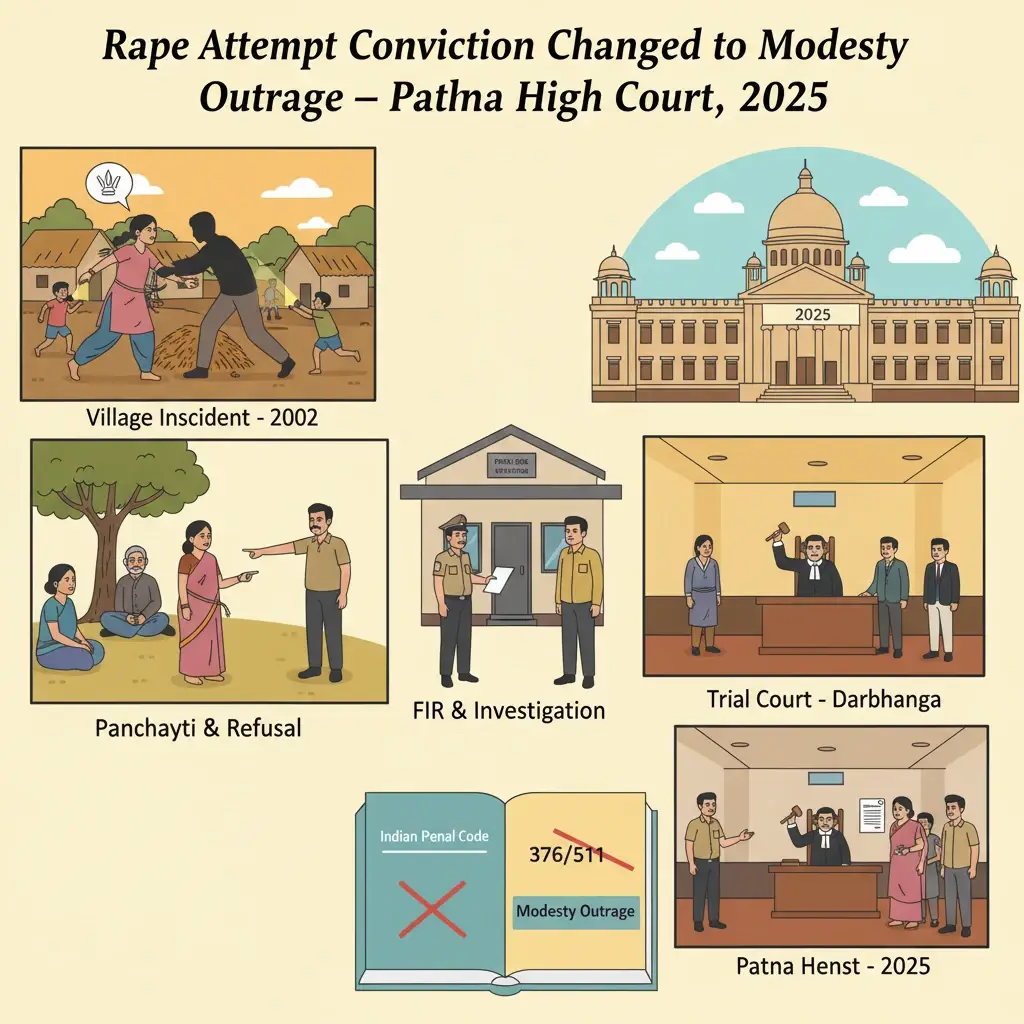
Case Background
This case arose from an incident on the night of 21.03.2002 in a village in Darbhanga district. Around 8 PM, the informant’s minor daughter, aged about 14 years, went out of the house to defecate.
According to the written report (fardbeyan) given by her father, the accused, a man from the same village, was returning in an inebriated condition after drinking toddy. On seeing the girl alone, he allegedly caught hold of her and tried to rape her. When the girl started shouting, her younger brother Hashim reached the spot, and the accused ran away. The girl then came home and narrated the incident to villagers.
On this basis, Singhwara P.S. Case No. 18 of 2002 was registered under Sections 376/511 IPC. After investigation, the police submitted charge-sheet on 31.07.2002 under the same sections.
The Chief Judicial Magistrate took cognizance and committed the case to the Court of the District and Sessions Judge, Darbhanga. It was registered as Sessions Trial No. 218 of 2003 and later transferred to the Additional District and Sessions Judge, Fast Track Court No. 4, Darbhanga, for trial.
By judgment dated 16.01.2008, the trial court held the accused guilty under Sections 376/511 IPC (attempt to commit rape) and sentenced him to rigorous imprisonment for ten years.
The accused then filed this Criminal Appeal (SJ) No. 153 of 2008 before the Patna High Court under Section 374(2) Cr.P.C., challenging both the conviction and the sentence.
What the Court Examined and Decided
The Patna High Court examined in detail the evidence of nine prosecution witnesses and six defence witnesses, as well as the medical evidence, to decide whether the act proved amounted to an “attempt to rape” or only to “outraging modesty”.
Key Prosecution Evidence
PW-1, a villager related to the informant, stated that on the date of occurrence, around 8 PM, he heard the victim shouting. When he reached the spot, he saw the victim lying on weed and the accused on top of her. He said her salwar was open and the accused was attempting to rape her; she was crying. By the time several people arrived, the accused fled.
PW-2, another villager, stated he heard shouts and saw the accused running away while the victim was crying. On asking her, she told him that the accused had forcibly thrown her on the ground and tried to open the string of her salwar. He clarified in cross-examination that he came to know of the act only from the victim and did not try to stop the accused as he did not then know what had happened.
PW-3, the victim’s brother, deposed that he was in the courtyard of his house when he heard his sister shout. He rushed towards the house of one Ramjani and saw the accused fleeing northwards. His sister was lying on leaves, and the string of her salwar was open. She told him the accused had forcibly tried to open the salwar strings and attempted to rape her. He said she was about 14 years old at the time.
PW-4, a cousin of the victim, stated that when he heard the victim’s cries and rushed there, he saw the accused on top of her. On seeing him, the accused ran away. He said other villagers, including PW-1, were present, and later the informant also arrived. In cross-examination he admitted he did not talk to the victim at the spot.
PW-5, the victim’s mother, said her daughter had gone to defecate and, while returning, the accused forcibly threw her on weed and, with the intention of raping her, opened the strings of her salwar. On hearing her cries, she and others rushed and saw the victim crying and the accused running away. The victim told them the accused had tried to rape her. She stated the victim was 14 years old then. However, in cross-examination, she admitted she did not see the actual act of throwing or opening the salwar strings with her own eyes.
PW-6, the victim, gave a direct account. She stated that when she was returning after attending to call of nature and had reached near the door of Ramjani Shah, the accused caught hold of her, pulled her, and threw her on a pile of leaves. With the intention to rape her, he closed her mouth forcefully, tried to open the strings of her salwar, opened them, and then climbed on top of her. She said she pushed him, freed her mouth, and started shouting. On her cries, Qasim, Naseem and her mother came; the accused then ran away. Later, other villagers came and she narrated the incident.
In cross-examination, she admitted the police got her medically examined about one month after the incident and that there were no injury marks on her body. She also stated that a Panchayati was called by her father to resolve the dispute.
PW-7, the informant and father of the victim, stated that his daughter had gone to attend call of nature and, on return, the accused forcibly threw her on the ground and opened the string of her salwar. On her shouts, he and others reached and saw the accused running away and the girl lying on weed with open salwar string. He stated she was about 15 years old at the time. In cross-examination he admitted that he filed the written report on the basis of what his daughter told him and that there were no injury marks on her body.
PW-8, the doctor, examined the victim on 25.04.2002, about a month after the incident. He found no external injuries on her body. On genital examination he found the vagina intact; the vaginal orifice admitted only the tip of the little finger with difficulty. No spermatozoa were found. Based on radiological examination, he opined that the girl was between 14-15 years of age. He clearly stated there was no positive finding to suggest commission of forceful sexual intercourse.
Defence Evidence and Arguments
The defence examined six witnesses, including DW-1, the informant’s brother, and DW-2, an independent witness. The defence case focused on alleged previous enmity and a failed marriage proposal. DW-1 and DW-2 stated that the informant wanted to marry his daughter to the accused, but the accused’s parents refused, and that the criminal case was then falsely lodged.
The appellant’s counsel argued that:
• Most prosecution witnesses were either hearsay or close relatives.
• The investigating officer was not examined, which, according to him, was fatal.
• The medical evidence showed no injuries, no signs of force, intact hymen, and no indication of rape or attempt to rape.
• At most, the accused’s act amounted to “preparation” to commit rape, not “attempt”; he relied on Madanlal v. State of J&K, (1997) 7 SCC 677, to highlight the difference between preparation and attempt.
He therefore asked the Court to set aside the conviction under Sections 376/511 IPC.
State’s Response
The Additional Public Prosecutor opposed the appeal, arguing that the victim’s testimony clearly showed an overt attempt by the accused to commit rape. He also pointed to PW-3’s evidence that he saw the accused on top of his sister, with her salwar strings open. He submitted that the trial court had rightly convicted the appellant for attempt to rape and that the prosecution had proved the case beyond reasonable doubt.
High Court’s Legal Analysis
The High Court first framed the central question: whether the proved act amounted to an “attempt” to commit rape under Section 376(2)(f) read with Section 511 IPC, or only to “preparation” leading to outraging the modesty of the victim.
The Court discussed the distinction between “preparation” and “attempt” with reference to State of M.P. v. Mahendra, (2022) 12 SCC 442, and Koppula Venkat Rao v. State of A.P., (2004) 3 SCC 602. It noted that “attempt” begins where “preparation” ends and involves an overt act going directly towards commission of the offence.
The Court then examined Section 375 IPC and highlighted that penetration is essential to constitute rape. It found that there was no dispute that penetration did not occur in this case.
To decide whether there was an “attempt to rape”, the Court considered whether the accused had gone beyond preparation and taken steps such as undressing himself or the victim in such a way that the act would have resulted in rape but for interruption.
The Court relied on Tarkeshwar Sahu v. State of Bihar (now Jharkhand), (2006) 8 SCC 560, where the Supreme Court held that in absence of any attempt at penetration, and where the accused had not undressed himself or the prosecutrix, conviction under Sections 376/511 IPC was unsustainable.
Applying these principles, the Court noted that in the present case the accused forcibly took the victim near Ramjani Shah’s house, threw her on the ground and opened the strings of her salwar. However, there was no evidence that he undressed himself, nor any act showing an attempt at penetration. The incident was interrupted when the victim raised an alarm and people reached the spot.
On this basis, the Court held that the case did not fulfil the legal requirements of “attempt to rape” under Sections 376/511 IPC.
Conversion to Section 354 IPC
Having found that “attempt to rape” was not made out, the Court then considered whether the accused could still be punished for a lesser related offence based on the same facts.
It invoked Section 222 Cr.P.C., which allows a court to convict an accused of a “minor offence” included in a major offence, even if he was not separately charged with that minor offence, provided the ingredients are proved.
Relying on Shamnsaheb M. Multtani v. State of Karnataka, (2001) 2 SCC 577, the Court explained that a minor offence is one whose main ingredients are common with the major offence, but carries a lesser punishment.
The Court then examined Section 354 IPC, which punishes assault or criminal force to a woman with intention, or knowledge of likelihood, of outraging her modesty. Referring also to various High Court decisions (including Jai Chand v. State, Raja v. State of Rajasthan, Bisheshwar Murmu v. State of Bihar (Jharkhand), Keshab Padhan v. State of Orissa, and Rameshwar v. State of Haryana), the Court highlighted situations where similar acts were treated as offences under Section 354 IPC rather than attempt to rape.
On evaluating the evidence, the Court held that it was proved beyond reasonable doubt that on 21.03.2002 at around 8 PM, the accused, in an inebriated state, caught the minor victim, forcibly threw her on weed, and opened the strings of her salwar with the intention to outrage her modesty. This was corroborated by the victim and other prosecution witnesses and, as noted by the Court, effectively admitted to the extent of presence and incident by the defence stance.
The Court therefore concluded that the accused was clearly guilty of the offence under Section 354 IPC, even though he had originally been charged only under Sections 376/511 IPC.
Non-examination of Investigating Officer
The appellant argued that not examining the investigating officer (IO) was fatal to the prosecution. The Court rejected this contention, relying on Behari Prasad v. State of Bihar, (1996) 2 SCC 317, where the Supreme Court held that non-examination of the IO does not automatically vitiate a trial. Prejudice must be shown on facts.
Here, the Court found that the necessary facts to prove the offence under Section 354 IPC were clearly established by substantive oral evidence. It held that mere absence of the IO’s testimony did not undermine the prosecution case.
Final Decision on Conviction and Sentence
On the basis of this reasoning, the Patna High Court modified the trial court’s judgment. It acquitted the appellant of the charge under Sections 376/511 IPC and instead convicted him for the offence punishable under Section 354 IPC.
On the question of sentence, the Court noted that the appellant had already faced a long trial since 2002 and had suffered custody. Referring to State of U.P. v. Tribhuwan, (2018) 1 SCC 90, and Section 428 Cr.P.C., the Court considered the period already undergone as adequate jail sentence in the circumstances.
The Court, noticing that there was no adverse report about the appellant’s conduct and the long pendency of proceedings, held that his sentence should be confined to the period already undergone, taken as one year. It ordered that the appellant stands discharged from the liabilities of his bail bonds, if any.
Accordingly, the appeal was partly allowed.
Why This Judgment Matters
This judgment is important for victims, families, and accused persons in sexual offence cases in Bihar and beyond.
First, the Patna High Court clearly explained when an act amounts to “attempt to rape” and when it is only “outraging modesty”. It emphasised that for “attempt to rape” there must be acts going beyond preparation, such as undressing and some move towards penetration. Merely throwing a girl down and opening her salwar strings, without any further sexual act, was held to fall short of that standard.
Second, the Court made it clear that such acts still remain serious criminal offences. Even when the higher charge of attempt to rape fails, the court can convict for the lesser but still grave offence of outraging modesty under Section 354 IPC, using Section 222 Cr.P.C.
Third, the decision shows that medical evidence of penetration is not necessary to punish a man for outraging modesty. The victim’s clear testimony and supporting witnesses were enough for conviction under Section 354 IPC, despite there being no injuries or signs of intercourse.
Lastly, the Court balanced punishment with fairness in sentencing. It recognised the long duration of the case and gave credit for time already spent in custody, rather than mechanically imposing the maximum sentence.
Legal Issues and Answers
- Issue: Did the accused’s act of catching the minor girl, throwing her on the ground, and opening her salwar strings amount to “attempt to commit rape” under Sections 376/511 IPC?
Answer: No. The Patna High Court held that there was no evidence of any attempt at penetration or of the accused undressing himself or the victim to that extent. The conduct amounted to preparation and outraging of modesty, not legal “attempt to rape”. - Issue: Could the Court convict the accused under Section 354 IPC even though he was only charged under Sections 376/511 IPC?
Answer: Yes. Applying Section 222 Cr.P.C., the Court held that when the major offence is not proved but the facts establish a minor included offence, the accused may be convicted for that minor offence. Section 354 IPC was treated as a cognate, lesser offence included in the facts of the case. - Issue: Was non-examination of the investigating officer fatal to the prosecution’s case?
Answer: No. Relying on Supreme Court precedent, the Court held that non-examination of the IO does not by itself vitiate the trial. Here, the substantive evidence of the victim and other witnesses sufficiently proved the ingredients of Section 354 IPC.
Cases Cited by the Court
- State of M.P. v. Mahendra, (2022) 12 SCC 442
- Koppula Venkat Rao v. State of A.P., (2004) 3 SCC 602
- Tarkeshwar Sahu v. State of Bihar (Now Jharkhand), (2006) 8 SCC 560
- Shamnsaheb M. Multtani v. State of Karnataka, (2001) 2 SCC 577
- Jai Chand v. State, 1996 Cri LJ 2039 (Delhi High Court)
- Raja v. State of Rajasthan, 1998 Cri LJ 1608 (Rajasthan High Court)
- Bisheshwar Murmu v. State of Bihar, 2004 Cri LJ 326 (Jharkhand High Court)
- Keshab Padhan v. State of Orissa, 1976 Cutt LR (Cri) 236 (Orissa High Court)
- Rameshwar v. State of Haryana, 1984 Cri LJ 786 (Punjab & Haryana High Court)
- Behari Prasad v. State of Bihar, (1996) 2 SCC 317
- State of U.P. v. Tribhuwan, (2018) 1 SCC 90
- Madanlal v. State of J&K, (1997) 7 SCC 677 (relied upon by the appellant’s counsel in argument)
Case Details
Case Number: Criminal Appeal (SJ) No. 153 of 2008
Case Title: Md. Zafre Imam @ Mangla v. State of Bihar
Court: High Court of Judicature at Patna
Bench / Coram: Hon’ble Mr. Justice Ramesh Chand Malviya
Date of Judgment: 29.04.2025
Citation: 2025 (2) PLJR 911
Advocates:
For the Appellant: Mr. Syed Arshad Alam, Advocate; Ms. Anjum Perveen, Advocate; Mr. Kamran Fazal, Advocate
For the State (Respondent): Mr. S. N. Prasad, APP
Nature of Case: Criminal appeal under Section 374(2) Cr.P.C. against conviction and sentence in Sessions Trial No. 218 of 2003 (Singhwara P.S. Case No. 18 of 2002).
Trial Court Result: Conviction under Sections 376/511 IPC; sentence of 10 years’ rigorous imprisonment.
High Court Result: Conviction under Sections 376/511 IPC set aside; appellant convicted under Section 354 IPC instead; sentence reduced to period already undergone (treated as one year); appeal partly allowed; bail bonds discharged.
Link to Judgment: https://patnahighcourt.gov.in/viewjudgment/MjQjMTUzIzIwMDgjMSNO-RvWSmR3334o=
If you found this explanation helpful and wish to stay informed about how legal developments may affect your rights in Bihar, you may consider following Samvida Law Associates for more updates.







