
Case Background
The case arose from a dispute between a private drug supplier and Nalanda Medical College and Hospital, Patna, a government-run institution under the Health Department of the State of Bihar.
The petitioner is the proprietor of a firm engaged in supplying drugs. The business premises are located at Basant Market, Shekhpur, Zero Mile Road, Muzaffarpur. The petitioner approached the Patna High Court by filing Civil Writ Jurisdiction Case No. 20505 of 2021.
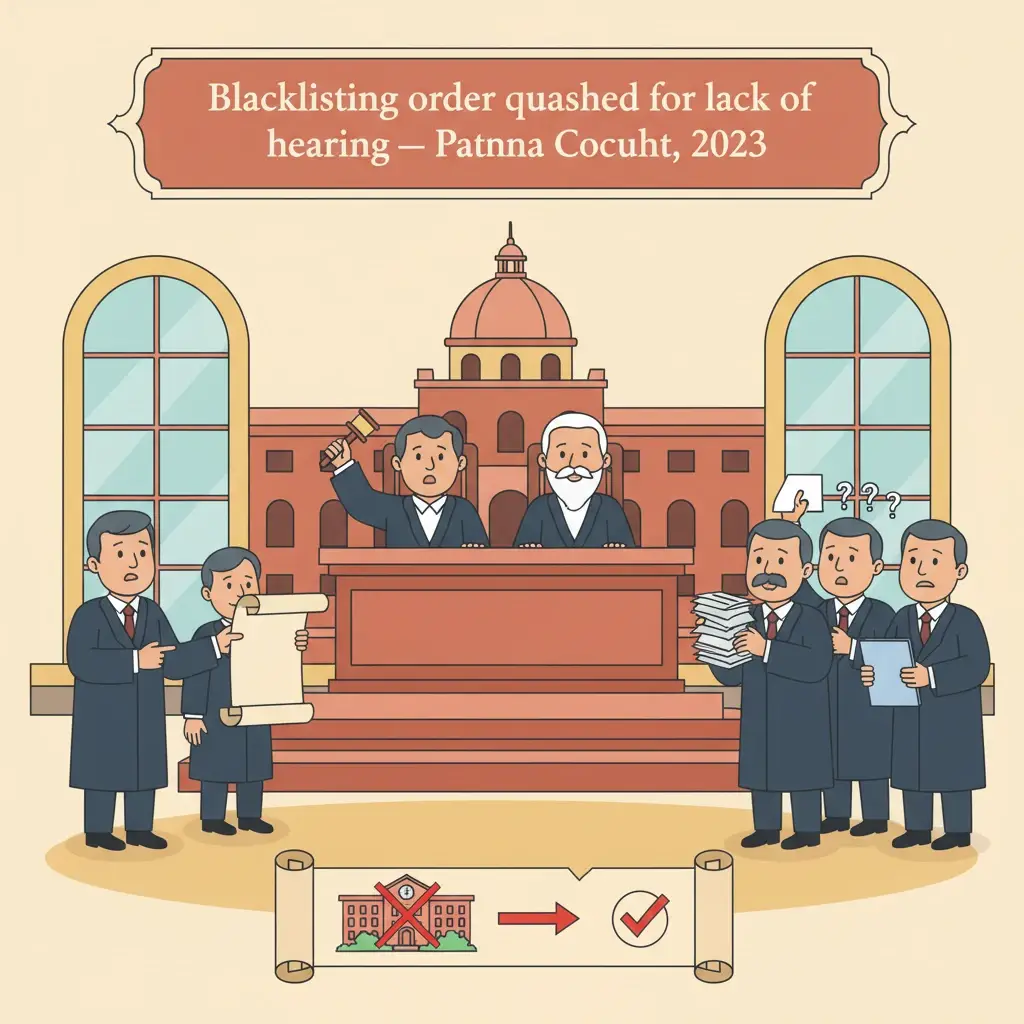
The challenge was directed against an order dated 09.11.2021 passed by the Superintendent, Nalanda Medical College and Hospital, Patna (respondent no. 4). By this order, the petitioner’s firm was blacklisted for a period of five years.
The blacklisting order had serious civil and penal consequences for the petitioner’s business, as it effectively barred the firm from dealing with the hospital for a long period. The petitioner asserted that this drastic step had been taken without giving her any proper notice or opportunity to be heard.
The matter came before a Division Bench of the Patna High Court, consisting of Hon’ble the Chief Justice and Hon’ble Mr. Justice Partha Sarthy. The oral judgment was delivered on 03.01.2023.
What the Court Examined and Decided
The Patna High Court first recorded that it had heard learned counsel for the petitioner and learned Government Advocate representing the State and hospital authorities.
The core of the challenge lay in the procedure followed before issuing the blacklisting order dated 09.11.2021. The respondents claimed that they had issued a notice to show cause and that the petitioner had responded to that notice. However, the Court closely examined whether this claim was supported by the record.
The Court noted that there was an absence of any proof of such show cause notice or reply. Importantly, the Court said that there was no reference in the impugned order itself to any show cause notice or to any reply submitted by the petitioner.
On the other hand, the petitioner, in paragraph 28 of the writ petition, had made a specific statement that she was never issued any show cause notice. This was a clear and direct assertion. The Court considered this averment carefully alongside the conduct of the respondents and the contents of the impugned order.
Since the respondents could not produce proof of service of show cause notice, nor did the blacklisting order itself mention any notice, hearing or consideration of a reply, the Bench inferred that the basic requirement of giving a reasonable opportunity of hearing had not been met.
The Court emphasised that an order blacklisting a person or a firm is not a small or routine step. It carries both civil and penal consequences. Civil consequences arise because blacklisting can severely affect the business reputation and ability to contract with the government. Penal consequences arise because it functions as a sanction or punishment.
Because of these serious effects, such an order cannot be passed lightly or mechanically. The Court underlined that principles of natural justice must be followed. One of the primary principles of natural justice is that the affected party must be given notice of the proposed action and a fair opportunity to present their case before any adverse order is passed.
Here, according to the Court, that principle stood violated. There was a clear allegation by the petitioner that no show cause notice was issued, and the respondents failed to demonstrate otherwise. Further, the blacklisting order made no mention of prior notice, hearings, or reasons arising out of any representation.
On these grounds, the Bench concluded that the impugned order dated 09.11.2021, passed by the Superintendent, Nalanda Medical College and Hospital, Patna, could not be sustained in law. It was vitiated by violation of principles of natural justice.
Accordingly, the Court quashed and set aside the blacklisting order. This quashing meant that, as on the date of the judgment, the five-year blacklisting imposed on the petitioner ceased to have legal effect.
However, the Court did not grant the petitioner immunity from any fresh proceedings. Instead, the Court adopted a balanced approach. It protected the petitioner against the illegal order, but left it open to the authorities to act again, provided they followed due process.
The writ petition was allowed with a set of detailed, mutually agreeable directions, which structured what should happen next.
First, the Court formally quashed the order dated 09.11.2021 (Annexure-18, page 46). This cleared the existing blacklisting from the record.
Second, the Court fixed a clear process for future action. It directed the petitioner to make herself available in the office of respondent no. 4, the Superintendent, Nalanda Medical College and Hospital, Patna, on 16.01.2023 at 10:30 a.m.
On that date, the Superintendent was required to fix a date which would enable the petitioner to present her case. Thus, the Court created a specific time-bound framework so that the authorities could lawfully revisit the issue while respecting the petitioner’s right to be heard.
Third, the Court directed that the petitioner must fully cooperate with the proceedings. This indicates that the Court expected the petitioner to participate actively and not delay or obstruct the process.
Fourth, the Court mandated that after affording an opportunity of hearing to the petitioner, the Superintendent shall pass a fresh order, assigning reasons, within two weeks from the date fixed for hearing. This ensured that any future decision would not be arbitrary and would be supported by clear reasoning.
Fifth, the Court required that the reasoned order be communicated to the petitioner. This is important so that the petitioner knows the basis of any decision and can take further steps, if necessary.
Sixth, the Court expressly reserved liberty to the petitioner to take recourse to such alternative remedies as are otherwise available in accordance with law. This refers to future legal remedies—such as appeal or fresh writ petition—if the petitioner feels aggrieved by the new order.
Seventh, the Court recorded its hope that whenever the petitioner avails such remedies before the appropriate forum, the same will be dealt with in accordance with law and with reasonable dispatch. This underlines the expectation of timely and fair adjudication in later proceedings as well.
Lastly, the Court reserved liberty to the petitioner to approach the Court again, should the need arise later on the same or subsequent cause of action. Thus, the door to the High Court remains open if future developments again violate law or natural justice.
With these directions, the writ petition was disposed of. Any interlocutory applications in the case were also treated as disposed of.
Why This Judgment Matters
This judgment is significant for suppliers, contractors and service providers dealing with government hospitals and departments in Bihar.
The Patna High Court made it clear that blacklisting cannot be imposed secretly or without a fair hearing. Before blacklisting, the authority must issue a show cause notice, allow the affected party to respond, and then pass a speaking order with reasons.
For ordinary businesspersons, this means that if they are suddenly blacklisted without prior notice or hearing, they can challenge such action. The judgment shows that the Court is willing to intervene where basic procedural fairness is missing.
The decision also guides government officers. It reminds them that they must respect principles of natural justice, especially when their orders can destroy business opportunities or damage reputations.
Legal Issues and Answers
- Issue: Whether the order dated 09.11.2021 blacklisting the petitioner for five years by the Superintendent, Nalanda Medical College and Hospital, Patna, could be sustained when there was no proof of issuance of show cause notice or opportunity of hearing.
Answer: No. The Patna High Court held that, in the absence of proof of show cause notice and with a clear plea that no such notice was issued, the blacklisting order violated principles of natural justice and was therefore quashed, with liberty to the authority to pass a fresh reasoned order after hearing the petitioner.
Cases Cited by the Court
- No previous judgments are cited or relied upon in the text of this order.
Case Details
Case Number: Civil Writ Jurisdiction Case No. 20505 of 2021
Case Title: Abha Chaudhary, Proprietor of the Firms Ganpati Drugs vs. The State of Bihar & Ors.
Coram: Hon’ble the Chief Justice; Hon’ble Mr. Justice Partha Sarthy
Citation: 2023 (1) PLJR 763
Advocates: For the petitioner: Mr. Sanjay Kumar, Advocate; For the respondents: Mr. Rajeshwar Singh, GA-10
Nature of the Case: Writ petition (Civil Writ Jurisdiction) challenging a blacklisting order passed by a government hospital authority.
Judgement Link ; https://patnahighcourt.gov.in/viewjudgment/MTUjMjA1MDUjMjAyMSMxI04=-U4d–ak1–KLORO80=
If you found this explanation helpful and wish to stay informed about
how legal developments may affect your rights in Bihar,
you may consider following Samvida Law Associates for more updates.







