
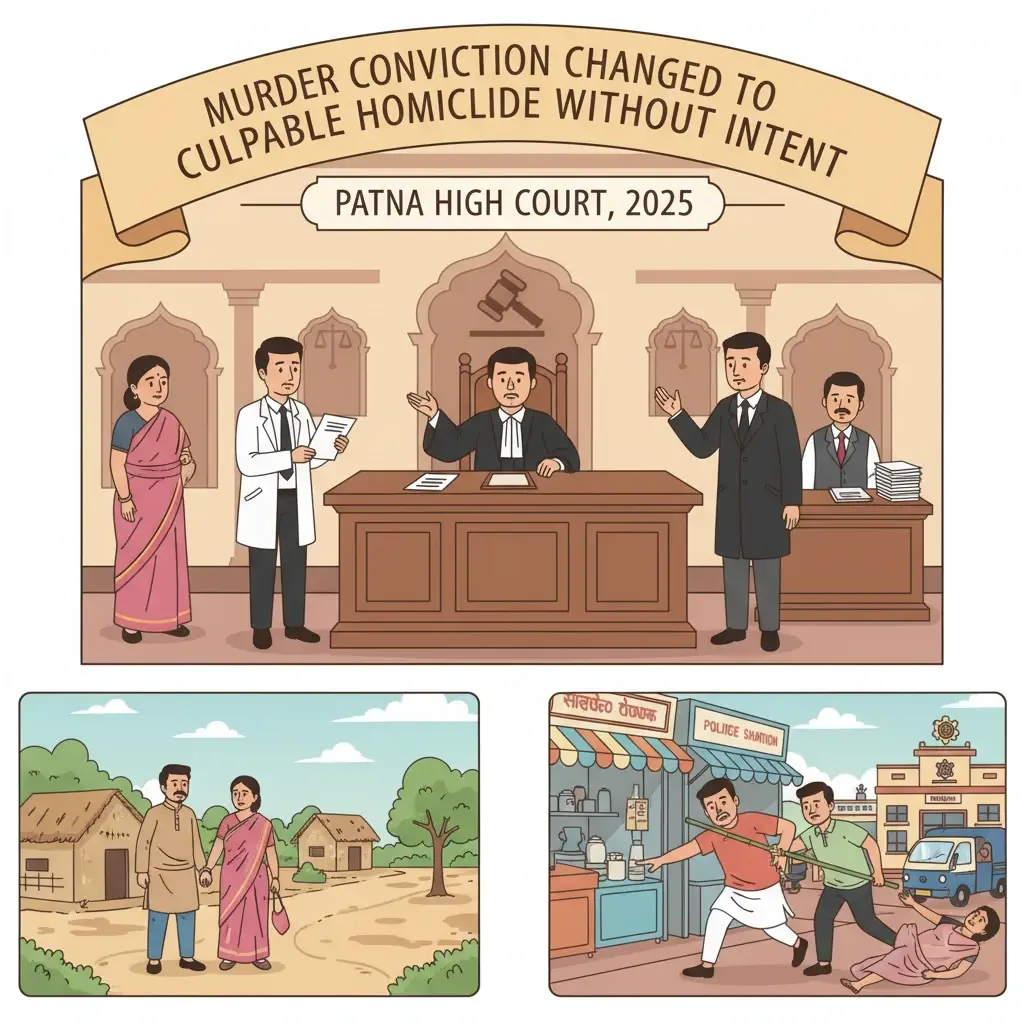
Case Background
This case arose from a village incident in Baruraj, District Muzaffarpur, on 08.06.2012. The informant, Md. Ramjan, lived with his wife, Julekha Khatoon. The appellant, Md. Jamshed Alam, was their neighbour.
On the morning of 08.06.2012, around 11:00 a.m., according to the fardbeyan, the informant and his wife were sitting at the door of their house. The appellant came and asked Julekha to come with him, saying he had to talk to her. She went with him towards his house.
Soon after, the informant heard his wife raising an alarm. He rushed towards the place and says he saw his wife being assaulted by the appellant and some of his family members with fists, slaps and legs. He intervened, stopped the quarrel, and started taking his injured wife towards the police station.
When they reached Sahdeo Chowk at about 11:30 a.m., the informant says the appellant came running there and struck Julekha with a bamboo stick on her head and neck. She fell to the ground injured. The informant then took her in a tempo towards the Primary Health Centre, Motipur, but she died on the way.
The informant brought the dead body back to the police station on the same tempo. His fardbeyan was recorded at about 12:00 noon on 08.06.2012, on the basis of which Baruraj P.S. Case No. 38 of 2012 was registered under Section 302/34 IPC against the appellant and others.
After investigation, the police submitted charge sheet against the appellant under Sections 341, 323, 504 and 302/34 IPC on 15.11.2012. Cognizance was taken on 23.11.2012. The case was committed to the Sessions Court and numbered as Sessions Trial No. 160 of 2013. Charges under Sections 341/34, 504, 323/34 and 302/34 IPC were framed against the appellant on 04.04.2013. He pleaded not guilty and claimed trial.
The 7th Additional Sessions Judge, Muzaffarpur, by judgment dated 09.03.2017, convicted the appellant under Section 302 IPC and, by order dated 10.03.2017, sentenced him to life imprisonment with a fine of Rs. 10,000/-, and in default, further rigorous imprisonment for one year.
Aggrieved, the appellant filed Criminal Appeal (DB) No. 541 of 2017 before the Patna High Court under Section 374(2) Cr.P.C., challenging both the conviction and sentence.
What the Court Examined and Decided
The Division Bench of the Patna High Court (Hon’ble Mr. Justice Mohit Kumar Shah and Hon’ble Mr. Justice Nani Tagia) carefully re-examined the oral and documentary evidence. Fourteen prosecution witnesses were considered, along with the postmortem report, seizure lists and the fardbeyan.
The Court first looked at the key eyewitnesses relied upon by the prosecution: PW-1 (informant and husband of the deceased), PW-4 (nephew of the deceased), PW-6 (sister-in-law of the informant) and PW-8 (brother-in-law of the deceased).
PW-1 deposed that the appellant came to his house and called his wife, saying his mother was calling her. His wife went along with a child, Rakibul Islam. After some time, the child came back crying, saying “they” were assaulting his mother. PW-1 went and saw his wife injured and crying, with her head broken. She told him that several persons, including the appellant, had assaulted her. He then started bringing her back and, at Sahdeo Chowk near a tea stall, the appellant arrived and hit her with a bamboo stick on her head and neck. She fell unconscious. PW-1 stated he lifted her on his shoulder, took her to the police station, and then, on the advice of staff, to the hospital, where the doctor declared her dead.
In cross-examination, PW-1 accepted that there had been previous tension between him and the appellant regarding water from his hand pump flowing into the appellant’s field, and also about his son’s relationship and court marriage with the appellant’s sister. He also admitted that his wife had walked to Sahdeo Chowk and was made to sit at a shop before the bamboo stick assault.
PW-4 stated that he was going to Motipur and had stopped at Sahdeo Chowk to eat paan. He saw his aunt, Julekha, sitting at the shop of one Vishwanath and drinking water. He testified that the appellant came there and assaulted her with a bamboo stick on her neck and temporal region, causing her to fall unconscious. He said the informant then lifted her on his shoulder, took her to the police station, and later to the hospital on a tempo, where she was declared dead. He candidly admitted he had not seen what happened at the appellant’s house earlier.
PW-6, the sister-in-law of the informant, claimed in court that she saw both the initial beating at the appellant’s house and the later bamboo stick blow at Sahdeo Chowk. However, when her earlier statement under Section 161 Cr.P.C. was put to the Investigating Officer (PW-11), it emerged that she had earlier said she was working elsewhere and only came to know from others that Jamshed had killed the deceased at Sahdeo Chowk. The High Court treated this as a major contradiction and considered her testimony unreliable as an eyewitness.
Similarly, PW-8, the brother-in-law of the deceased, claimed at trial that he had seen the deceased being beaten at the appellant’s house and again assaulted with a brick and then a bamboo stick on the way. But PW-11 deposed that PW-8 had not said this in his police statement. Instead, PW-8 had earlier stated that he was plucking moong in his field, and on being told by a child that his mother had died, he came and saw the deceased lying near the shop of Vishwanath. The Court held that such material contradictions made PW-8’s testimony unsafe to rely upon for proving the alleged assaults.
Other witnesses like PW-2, PW-3, PW-5, PW-7, PW-9, PW-10, PW-12 and PW-13 largely gave hearsay accounts or spoke of formal aspects like seizure lists or inquest reports. Many of them admitted they had not actually seen the assault. The Court, therefore, held that their evidence had no direct value for fixing the appellant’s guilt, though it supported the surrounding circumstances such as the seizure of a blood-stained bamboo stick and blood-soaked earth.
The Investigating Officer, PW-11, confirmed the recording of the fardbeyan, registration of the FIR, preparation of seizure lists, inquest report, and collection of blood-soaked soil and the bamboo stick. The seized items were produced in court as Material Exhibit-I (bamboo stick) and Material Exhibit-II (blood-soaked soil).
The medical evidence came from PW-14, Dr. Pramod Kumar, who conducted the postmortem on 09.06.2012 at SKMCH, Muzaffarpur. He found one external ante-mortem injury: a lacerated wound on the occipital bone of the skull, 2″ x 1″ x bone deep. On internal examination, he found that the left 4th, 5th and 6th ribs were fractured, the left lung was lacerated and the chest cavity full of blood and clots. The occipital bone of the skull was fractured and brain tissues in that area were lacerated. He opined that death was due to haemorrhage and shock caused by these injuries, inflicted by a hard and blunt substance. He also stated there was only one external injury, and there was no injury on the neck or temporal region.
The High Court then separated the case into two stages: first, the alleged assault at the appellant’s house; second, the assault at Sahdeo Chowk where the bamboo stick blow was said to have been given.
For the first stage at the appellant’s house, the Court found that there was no reliable eyewitness evidence. The testimonies of PW-6 and PW-8, who tried to support this part, were riddled with contradictions when compared with their earlier police statements. So, the Court did not treat that earlier alleged beating as proved for the purpose of fixing criminal liability.
For the second stage at Sahdeo Chowk, the Court focused on PW-1 and PW-4. Both placed the appellant at Sahdeo Chowk, and both said he hit Julekha with a bamboo stick, causing her to fall and later die. Their versions about this incident were consistent with each other and, in the Court’s view, withstood cross-examination. The defence could not shake their core account of the bamboo stick assault.
Although there was some difference between their description (head and neck versus head and neck/temporal region) and the medical finding (one external injury on the back of the head, no neck or temporal injury), the Court held that this did not destroy their credibility. The essential fact – a hard, blunt blow with a bamboo stick to the head area at Sahdeo Chowk, followed by collapse and death – matched the medical opinion that a hard, blunt blow caused the skull and internal injuries leading to haemorrhage and shock.
On this basis, the Court held that the prosecution had proved beyond reasonable doubt that the appellant assaulted the deceased with a bamboo stick at Sahdeo Chowk and that this assault caused her death.
The remaining question was the nature of the offence. The trial court had convicted the appellant under Section 302 IPC (murder), implying an intention to cause death or such bodily injury as is sufficient in the ordinary course of nature to cause death. The defence argued before the High Court that there was no premeditation and that the appellant gave only a single blow. It was also urged that the background dispute related to water flow from a hand pump and the informant’s son eloping and marrying the appellant’s sister, suggesting provocation and tension rather than a planned killing.
The High Court accepted that the incident was not pre-planned, that only one blow was given on a vital part, and that the appellant had not repeatedly assaulted the deceased with the bamboo stick. The Court concluded that the appellant had knowledge that such a blow was likely to cause death, but it was not proved that he had the intention to cause death. On this reasoning, the Bench held that the case fell under Section 304 Part-II IPC (culpable homicide not amounting to murder, where there is knowledge but no intention), not Section 302 IPC.
Accordingly, while affirming the appellant’s involvement in causing the death, the High Court set aside his conviction under Section 302 IPC and the life sentence with fine. It instead convicted him under Section 304 Part-II IPC and sentenced him to 10 years’ rigorous imprisonment. Since he was already in custody, he was directed to serve the remaining period of this reduced sentence. The appeal was thus partly allowed.
Why This Judgment Matters
This judgment is important for people facing serious criminal charges, especially in village disputes or family-related clashes. The Patna High Court shows that even if a death is clearly caused by an accused, the exact nature of the crime still depends on intention and the manner of the assault.
Here, the Court did not blindly uphold a murder conviction just because the victim died. It closely read the witness statements and medical report. Where witnesses changed their statements or added new details later, the Court rejected those parts. Only the consistent, trustworthy parts were accepted.
At the same time, the Court did not let the appellant go free. It found that he did hit the woman with a bamboo stick, and that this blow caused her death. For that, he must face a serious punishment. But because there was no proof of clear intention to kill, the offence was treated as culpable homicide not amounting to murder, with a fixed term of 10 years instead of life imprisonment.
This decision will matter to accused persons, their families and victims’ families in Bihar and beyond. It underlines that:
– Courts will differentiate between an intentional killing and a serious assault that leads to death without a clear intent to kill.
– Contradictions between court testimony and earlier police statements can significantly weaken a witness’s reliability.
– Medical evidence and eyewitness accounts must broadly match; if they do, the Court can rely on them even if there are small differences.
Legal Issues and Answers
-
Issue: Did the prosecution prove beyond reasonable doubt that the appellant caused the death of the informant’s wife by assaulting her with a bamboo stick at Sahdeo Chowk?
Answer: Yes. The Patna High Court held, based mainly on the consistent and reliable testimony of PW-1 and PW-4, supported by seizure of a blood-stained bamboo stick and the postmortem report, that the appellant assaulted the deceased with a bamboo stick at Sahdeo Chowk, causing injuries that led to her death. -
Issue: Was the appellant rightly convicted for murder under Section 302 IPC, or did the facts disclose a lesser offence under Section 304 Part-II IPC?
Answer: The Court held that the case fell under Section 304 Part-II IPC. It found that although the appellant had knowledge that his act was likely to cause death, the evidence did not prove an intention to cause death, especially as only a single blow was inflicted and the incident was not premeditated. The conviction was therefore altered from Section 302 IPC to Section 304 Part-II IPC, with the sentence reduced to 10 years’ rigorous imprisonment.
Cases Cited by the Court
- Camilo Vaz vs. State of Goa, (2000) 9 SCC 1
- Rampal Singh vs. State of U.P., (2012) 8 SCC 289
- Ankush Shivaji Gaikwad vs. State of Maharashtra, (2013) 6 SCC 770
- Chenda vs. State of Chhattisgarh, (2013) 12 SCC 110
- Surain Singh vs. State of Punjab, (2017) 5 SCC 796
- Anbazhagan vs. State, 2023 SCC OnLine SC 857
- Velthepu Srinivas vs. State of Telangana, 2024 SCC OnLine SC 107
Case Details
Case Number: Criminal Appeal (DB) No. 541 of 2017 (arising out of Baruraj P.S. Case No. 38 of 2012; Sessions Trial No. 160 of 2013)
Case Title: Md. Jamshed Alam vs. The State of Bihar
Court: High Court of Judicature at Patna
Coram: Hon’ble Mr. Justice Mohit Kumar Shah; Hon’ble Mr. Justice Nani Tagia
Date of High Court Judgment: 06.03.2025
Trial Court: Court of 7th Additional Sessions Judge, Muzaffarpur
Trial Court Judgment and Sentence: Judgment of conviction dated 09.03.2017 and order of sentence dated 10.03.2017 under Section 302 IPC, sentencing the appellant to life imprisonment with fine of Rs. 10,000/- and in default, further rigorous imprisonment for one year.
High Court Outcome: Conviction under Section 302 IPC set aside; appellant convicted under Section 304 Part-II IPC and sentenced to 10 years’ rigorous imprisonment. Appeal partly allowed.
Citation: 2025 (2) PLJR 384
Advocates:
For the Appellant: Mr. Hari Kishore Thakur, Advocate
For the Respondent/State: Mr. Dilip Kumar Sinha, APP
Nature of the Case: Criminal appeal (Division Bench) under Section 374(2) Cr.P.C. against judgment of conviction and sentence in a Sessions trial for homicide.
Relevant Statutory Provisions: Sections 302, 304 Part-II, 341, 323, 504, 34 of the Indian Penal Code; Section 374(2) of the Code of Criminal Procedure, 1973; Section 161 Cr.P.C. (for witness statements considered in contradiction).
Link to Judgment: Click here to read the full Patna High Court judgment
If you found this explanation helpful and wish to stay informed about
how legal developments may affect your rights in Bihar,
you may consider following Samvida Law Associates for more updates.







