
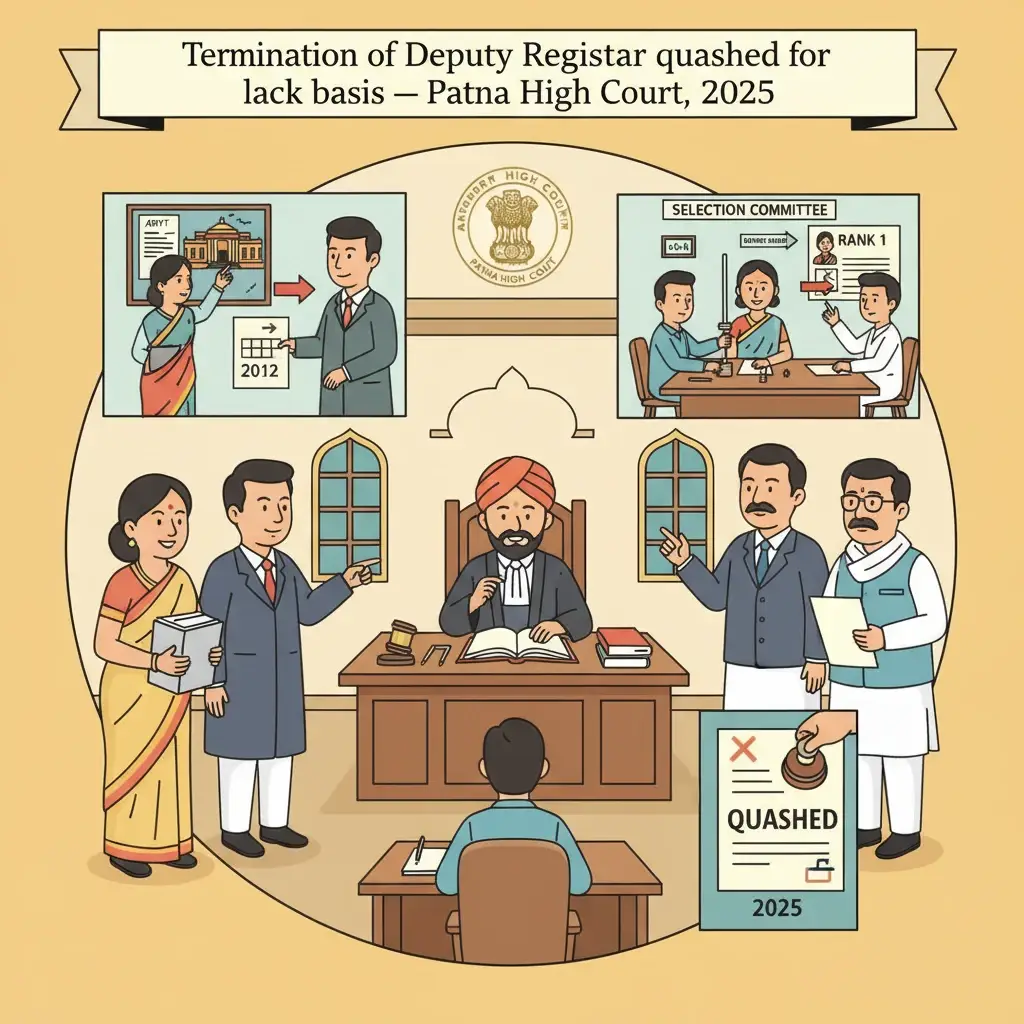
Case Background
The petitioner originally served as a Child Development Project Officer (CDPO) in the Department of Social Welfare, Government of Bihar. She was selected through BPSC, stood topper in the final merit list, and was appointed as CDPO by Memo No. 1689 dated 11.10.2000. She joined on 24.10.2000 in the pay scale of Rs. 6500-10500 and completed over 13 years of unblemished service by 2013.
After 10 years of service, she received the first Assured Career Progression (ACP) in PB-2 with Grade Pay of Rs. 5400. While she was working as CDPO, Aryabhatta Knowledge University (AKU), Patna, issued an advertisement on 19.08.2011 for several academic, administrative, and non-teaching posts, including Deputy Registrar.
The advertisement required a Master’s degree with at least 55% marks and either nine years’ experience as Assistant Professor with educational administration experience, comparable experience in research or higher education institutions, or five years’ administrative experience as Assistant Registrar or on an equivalent post. The general conditions (Clause 8(i) of Section A) empowered the University to relax minimum qualification and/or experience on the recommendation of the Screening/Selection Committee.
The petitioner, who held a Master’s degree in first division, along with M.Phil. and Ph.D. from Jawaharlal Nehru University, New Delhi, and had more than 11 years’ administrative experience in a higher pay scale than an Assistant Registrar, applied for the post of Deputy Registrar. Her application was forwarded by the State Government on 13.12.2012.
A duly constituted Selection Committee of the University interviewed candidates. The petitioner secured the highest marks and was placed at the top of the merit list. The Executive Council, constituted by the State Government, approved the recommendation, and the petitioner was appointed as Deputy Registrar on a sanctioned post in Pay Band-3 with Grade Pay of Rs. 7600 by letter dated 08.10.2013. The State Government, by Memo No. 5152 dated 18.10.2013, allowed her to join on deputation while retaining her lien as CDPO. She joined as Deputy Registrar on 19.10.2013.
In 2017, after satisfactory service during probation, the University issued letters dated 31.01.2017 confirming her on the post of Deputy Registrar with effect from 18.10.2014 and asked her to resign from the CDPO post to avoid complications. She resigned on 02.02.2017, and the State Government accepted her resignation by Memo No. 2328 dated 31.05.2017 with effect from 18.10.2013, the date of initial appointment as Deputy Registrar.
What the Court Examined and Decided
After her confirmation, objections were raised against her appointment through audit and complaints.
First, an audit objection dated 18.08.2017 questioned her appointment. The University Registrar replied on 19.08.2017, stating that she had drawn a pay scale higher than that of an Assistant Registrar for more than 10 years and fulfilled all eligibility conditions as per UGC norms. This had been examined by the Selection Committee and Executive Council at the time of appointment. The Senior Audit Officer, Accountant General (Audit), Bihar, examined this and did not raise further objection in the final audit report.
Second, a complaint reached the Governor’s Secretariat/Chancellor. On 25.01.2018, the Registrar submitted a detailed report affirming her educational qualifications, administrative experience, and valid appointment. It also recorded her confirmation as Deputy Registrar and her resignation from the government post. The Chancellor took no adverse action at that time.
Later, a public interest litigation, CWJC No. 5406 of 2020, was filed in which the petitioner was arrayed as a respondent. The University’s counter and supplementary counter affidavits again defended her appointment as valid on the basis of the advertisement and regulations. Another writ petition, CWJC No. 334 of 2022, challenged her appointment. This was disposed of by the Court on 13.01.2022 without entering into merits, giving liberty to the petitioner therein to make a representation before the Chancellor or any statutory authority.
On this liberty, a representation dated 28.01.2022 was filed before the Chancellor. According to the petitioner, earlier inquiries and favourable reports were suppressed in that representation.
The Governor’s Secretariat then sought a comprehensive report from AKU by letter dated 25.03.2022. The University issued a show cause notice to the petitioner on 08.04.2022. She filed her reply on 18.04.2022. The University, however, in its report dated 26.08.2022, opined that the petitioner lacked the minimum experience required for the post of Deputy Registrar, stating that her CDPO experience could not be treated as equivalent to Assistant Registrar experience.
On 03.10.2023, the petitioner filed a detailed written submission before the Chancellor. She reiterated that her CDPO post was higher in pay and rank than Assistant Registrar, that she had gained administrative experience far exceeding the five years required, that a duly constituted Selection Committee and the Executive Council had appointed her, and that the advertisement itself allowed relaxation of qualification and experience. She also highlighted that she was confirmed and compelled to resign from her secure government post, making reversion impossible.
Despite this, the Chancellor passed an order dated 26.09.2023 holding that she met the educational qualification but did not have work experience in the educational field. The Chancellor viewed CDPO as merely a supervisory authority over Anganwadi Centres with no connection to higher education administration and concluded that CDPO and Assistant Registrar posts were not equivalent. The Chancellor therefore cancelled her appointment. This order was communicated to AKU through letter dated 03.01.2024, and the University, in its 49th Executive Council meeting on 05.01.2024, resolved to terminate her services. A notification was issued vide Memo No. 120 dated 06.01.2024 terminating her with immediate effect.
The petitioner challenged both the Chancellor’s order dated 26.09.2023 and the termination notification dated 06.01.2024 before the Patna High Court. She argued that:
- Her CDPO post was higher in pay scale than Assistant Registrar and therefore “equivalent”, as understood in the advertisement and under the Bihar State University Act, 1976.
- The advertisement expressly allowed relaxation of minimum qualification and experience, and her selection was after full consideration by an expert Selection Committee and approval by the Executive Council.
- Earlier audit and Chancellor-level inquiries in 2017 and 2018 had cleared her appointment, but these were deliberately concealed by officials in the later proceedings.
- The complaint was filed after nearly a decade of service and should be treated as stale.
- She had legitimately changed her position by resigning from her permanent government job on the University’s direction, creating a strong case of promissory estoppel and legitimate expectation.
- The Chancellor lacked jurisdiction to decide equivalence of posts and to terminate her, as these matters fall within the domain of expert committees and the University Statutes.
- The order was ante-dated to 26.09.2023 though communicated only on 06.01.2024, and her written submissions dated 03.10.2023 showed that the matter was not decided by 26.09.2023, violating the Supreme Court’s directions in Anil Rai v. State of Bihar regarding timely pronouncement of reserved orders.
The Chancellor’s side argued that the petitioner did not meet the prescribed experience: she had no experience as Assistant Professor, no experience in research establishments or higher education institutions, and no five years’ experience as Assistant Registrar. They insisted that CDPO work related to child development and Anganwadi supervision was not equivalent to higher education administration, and that the University’s later report correctly found her ineligible. They also referred to an inspection report of the Accountant General (Audit) to suggest that the earlier audit had not fully accepted the University’s justification.
The University (Vice Chancellor and Registrar) in its affidavit, however, confirmed that the original selection process was proper. Twelve candidates appeared before a Selection Committee constituted under Section 22(b) and 22(b)(iii) of the AKU Statute, 2011. The petitioner secured first rank based on academic record, experience, and interview. The Executive Council approved the recommendation on 03.10.2013 and appointment letter was issued on 08.10.2013. On pay fixation, the University stated that only the issue was lack of prior State approval, which was later obtained; no specific objection was sustained against the petitioner’s pay.
The Court carefully examined the statutory framework. Section 2(am) of the Bihar State University Act, 1976 defines “other equivalent post” as any post whose scale of pay is equivalent or may be declared so by the State Government. Comparing pay scales, the Court noted that CDPO carried an unrevised scale of Rs. 6500–10500, later PB‑2 with Grade Pay Rs. 4800 and then Rs. 5400 under ACP, whereas the Assistant Registrar’s unrevised scale was Rs. 5500–9000, later PB‑2 with Grade Pay Rs. 4200. Thus, even after revision, the CDPO post had a higher pay scale. This supported treating CDPO as an equivalent or superior post for experience purposes.
The Court also examined Clause 8(i) of the advertisement’s general conditions, which expressly allowed the University to relax minimum qualifications and/or experience on the Selection Committee’s recommendation. The Selection Committee had been properly constituted under the AKU Statute; there was no allegation of mala fides or irregular constitution. Relying on Supreme Court judgments such as Dalpat Abasaheb Solunke, M.V. Thimmaiah, and Commissioner of Police v. Raj Kumar, as well as decisions of the Patna High Court, the Court reiterated that it is not open to courts or external authorities to sit in appeal over expert Selection Committee decisions or to reassess comparative merits, absent illegality, mala fides, or procedural irregularity.
The Judge found that in this case the Selection Committee did not even have to formally relax the eligibility because the petitioner’s CDPO role, with higher pay and substantial administrative responsibilities, satisfied the “equivalent post” requirement. Even if there was any doubt at the time of appointment, her nearly ten years’ actual service as Deputy Registrar had by now cured any alleged deficiency through efflux of time, reinforcing the equitable considerations raised by the petitioner with reference to Supreme Court cases such as Buddhi Nath Chaudhary and Vivek Kaisth.
On delay and concealment, the Court held that the challenge to her appointment almost a decade later, after previous favourable inquiries in 2017 and 2018, was tainted with malice. The Court observed that concerned officials had deliberately concealed the earlier audit and Chancellor-level reports that supported the petitioner, thereby misleading the Chancellor into passing an erroneous order. This, combined with the long delay, justified interference on principles of equity.
The Court also closely examined the allegation of ante-dating. The records from Raj Bhawan showed that the matter was heard on various dates and order was reserved on 26.09.2023. The petitioner’s written arguments were submitted on 03.10.2023, yet the order bore the date 26.09.2023 and was communicated only on 06.01.2024. When questioned, the Officer on Special Duty (Judicial) and Officer on Special Duty (University) from the Governor’s Secretariat could not give any satisfactory explanation and only offered oral apologies. The Court concluded that the order had been ante-dated to avoid violating the Supreme Court’s binding directions in Anil Rai on pronouncing reserved judgments within a reasonable time.
The Court strongly criticised the functioning of the Governor’s Secretariat in this case. It held that the Officers on Special Duty (Judicial) and (University) had failed in their duty to present accurate facts, statutory provisions, and relevant precedents to the Chancellor, had concealed crucial material, and had thereby made the Chancellor pass an unlawful order. The Court found them unfit for their positions and directed that they be sent for appropriate training. It also directed that a copy of the judgment be placed before the Hon’ble Acting Chief Justice regarding the Officer on Special Duty (Judicial), and before the Hon’ble Chancellor through the Principal Secretary to the Governor regarding the Officer on Special Duty (University), for appropriate action.
Ultimately, the Court held that the Chancellor’s order dated 26.09.2023 and the University’s termination notification dated 06.01.2024 were illegal, arbitrary, non-est in the eyes of law, and violative of Articles 14 and 16 of the Constitution. The writ petition was allowed, both impugned orders were set aside, and the respondents were directed to reinstate the petitioner with all consequential benefits forthwith.
Why This Judgment Matters
This judgment has major practical importance for government employees and university officers in Bihar and beyond.
First, it confirms that long-settled appointments, especially those made through proper selection by expert bodies and followed by years of satisfactory service, cannot be lightly reopened after a decade. Late complaints and stale disputes will be viewed with suspicion, especially where earlier inquiries had cleared the employee.
Second, the Patna High Court clarifies that experience in an “equivalent post” is not limited to university titles but should be assessed through objective criteria like pay scale, responsibilities, and statutory definitions. For officers moving from government services to universities, this gives clearer protection where their pay scale and status are higher than the advertised post.
Third, the judgment reinforces that Selection Committees, properly constituted under statutes, enjoy primacy in evaluating eligibility and merit. External authorities, including the Chancellor, cannot casually override their decisions without clear illegality, mala fides, or statutory violation.
Fourth, it strengthens the doctrines of promissory estoppel and legitimate expectation in service matters. Where an institution confirms an employee and compels resignation from a permanent government post, it cannot later deny the very basis of that appointment without strong legal justification.
Finally, the judgment sends a strong signal to the Governor’s Secretariat and all quasi-judicial authorities: ante-dating orders and concealing crucial records are serious lapses. Officers assisting the Chancellor must act with integrity and competence, or face consequences and corrective measures. For employees facing similar delayed challenges to their appointments, this decision of the Patna High Court provides a clear precedent and reassurance.
Legal Issues and Answers
- Issue: Whether the petitioner’s past service as CDPO could be treated as experience on an “equivalent post” to Assistant Registrar for eligibility to the Deputy Registrar post under the 2011 advertisement.
Answer: Yes. The Court held that CDPO carried a higher pay scale than Assistant Registrar under the Bihar State University Act definition of “equivalent post”, and her administrative experience satisfied the advertised requirement. - Issue: Whether the Chancellor and University could cancel the petitioner’s appointment and terminate her service nearly 10 years later on the ground of lack of initial experience.
Answer: No. The Court held the cancellation and termination orders illegal, arbitrary, non-est, vitiated by delay, concealment, and improper interference with Selection Committee decisions, and violative of Articles 14 and 16. - Issue: Whether the alleged ante-dating of the Chancellor’s order and conduct of officers in the Governor’s Secretariat warranted judicial censure and directions.
Answer: Yes. The Court found that the order was ante-dated to evade the Supreme Court’s directions in Anil Rai, and that the Officers on Special Duty had misled the Chancellor. The Court directed their training and referred the matter to the Hon’ble Acting Chief Justice and the Hon’ble Chancellor for appropriate action.
Cases Cited by the Court
- Anil Rai v. State of Bihar, 2001 (7) SCC 318
- Maitreyee Chakraborty v. Tripura University and Others, (2024) INSC 616
- Ram Pravesh Singh v. State of Bihar, (2006) 8 SCC 381 (referred through Maitreyee Chakraborty)
- Sivanandan C.T. v. High Court of Kerala, (2024) 3 SCC 799
- Dalpat Abasaheb Solunke and Others v. Dr. B.S. Mahajan and Others, (1990) 1 SCC 305
- M.V. Thimmaiah and Others v. UPSC and Others, (2008) 2 SCC 119
- Commissioner of Police v. Raj Kumar, (2021) 8 SCC 347
- B.C. Mylarappa @ Dr. Chikkamylarappa v. Dr. R. Venkatasubbaiah and Others, (2008) 14 SCC 306
- Basavaiah (Dr.) v. Dr. H.L. Ramesh and Others, (2010) 8 SCC 372
- Dr. Triloki Nath Singh v. Dr. Bhagwan Din Misra and Others, (1990) 4 SCC 510
- G.N. Nayak v. Goa University and Others, (2002) 2 SCC 712
- Tariq Islam v. Aligarh Muslim University and Others, (2001) 8 SCC 546
- Buddhi Nath Chaudhary and Others v. Abahi Kumar and Others, (2001) 3 SCC 328
- Vivek Kaisth and Another v. State of Himachal Pradesh and Others, (2024) 2 SCC 269
- Manoranjan Priyadarshi v. The Vice Chancellor, Aryabhatta Knowledge University, CWJC No. 4503 of 2015 (Patna High Court)
- Dr. Raj Kishore Prasad v. The Patna University and Others, L.P.A. No. 1106 of 2011 (Patna High Court)
Case Details
Case Number: Civil Writ Jurisdiction Case No. 2965 of 2024
Case Title: Kumari Anjana v. The State of Bihar & Others
Citation: 2025 (2) PLJR 359
Court: High Court of Judicature at Patna
Coram: Hon’ble Mr. Justice Anjani Kumar Sharan
Date of Judgment: 05.03.2025
Nature of the Case: Writ petition under Article 226 of the Constitution of India challenging cancellation of appointment and termination from the post of Deputy Registrar, Aryabhatta Knowledge University.
Petitioner’s Advocates: Mr. Aditya Prakash Sahay, Adv.; Ms. Ankita Kumari, Adv.; Mr. Sanjay Sinha, Adv.; Mr. Fazle Karim, Adv.
Advocates for the State: Mr. Government Pleader (17)
Advocates for the Chancellor: Hon’ble Dr. K.N. Singh, Sr. Adv.; Mr. Rajiv Kumar Pandey, Adv.
Advocates for Aryabhatta Knowledge University: Mr. Nadim Seraj, Adv.; Mr. Sanjiv Kumar, Adv.; Mr. Bindyachal Rai, Adv.
Link to Judgment: MTUjMjk2NSMyMDI0IzEjTg==-6Y–am1–sL2EeRS4=
If you found this explanation helpful and wish to stay informed about
how legal developments may affect your rights in Bihar,
you may consider following Samvida Law Associates for more updates.







