

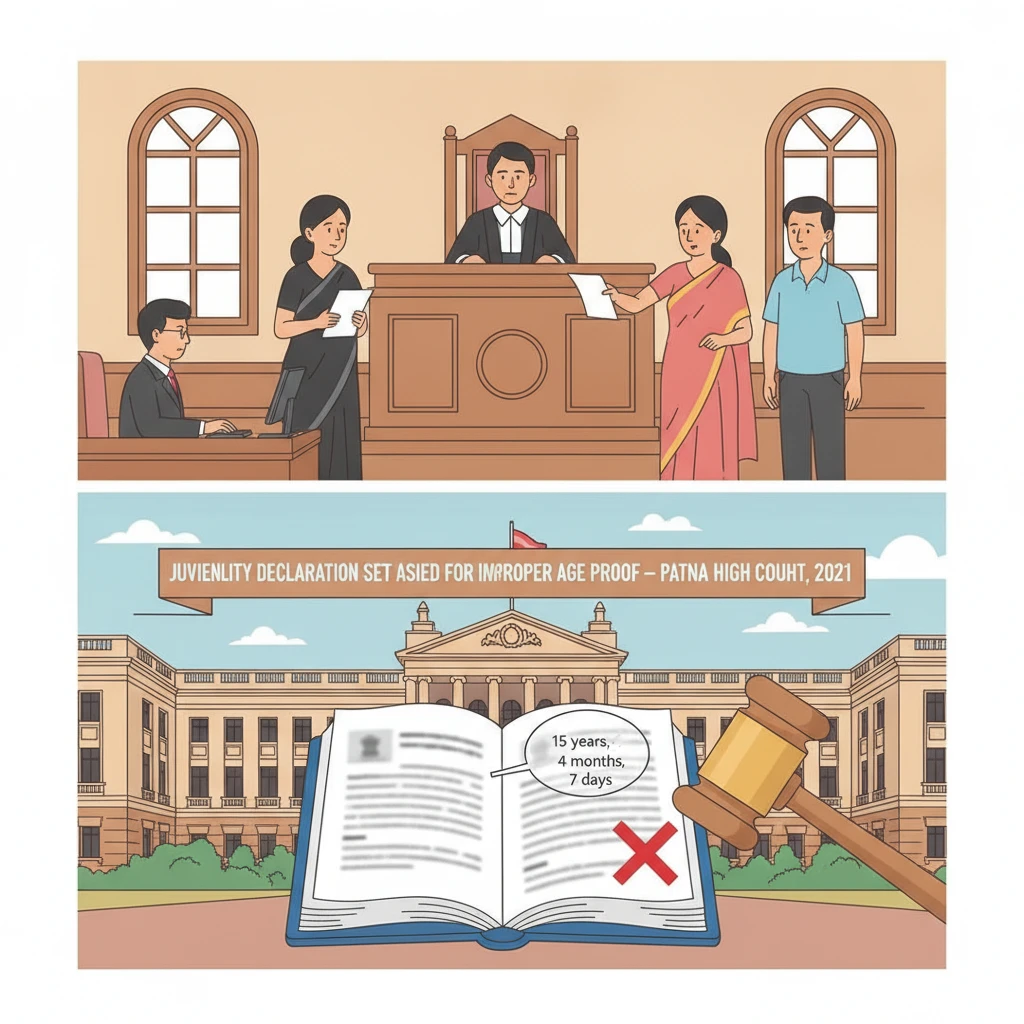
Case Background
The petitioner is the wife of opposite party no. 2. Their marriage took place on 09.06.2014.
After the marriage, according to the petitioner, she was assaulted and driven out of her matrimonial home. She alleged that her ornaments were snatched and there was a demand of rupees five lakh.
On the basis of her written information, Nawada Muffasil P.S. Case No. 67 of 2014 was registered against five accused persons, including opposite party no. 2. The case was numbered as G.R. No. 1570 of 2014, Trial No. 476 of 2016.
During the criminal proceedings, opposite party no. 2 claimed that he was a minor on the date of occurrence, i.e., 09.06.2014. The matter regarding his age was referred to the Juvenile Justice Board, Nawada.
On 23.06.2016, opposite party no. 2 took the plea of juvenility before the Court of the learned S.D.J.M., Nawada. The S.D.J.M. split up the records and sent the matter to the Juvenile Justice Board for enquiry on the point of juvenility.
The Juvenile Justice Board, after hearing the parties, relied upon a provisional certificate issued by the Bihar School Examination Board, Patna, which mentioned the date of birth of opposite party no. 2 as 02.02.1999. On that basis, the Board held that on the date of occurrence, he was a juvenile and passed an order dated 17.09.2016 declaring him so.
Aggrieved by this order, the petitioner filed Criminal Appeal No. 62 of 2016 before the 1st Additional Sessions Judge-cum-Special Judge (Children Court), Nawada. The appellate court, by judgment dated 12.02.2018, dismissed the appeal and upheld the Juvenile Justice Board’s order.
The petitioner then approached the Patna High Court in Criminal Revision No. 611 of 2018 challenging both these orders.
What the Court Examined and Decided
The Patna High Court, through Hon’ble Mr. Justice Prabhat Kumar Singh, examined whether the Juvenile Justice Board and the appellate court had correctly followed the legal procedure for determining age under Section 94(2) of the Juvenile Justice (Care and Protection of Children) Act, 2015.
The petitioner’s main argument was that opposite party no. 2 had been declared juvenile solely on the basis of a provisional certificate produced by him, allegedly issued by the Bihar School Examination Board, Patna. According to her, this was contrary to Section 94(2) of the 2015 Act.
She contended that, in terms of Section 94(2), only the office, institution or person who issued the certificate can properly confirm whether the document is genuine or not. In other words, the Board or court cannot simply accept any document produced by an accused without verifying its authenticity from the issuing authority.
The petitioner also argued that a “provisional certificate” is not among the documents specifically listed under Section 94(2) for determining age. She submitted that the law permits reliance on a date of birth certificate from the school, or a matriculation or equivalent certificate from the examination board, and, in their absence, birth certificates from civic authorities or, finally, medical tests like ossification.
To support her stand, the petitioner relied on two earlier decisions of the Patna High Court:
First, 2017(3) East Cr. C 655 (Pat), Mukesh Yadav @ Mukesh Kumar vs. State of Bihar, where the Court had considered the requirements of age determination and the nature of acceptable documents.
Second, 2020 (1) PLJR 91, Suresh Rai vs. State of Bihar, where the Court had emphasised that only the issuing office or institution can confirm genuineness of the documents relied on for fixing age.
On the other hand, counsel for opposite party no. 2 defended the impugned orders. He submitted that the order of the Juvenile Justice Board was a reasoned one and had rightly been passed on the basis of the provisional certificate issued by the Bihar School Examination Board.
He pointed out that, according to this provisional certificate, the date of birth of opposite party no. 2 was 02.02.1999. On the date of occurrence, 09.06.2014, he was only 15 years, 4 months and 7 days old. Therefore, he clearly fell within the definition of a juvenile, and the Board had correctly declared him so.
He further argued that, once such a certificate from the Bihar School Examination Board is produced, there is no need to look for any other document for age determination as per Section 94(2) of the Act. In his view, the impugned orders were legal, reasonable and in accordance with law.
The High Court then closely examined Section 94(2) of the Juvenile Justice (Care and Protection of Children) Act, 2015. The Court reproduced the provision in full in its judgment.
Section 94 deals with presumption and determination of age. Sub-section (1) allows the Committee or Board to record its observation about age based on appearance where it is obvious that the person before it is a child, and proceed with the inquiry without waiting for further age confirmation.
Sub-section (2) addresses the situation where the Committee or Board has reasonable doubt about whether the person before it is a child. In such a case, it must undertake an age determination process by seeking evidence in a particular order:
First, it should obtain the date of birth certificate from the school, or the matriculation or equivalent certificate from the concerned examination board, if available.
Second, if such documents are not available, it should obtain the birth certificate from a corporation, municipal authority, or panchayat.
Third, only if both the above are not available, age is to be determined by ossification test or any other latest medical age determination test ordered by the Committee or Board.
After setting out the legal framework, the Patna High Court applied it to the facts of the case.
The Court noted that the Juvenile Justice Board, Nawada, had declared opposite party no. 2 juvenile “simply on the basis of provisional certificate” issued by the Bihar School Examination Board. The Board did not verify the genuineness of this provisional certificate or compare it with the original records.
The High Court accepted the petitioner’s contention that a provisional certificate issued by the Bihar School Examination Board is not one of the documents specifically required to be taken into consideration for age determination under Section 94(2) of the 2015 Act.
The Court emphasised that the law, as explained in earlier decisions, requires that the office, agency, institution or person who has issued the document must confirm whether it is genuine. In this case, no such verification was done. The Board simply relied on the provisional certificate produced by opposite party no. 2.
Importantly, the High Court also found fault with the appellate court. The 1st Additional Sessions Judge-cum-Special Judge (Children Court), Nawada, had dismissed the appeal without examining these legal infirmities in the Board’s order. It merely stated that it did not find any illegality in the Juvenile Justice Board’s decision.
Considering the submissions of both sides and the materials on record, the Patna High Court concluded that both the order dated 17.09.2016 of the Juvenile Justice Board and the order dated 12.02.2018 of the appellate court were in “gross violation” of Section 94(2) of the Juvenile Justice (Care and Protection of Children) Act, 2015.
The Court therefore held that these orders could not be sustained in law. It quashed both orders and remanded the matter to the Juvenile Justice Board, Nawada.
The Board has now been directed to conduct a fresh enquiry on the juvenility of opposite party no. 2, after hearing all the parties, strictly in accordance with Section 94(2) of the 2015 Act. The High Court made it clear that it had not expressed any opinion on the merits of the underlying criminal case.
Why This Judgment Matters
This judgment is important for anyone involved in criminal cases where an accused claims to be a minor. It explains that juvenility cannot be accepted only on the basis of an unverified provisional certificate.
The Patna High Court has clearly stated that the Juvenile Justice Board must strictly follow Section 94(2) of the 2015 Act. The Board must look for proper age proof in the order required by law and must also verify the genuineness of such documents from the issuing authority.
For complainants, especially in matrimonial cruelty or dowry-related cases, this decision shows that they can challenge a juvenility claim if it appears to be based on doubtful or incomplete documents.
For accused persons who are genuinely minors, the judgment does not take away their rights. Instead, it ensures that their age determination is done fairly and correctly, so that only those who truly qualify as children get the benefit of juvenile justice protections.
Legal Issues and Answers
- Issue: Can a person be declared juvenile solely on the basis of an unverified provisional certificate from the Bihar School Examination Board under Section 94(2) of the Juvenile Justice (Care and Protection of Children) Act, 2015?
Answer: No. The Patna High Court held that a provisional certificate is not one of the prescribed documents under Section 94(2), and, in any case, its genuineness must be verified from the issuing authority before relying on it. - Issue: Were the orders of the Juvenile Justice Board, Nawada, and the appellate Children Court, Nawada, in compliance with Section 94(2) of the 2015 Act?
Answer: No. The Court found both orders to be in gross violation of Section 94(2) because they relied only on an unverified provisional certificate and ignored the mandatory procedure for age determination. - Issue: What course of action should be taken when age determination has not followed the statutory procedure?
Answer: The Court quashed the defective orders and remanded the matter to the Juvenile Justice Board to conduct a fresh enquiry after hearing all parties, strictly in terms of Section 94(2) of the Act.
Cases Cited by the Court
- 2017(3) East Cr. C 655 (Pat), Mukesh Yadav @ Mukesh Kumar vs. State of Bihar.
- 2020 (1) PLJR 91, Suresh Rai vs. State of Bihar.
Case Details
Case Number: Criminal Revision No. 611 of 2018; arising out of Nawada Muffasil P.S. Case No. 67 of 2014, G.R. No. 1570 of 2014, Trial No. 476 of 2016; Criminal Appeal No. 62 of 2016.
Case Title: Archana Kumari vs. State of Bihar & Anr.
Coram: Hon’ble Mr. Justice Prabhat Kumar Singh.
Citation: 2022 (3) PLJR 49.
Advocates: Mr. Sidhendra Narayan Singh and Mr. Kumar Lalit for the petitioner; Mr. Anil Kumar Singh 1 for the State; Mr. Deepak Kumar for opposite party no. 2.
Nature of the Case: Criminal revision challenging orders declaring opposite party no. 2 as juvenile in a criminal case and dismissal of appeal by the Children Court.
Date of Patna High Court Judgment: 05.03.2021.
Link to Judgment: https://patnahighcourt.gov.in/viewjudgment/NyM2MTEjMjAxOCMxI04=-Z0F1lWTGVAc=
If you found this explanation helpful and wish to stay informed about how legal developments may affect your rights in Bihar, you may consider following Samvida Law Associates for more updates.







