

Case Background
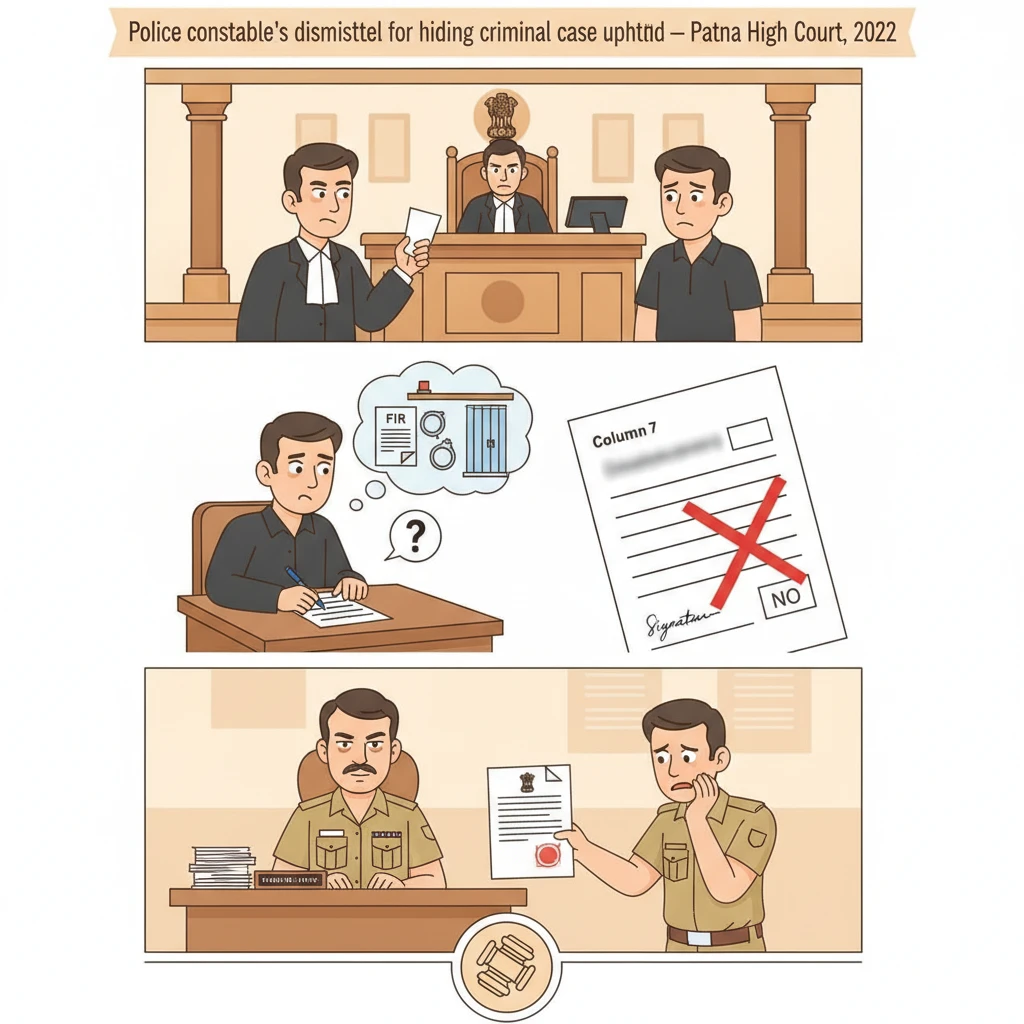
The petitioner was appointed as a constable in Bihar Military Police No. 15. At the time of his joining, he had to fill a declaratory form numbered 101.
In column 7 of this form, he was required to state clearly whether any criminal case was pending against him. On 01.09.2011, he filled up this form and declared that he had no criminal antecedent.
However, before filling this form, a criminal case had already been registered against him. Madhepur P.S. Case No. 87 of 2011 was lodged on 28.06.2011 for offences under Sections 395 and 397 of the Indian Penal Code. In that case, he was arrested on 06.07.2011 and was later released on bail.
These facts – registration of the case, his arrest and subsequent release on bail – were not disclosed by him in the declaratory form submitted to the employer.
Later, he was served with a departmental notice alleging that he had concealed this material fact relating to his pending criminal case. A disciplinary proceeding followed, and by order dated 12.02.2014, issued vide memo no. 16/GO by the Commandant, Bihar Military Police-06, Muzaffarpur, his services were terminated.
Aggrieved by the termination, he approached the Patna High Court by filing CWJC No. 6552 of 2014. In a connected proceeding, MJC No. 878 of 2015, a learned Single Judge of the Patna High Court gave him an opportunity to file a departmental appeal before the competent authority within four weeks. The Court also directed that if such an appeal was preferred, it must be considered by the appellate authority.
According to the present judgment, there was no proof before the appellate authority that any such appeal had actually been filed within the time allowed by the High Court. Eventually, some time in 2019, the appellate authority considered his appeal, noted the delay and the grounds on which he had been dismissed, and rejected the appeal.
The petitioner then filed the present writ petition, CWJC No. 2972 of 2021, challenging both the termination order dated 12.02.2014 (memo no. 16/GO) and the appellate order dated 27.01.2020 (memo no. 119/SA 2110) passed by the Deputy Inspector General, Bihar Military Police-06, Muzaffarpur.
What the Court Examined and Decided
The Division Bench of the Patna High Court, consisting of Hon’ble Mr. Justice P. B. Bajanthri and Hon’ble Mr. Justice Rajeev Ranjan Prasad (author of the oral judgment), heard both sides on 26.04.2022.
The petitioner sought three main reliefs. First, he wanted the appellate order dated 27.01.2020 (memo no. 119/SA 2110) set aside, alleging that the appellate authority had rejected his request only on limitation without considering his earlier application dated 25.07.2015 and without properly following the High Court’s 01.07.2015 order in MJC No. 878 of 2015. Second, he asked for the termination order dated 12.02.2014 (memo no. 16/GO) to be quashed, claiming that the Commandant had not applied his mind, had ignored his reply, and had not provided him proper opportunity. Third, he sought reinstatement in his original cadre with all consequential service benefits.
The Court first recorded the undisputed factual position. It noted that the petitioner had himself filled up form no. 101 on 01.09.2011. At that time, Madhepur P.S. Case No. 87 of 2011, under Sections 395 and 397 IPC, had already been registered on 28.06.2011. He had been arrested on 06.07.2011 and then released on bail in that case. The judgment emphasizes that all these facts were “well within the knowledge of the petitioner” when he filled the form.
Despite this knowledge, the petitioner declared in column 7 of the form that no criminal case was pending against him. The Court treated this as deliberate concealment of a material fact from the employer.
Turning to the disciplinary process, the Bench noted that the petitioner’s services were terminated on the basis of this concealment, as recorded in the disciplinary order (Annexure-6). When this order was earlier challenged, the High Court had not directly set it aside but instead allowed him a limited opportunity to file an appeal within four weeks before the competent authority, which would then decide it.
On the question whether he had utilised this opportunity, the petitioner claimed that he had filed an appeal in time and that the appellate authority wrongly held otherwise. However, the Division Bench examined the appellate order (Annexure-11) and found that the authority had clearly recorded that the appellant failed to produce any material showing that an appeal had been filed within the period fixed by the Single Judge.
Thus, on the record placed before the Court, there was no proof that he had complied with the time limit fixed earlier by the High Court.
The petitioner advanced another important line of argument: that during the disciplinary proceedings he was not given a proper opportunity to defend himself. He claimed that he could not cross-examine the witnesses who appeared in the departmental enquiry because no such opportunity was provided. He also asserted that though he had filed a show-cause reply, the authority did not consider it.
The State, on the other hand, argued that the matter was an “open and shut case.” According to the State counsel, the principles of natural justice cannot be reduced to a rigid, mechanical formula. In a situation like this, where the charge was that the petitioner knowingly concealed his criminal case and arrest while filling up the form, the disciplinary authority was justified in terminating his service. The State maintained that no illegality could be found in the termination or in the appellate order.
After “anxious consideration” of the submissions and perusal of the records, the Division Bench agreed with the State’s stand. The judgment highlights the admitted factual position: the petitioner was an accused in a criminal case, had been arrested and kept in custody, and was later released on bail, all prior to filling up form no. 101.
The Court observed that, in these circumstances, the concealment was deliberate. The omission was not a small or technical mistake but a suppression of serious information that the employer had a right to know. Once this key fact was accepted as admitted, the Court saw no ground to interfere with the orders.
Regarding the plea of violation of natural justice, the Court did not find sufficient reason to overturn the disciplinary action. It accepted the State’s argument that rules of natural justice are flexible and must be applied in the context of the case. Here, the central fact – concealment of criminal antecedent – was clear and undisputed. The Bench did not find any demonstrated prejudice that would justify setting aside the dismissal.
The Court then considered the nature of its own jurisdiction. It reminded that under Article 226 of the Constitution of India, the High Court exercises extraordinary writ jurisdiction, which is discretionary in nature. Even if some argument is raised, the Court is not bound to grant relief when the admitted facts go against the petitioner.
In the present matter, the admitted concealment of the criminal case, arrest and bail weighed heavily with the Bench. The judges found that this conduct did not warrant exercise of the Court’s discretionary powers in favour of the petitioner.
As a result, the Court concluded that the writ petition had “no merit” and dismissed it. No directions were issued for reinstatement or for reconsideration of the petitioner’s case. The termination from service, as well as the dismissal of the departmental appeal, thus stand confirmed.
Why This Judgment Matters
This judgment is important for government job aspirants and serving employees, especially in disciplined forces like the Bihar Military Police.
The Patna High Court has made it clear that if a candidate hides information about a criminal case, especially when he has already been arrested and is on bail, such concealment can lead to dismissal from service. Courts may refuse to interfere even on pleas of natural justice when the concealment is admitted.
For ordinary citizens, the message is that honesty in recruitment forms and service declarations is crucial. Even if a person later gets acquitted or the case is closed, hiding the fact at the time of appointment can itself be treated as serious misconduct.
The judgment also shows that when the High Court gives a time-bound opportunity to file an appeal or representation, the person must strictly follow that time limit, or at least have clear proof that it was followed. Later claims without documents may not be accepted.
Legal Issues and Answers
Issue: Whether the termination of a Bihar Military Police constable for concealing a pending criminal case, including his arrest and bail, while filling up the declaratory form was illegal or violated principles of natural justice.
Answer: No. The Patna High Court held that the petitioner had admittedly concealed material facts about his criminal case, and on these admitted facts there was no ground to interfere with the disciplinary and appellate orders.
Issue: Whether the appellate order rejecting the petitioner’s appeal on the ground of limitation and on merits required interference in writ jurisdiction under Article 226 of the Constitution of India.
Answer: No. The Court noted that the petitioner failed to produce any material to show that he had filed the appeal within the period granted by the earlier High Court order, and refused to exercise its discretionary writ jurisdiction in his favour.
Cases Cited by the Court
- The judgment does not mention or rely upon any specific earlier case law by name or citation.
Case Details
Case Number: Civil Writ Jurisdiction Case No. 2972 of 2021
Case Title: Biraju Paswan @ Birjoo Paswan @ Biraju Kumar Paswan v. The State of Bihar & Ors.
Coram: Hon’ble Mr. Justice P. B. Bajanthri and Hon’ble Mr. Justice Rajeev Ranjan Prasad
Citation: 2022 (3) PLJR 69
Advocates: For the petitioner – Mr. Sanjeev Kumar Jha, Advocate. For the respondents – Mr. Anil Kumar, AC to SC-8.
Nature of the case: Writ petition under Article 226 of the Constitution of India challenging dismissal from service and rejection of departmental appeal.
Link to judgment: Click here to read the full judgment of the Patna High Court
If you found this explanation helpful and wish to stay informed about
how legal developments may affect your rights in Bihar,
you may consider following Samvida Law Associates for more updates.







