

Case Background
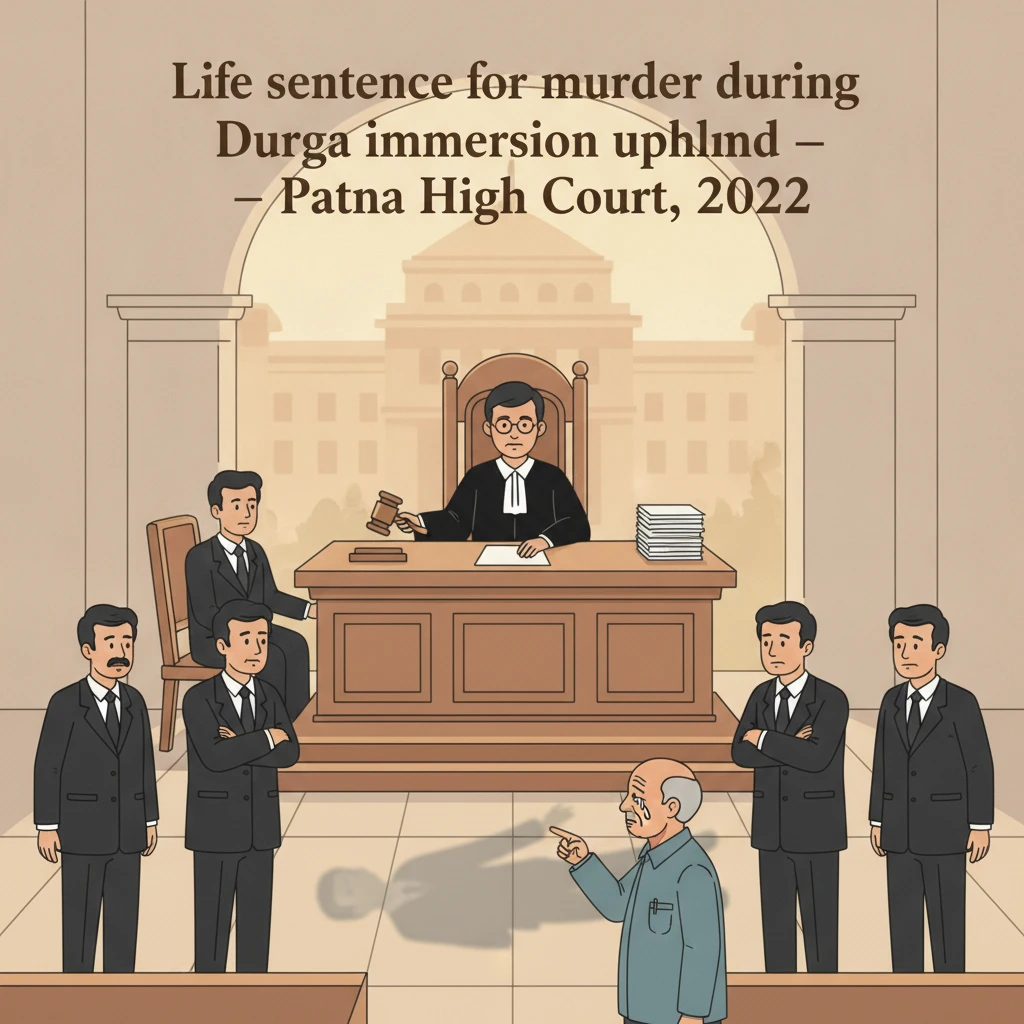
This criminal appeal came before the Patna High Court from a judgment of the Sessions Judge, Muzaffarpur, in Sessions Trial No. 45 of 2010 arising out of Aurai P.S. Case No. 80 of 2009.
The trial court had, by judgment dated 27 April 2012 and order of sentence dated 19 May 2012, convicted one appellant, Chandan Singh, under Section 302 of the Indian Penal Code (IPC) for murder. The other appellant, Kislay Kumar Singh, was convicted under Section 302 read with Section 34 IPC, which deals with acts done by several persons in furtherance of a common intention.
Both appellants were sentenced to imprisonment for life and a fine of Rs. 25,000 each, with an additional one-year imprisonment in default of payment of fine.
The incident took place on 28 September 2009 in Semri Bazar, under Aurai Police Station, District Muzaffarpur. The prosecution case began with the fardbeyan (initial written statement) of the informant, Prakash Kumar Sinha @ Nattu Singh, who is the father of the deceased, Samant Kumar Singh.
According to the fardbeyan, on the evening of the Dussehra festival, two Durga idols installed at Semri Bazar were being taken for immersion in the Lakhan Dei river. When the immersion procession reached near a bridge, a quarrel broke out between the deceased and the two accused. The accused allegedly threatened to kill the deceased and said they would eliminate him from the world.
After the immersion, the deceased returned to the flour mill run by his uncle, Krishna Chandra Sharma. The informant was also present there. Around 7.00–7.30 p.m., the two accused allegedly arrived at the mill armed with knives, threatened everyone present not to raise an alarm, caught hold of the deceased, dragged him outside onto the brick-soling road and stabbed him under his left armpit. The injured youth was first taken to a local doctor, then referred to Aurai Hospital, where he was declared dead.
The informant then brought the dead body to Aurai Police Station, where his fardbeyan was recorded. On this basis, Aurai P.S. Case No. 80 of 2009 was registered under Section 302/34 IPC against both accused.
After investigation, the police submitted a charge sheet against Chandan Kumar and Kislay Kumar Singh. Cognizance was taken by the Magistrate on 21 November 2009, and the case was committed to the Sessions Court on 18 January 2010.
The Sessions Court framed charges under Section 302 IPC against Chandan Kumar and under Section 302/34 IPC against Kislay Kumar Singh. Both pleaded not guilty and claimed trial. Nine prosecution witnesses were examined, including six witnesses of fact and three official witnesses. One defence witness was also examined to support the plea that Chandan Singh was handicapped.
What the Court Examined and Decided
The Patna High Court, speaking through Hon’ble Mr. Justice Sunil Kumar Panwar (for the Division Bench with Hon’ble Mr. Justice A.M. Badar), heard the appeals together. The Court considered the oral evidence of the eyewitnesses, the medical evidence, and the defence argument that the trial court had misread the evidence.
The main prosecution witnesses were close relatives of the deceased. PW-1, PW-2 and PW-4 were uncles of the deceased, and PW-6 was his father and the informant. Some villagers were hearsay witnesses, and two doctors and the investigating officer were official witnesses.
PW-1, an uncle of the deceased, stated that on 28 September 2009 at about 7–7.30 p.m., while returning home with PW-2, he heard noise near the flour mill. He rushed to the spot and, in the light of the electric bulb, saw Kislay catching hold of the arm of the deceased and Chandan holding the deceased by the collar with one hand and dealing a knife blow with the other. He and others chased the accused for about twenty steps, but they fled away waving the knife. He also deposed that there had been a dispute earlier during the immersion procession, when the accused threatened to kill the deceased.
PW-2, another uncle, confirmed that he was with PW-1 returning from Semri Chowk and, on hearing the noise, rushed to the flour mill and saw the occurrence in the electric light.
PW-4, the uncle who owned the flour mill, gave a detailed account: the deceased was sitting on a chair in the mill; the informant (PW-6) was at the cash counter. The two accused entered the mill, one with a knife. They started quarrelling with the deceased. When PW-4 and PW-6 tried to calm the situation, the accused threatened that anyone raising an alarm would be killed. Chandan then caught the deceased by the collar with his left hand, dragged him out onto the brick-soling road, and stabbed him below the left armpit. During this time, Kislay held the deceased’s arms from behind. PW-4 also explained the motive: the deceased wanted the idols to be immersed from the bridge directly, while the accused wanted them to be taken around the village before immersion.
PW-6, the father of the deceased and informant, gave a similar version. He confirmed that both accused came to the mill, quarrelled with his son, and that Chandan dragged his son outside and stabbed him under the left armpit while Kislay held his arms from behind. The accused fled, waving the knife. He took his injured son to the local doctor, then to Aurai Hospital where his son was declared dead, and thereafter he went to the police station to give his statement.
PW-3 and PW-5, villagers, did not witness the stabbing but reached the spot soon after and saw the deceased lying in a pool of blood. They stated that the family members were saying at the spot that Chandan had stabbed the deceased while Kislay had held him.
PW-7, the local doctor who gave first aid, stated that he found a wound on the left side of the chest of the deceased, bleeding profusely, and referred him to Aurai or Muzaffarpur Hospital as the injury was grievous.
PW-8, the doctor who performed the post-mortem, examined the body on 29 September 2009 at 11.30 a.m. He found rigour mortis in all limbs and recorded two key ante-mortem injuries. The first was a punctured wound over the lower part of the left armpit, above and lateral to the left nipple, cavity deep and spindle-shaped, with clear-cut margins, passing downwards and medially and cutting the skin, muscles and axillary artery. The second was that the upper part of the left lung was pierced and the chest cavity was full of blood. He opined that the cause of death was hemorrhage and shock due to the punctured wound caused by a sharp-pointed knife, and that the injury was sufficient in the ordinary course of nature to cause death.
PW-9, the Station House Officer of Aurai Police Station, proved the registration of the FIR and the investigation, including seizure of bloodstained earth and preparation of the formal FIR.
The defence examined DW-1, an official who produced the Handicap Register for 2008 and proved a disability certificate of appellant Chandan Singh. The defence case was that Chandan was disabled in his leg, could not walk properly and was fasting on the day of occurrence, hence could not have committed the offence.
Both accused, in their statements under Section 313 Cr.P.C., denied the allegations and claimed innocence. Chandan specifically claimed he was handicapped and on fast, and therefore not in a position to move.
The High Court considered the main grounds raised in appeal. The first defence was that all eyewitnesses were related to the deceased and therefore “interested” witnesses, whose evidence should not be relied upon. The Court rejected this contention. It referred to the Supreme Court decision in Seeman alias Veeranan vs. State represented by Inspector of Police, (2005) 11 SCC (Cri) 142, which states that the evidence of close relatives cannot be discarded merely due to relationship if their testimony is trustworthy, corroborated by medical evidence, and free from major discrepancies.
The Court noted that there was no prior enmity between the accused and the family of the deceased. The defence had not suggested any such enmity in cross-examination. Hence, the close relatives had no reason to falsely implicate the appellants while sparing the real culprits. On the contrary, the earlier quarrel one hour prior to the incident, during the immersion procession, provided a direct motive.
The Court then examined consistency between the oral and medical evidence. All material witnesses said that only one knife blow was delivered by Chandan under the left armpit of the deceased while Kislay held his arms. The post-mortem report showed a single punctured wound in the same region, caused by a sharp-pointed weapon, damaging vital structures and causing massive bleeding. The Court found that the description of the manner of occurrence fully matched the medical evidence. It noticed no serious discrepancies, contradictions, or exaggerations in the witnesses’ testimonies.
Next, the Court considered the plea that Chandan’s disability made it impossible for him to inflict the knife blow. The Court observed that the prosecution case was supported by consistent, credible eye-witnesses. It also noted from the evidence that Chandan had participated in the immersion procession and could move smoothly from one place to another. During cross-examination of the witnesses, the defence had not even put suggestions that Chandan was unable to walk. Therefore, the Court held that the defence had failed to prove that his disability prevented him from committing the crime.
The appellants’ counsel further argued that since there was only a single blow, without any attempt to repeat it, there was no intention to cause death, and at most the case would fall under Section 304 Part II IPC (culpable homicide not amounting to murder). The Court rejected this argument. It relied on the facts that both accused went armed with knives to the flour mill shortly after the quarrel, threatened to kill anyone who raised alarm, dragged the deceased outside, and then Chandan stabbed him in a vital part of the body, under the left armpit, causing fatal internal damage.
The Court referred to the medical evidence that the injury was sufficient in the ordinary course of nature to cause death. It concluded that the case squarely fell within the definition of “murder” under Section 300 IPC and was punishable under Section 302 IPC. The fact that only one blow was given did not reduce the gravity when that blow was deliberately aimed at a vital part with such force that it severed the axillary artery and pierced the lung.
Regarding appellant Kislay, the Court observed that he had held the deceased’s arms from behind, enabling Chandan to inflict the knife blow. On this basis, the Court held that he shared the common intention to commit murder and was equally responsible under Section 34 IPC. Therefore, no benefit of doubt could be given to him.
After evaluating all evidence and arguments, the High Court found “no illegality” in the trial court’s judgment. It held that the prosecution witnesses had been cross-examined at length but only minor contradictions, if any, had emerged. Their testimonies were natural, free from serious omissions or embellishments, and inspired confidence.
The Court concluded that there were no compelling reasons to believe that the witnesses had falsely implicated the appellants. It found the contentions of the appellants’ counsel “devoid of merit” and dismissed both appeals.
Consequently, the High Court confirmed the conviction dated 27 April 2012 and sentence dated 19 May 2012 passed by the Sessions Judge, Muzaffarpur. Appellant Kislay Kumar Singh, who was on bail during appeal, had his bail bond cancelled and was directed to surrender before the trial court to serve out the remaining period of his life sentence. Both appeals were dismissed.
Why This Judgment Matters
This judgment is important for families of victims and for accused persons alike because it shows how the Patna High Court assesses eyewitness evidence when most witnesses are relatives.
The Court made it clear that being a relative does not automatically make a witness unreliable. What matters is whether their version is consistent, supported by medical evidence, and free from serious contradictions. Here, because the father and uncles of the deceased all gave matching accounts, and the medical report confirmed exactly what they described, the Court trusted their testimony.
The decision also highlights that a single knife blow can still amount to murder if it is targeted at a vital part of the body and is likely to cause death in the ordinary course of nature. People involved in festival disputes or local quarrels should understand that even one intentional, serious blow with a weapon can lead to a life sentence.
For those who help or hold a victim while another person attacks, the judgment shows that the law treats them as equally responsible if they share the intention to cause the harm. Holding the victim to let another person stab can result in conviction for murder with the same punishment as the person who actually wields the weapon.
Legal Issues and Answers
-
Issue: Can the conviction for murder rest mainly on the testimony of close relatives of the deceased?
Answer: Yes. The Patna High Court held that related witnesses can be relied upon when their evidence is trustworthy, consistent, corroborated by medical evidence, and there is no proof of prior enmity or motive to falsely implicate the accused. -
Issue: Does a single knife blow on a vital part of the body reduce the offence from murder (Section 302 IPC) to culpable homicide not amounting to murder (Section 304 Part II IPC)?
Answer: No. The Court found that the deliberate single stab under the left armpit, which severed major blood vessels and lung tissue and was sufficient in the ordinary course of nature to cause death, squarely fell within Section 300 IPC and attracted Section 302 IPC. -
Issue: Is a person who only holds the victim, while another inflicts the fatal blow, liable for murder with the aid of Section 34 IPC?
Answer: Yes. By catching hold of the deceased’s arms to facilitate the stabbing, appellant Kislay Kumar shared the common intention to commit murder and was therefore equally responsible under Section 302/34 IPC. -
Issue: Can a plea of physical disability by the accused negate the possibility of committing the offence without strong supporting evidence?
Answer: No. The Court held that mere production of a disability certificate, without proving that the accused was actually unable to walk or act as alleged, especially where witnesses consistently state that he participated in the occurrence, is insufficient to dislodge the prosecution case.
Cases Cited by the Court
- Seeman alias Veeranan vs. State represented by Inspector of Police, (2005) 11 SCC (Cri) 142 – cited to affirm that evidence of a close relative is not to be discarded merely due to relationship if otherwise credible and supported by medical evidence.
Case Details
Case Number: Criminal Appeal (DB) No. 645 of 2012 with Criminal Appeal (DB) No. 655 of 2012; arising out of Aurai P.S. Case No. 80 of 2009; Sessions Trial No. 45 of 2010.
Case Title: Kislay Kumar Singh vs. The State of Bihar; Chandan Singh @ Chandan Kumar vs. The State of Bihar.
Citation: 2022 (3) PLJR 133.
Court: High Court of Judicature at Patna.
Coram: Hon’ble Mr. Justice A.M. Badar and Hon’ble Mr. Justice Sunil Kumar Panwar.
Date of Judgment: 20 May 2022.
Advocates:
- For appellant in Criminal Appeal (DB) No. 645 of 2012: Mr. Pratik Mishra, Advocate.
- For appellant in Criminal Appeal (DB) No. 655 of 2012: Mr. Udit Narayan Singh, Advocate and Mr. Gajendra Kumar Singh, Advocate.
- For the State: Ms. Shashi Bala Verma, Additional Public Prosecutor; Mr. Abhimanyu Sharma, Additional Public Prosecutor; Mr. A. Sharma, APP (as recorded).
- For the informant: Mr. Gopal Prasad Roy, Advocate.
Nature of the Case: Criminal appeals (Division Bench) against conviction and sentence for offences under Section 302 IPC and Section 302 read with Section 34 IPC.
Link to the Judgment: Patna High Court Judgment – Criminal Appeal (DB) No. 645 of 2012 with 655 of 2012
If you found this explanation helpful and wish to stay informed about how legal developments may affect your rights in Bihar, you may consider following Samvida Law Associates for more updates.







