

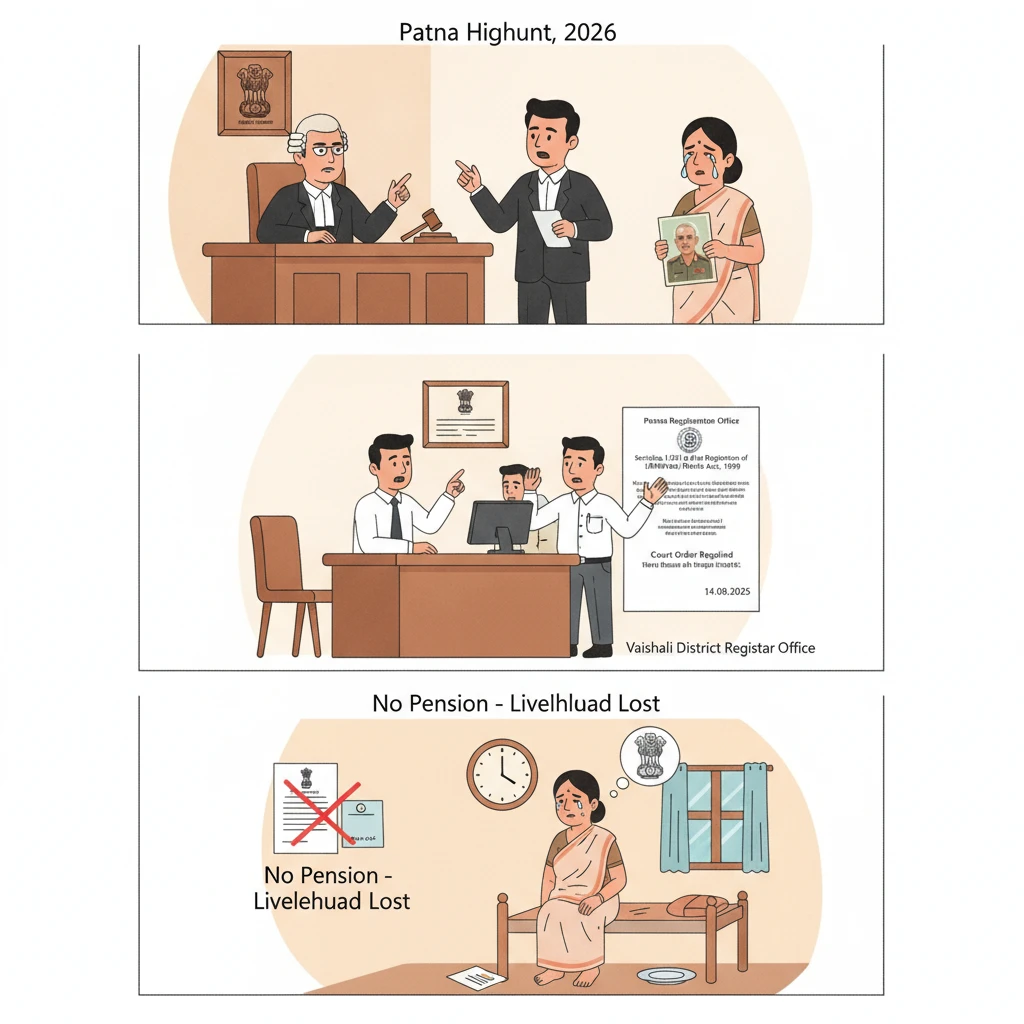
Case Background
The petitioner is the widow of a retired army employee who was receiving pension from the Government of India. According to her, this pension was the only source of income for her survival.
Her husband went missing in May 2024. A complaint was lodged at Udwantnagar Police Station, which led to registration of Udwantnagar P.S. Case No. 193 of 2024. The First Information Report (FIR) recorded that the petitioner’s husband went missing on 4.5.2024. The FIR itself was lodged on 12.5.2024.
During investigation of this criminal case, one of the accused allegedly confessed to having murdered the petitioner’s husband. On this basis, the petitioner approached the local registration authorities seeking issuance of a death certificate in respect of her husband.
The request for issuance of a death certificate was rejected by the respondents, including the District Registrar, Vaishali, and officials of Nagar Parishad, Mahnar. Aggrieved by this refusal, the widow filed a writ petition before the Patna High Court in Civil Writ Jurisdiction Case No. 19241 of 2025.
She also challenged the order dated 14.08.2025 of the District Registrar, Vaishali (Respondent No. 2), by which her claim had been rejected. In the writ petition she prayed for a writ of mandamus directing the authorities to issue the death certificate of her husband and to set aside the said order.
What the Court Examined and Decided
The matter was heard by Hon’ble Mr. Justice Partha Sarthy on 14.05.2026. Counsel for the petitioner, Mr. Manish Kumar, Advocate, was present. No one appeared on behalf of the respondents, even though they had filed a counter affidavit.
The central grievance of the petitioner was that without a death certificate she could not access the pension and other benefits linked to her husband’s death. She argued that because an accused person in the criminal case had confessed to murdering her husband, the authorities ought to have accepted this as sufficient basis to issue a death certificate.
To support the stand of the authorities, the Court examined a letter dated 14.08.2025, marked as Annexure-6 to the writ petition. This letter was written by the Executive Officer, Nagar Parishad, Mahnar, to the Nodal Officer, RTI, Vaishali.
In this letter, the Executive Officer clearly stated that in cases of missing persons, the death certificate is issued only after an order of a competent court, in view of Section 13(3) of the Registration of Births and Deaths Act, 1969. Thus, the local body conveyed that they had no power to themselves declare a missing person dead and register the death when more than one year had passed.
The Court then turned to the statutory framework under the Registration of Births and Deaths Act, 1969, particularly Section 13. A relevant extract of this provision was reproduced in the judgment.
Section 13 deals with delayed registration of births and deaths. Sub-section (1) covers cases where information is given within thirty days of occurrence. Sub-section (2) applies when delayed information is given after thirty days but within one year of the occurrence, in which case registration is possible with the written permission of the District Registrar and on payment of the prescribed fee along with self‑attested documents.
Most important for this case was Section 13(3). This sub-section provides that any birth or death, information of which is given after one year of its occurrence, shall be registered only on an order made by a District Magistrate, Sub-Divisional Magistrate, or an Executive Magistrate authorised by the District Magistrate, having jurisdiction over the area where the birth or death took place. Such registration can be done only after verifying the correctness of the birth or death and on payment of the prescribed fee.
Section 13(4) clarifies that these provisions are in addition to any action that may be taken for failure to register a birth or death within the specified time. It also states that registration can be done even during the pendency of such action.
Applying this law to the facts, the Court first noted the undisputed dates. The FIR showed that the petitioner’s husband went missing on 4.5.2024. The disappearance was reported and the FIR was registered on 12.5.2024. By the time the writ petition was decided in May 2026, more than two years had passed since the disappearance.
The Court observed that the death of the petitioner’s husband had neither been confirmed nor registered within one year of his disappearance. Therefore, any attempt to register his death at this stage would fall squarely under Section 13(3) of the Act.
Under Section 13(3), the power to order registration of such a delayed death lies not with the Registrar directly, but with a Magistrate — namely, the District Magistrate, Sub-Divisional Magistrate, or an Executive Magistrate authorised by the District Magistrate. The Magistrate must first verify the correctness of the alleged death before passing such an order.
On this basis, the Court held that the authorities were right in insisting that a competent Magistrate’s order was necessary. The Patna High Court accepted the stand communicated to the petitioner that, in the absence of such an order, the respondents could not lawfully register the death or issue a death certificate.
The Court did not accept the submission that the confession of an accused in the criminal case was by itself sufficient ground for the Registrar to issue a death certificate. The judgment records that, even though such a confession was said to have been made, the legal requirement under Section 13(3) remained that an order of the specified Magistrate must precede any registration after one year.
The Court concluded that there was no illegality in the respondents’ decision as conveyed to the petitioner. The writ court’s role in this case was limited to testing whether the refusal to issue a death certificate, without an order of a competent Magistrate, was contrary to law. On a plain reading of Section 13(3), the Court found the refusal to be justified.
Consequently, the Court held that there was no error in the impugned order dated 14.08.2025 of the District Registrar, Vaishali, and that there was no merit in the writ petition. The application was dismissed.
The judgment does not record any further directions, such as liberty to approach the Magistrate. It simply ends with dismissal of the writ petition.
Why This Judgment Matters
This decision is important for families of missing persons who seek a death certificate after a long gap. Many such families depend on pension or other benefits that require official proof of death.
The Patna High Court has made it clear that, once more than a year has passed, the normal registration authorities cannot directly issue a death certificate. Even if the police investigation suggests that the missing person has been killed, or an accused has confessed, the Registrar cannot use this alone to register the death.
Instead, the family or concerned person must obtain an order from the District Magistrate, Sub-Divisional Magistrate, or authorised Executive Magistrate. Only after such an order, and after verification of facts, can the death be registered and a certificate issued.
This judgment therefore guides widows, dependants, lawyers and officials in Bihar on the proper legal route under Section 13(3) of the Registration of Births and Deaths Act, 1969. It also protects registration officials from being forced to act beyond their legal powers through writ petitions.
Legal Issues and Answers
- Issue: Can the Patna High Court, in a writ petition, direct registration authorities to issue a death certificate for a missing person after more than one year has passed, solely on the basis of a confession by an accused in a criminal case?
Answer: No. The Court held that under Section 13(3) of the Registration of Births and Deaths Act, 1969, such death can be registered only on an order of the competent Magistrate (District Magistrate, Sub-Divisional Magistrate, or authorised Executive Magistrate) after verifying the correctness of the death, and therefore the Registrar rightly refused without such an order.
Cases Cited by the Court
- No previous judicial decisions or case law are cited or relied upon in this judgment. The Court’s reasoning is based solely on the text of Section 13 of the Registration of Births and Deaths Act, 1969.
Case Details
Case Number: Civil Writ Jurisdiction Case No. 19241 of 2025
Case Title: Priyanka Kumari vs. The State of Bihar & Ors.
Court: High Court of Judicature at Patna
Coram: Hon’ble Mr. Justice Partha Sarthy
Date of Judgment: 14.05.2026
Citation: 2026(3) PLJR 626
Advocates:
- For the petitioner: Mr. Manish Kumar, Advocate
- For the respondents: None appeared
Respondents: State of Bihar through the Chief Registrar, Birth and Death Registration Department; District Registrar, Vaishali; Executive Officer-cum-Registrar (Death and Birth), Nagar Parishad, Mahnar; Secretary, Nagar Parishad, Mahnar; Secretary, Urban Department, Bihar, Patna.
Nature of the case: Writ petition (civil) seeking mandamus for issuance of death certificate and quashing of order of District Registrar.
Statute Involved: Registration of Births and Deaths Act, 1969, particularly Section 13(1)–(4).
Link to full judgment: Patna High Court Judgment in CWJC No. 19241 of 2025
If you found this explanation helpful and wish to stay informed about
how legal developments may affect your rights in Bihar,
you may consider following Samvida Law Associates for more updates.







