

Case Background
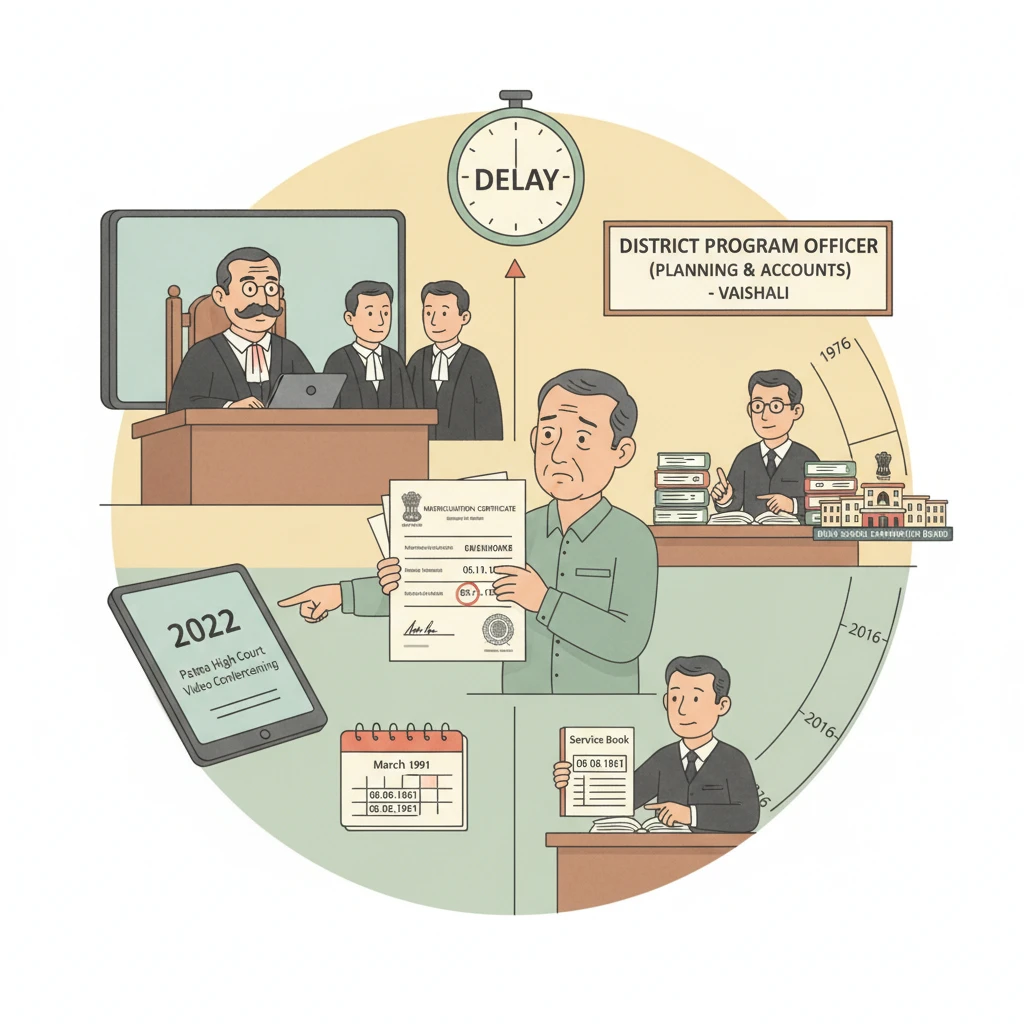
The petitioner is a government employee working as District Program Officer (Planning and Accounts) in Vaishali district. He had joined government service in March 1991.
His matriculation certificate originally recorded his date of birth as 08.08.1961. According to the judgment, the petitioner had applied to the Bihar School Examination Board in 1976 for correction of his date of birth in the matriculation certificate. However, the matter was ultimately decided only in 2016.
In 2016, the Bihar School Examination Board issued a corrected matriculation certificate showing his date of birth as 05.11.1962. After this change in the educational record, a gradation list of officers was published by the authorities vide Memo No. 1845 dated 07.10.2016, in which his date of birth continued to appear as 08.08.1961.
Feeling aggrieved, the petitioner filed this writ petition in 2020 before the Patna High Court. He sought directions to correct his date of birth in the gradation list, in the service book and in all other relevant service records, in line with the corrected matriculation certificate.
What the Court Examined and Decided
The Patna High Court, through Hon’ble Mr. Justice P. B. Bajanthri, heard the matter via video conferencing on 16.02.2022 due to the COVID-19 pandemic.
The core question framed by the Court was simple: whether the petitioner was entitled to correction of his date of birth in service records from 08.08.1961 to 05.11.1962.
The Court first recorded certain undisputed facts. The petitioner joined service in March 1991. His date of birth in the service record stood recorded as 08.08.1961. The Bihar School Examination Board, upon an application said to have been made in 1976, issued a corrected matriculation certificate only in 2016, showing his date of birth as 05.11.1962.
On the strength of this 2016 correction by the Board, the petitioner approached the High Court in 2020 seeking directions to the State authorities to alter his date of birth in the gradation list and the service records.
The Court then examined when the cause of action for seeking correction in service actually arose. It held that the petitioner had a cause of action for correction of his date of birth in service records in March 1991 itself, when he joined government service with the existing entry of 08.08.1961.
The Court observed that, if there was any lapse on the part of the Bihar School Examination Board in not rectifying the petitioner’s matriculation certificate from the date of his application in 1976, then he had a cause of action against the Board at least till 1979, treating three years as the relevant period. In other words, according to the Court, any challenge or insistence for timely correction should have been taken within a few years of the initial application.
Instead, the petitioner waited for decades. The correction in his matriculation certificate took place in 2016, and only after that, in 2020, did he seek changes in his service records and gradation list.
The Court emphasised that claims relating to rectification of date of birth made at a belated stage cannot be entertained. It noted that the petitioner was about 58 years old at the time of filing of the writ petition in 2020. This meant he was approaching towards the end of his service career when he sought to change his recorded date of birth.
The Court relied on the principle laid down by the Hon’ble Supreme Court that belated claims for correction of date of birth in service records should not be accepted. The judgment specifically referred to three Supreme Court decisions:
(i) Union of India vs. Shashank Goswami, (2012) 11 SCC 307.
(ii) Shreejith L. vs. Director of Education, Kerala, (2012) 7 SCC 248.
(iii) Dhalla Ram vs. Union of India, (1997) 11 SCC 201.
These decisions, as cited by the Court, reiterate that employees cannot be allowed to seek change of date of birth near the end of service, as it affects service seniority, retirement, and the rights of others, and such claims must be made within a reasonable time.
The petitioner’s counsel tried to rely on a judgment of a Division Bench of the Patna High Court in LPA No. 84 of 2018 arising out of CWJC No. 3034 of 2016, decided on 24.05.2018. However, the Court held that this LPA judgment had no application in view of the above-mentioned Supreme Court decisions. On this basis, the Court refused to extend any benefit from that LPA to the petitioner.
The Court thus concluded that, in light of the long delay and laches on the part of the petitioner, he was not entitled to the reliefs sought. The writ petition was therefore dismissed.
After the main dismissal, the petitioner’s counsel raised another submission. He argued that at least for the purpose of the gradation list published on 07.10.2016, the petitioner had a fresh cause of action for correction of his date of birth in that list in 2016.
The Court dealt with this contention separately. It noted that the date of birth shown in the gradation list could not be treated in isolation. The governing date of birth is the one recorded in the service record. A gradation list only reflects data that fundamentally flows from the service record.
The Court further stated that any rectification in the service record, gradation list or in matters of promotion has to be undertaken within a reasonable period of time, which the Supreme Court has treated as about six months. In support of this proposition, the Court referred to two more Supreme Court decisions:
(i) P.S. Sadasivaswamy vs. The State of Tamilnadu, (1975) 1 SCC 152.
(ii) Vijay Kumar Kaul vs. Union of India, (2012) 7 SCC 610.
On this reasoning, the Court rejected the argument that publication of the 2016 gradation list created a fresh or independent cause of action that could justify the 2020 writ petition.
Summarising its findings, the Court held that:
• The petitioner’s challenge was highly belated, both with reference to his joining in 1991 and the eventual correction of the matriculation certificate in 2016.
• The governing principle from the Supreme Court is that date of birth corrections in service matters must be sought promptly and not near retirement age.
• A mere entry in a gradation list does not override the primary date of birth entered in the service record, and any attempt to change such entries must also be within a reasonable time.
Accordingly, the Patna High Court dismissed the writ petition and declined all reliefs sought by the petitioner.
Why This Judgment Matters
This judgment is important for government employees and others in public service who wish to seek correction of their date of birth in service records.
The Patna High Court has made it clear that such requests cannot be kept pending or raised at the fag end of service. Even if a school board or other body corrects a certificate after many years, the employee must act without delay for corresponding changes in service records.
The decision underlines that courts will rely on the principle of delay and laches. If an employee waits for decades and then seeks to change the date of birth when retirement is approaching, the court is likely to refuse relief.
The judgment also clarifies that entries in a gradation list are not independent. They follow what is already recorded in the service book. Therefore, workers cannot treat the gradation list as a fresh ground to reopen the question of date of birth.
Legal Issues and Answers
- Issue: Whether the petitioner was entitled to correction of his date of birth in the gradation list and service records from 08.08.1961 to 05.11.1962 based on a matriculation certificate corrected in 2016.
Answer: No. The Patna High Court held that the claim was hopelessly belated and barred by delay and laches, and that late-stage correction of date of birth in service records could not be entertained. - Issue: Whether the publication of the gradation list in 2016 created a fresh cause of action to seek correction of date of birth therein.
Answer: No. The Court held that the gradation list merely reflects the date of birth from the service record, and any rectification in service record or gradation list must be sought within a reasonable time, which was not done here.
Cases Cited by the Court
- Union of India vs. Shashank Goswami, (2012) 11 SCC 307.
- Shreejith L. vs. Director of Education, Kerala, (2012) 7 SCC 248.
- Dhalla Ram vs. Union of India, (1997) 11 SCC 201.
- P.S. Sadasivaswamy vs. The State of Tamilnadu, (1975) 1 SCC 152.
- Vijay Kumar Kaul vs. Union of India, (2012) 7 SCC 610.
Case Details
Case Number: Civil Writ Jurisdiction Case No. 2796 of 2020
Case Title: Dev Ranjan Kumar vs. The State of Bihar & Ors.
Coram: Hon’ble Mr. Justice P. B. Bajanthri
Citation: 2022(2) PLJR 308
Advocates:
- For the petitioner: Mr. Nikhil Kumar Agrawal, Advocate
- For the respondents: Mr. Prabhakar Jha, GP 27
Nature of the case: Writ petition under Civil Writ Jurisdiction seeking mandamus for correction of date of birth in gradation list and service records.
Date of Judgment: 16.02.2022
Court: High Court of Judicature at Patna
Link to the Judgment: Click here to view the official judgment
If you found this explanation helpful and wish to stay informed about
how legal developments may affect your rights in Bihar,
you may consider following Samvida Law Associates for more updates.







