

Case Background
The case arises from Narpatganj P.S. Case No. 281 of 2019, registered on 08.05.2019 in District Araria.
The informant (the petitioner in this application) alleged that his neighbour Ramchandra Das and some others had earlier assaulted him. In that earlier criminal case they were convicted, and the informant’s brother Pawan Das used to pursue (pairvi) the case.
Because of this past case, there was alleged enmity. On the eve of Holi, Ramchandra Das is said to have forcibly entered the informant’s house, assaulted family members and looted articles. In that case, one associate, Santo Das, was sent to jail. After this, according to the informant, Ramchandra Das and his associates used to threaten his father and brother every day and pressured them to withdraw the case.
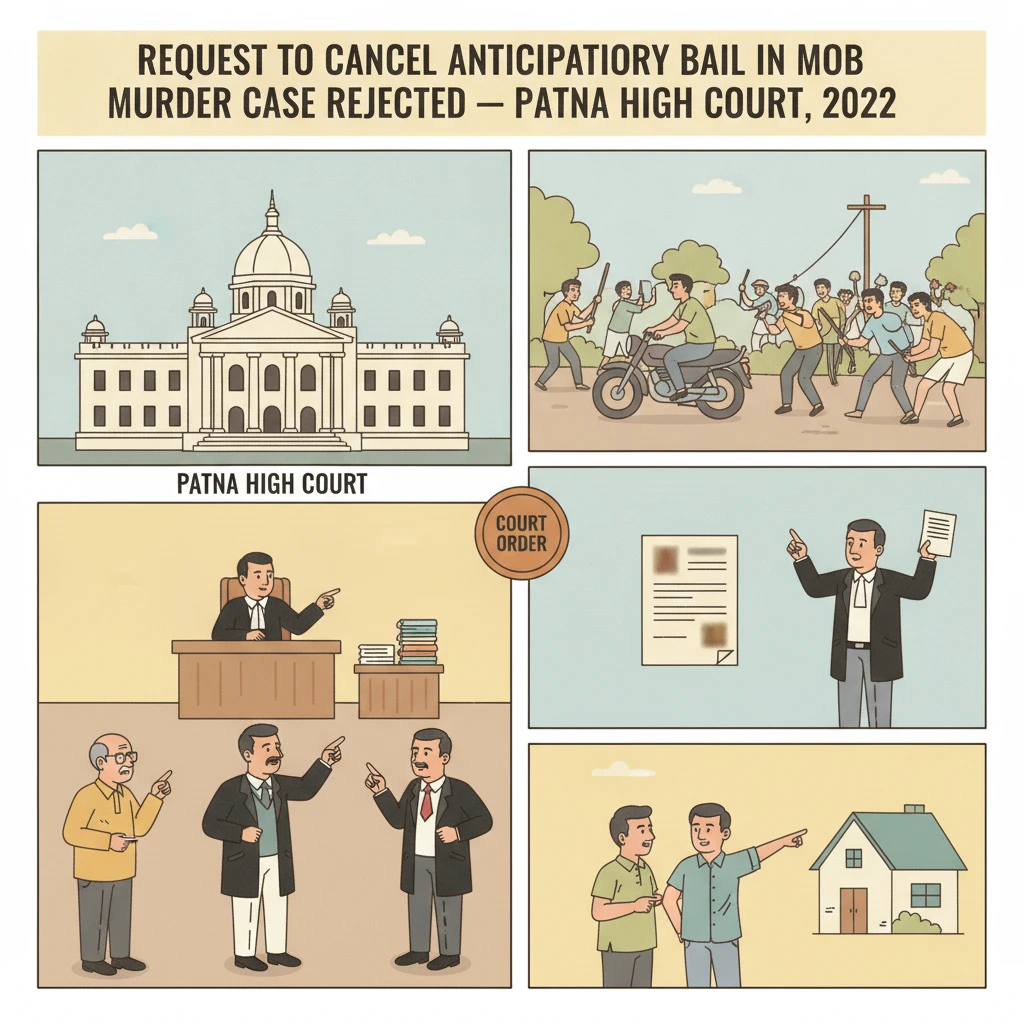
The informant further alleged that on 07.05.2019, Ramchandra Das convened a meeting where a plan was made to kill the informant and his family members. On 08.05.2019, when the informant’s father and brother were returning home on a motorcycle, they were allegedly ambushed by Ramchandra Das and 65 other named persons. The mob allegedly attacked them with various weapons, causing their death.
The informant claimed that on hearing the noise, he rushed to the spot and saw all the accused persons fleeing. In the First Information Report (FIR), 66 persons, including opposite party no. 2 in this case, were named as members of the mob. There was, however, no specific allegation of any overt act by opposite party no. 2.
Opposite party no. 2 later approached the Patna High Court for anticipatory bail under Section 438 of the Code of Criminal Procedure (Cr.P.C.). His application in Cr. Misc. No. 43593 of 2019 was allowed on 16.07.2019. The Court granting bail had taken into account the submission that the main allegation was against co-accused Ramchandra Das and that opposite party no. 2, being the Mukhia of the Gram Panchayat, had been falsely implicated.
The present criminal miscellaneous application, Cr. Misc. No. 16962 of 2020, was then filed under Section 439(2) Cr.P.C. by the informant, seeking cancellation of that anticipatory bail.
What the Court Examined and Decided
The petitioner argued that the anticipatory bail in favour of opposite party no. 2 had been obtained by concealing important facts and that the gravity of the offence also required cancellation of bail.
Her main point was that on 05.07.2019, in Cr. Misc. No. 41562 of 2019, the Patna High Court had already rejected anticipatory bail applications of nine co-accused from the same case who were similarly placed. That rejection order, she said, was not disclosed when opposite party no. 2’s anticipatory bail was heard and allowed on 16.07.2019.
Subsequently, on 31.07.2019, in Cr. Misc. No. 47611 of 2019, the Court rejected anticipatory bail of ten more co-accused, noting that the earlier rejection dated 05.07.2019 had not been brought to the Court’s notice at the time of granting anticipatory bail to opposite party no. 2.
Two further anticipatory bail applications of other co-accused were rejected on 21.10.2019 and 28.11.2019 in Cr. Misc. No. 46903 of 2019 and Cr. Misc. No. 50907 of 2019, copies of which were filed by the petitioner.
The petitioner argued that if the Court had been told on 16.07.2019 that similarly circumstanced co-accused had already been denied anticipatory bail, it would not have granted the privilege to opposite party no. 2. She further submitted that persons who had obtained bail were threatening witnesses, and an application about these threats had been filed before the Chief Judicial Magistrate, Araria (Annexure-7).
On the other hand, counsel for opposite party no. 2 filed a counter affidavit and denied any concealment. He stated that opposite party no. 2 did not know that co-accused had been refused anticipatory bail by the order dated 05.07.2019 in Cr. Misc. No. 41562 of 2019. He pointed out that the advocate who argued for opposite party no. 2 in Cr. Misc. No. 43593 of 2019 was different from the advocate in Cr. Misc. No. 41562 of 2019, and so had no occasion to know of that earlier order.
He also denied that opposite party no. 2 had tampered with evidence or threatened any witness. Referring to the FIR, he argued that there was only a general, omnibus allegation of participation; there was no specific overt act attributed to opposite party no. 2. He submitted that no ground based on later events (supervening circumstances) had been made out to cancel bail already granted.
The Court first noted an important limitation on its own power. In a proceeding under Section 439(2) Cr.P.C., the Court cannot reassess the correctness of its earlier order granting bail. Doing so would amount to reviewing its own order, which is barred by Section 362 Cr.P.C. The Court referred to Supreme Court decisions in Sankatha Singh and others v. State of Uttar Pradesh (AIR 1962 SC 1208), State of Orissa v. Ram Chander Agarwala and others (AIR 1979 SC 87), and Simrikhia v. Dolley Mukherjee and Chhabi Mukherjee (AIR 1990 SC 1605).
The real question, therefore, was not whether the earlier grant of anticipatory bail on 16.07.2019 was right or wrong, but whether new, strong reasons had arisen to cancel that bail.
For this, the Court relied heavily on Supreme Court jurisprudence. It cited Dolat Ram and others v. State of Haryana, (1995) 1 SCC 349. In that case, the Supreme Court clearly held that rejecting bail at the first stage and cancelling bail already granted are two different things. Bail once granted should not be cancelled unless there are very cogent and overwhelming circumstances.
Dolat Ram listed examples of such grounds: interference or attempt to interfere with the administration of justice, evasion of the course of justice, or abuse of the concession of bail. The possibility of the accused absconding can also justify cancellation. These grounds are generally linked to the conduct of the accused after grant of bail.
The Court then discussed Nityanand Rai v. State of Bihar and another, (2005) 4 SCC 178, where the Supreme Court once again stressed that cancellation of bail stands on a different footing from granting bail. The grounds must arise after bail is granted, and must relate to how the accused behaves while on bail.
In Nityanand Rai, the Supreme Court also held that an accused cannot automatically be blamed for not bringing certain prosecution facts to the Court’s notice; it is the prosecution’s duty to present such material. The Patna High Court reproduced paragraph 8 of that judgment, where the Supreme Court had set aside a cancellation of bail that was based on alleged suppression and threats which were not properly proved.
The Court further relied on Ranjit Singh v. State of Madhya Pradesh and others, (2013) 16 SCC 797. That case underlined the difference between cancelling bail due to misconduct or supervening circumstances, and setting aside a perverse or illegal bail order. If an order granting bail is wholly unjustified and based on irrelevant materials, a superior court can annul it. But this is different from a Section 439(2) exercise based on later conduct.
Lastly, the Court cited X v. State of Telangana and another, (2018) 16 SCC 511, where the Supreme Court repeated that very cogent and overwhelming circumstances are a sine qua non for cancelling bail already granted, and distinguished such cancellation from an appeal against grant of bail.
Applying these principles, the Court examined the record of this case.
First, it noted that the FIR contained no specific allegation of any overt act by opposite party no. 2, only a general allegation of presence in the mob. It also recorded that the application for cancellation did not allege that opposite party no. 2 had any prior criminal antecedent.
Second, regarding the alleged concealment of the earlier rejection order dated 05.07.2019, the Court considered the stand taken in the counter affidavit that opposite party no. 2 and his lawyer had no knowledge of that order. Following the reasoning of the Supreme Court in Nityanand Rai, the Court indicated that it is primarily for the prosecution to place such previous orders before the Court.
Third, on the allegation that accused persons enlarged on bail were threatening witnesses, the Court noted the claim and the application said to have been filed before the Chief Judicial Magistrate. However, in light of the legal standard, the Court did not find sufficient material to show that opposite party no. 2, in particular, had misused the privilege of bail, interfered with justice, or abused the concession granted.
Considering all these aspects together, and keeping in mind the Supreme Court’s insistence that only strong supervening circumstances can justify cancelling bail, the Court concluded that no such case had been made out against opposite party no. 2.
It therefore held that there was no ground to cancel the anticipatory bail earlier granted in Cr. Misc. No. 43593 of 2019. The present application under Section 439(2) Cr.P.C. was found to be without merit and was dismissed.
Why This Judgment Matters
This judgment is important for complainants, accused persons, and lawyers dealing with serious offences like murder where many people are named in the FIR.
First, it makes clear that once the Patna High Court or any court grants bail or anticipatory bail, it is not easy to get that order cancelled. The focus is not on rearguing whether bail should have been granted, but on whether, after getting bail, the accused has done something wrong such as threatening witnesses, absconding, or misusing the liberty.
Second, the Court shows that simply saying an accused hid some facts is not enough. The party seeking cancellation has to show clear material that the accused knowingly suppressed important information, and even then, cancellation will depend on the overall circumstances.
Third, for people facing allegations of being part of a large mob, the judgment underlines that courts will look at whether there are specific allegations of individual acts, or only general statements of presence. The absence of a specific overt act can matter when the Court considers bail and any later request to cancel it.
Finally, this decision reassures accused persons that bail is a serious protection, not something that can be withdrawn lightly, while also reminding complainants that if witnesses are genuinely threatened or evidence is interfered with, such conduct must be clearly proved and properly placed before the court.
Legal Issues and Answers
- Issue: Can the Patna High Court cancel anticipatory bail already granted to an accused in a murder case, on the ground that earlier rejection of bail to co-accused was not disclosed and that the offence is grave?
Answer: No. The Court held that under Section 439(2) Cr.P.C., bail once granted can be cancelled only on the basis of strong supervening circumstances, such as misconduct or interference with justice after grant of bail. Alleged non-disclosure of earlier orders and the general gravity of the offence, without proof of later misuse of bail by opposite party no. 2, were insufficient. - Issue: Is a court allowed to reassess the correctness of its earlier bail order in a cancellation proceeding?
Answer: No. The Court held that reconsidering the correctness of the earlier grant of anticipatory bail would amount to reviewing its own order, which is barred by Section 362 Cr.P.C. A cancellation petition cannot be used as an appeal against the earlier bail order.
Cases Cited by the Court
- Sankatha Singh and others v. State of Uttar Pradesh, AIR 1962 SC 1208.
- State of Orissa v. Ram Chander Agarwala and others, AIR 1979 SC 87.
- Simrikhia v. Dolley Mukherjee and Chhabi Mukherjee, AIR 1990 SC 1605.
- Dolat Ram and others v. State of Haryana, (1995) 1 SCC 349.
- Nityanand Rai v. State of Bihar and another, (2005) 4 SCC 178.
- Ranjit Singh v. State of Madhya Pradesh and others, (2013) 16 SCC 797.
- X v. State of Telangana and another, (2018) 16 SCC 511.
- Central Bureau of Investigation, Hyderabad v. Subramani Gopalakrishnan and another, (2011) 5 SCC 296.
- Dataram Singh v. State of Uttar Pradesh and another, (2018) 3 SCC 22.
Case Details
Case Number: Criminal Miscellaneous No. 16962 of 2020, arising out of Narpatganj P.S. Case No. 281 of 2019, District Araria.
Case Title: Bharat Kumar Das v. The State of Bihar and another.
Citation: 2022 (2) PLJR 205.
Coram: Hon’ble Mr. Justice Chakradhari Sharan Singh.
Advocates:
- For the petitioner (informant): Mr. Ashok Kumar Keshari, Advocate; Ms. Shilpi Keshri, Advocate.
- For the State (opposite party no. 1): Mr. Choubey Jawahar, Additional Public Prosecutor.
- For opposite party no. 2: Mr. Shardanand Mishra, Advocate; Mr. Dhananjay Kumar Gupta, Advocate; Mr. Rajiv Ranjan, Advocate.
Nature of the case: Application under Section 439(2) Cr.P.C. seeking cancellation of anticipatory bail granted under Section 438 Cr.P.C. in a murder case under Sections 302/120B and 34 of the Indian Penal Code.
Link to full judgment: Patna High Court Judgment
If you found this explanation helpful and wish to stay informed about how legal developments may affect your rights in Bihar, you may consider following Samvida Law Associates for more updates.







