

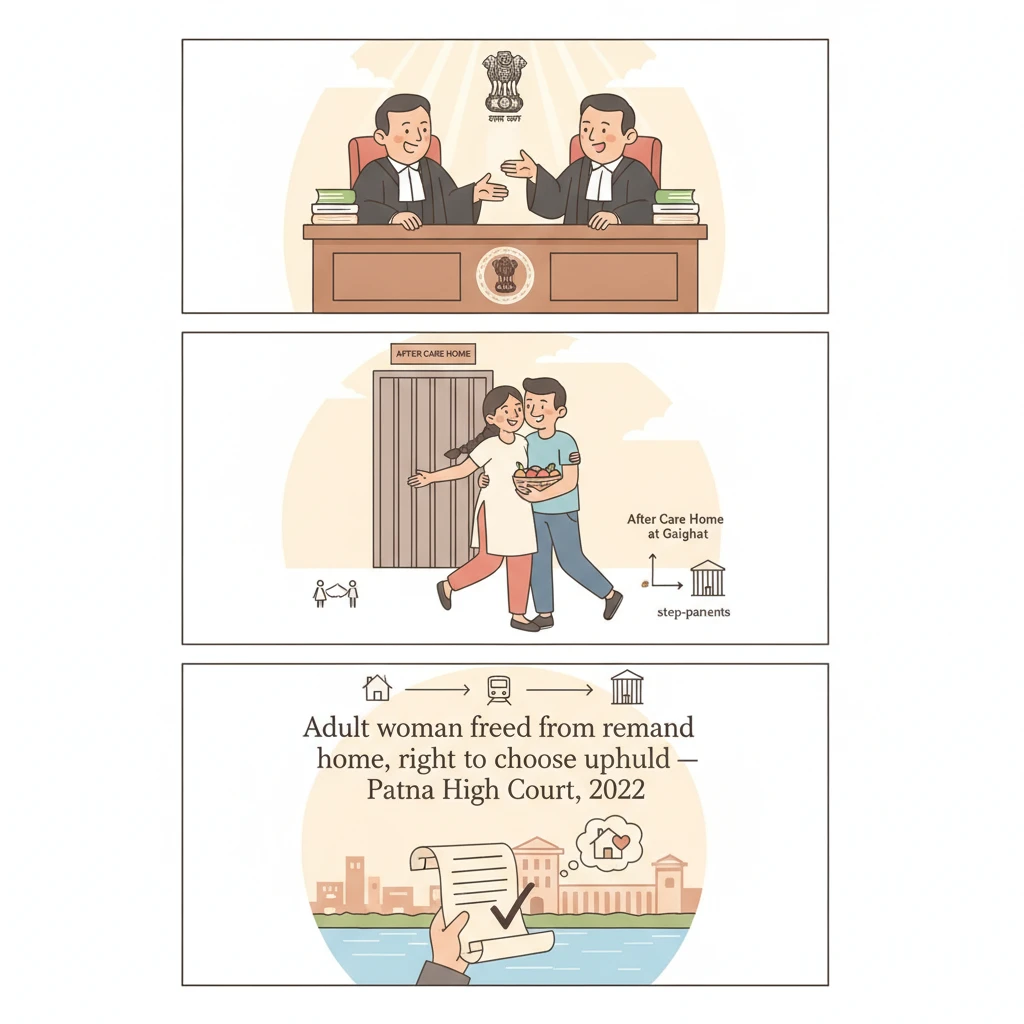
Case Background
The case arose from a criminal writ petition filed in the Patna High Court, numbered Criminal Writ Jurisdiction Case No. 1244 of 2021. The petitioner is a woman who had been living in various remand and After Care Homes under the child protection system since 2011.
According to her writ petition, her biological father and mother had died. She stated that her stepfather and stepmother wanted to sell her. Because of this threat, she left her house on 10.11.2011 and reached Kishanganj.
In Kishanganj, a man, whose name is recorded in the writ petition, allegedly wanted to marry her against her wishes. When she raised an alarm, that man was booked in a criminal case and sent to jail. As there was nobody willing to keep her in their home, the petitioner was sent to the Remand Home at Kishanganj.
The petitioner narrates that she was later moved from one remand home to another. She travelled from the Remand Home at Kishanganj to a Remand Home at Araria. Finally, by an order of the competent authority, she was transferred to the Remand Home at Patna City on 10.07.2020. Since then she has been staying in the After Care Home/Remand Home at Gaighat, Patna City, Patna.
Having spent around a decade in such institutions, she approached the Patna High Court. Her main request was simple: she wanted to be released from the remand home, claiming that she was now a major, and she wanted to settle in life and live like any other adult woman.
What the Court Examined and Decided
The writ petition was heard by a Division Bench of the Patna High Court comprising Hon’ble Mr. Justice Ashwani Kumar Singh and Hon’ble Mr. Justice Rajeev Ranjan Prasad. The oral judgment was delivered by Hon’ble Mr. Justice Rajeev Ranjan Prasad on 10.03.2022.
In her writ petition, the petitioner also stated that she had married the deponent of the writ affidavit, one Mr. Shravan Kumar, and sought release to live with him. However, during the hearings it came out that this statement about marriage was not factually correct.
On earlier dates, the Court felt it necessary to check the deponent’s identity and his relationship with the petitioner, because the petition had been filed claiming that he was her husband. Accordingly, by order dated 23.12.2021, the Court directed that the deponent, Shravan Kumar, must appear in person.
On 24.02.2022, the matter was taken up in Chambers. Shravan Kumar appeared in person. The Court interacted with him in the presence of the petitioner’s counsel and the learned Assistant Counsel to the Advocate General representing the State. His detailed statement was recorded in the order.
He stated that he is the only son of one Upendra Ram of village Saraiya, P.S. Bounsi, District Banka. His father works as a mason in Delhi. He has five sisters, three married and two unmarried. As a child, he had gone to Delhi with his father, but later he came to Kishanganj with someone whose name he no longer remembers.
At Kishanganj, he was earning his livelihood by selling fruits in the campus of Kishanganj Hospital. There, he claimed, he met the petitioner, who used to visit the hospital for treatment. Over time, they developed a relationship. After some time, the petitioner was transferred to the Remand Home at Patna.
For about one and a half years before the hearing, Shravan Kumar had been living in Patna. He somehow reached the Remand Home at Gaighat, Patna in search of the petitioner. After learning that she was staying there, that she had become a major, and that she wanted to marry him, he decided to file the writ petition to seek her release.
Crucially, in the presence of both sides’ lawyers, Shravan Kumar clearly stated that no marriage had yet taken place between him and the petitioner. He said that the statements in the writ petition about a solemnised marriage were not based on his instructions and were mistakenly made. The Court checked his Aadhaar card bearing No. 954814084591 and found that the address in the affidavit matched the address on the Aadhaar card.
The Court recorded that, had the case rested only on such incorrect statements about marriage, the writ petition could have been straightaway rejected. However, another important aspect emerged from the records: the petitioner was said to be major. The Child Welfare Committee, Kishanganj, had already been making inquiries into her parentage and correct address.
The counter affidavit filed on behalf of Respondent No. 5, the Superintendent of the Remand Home at Gaighat, showed that the petitioner herself had written a letter dated 28.11.2021, stating that she had not solemnised any marriage with the deponent. This letter was annexed as Annexure D. The same counter affidavit also referred to communication with the Child Welfare Committee and other child protection authorities regarding the petitioner’s background.
Given these circumstances, and keeping in view its duty under Article 226 of the Constitution of India, the Court considered it proper to interact with the petitioner herself. It directed that she be produced in Chambers on 10.03.2022.
On 10.03.2022, the petitioner appeared in Chambers, accompanied by Ms. Vandana Gupta, Superintendent of the Remand Home at Gaighat. In the presence of counsel for both sides and the Superintendent, the Bench interacted with the petitioner.
The petitioner repeatedly asserted that she was a major. A duly attested copy of her Aadhaar card, showing her date of birth as 01.01.2001, was produced and taken on record. On that basis, the Court accepted that she was more than 21 years old as on the date of hearing.
The petitioner appeared confident about her acquaintance with Shravan Kumar, the deponent. She clearly told the Court that she wanted to leave the Remand Home and live a life of her own choice. On a question from the Bench, she said she had learnt stitching while in the Home, and, if given a chance, she could work in that field. She also stated that she could understand alphabets and sign her name in Hindi.
The State side produced a letter bearing No. 44 dated 03.03.2022 from the Superintendent of Police, Banka, addressed to the Advocate General. In this letter, after verification, the Superintendent of Police, Banka certified that the name and address of Shravan Kumar were correct and that he had no criminal antecedent in the records of the local police station.
Respondent No. 5, the Superintendent of the Remand Home, filed a supplementary counter affidavit explaining her efforts to obtain complete information regarding the petitioner’s parentage from the District Child Protection Units and Child Welfare Committees of Araria and Kishanganj. Despite telephonic follow-up on 05.03.2022, she received no records from them. However, the writ petition already contained annexures from the Child Welfare Committee, Bihar and the Assistant Director, District Child Welfare Unit, Araria, showing the petitioner’s parentage and address.
In view of all this, and noting that the petitioner was above 21 years of age, learned counsel for the State fairly submitted that if she is a major and wishes to live her own life, she should be set free. The Superintendent of the After Care Home/Remand Home at Gaighat also stated that there was no difficulty in allowing her to go, now that she had become an adult.
The Court then considered the legal position. It observed that there was no doubt that the petitioner had attained majority. Her medical certificate attached to the counter affidavit of Respondent No. 5 supported this. Her Aadhaar card authenticated her date of birth. The petitioner had consistently expressed before the Court her desire to come out of the Remand Home and live with the deponent, or at any rate to live according to her own choice.
The Bench made it clear to the petitioner that the Court would not give any opinion on her personal choice of whom to live with or not. That decision was entirely hers. The Court’s role was limited to ensuring that her legal right to choose her life, as an adult, was respected.
At this stage, the Bench recalled the judgment of the Hon’ble Supreme Court in Shafin Jahan v. Asokan K. M., reported in AIR 2018 SC 1933. In that case, the Supreme Court was dealing with a habeas corpus petition concerning a 23-year-old woman who wanted to live with a person of her own choice. The Supreme Court had laid down clear principles regarding the jurisdiction in habeas corpus matters.
The Patna High Court quoted paragraph 27 of the Supreme Court judgment, where it was stressed that the main purpose of a writ of habeas corpus is to ensure that no one is deprived of liberty without sanction of law, and that the Court must ascertain the independent choice of the person concerned and secure release from illegal restraint. The Supreme Court had further emphasised that the expression of choice is a fundamental right under Articles 19 and 21 of the Constitution, so long as it does not violate any valid legal framework, and that once this aspect is clear, the Court’s enquiry must end.
The Bench also referred to its own earlier decision in Based on the News Item Uploaded On the Website of News App Bar And Bench v. The State of Bihar & Ors., reported in 2018 SCC Online Pat 1179, where the same principles were followed.
The Court pointed out that those earlier cases were about “illegal restraint” of a woman. In the present case, the petitioner had been staying in remand homes since 2011 under orders of the competent authorities. Technically, it was not a case of illegal detention, because she had been placed there through proper child protection processes.
However, the Court held that the more important fact now was that the petitioner had become a major, more than 21 years old, and she clearly wanted to come out of the Remand Home and live her own life as per her choice. In such a situation, continuing to keep her in the Remand Home would go against the spirit of the constitutional guarantee of personal liberty and choice.
The Bench summed up that the ratio of the Supreme Court and High Court decisions is that an adult’s expression of choice is a fundamental right under Articles 19 and 21 of the Constitution. As long as the choice does not break any existing law, it must be respected, and the Constitution itself protects it.
Therefore, the Court concluded that the only way to uphold constitutional values and the guarantees conferred upon the petitioner was to allow her freedom—specifically, to permit her to leave the Remand Home at Gaighat and live in terms of her own choice.
Accordingly, the writ application was allowed. The Court directed the Superintendent of the After Care Home/Remand Home at Gaighat, Patna City, Patna to allow the petitioner to leave and ensure that she goes forthwith without any hindrance.
The Court also directed that a copy of the order be handed over to the learned Assistant Counsel to the Advocate General, to be made available to the Superintendent of the After Care Home/Remand Home, Gaighat, for prompt compliance. With these directions, the writ petition was disposed of.
Why This Judgment Matters
This judgment is important for any person who has grown up in a child protection institution and has now become an adult. It makes clear that once a person attains majority, she cannot be kept in a remand home against her will, if there is no legal order justifying such detention.
The Patna High Court focused on the petitioner’s age and her clear wish to live her own life. Even though she had been properly sent to remand homes as a child in need of care and protection, those arrangements could not continue indefinitely once she became an adult.
The decision reinforces that the role of the State and child welfare authorities is to protect children, not to control adults. When a person crosses 18 years and particularly when she is above 21 years, her right to choose where and with whom to live becomes central.
For women like the petitioner, who may have no strong family support and have spent years in institutions, this decision assures that the court will respect their personal decisions, as long as no law is broken. It also sends a message to remand homes and After Care Homes that they must review the status of residents who reach adulthood and cannot keep them confined merely out of habit or administrative delay.
Legal Issues and Answers
-
Issue: Can an adult woman, who has spent years in a remand or After Care Home under child protection orders, be compelled to continue living there against her wishes?
Answer: No. The Patna High Court held that once it is clear that she is a major and her choice does not violate any valid legal framework, she must be allowed to leave and live her life according to her own choice. -
Issue: Does the Court decide with whom an adult woman should live after her release from such a Home?
Answer: No. The Court clarified that it would not form any opinion on her personal choice of companion; that decision is solely hers. The Court only ensures her freedom to make that choice.
Cases Cited by the Court
- Shafin Jahan v. Asokan K. M., AIR 2018 SC 1933 (Supreme Court).
- Based on the News Item Uploaded On the Website of News App Bar And Bench v. The State of Bihar & Ors., 2018 SCC Online Pat 1179 (Patna High Court).
Case Details
Case Number: Criminal Writ Jurisdiction Case No. 1244 of 2021; arising out of P.S. Case No. 467 of 2011, District Patna.
Case Title: Kajal Parvin v. The State of Bihar & Ors.
Coram: Hon’ble Mr. Justice Ashwani Kumar Singh and Hon’ble Mr. Justice Rajeev Ranjan Prasad.
Citation: 2022 (2) PLJR 184.
Advocates: Mr. Upendra Kumar Singh, Advocate for the petitioner; Mr. Prabhu Narayan Sharma, AC to Advocate General, for the respondents.
Nature of the Case: Criminal writ petition under Article 226 of the Constitution of India seeking release of the petitioner from an After Care Home/Remand Home.
Date of Judgment: 10.03.2022.
Link to Judgment: https://patnahighcourt.gov.in/viewjudgment/MTYjMTI0NCMyMDIxIzEjTg==-OYgQIWNQpdA=
If you found this explanation helpful and wish to stay informed about how legal developments may affect your rights in Bihar, you may consider following Samvida Law Associates for more updates.







