

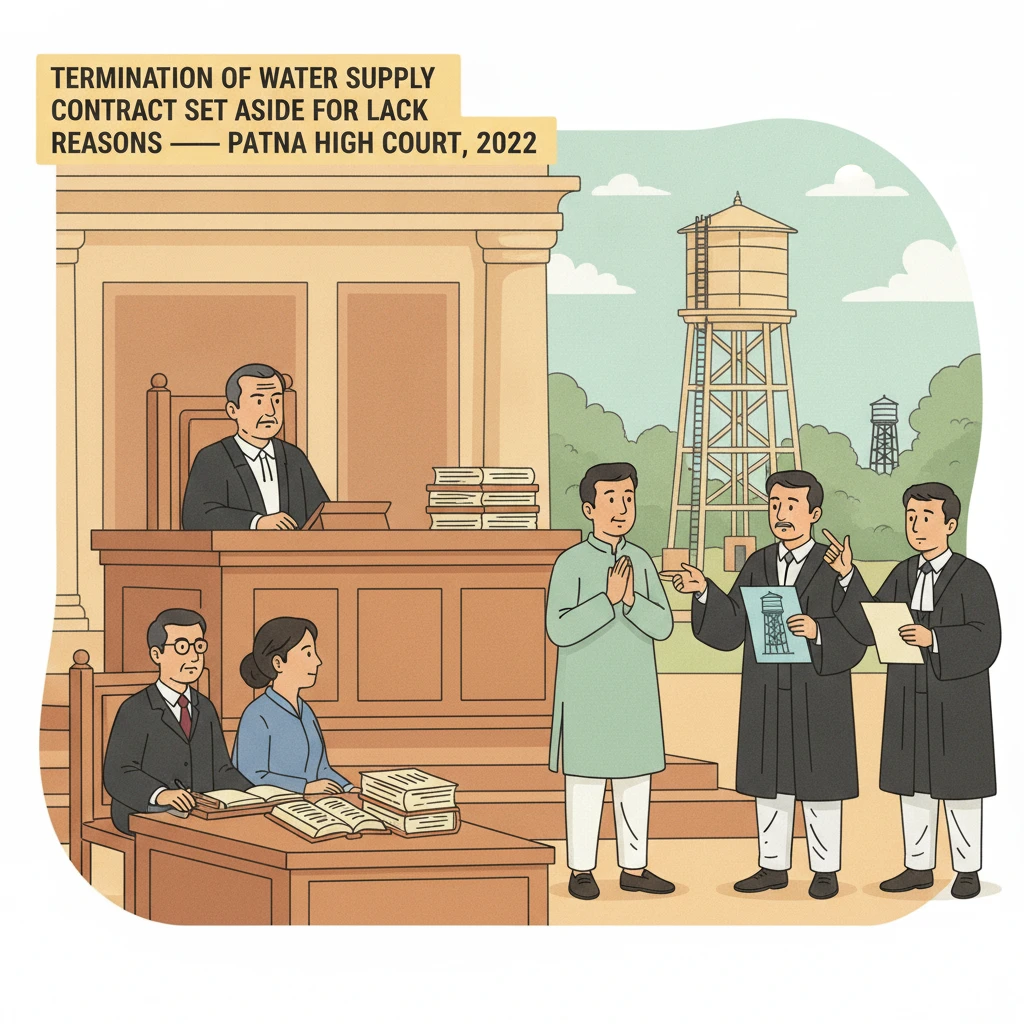
The Court found that the termination order was cryptic and did not discuss the contractor’s detailed reply.
Because natural justice was not followed, the Court quashed the order and sent the matter back to the department.
The department may pass a fresh, reasoned order, after properly considering the contractor’s response.
Case Background
The case arose from a contract for the “Jamalpur Chaksarwar Single Gram Pipe Water Supply Scheme” in Patna district. The work related to construction of a water supply system, including a water tank or water tower, under the Public Health Engineering Department (PHED), Government of Bihar.
The petitioner, a proprietorship firm, was selected through a Notice Inviting Tender (N.I.T.) and entered into Agreement No. SBD-10(WB)/2016-17 with the Executive Engineer-cum-Project Manager, District Project Management Unit (DPMU), Patna, on 09.01.2017. On the same date, a work order was issued in his favour.
As the work progressed, disputes arose between the contractor and the PHED officials. Each side blamed the other for delay and poor progress of the project. The contractor claimed that there were serious impediments which prevented smooth execution of the work. The department, however, alleged that the contractor did not maintain the required pace of work.
The department also alleged that the contractor had not constructed the water tower according to the approved design and drawing. Because of this, by letter dated 12.03.2020, the contractor was directed to construct the water tower in accordance with the approved design. The letter warned that if this was not done, the department would get the work done on “risk and cost” basis and recover the expenses from the contractor.
Even before this, the Executive Engineer, PHED Division, Patna East, had issued a show cause notice dated 29.02.2020. In this notice, the contractor was asked to explain, within one week, why the agreement should not be terminated and why his security deposit should not be forfeited.
The contractor stated that he received the notice only on 07.03.2020, during the Holi festival period. Because of this, he requested, by letter dated 13.03.2020, an extension of one more week for submitting his reply. He then submitted a detailed show cause reply on 17.03.2020, giving his explanation on the allegations and the progress of work.
Despite this, on 18.03.2020 the Executive Engineer-cum-Project Manager, DPMU, Patna, issued an order cancelling the agreement. By the same order, the authority ordered forfeiture of the security deposit and proposed recovery on risk and cost basis for the cost of constructing the water tank.
Feeling aggrieved, the contractor filed a writ petition before the Patna High Court, seeking quashing of the order dated 18.03.2020. Although the writ petition also contained a prayer for payment of outstanding dues for work already executed, at the time of hearing the petitioner’s senior counsel confined the relief to challenging the termination and related directions for security forfeiture and recovery.
What the Court Examined and Decided
The Division Bench of the Patna High Court, comprising Hon’ble Mr. Justice Rajan Gupta and Hon’ble Mr. Justice Mohit Kumar Shah, heard the matter. The oral judgment was delivered on 22.03.2022 by Hon’ble Mr. Justice Rajan Gupta.
The first question before the Court was whether the writ petition itself was maintainable, since the State argued that the contract contained an arbitration clause. The second and central question was whether the termination order dated 18.03.2020, and the decision to forfeit the security and impose risk and cost recovery, could stand in law.
On behalf of the contractor, senior counsel argued that the impugned order was completely cryptic. According to him, the detailed reply submitted by the contractor on 17.03.2020 was not discussed at all. The order simply recorded in one line that the show cause reply was “unsatisfactory.”
The petitioner pointed out that the order did not give any clear, cogent or precise reasons for rescinding the agreement. When a person’s rights are being affected – such as termination of a public contract and forfeiture of money – the authority must pass a reasoned order. Because this was not done, the contractor argued that the order violated the principles of natural justice and was liable to be quashed.
In response, the State defended the action and relied on Clause 25 of the Standard Bidding Document, which provided for “settlement of disputes and arbitration.” According to the State, since there was an alternative remedy of arbitration, the contractor should not have approached the High Court under Article 226 of the Constitution.
However, when the Bench asked specifically how the impugned order could be justified as a valid, reasoned order, the State counsel was unable to explain or show from the text of the order that the contractor’s reply had been considered in any meaningful way.
The Court then examined the materials on record. It noted that the writ petition revolved around the legality of the termination order itself, especially whether it was passed in compliance with principles of natural justice.
On the issue of maintainability, the Court held that the existence of an arbitration clause did not bar it from exercising writ jurisdiction where there was a clear violation of natural justice. The Court stated that this is the settled position: even in contractual matters, a writ petition is maintainable if the impugned action is illegal, violates natural justice, or infringes fundamental rights.
To support this view, the Court referred to a series of Supreme Court and High Court judgments. These included:
Gunwant Kaur v. Municipal Committee, Bhatinda, (1969) 3 SCC 769; Harbans Lal Sahnia v. Indian Oil Corporation Ltd., (2003) 2 SCC 107; ABL International Ltd. v. Export Credit Guarantee Corporation, (2004) 3 SCC 553; Cholan Roadways Ltd. v. G. Thirugnanasambandam, (2005) 3 SCC 241; Popcorn Entertainment & Anr. v. City Industrial Development Corporation, (2007) 9 SCC 593; Food Corporation of India & Ors. v. Seil Ltd. & Ors., (2008) 3 SCC 440; M/s NCC Ltd. v. State of Bihar & Ors., 2013 (1) PLJR 952; and Joshi Technologies International Inc. v. Union of India & Ors., (2015) 7 SCC 728.
After settling the maintainability issue, the Bench turned to the nature of the termination order. It carefully read the impugned order dated 18.03.2020 and the petitioner’s show cause reply dated 17.03.2020.
The Court found that the impugned order did not deal with any of the issues raised in the contractor’s detailed reply. There was no discussion of the alleged “serious impediments,” no reasoning about whether the contractor had in fact violated the approved design, and no explanation for why the reply was considered unsatisfactory.
Instead, the authority had simply concluded, in one line, that the reply was unsatisfactory and then went on to terminate the agreement, forfeit the security deposit and initiate recovery. The Court observed that such an order, which is unreasoned and does not show consideration of the reply, is contrary to settled principles of administrative law.
The Bench emphasised that giving reasons is an indispensable component of the decision-making process. It relied heavily on the Supreme Court judgment in Oryx Fisheries Private Limited v. Union of India and others, (2010) 13 SCC 427. In that case, the Supreme Court had discussed in detail the requirement of giving a reasonable opportunity and recording reasons, especially when punitive steps are taken after issuing a show cause notice.
The Patna High Court reproduced several paragraphs from Oryx Fisheries. These extracts highlighted key points:
First, a person must be told clearly what the charges and allegations against him are, so that he can deny guilt and defend himself. Second, when an authority issues a show cause notice, it must keep an open mind and act fairly while considering the reply. Third, an order which simply declares a reply “not satisfactory” without dealing with its contents is a “non-speaking” order and cannot be sustained.
The Court also referred to the Supreme Court’s decision in Kranti Associates (P) Ltd. v. Masood Ahmed Khan, (2010) 9 SCC 496, which laid down a long list of principles on the need to record reasons. These include that recording reasons prevents arbitrary exercise of power, reassures parties that relevant factors have been considered, facilitates judicial review, and is closely tied to transparency and fairness.
Applying these principles, the Bench held that the termination order in the present case was vitiated. It did not meet the standard of a reasoned, speaking order. It did not show that the authority had applied its mind to the contractor’s explanation. In the eyes of law, such an order could not be allowed to stand.
Therefore, the Court quashed the impugned order dated 18.03.2020 passed by the Executive Engineer-cum-Project Manager, DPMU, Patna. However, the Court did not express any opinion on the merits of the dispute regarding the quality or pace of work.
Instead, the matter was remitted back to the same authority, respondent no. 5, for fresh consideration in accordance with law. The authority is now required to consider the contractor’s show cause reply properly, apply its mind and then pass a speaking and reasoned order.
The Court also clarified that if, after such fresh consideration, any adverse order is passed again against the contractor, he will be free to avail the alternative remedy available to him, such as arbitration under Clause 25 or any other remedy as per law.
On these terms, the writ petition was allowed.
Why This Judgment Matters
This judgment is important for contractors and small businesses working on government projects in Bihar and elsewhere. It underlines that government officials cannot cancel contracts and confiscate security deposits through vague, one-line orders.
Whenever an authority issues a show cause notice and a person gives a detailed reply, the authority must read and consider that reply. It must explain, in writing, why it finds the reply unsatisfactory and on what basis it is taking a harsh step like termination or recovery on risk and cost basis.
The ruling also reassures contractors that the Patna High Court will intervene under Article 226 of the Constitution if an order is passed in violation of natural justice, even though the contract contains an arbitration clause. This is especially significant where a person’s money is at stake and the decision appears arbitrary.
For government departments, the judgment is a reminder that their decisions are subject to judicial review. Orders which affect civil rights must be transparent, speak for themselves and show clear reasons. Otherwise, they risk being struck down and sent back for fresh decision-making.
Legal Issues and Answers
-
Issue: Can the Patna High Court entertain a writ petition challenging termination of a government contract when an arbitration clause exists?
Answer: Yes. The Court held that the existence of an alternative remedy like arbitration does not bar writ jurisdiction where the impugned order is illegal and passed in violation of the principles of natural justice. -
Issue: Is an order cancelling a contract and forfeiting security valid if it merely states that the contractor’s reply is “unsatisfactory” without giving reasons?
Answer: No. The Court held that such a cryptic, unreasoned order, which does not deal with the contents of the show cause reply, is contrary to the requirement of a speaking order and violates natural justice. The order was therefore quashed and the matter remanded for fresh consideration.
Cases Cited by the Court
- Gunwant Kaur v. Municipal Committee, Bhatinda, (1969) 3 SCC 769
- Harbans Lal Sahnia v. Indian Oil Corporation Ltd., (2003) 2 SCC 107
- ABL International Ltd. v. Export Credit Guarantee Corporation, (2004) 3 SCC 553
- Cholan Roadways Ltd. v. G. Thirugnanasambandam, (2005) 3 SCC 241
- Popcorn Entertainment & Anr. v. City Industrial Development Corporation, (2007) 9 SCC 593
- Food Corporation of India & Ors. v. Seil Ltd. & Ors., (2008) 3 SCC 440
- M/s NCC Ltd. v. State of Bihar & Ors., 2013 (1) PLJR 952
- Joshi Technologies International Inc. v. Union of India & Ors., (2015) 7 SCC 728
- Oryx Fisheries Private Limited v. Union of India and others, (2010) 13 SCC 427
- Kranti Associates (P) Ltd. v. Masood Ahmed Khan, (2010) 9 SCC 496
Case Details
Case Number: Civil Writ Jurisdiction Case No. 8481 of 2020
Case Title: M/s Sanjeev Kumar through its Proprietor Sri Sanjeev Kumar v. The State of Bihar & Ors.
Citation: 2022 (2) PLJR 161
Court: High Court of Judicature at Patna
Coram: Hon’ble Mr. Justice Rajan Gupta, Hon’ble Mr. Justice Mohit Kumar Shah
Date of Judgment: 22.03.2022
Advocates: Mr. Vikas Kumar, Advocate for the petitioner; Mr. Lalit Kishore, Advocate General for the respondents
Respondent Authorities: State of Bihar through Principal Secretary, Public Health Engineering Department and other departmental officers including Chief Engineer, Superintendent Engineer, Executive Engineer-cum-Project Manager, DPMU Patna, and Assistant Engineer, Public Health Sub Division, Branch Patna East
Nature of the Case: Writ petition under Article 226 of the Constitution challenging termination of a public works contract, forfeiture of security deposit and proposed risk and cost recovery
Impugned Order: Order dated 18.03.2020 passed by the Executive Engineer-cum-Project Manager, District Project Management Unit, Patna, rescinding Agreement No. SBD-10(WB)/2016-17 for the “Jamalpur Chaksarwar Single Gram Pipe Water Supply Scheme”, directing forfeiture of security deposit and recovery on risk and cost basis
Final Outcome: Writ petition allowed; impugned order dated 18.03.2020 quashed; matter remitted to respondent no. 5 for fresh decision in accordance with law, with liberty to petitioner to pursue alternative remedies if any adverse order is passed
Link to Judgment: Click here to read the full judgment of the Patna High Court
If you found this explanation helpful and wish to stay informed about
how legal developments may affect your rights in Bihar,
you may consider following Samvida Law Associates for more updates.







