

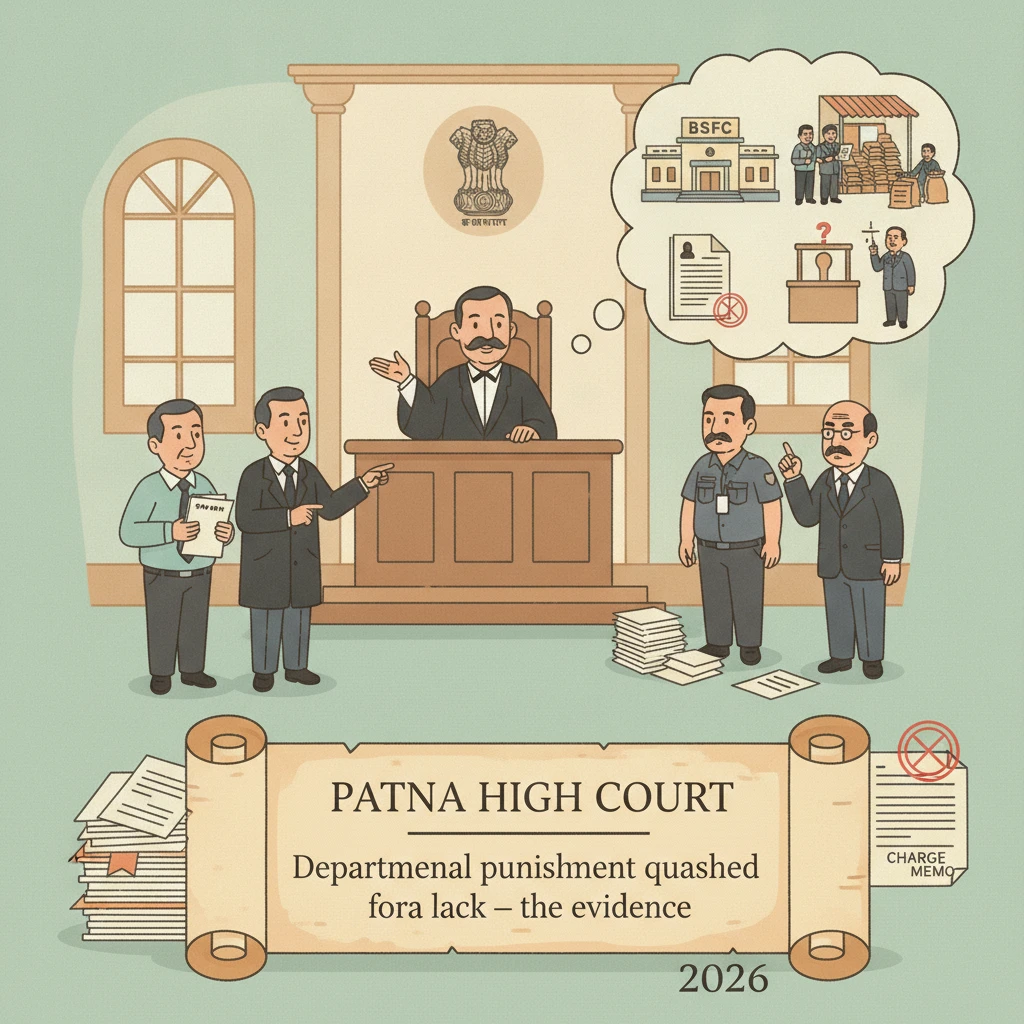
The Court found that the departmental enquiry was conducted without witnesses, without a Presenting Officer and without proper proof of documents.
All punishment and appellate orders were set aside, and the employee’s pay and promotion benefits were restored for the period till retirement.
The corporation has been directed to complete the corrective exercise within three months.
Case Background
The petitioner was working as an Assistant Manager in the Bihar State Food and Civil Supplies Corporation Limited (BSFC), Bettiah. The Vigilance Investigation Bureau conducted an enquiry into alleged irregularities in distribution of food grains from BSFC godowns to Public Distribution System (PDS) dealers and then to beneficiaries.
On the basis of this vigilance enquiry, the Food Supplies and Commerce Department, Government of Bihar, issued Letter No.1041 dated 28.02.2006. Through this letter, Managing Directors and Senior Regional Managers of BSFC were directed to take disciplinary action against persons found responsible for irregularities in distribution of food grains.
Following this direction, BSFC issued a show cause notice to nine persons, including the petitioner, by Letter No.1660 dated 14.03.2007 under the signature of the Vigilance Chief. The petitioner was broadly alleged to have committed irregularities regarding lifting of food grains from Sangrampur Godown for the period 1997–1998 to 27.05.1999.
The show cause notice itself did not clearly spell out specific, detailed allegations against the petitioner. Despite this, he submitted his written reply on 05.04.2007 denying all allegations.
Without dealing with this reply, the authority issued a formal memo of charge (Prapatra Ka) on 05.07.2007. This charge-sheet contained specific articles of charge against the petitioner and enclosed a list of documents and witnesses said to support those charges.
What the Court Examined and Decided
The core dispute before the Patna High Court was whether the departmental enquiry and the resulting punishment orders against the petitioner were legally valid.
According to the petitioner’s counsel, once the memo of charge was issued, BSFC initiated a regular departmental proceeding. However, no Presenting Officer was appointed to present the department’s case, as required under the Bihar Government Servants (Classification, Control & Appeal) Rules, 2005 (CCA Rules, 2005).
During the enquiry, two of the witnesses named in the memo of charge filed a common written statement. They stated that they were not involved in the enquiry against the concerned persons. Importantly, these witnesses were never examined orally before the Enquiry Officer. As a result, the petitioner had no opportunity to cross-examine them.
The Enquiry Officer proceeded only on the basis of the charge memo, the petitioner’s reply, a report of the District Manager, Munger, and other record documents. No oral witness was examined by the department. No Presenting Officer led evidence or proved the documents.
Despite this, the Enquiry Officer submitted his report on 25.03.2009. He held that two charges against the petitioner were proved and one charge was not proved. The report, as highlighted by the petitioner, effectively treated the petitioner’s failure to “prove his innocence” or to give a “satisfactory” reply as the basis for holding the charges proved.
The High Court noted that this approach completely reversed the basic principle that in any disciplinary proceeding, the department has to prove the charges. It is not for the employee to prove his innocence.
After receiving the enquiry report, the Managing Director of BSFC, acting as disciplinary authority, issued a second show cause notice vide Memo No.1832 dated 30.03.2009. The petitioner submitted a detailed reply. However, the disciplinary authority, through Memo No.5106 dated 19.06.2009, imposed three major consequences:
(a) the petitioner’s pay scale was brought down to its lowest stage,
(b) his promotion was withheld for the next five years, and
(c) he was warned that any repetition of such irregularities would lead to dismissal after a departmental proceeding.
Aggrieved, the petitioner filed a review petition before the Managing Director. This review was rejected by Memo No.11221 dated 29.12.2009.
He then preferred an appeal before the Principal Secretary, Food & Consumer Protection Department, Government of Bihar. The appellate authority, by Memo No.1275 dated 27.02.2013, dismissed the appeal without assigning reasons.
In the writ petition before the Patna High Court, the petitioner argued that the entire departmental proceeding was void because:
First, the enquiry violated Rule 17(3), 17(4) and 17(14) of the CCA Rules, 2005. Though the charge-sheet mentioned witnesses and documents, the witnesses were not examined and the documents were never proved by their authors. Without examination, there could be no cross-examination, and therefore, no fair opportunity to defend.
Second, no Presenting Officer was appointed. The Enquiry Officer effectively assumed the role of both prosecutor and judge, which is not permissible in law.
Third, the Enquiry Officer treated unproved documents and the petitioner’s alleged failure to disprove charges as enough to hold him guilty. This placed an illegal burden on the employee and ignored settled law that departmental charges must be proved through admissible evidence.
To support these points, the petitioner relied on several precedents. The Court quoted extensively from the Supreme Court decision in Roop Singh Negi v. Punjab National Bank, (2009) 2 SCC 570. That judgment clarified that:
• a departmental enquiry is a quasi-judicial proceeding,
• the Enquiry Officer must base findings only on material properly brought on record,
• mere production of documents is not proof; contents must be proved by witnesses, and
• an FIR or investigation report cannot, by itself, be treated as evidence in a disciplinary enquiry without examination of witnesses.
The petitioner also cited a series of Patna High Court decisions, including Ashwini Kumar v. State of Bihar (C.W.J.C. No.610 of 2017), Ram Lagan v. State of Bihar (L.P.A. No.389 of 2024), Ashok Paswan v. State of Bihar (2021 (4) PLJR 490) and Uma Shankar Ram v. State of Bihar (2025 (1) BLJ 783). These cases reinforced the same principles: documents must be proved by witnesses, enquiry officers must remain neutral adjudicators, and absence of evidence renders findings unsustainable.
The respondents, particularly BSFC, argued that the proceeding was properly conducted. They contended that the petitioner was given opportunity at every stage: show cause notice, charge-sheet, enquiry, second show cause with copy of enquiry report, review and appeal. They maintained that the authorities had carefully considered the materials and that the punishment was justified, especially in light of alleged financial irregularities found by vigilance.
BSFC’s counsel relied on a Division Bench judgment in L.P.A. No.571 of 2018 (The State of Bihar v. Ram Tawakal Singh & Ors.), where a case had been remanded to the enquiry authority to correct technical defects after a penalty was set aside.
Justice Ritesh Kumar carefully evaluated these rival stands. He found that in the present case, although a list of witnesses and documents was attached with the charge memo, only two out of three witnesses appeared, and even they only filed written submissions stating they were not concerned with the enquiry. No witness was examined on oath.
This, the Court held, amounted to “complete violation” of Rules 17(3), 17(4) and 17(14) of the CCA Rules, 2005. The petitioner had no chance to cross-examine, and the documents relied upon by the Enquiry Officer were never proved by their authors.
The Court further held that in the absence of a Presenting Officer, the Enquiry Officer impermissibly took on the role of prosecutor. This vitiated the entire process.
Importantly, the Court also noted that the Enquiry Officer and disciplinary authority did not meaningfully consider the petitioner’s replies, either to the first show cause or to the second show cause. Similarly, the appellate authority dismissed the appeal mechanically, without meeting the grounds raised.
On these findings, the Patna High Court concluded that the enquiry findings and subsequent punishment were based on “no evidence”. Relying on the principles laid down by the Supreme Court in Union of India v. P. Gunasekaran, the Court observed that in a writ under Articles 226/227, it can interfere if findings are based on no evidence.
The Court distinguished situations where proceedings are remanded to cure mere “technical” defects, such as non-supply of enquiry reports. Here, the problem was substantive — the complete failure to lead evidence — and allowing a remand would “offer a premium to the negligence” of the disciplinary authority and Presenting Officer. Therefore, no remand was ordered.
Consequently, the Court set aside the disciplinary order (Memo No.5106 dated 19.06.2009), the order rejecting review (Memo No.11221 dated 29.12.2009), and the appellate order (Memo No.1275 dated 27.02.2013).
The Court took note that the petitioner had already superannuated on 29.08.2019. It therefore directed that he would be entitled to all benefits of grant of increment on the pay scale on which he was working on 19.06.2009, and that he would be considered for promotion, if otherwise found suitable. The Managing Director, BSFC, was directed to complete this exercise within three months of receiving the order.
Why This Judgment Matters
This judgment is important for government and public sector employees across Bihar, particularly those facing departmental proceedings on the basis of vigilance reports or audit objections.
The Patna High Court has clearly held that an employee cannot be punished merely because a vigilance report exists or because a charge-sheet has been issued. Charges must be proved through proper evidence: witnesses must be examined, documents must be proved, and the employee must get a real chance to cross-examine and defend.
For employees in BSFC and other departments, the decision signals that:
• absence of a Presenting Officer,
• failure to examine listed witnesses, and
• mechanical rejection of replies and appeals
can together render the entire enquiry illegal.
The judgment also warns disciplinary authorities that courts will not always give them a “second chance” by remanding the case. Where no evidence is led, findings may be struck down outright, especially after the employee has already retired.
Legal Issues and Answers
Issue: Whether the departmental enquiry and punishment against the petitioner were valid when no Presenting Officer was appointed, no witnesses were examined, and documents were not formally proved.
Answer: No. The Patna High Court held that the enquiry violated Rule 17 of the CCA Rules, 2005 and principles of natural justice. The findings were based on no evidence, so the punishment and appellate orders were set aside.
Issue: Whether the case should be remanded to the enquiry authority to cure the defects and allow the department to lead evidence afresh.
Answer: No. The Court held that remand is appropriate only to cure technical defects, not to allow the management to fill gaps where it failed to lead evidence. Remanding in such circumstances would reward negligence in conducting enquiries.
Issue: What consequential benefits the petitioner is entitled to after the punishment orders are quashed, especially since he has already retired.
Answer: The petitioner is entitled to increments on the pay scale he held on 19.06.2009 and consideration for promotion, if otherwise suitable. BSFC must complete this exercise within three months.
Cases Cited by the Court
- Roop Singh Negi v. Punjab National Bank & Ors., (2009) 2 SCC 570
- State of Uttar Pradesh v. Saroj Kumar Sinha, (2010) 2 SCC 772
- Indu Bhushan Dwivedi v. State of Jharkhand & Ors., (2010) 11 SCC 278; 2010(3) PLJR (SC)197
- Union of India v. Mohd. Ramzan Khan, (1991) 1 SCC 588
- ECIL v. B. Karunakar, (1993) 4 SCC 727
- Union of India v. P. Gunasekaran, (2015) 2 SCC 610
- Ashwini Kumar v. The State of Bihar & Ors., C.W.J.C. No.610 of 2017 (Patna High Court, 09.05.2017)
- Ram Lagan v. The State of Bihar & Ors., L.P.A. No.389 of 2024 (Patna High Court, 06.08.2024)
- Ashok Paswan v. The State of Bihar & Ors., 2021 (4) PLJR 490
- Uma Shankar Ram v. The State of Bihar & Ors., 2025 (1) BLJ 783
- The State of Bihar v. Ram Tawakal Singh & Ors., L.P.A. No.571 of 2018 (Patna High Court)
Case Details
Case Number: Civil Writ Jurisdiction Case No.18168 of 2013
Case Title: Upendra Paswan v. The State of Bihar & Ors.
Coram: Hon’ble Mr. Justice Ritesh Kumar
Date of Judgment: 17-03-2026
Citation: 2026 (3) PLJR 429
Advocates for Petitioner: Mr. Ranjeet Kumar, Advocate; Mr. Kanishk Kaustubh, Advocate; Mr. Lakshmi Kumari, Advocate; Mr. Rajnish Prakash, Advocate; Mr. Ankesh Kumar Singha, Advocate; Ms. Manisha Rathour, Advocate
Advocates for State/Respondents: Mr. Ashok Kumar Keshri, Advocate (for the Respondents); Mr. Shailendra Kumar Singh, Advocate (for BSFC); Mr. Utkarsh Utpal, Advocate (for BSFC)
Nature of Case: Writ petition (Civil) challenging departmental enquiry report, punishment order, review order and appellate order in service/disciplinary matter
Link to Full Judgment: Patna High Court Judgment in CWJC No.18168 of 2013
If you found this explanation helpful and wish to stay informed about
how legal developments may affect your rights in Bihar,
you may consider following Samvida Law Associates for more updates.







