

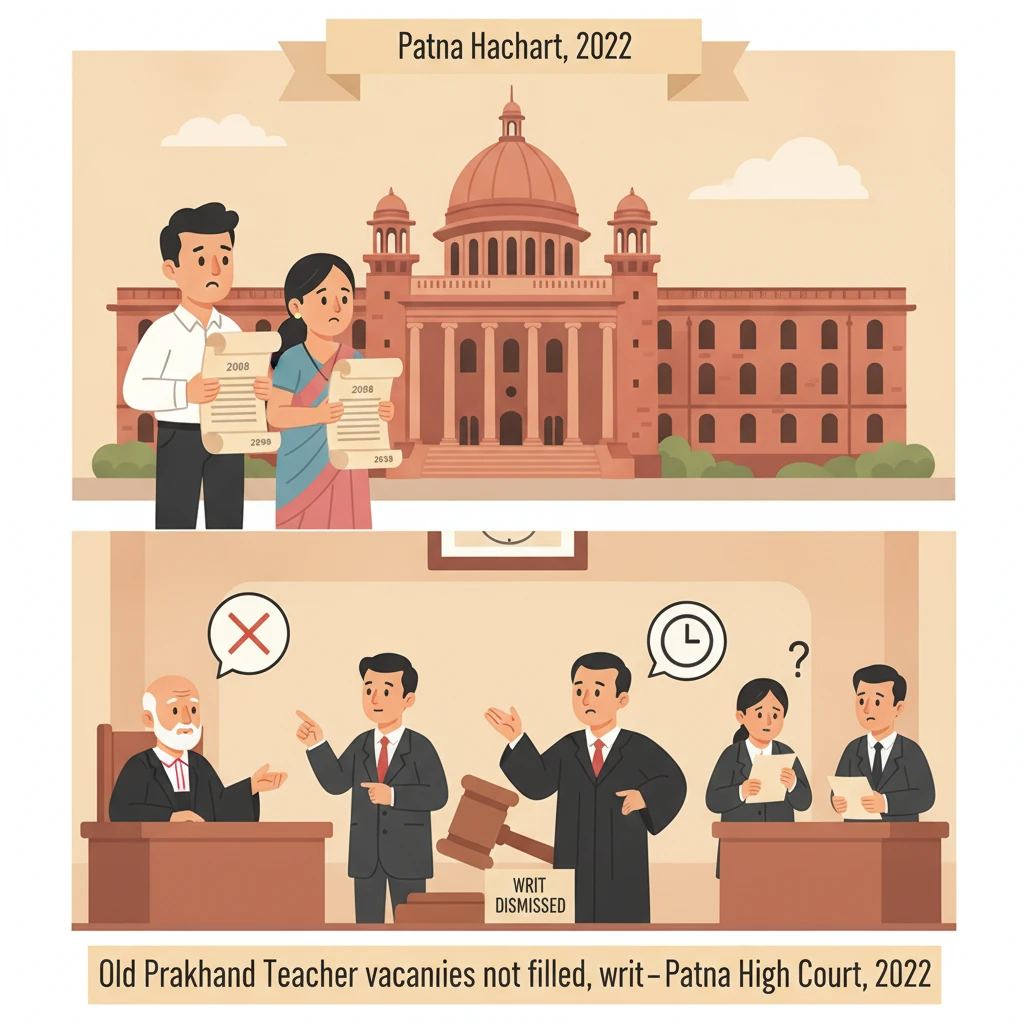
Case Background
This case arose from a recruitment process for Prakhand Teachers in the State of Bihar.
An advertisement was issued in the year 2008 for 207 posts of Prakhand Teacher. The petitioners before the Patna High Court were candidates connected with this recruitment process.
The petitioners claimed that, even after the selection process, 38 posts out of the 207 advertised remained unfilled. They approached the Patna High Court under its civil writ jurisdiction in 2021, seeking directions to the State and its authorities to fill these remaining vacancies.
The writ petition was registered as Civil Writ Jurisdiction Case No. 1316 of 2021, titled with the two petitioners as against the State of Bihar and several officials of the Education Department and district authorities in Gopalganj.
When the matter was heard on 29-03-2022, the Court first noted that the case was being taken up from the defect side and directed the petitioners’ counsel to submit the original petition with attested affidavits and to remove all defects pointed out by the Registry within two weeks. The Court then proceeded to consider the main grievance raised in the writ petition.
What the Court Examined and Decided
The Patna High Court, through Hon’ble Mr. Justice Sanjeev Prakash Sharma, examined the core complaint of the petitioners: that 38 posts of Prakhand Teacher, advertised in 2008, had allegedly been left unfilled by the authorities.
The Court recorded that the advertisement for the post of Prakhand Teacher had been issued in the year 2008 and that 207 posts were advertised. It further recorded the petitioners’ case that 38 posts remained unfilled from this recruitment.
The central question was whether, after such a long passage of time, the Court could direct the State Government or its officials to fill those remaining posts under the 2008 advertisement.
The Court first addressed the issue of time lapse. It observed that a select list cannot be treated as “alive” for as long as 14 years. The advertisement was of 2008, and the writ petition was being decided in 2022. This long gap was crucial in the Court’s reasoning.
According to the Court, once such a long period has passed, the State Government’s decision not to fill up the remaining vacancies cannot ordinarily be interfered with. The Court clearly stated that, under the advertisement of 2008, after 14 years, it would not direct the State or its authorities to fill up the said posts.
The Court also recognised a practical aspect: the petitioners and other candidates from the 2008 selection may have become overage by the time of the judgment. This indicated that the recruitment process and the situation of candidates had changed significantly over the years, making it inappropriate for the Court to revive the old recruitment.
Next, the Court turned to the legal position on whether mere participation in a selection process gives a candidate an enforceable right to appointment.
For this, the Court relied upon the settled law laid down by the Hon’ble Supreme Court of India in Shankarsan Dash v. Union of India, reported as AIR 1991 SC 1612.
Quoting the legal principle from that case, the Court noted that no right of appointment is vested in favour of a candidate merely because they had applied pursuant to an advertisement or may have been included in a select list. The law recognises that the State, as employer, and its authorities have the exclusive right not to fill up some or all of the advertised posts, provided that such decision is taken for cogent reasons.
Applying this principle, the Patna High Court held that the petitioners, who were only candidates under the 2008 advertisement, did not have a legal right to claim appointment to the remaining 38 posts. The Court emphasised that simply because posts were advertised and some may have remained vacant did not, by itself, create a legally enforceable right in favour of the petitioners.
The Court also underlined that the decision whether to fill or not to fill the advertised vacancies lies primarily with the State Government and its authorities. Judicial interference in such decisions is limited and would require strong reasons, which were not present in this case.
Considering all these aspects together—the extraordinary delay of 14 years, the possible overage of candidates, and the settled law from the Supreme Court—the Court held that there was no reason to direct the State or its authorities to fill up the posts.
Accordingly, the writ petition was dismissed. No direction was issued to the State of Bihar or the concerned education authorities to proceed with appointments under the 2008 advertisement, and no further relief was granted to the petitioners.
Why This Judgment Matters
This judgment has an important message for candidates who participate in government recruitment processes and later approach courts after many years.
First, it reinforces that old selection lists or vacancies cannot be kept alive indefinitely. If recruitment is from 2008, a candidate cannot expect the Court in 2022 to order appointments on the basis of that same advertisement.
Second, it makes clear that applying for a post, or even being in a select list, does not guarantee an automatic right to get a job. The Patna High Court, following the Supreme Court’s ruling in Shankarsan Dash, has reminded that the government may decide not to fill posts, and such a decision will usually not be interfered with unless there is clear illegality or mala fide, which was not shown here.
Third, the judgment highlights the practical problem of delay. Over long periods, candidates may cross the age limit or their circumstances may change. Courts are reluctant to reopen very old recruitment processes because it can disturb the functioning of departments and create unfairness for others who were not part of the old process.
For aspiring teachers and other job seekers, this decision signals the importance of timely legal action, and also the limit of what courts can do when the State chooses not to fill all advertised posts after many years.
Legal Issues and Answers
Issue: Can the Patna High Court, in 2022, direct the State of Bihar and its education authorities to fill 38 alleged remaining vacancies for Prakhand Teachers from an advertisement issued in 2008?
Answer: No. The Court held that a select list cannot remain alive for 14 years, candidates may have become overage, and, as per Shankarsan Dash v. Union of India (AIR 1991 SC 1612), candidates have no vested right to appointment merely by applying under an advertisement. The State has the exclusive right not to fill posts for cogent reasons.
Cases Cited by the Court
- Shankarsan Dash v. Union of India, AIR 1991 SC 1612
Case Details
Case Number: Civil Writ Jurisdiction Case No. 1316 of 2021
Case Title: Nitu Kumari & Anr. v. The State of Bihar & Ors.
Citation: 2022 (2) PLJR 459
Court: High Court of Judicature at Patna
Coram: Hon’ble Mr. Justice Sanjeev Prakash Sharma
Date of Judgment: 29-03-2022
Advocates:
- For the petitioners: Mr. Uday Pratap Singh, Advocate
- For the respondents: Mr. Lalit Kishore, Advocate General
Respondents (roles): State of Bihar through the Principal Secretary, Department of Education; Director, Primary Education; District Collector, Gopalganj; District Education Officer, Gopalganj; District Program Officer (Establishment), Gopalganj; Block Education Officer, Gopalganj; Block Employment Committee of Prakhand Teacher, Kuchaykote; Block Development Officer, Kuchaykote
Nature of the Case: Writ petition under civil writ jurisdiction seeking directions to fill alleged remaining vacancies under a 2008 advertisement for Prakhand Teacher posts.
Link to Judgment: Click here to access the official Patna High Court judgment
If you found this explanation helpful and wish to stay informed about
how legal developments may affect your rights in Bihar,
you may consider following Samvida Law Associates for more updates.







