

Case Background
The dispute arises from the process of granting licences for fair price shops under the Bihar Targeted Public Distribution System (Control) Order, 2016.
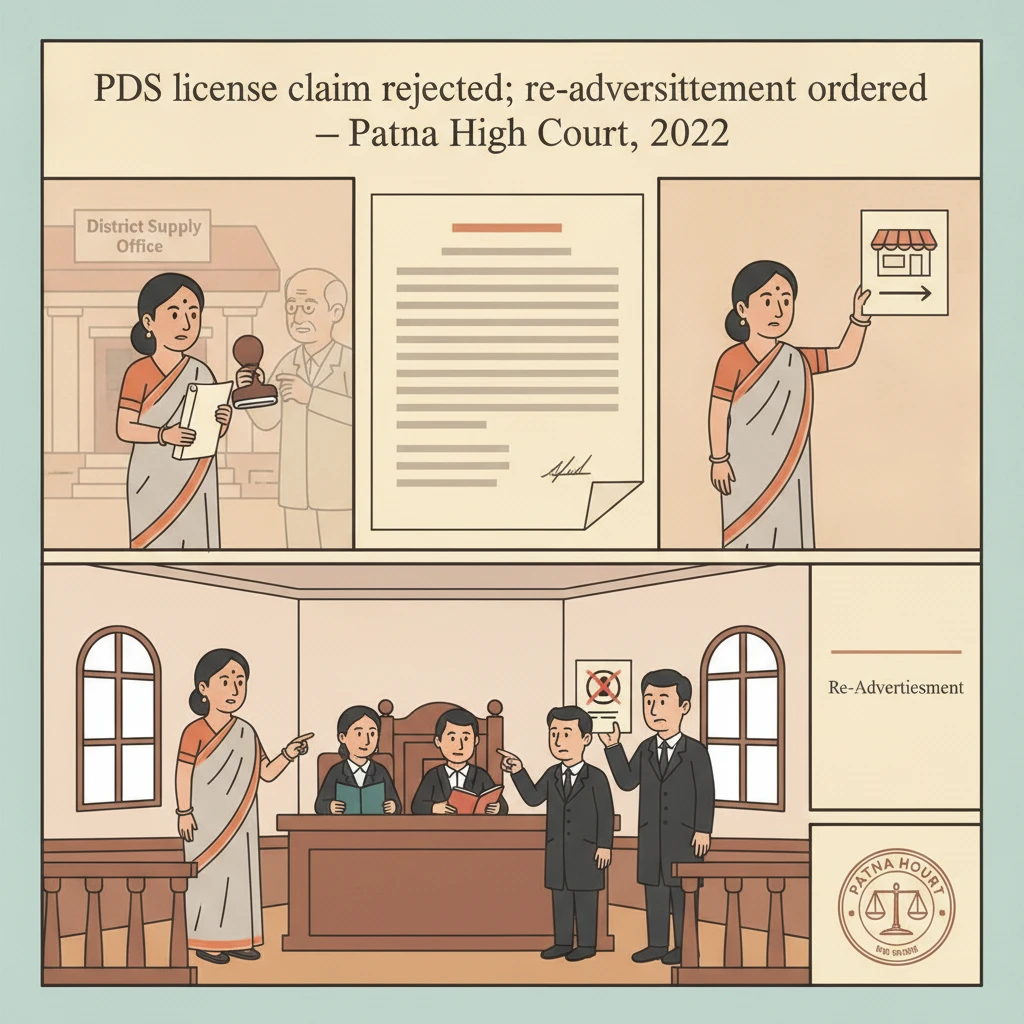
In 2017, the authorities issued an advertisement for vacant PDS shops. The petitioner, a resident of District Patna, applied for one of these shops. After the selection process, she was adjudged the most suitable candidate for a particular vacant shop.
However, when it came to actually issuing the licence, the authorities refused. They relied on Rule 11(i) of the Bihar Targeted Public Distribution System (Control) Order, 2016. Under this rule, more than one member of the same family cannot hold a PDS licence. At that time, the petitioner’s father-in-law was already a PDS licensee.
Based on this prohibition, an order was passed in 2017 declining to grant her the licence, even though she had been recommended as the most suitable candidate.
The petitioner then approached the Patna High Court, challenging the 2017 refusal. She argued that her father-in-law had since passed away, and therefore the disqualification under Rule 11(i) no longer applied to her.
A Bench of the High Court accepted that this aspect (the subsequent death of the father-in-law) needed consideration. The earlier decision refusing her the licence was set aside, and the matter was remitted to the licensing authority to take a fresh decision in light of the current facts.
What the Court Examined and Decided
After the remand by the earlier Bench, the licensing authority reconsidered the matter. The authority again refused to grant the licence to the petitioner.
This time, the licensing authority acknowledged that the petitioner’s father-in-law, who had been the PDS licensee in the family, was no longer alive. It was also noted that there was now no other PDS licensee in her family. So the earlier bar under Rule 11(i) no longer existed.
Despite that, the authority gave a different reason for refusing her claim. It observed that the entire selection process initiated in 2017 had already been completed. The recommendation in that process had effectively lapsed with the conclusion of the process. In its view, it would not be appropriate to grant a licence now, several years later, on the strength of an old recommendation from a concluded process.
The authority also felt that, to ensure fairness and to attract more suitable candidates, the vacant position should be re-advertised afresh rather than filled on the basis of the 2017 panel.
The petitioner again came to the Patna High Court in Civil Writ Jurisdiction Case No.1837 of 2022, challenging this fresh order of the licensing authority.
Before the Division Bench, led by Hon’ble Mr. Justice Ashutosh Kumar (authoring the oral judgment) and Hon’ble Mr. Justice Anjani Kumar Sharan, the petitioner raised two main arguments.
First, she argued that the licensing authority had gone beyond the limited scope of the remand. According to her, the earlier Bench had directed the authority only to consider whether, in view of her father-in-law’s death and the absence of any other licensee in her family, she was now entitled to the licence. She claimed that the authority could not now take shelter behind the completion of the 2017 process.
Secondly, she contended that the order was bad because it was passed only by the licensing authority. She pointed out that under the Control Order, recommendations for PDS licences are made by a district-level selection committee consisting of several members, including the licensing authority. Since the earlier recommendation had been made by this multi-member committee, she argued that one member alone (the licensing authority) could not now nullify that recommendation.
The State defended the decision of the licensing authority and supported the reasoning that the 2017 selection process had ended and that a fresh advertisement was necessary.
The Patna High Court carefully considered both sides. On the first argument, the Court acknowledged that the matter had indeed been remanded earlier. However, the Bench held that it was inclined to accept the reasoning of the licensing authority. The judges noted that the selection process under the 2017 advertisement had already concluded.
The Court stressed that the petitioner had been adjudged the most suitable candidate “way back in the year 2017” and that, at that time, a clear deficiency regarding her entitlement was found because of Rule 11(i). She had therefore not been granted the licence then. In such a situation, the Court held that the earlier recommendation could not now be revived and used as a basis for filling the vacancy years later.
In other words, although the father-in-law’s death removed the original disqualification, that change occurred after the 2017 process had ended. The Court accepted that it would not be proper to treat the old panel as still alive, particularly when there was only one candidate now pressing a claim to the vacant 20th shop.
On the second argument, relating to the competence of the licensing authority, the Court was equally clear. It examined Regulation 5 of the Bihar Targeted Public Distribution System (Control) Order, 2016.
Under Regulation 5, the district-level selection committee indeed makes recommendations regarding who should be granted licences. The committee is composed of the District Magistrate, Additional District Magistrate (Supply), Sub-divisional Officer/Licensing Officer, a Scheduled Caste/Scheduled Tribe officer posted in the district, and the District Co-operative Officer.
However, the Court emphasised that the actual power to grant the licence lies not with the committee but with the licensing authority, that is, the Sub-divisional Officer of the concerned sub-division. The committee only recommends; the final decision is of the licensing authority.
On this basis, the Bench held that the petitioner’s grievance was “absolutely unacceptable”. The fact that the recommendation came from a multi-member body did not prevent the licensing authority from taking its own decision on whether to grant or not grant a licence, especially when the legal bar that existed at the time of the initial decision was indisputable.
Summing up, the Court found no fault in the view that, once the 2017 selection process was over and the petitioner had been found ineligible at that time due to her father-in-law’s existing licence, that old recommendation could not be relied upon today to claim a licence.
Instead of directing that the licence be given to the petitioner, the Court issued a forward-looking direction. The authorities were “well advised and directed” to advertise the vacant shop afresh for grant of licence.
The Court further clarified that if the petitioner applies for the licence in this new round, and if she is again adjudged the most suitable candidate, then the authorities must take the necessary decision in accordance with law.
Finally, the Bench reminded the authorities that under the scheme of the 2016 Control Order, the process of granting PDS licences is intended to be continuous. There should be no delay in filling vacancies. With these observations and directions, the writ petition was disposed of.
Why This Judgment Matters
This judgment is important for people who apply for PDS shop licences in Bihar.
First, it shows that being recommended as “most suitable” in one selection process does not give a permanent or automatic right to a licence. If the process is over and the candidate was ineligible at that time, they cannot later insist on a licence on the basis of that old recommendation, even if their disqualification later disappears.
Second, the decision clarifies that the district-level committee only recommends candidates. The real legal power to issue or refuse a PDS licence lies with the Sub-divisional Officer as licensing authority. Applicants must understand that recommendations alone do not guarantee a licence.
Third, the Court has emphasised that vacancies in PDS shops must be filled without delay and through continuous processes. Authorities are expected to issue fresh advertisements where necessary, so that more people get a fair chance to compete.
For ordinary citizens, especially those seeking livelihood through PDS shops, this case underlines the importance of checking family-related disqualifications under Rule 11(i) before applying, and also of participating in fresh advertisements rather than relying solely on old selections.
Legal Issues and Answers
Issue: Can a candidate, once found ineligible in a concluded PDS licence selection process due to a family bar under Rule 11(i), later claim the licence on the same old recommendation after the bar is removed?
Answer: No. The Patna High Court held that since the 2017 selection process had concluded and the petitioner was ineligible at that time, the old recommendation could not now be used to grant her the licence. A fresh advertisement and selection are required.
Issue: Is an order of the Sub-divisional Officer (licensing authority) invalid because the earlier recommendation came from a multi-member district-level selection committee?
Answer: No. The Court held that while the committee makes recommendations, the power to grant a licence vests in the licensing authority. Therefore, the impugned order passed by the Sub-divisional Officer was within his competence.
Cases Cited by the Court
- The judgment does not mention or rely on any other decided cases.
Case Details
Case Number: Civil Writ Jurisdiction Case No.1837 of 2022
Case Title: Anju Kumari v. The State of Bihar & Ors.
Coram: Hon’ble Mr. Justice Ashutosh Kumar and Hon’ble Mr. Justice Anjani Kumar Sharan
Citation: 2022 (2) PLJR 471
Advocates: For the petitioner – Mr. Ashok Kumar Choudhary, Senior Advocate; Mr. Bhola Kumar, Advocate. For the respondents – Mr. Anisul Haque, AC to AAG5.
Nature of the Case: Writ petition under civil writ jurisdiction challenging refusal of PDS licence and subsequent order after remand.
Link to Judgment: Click here to read the full judgment of the Patna High Court
If you found this explanation helpful and wish to stay informed about how legal developments may affect your rights in Bihar, you may consider following Samvida Law Associates for more updates.







