

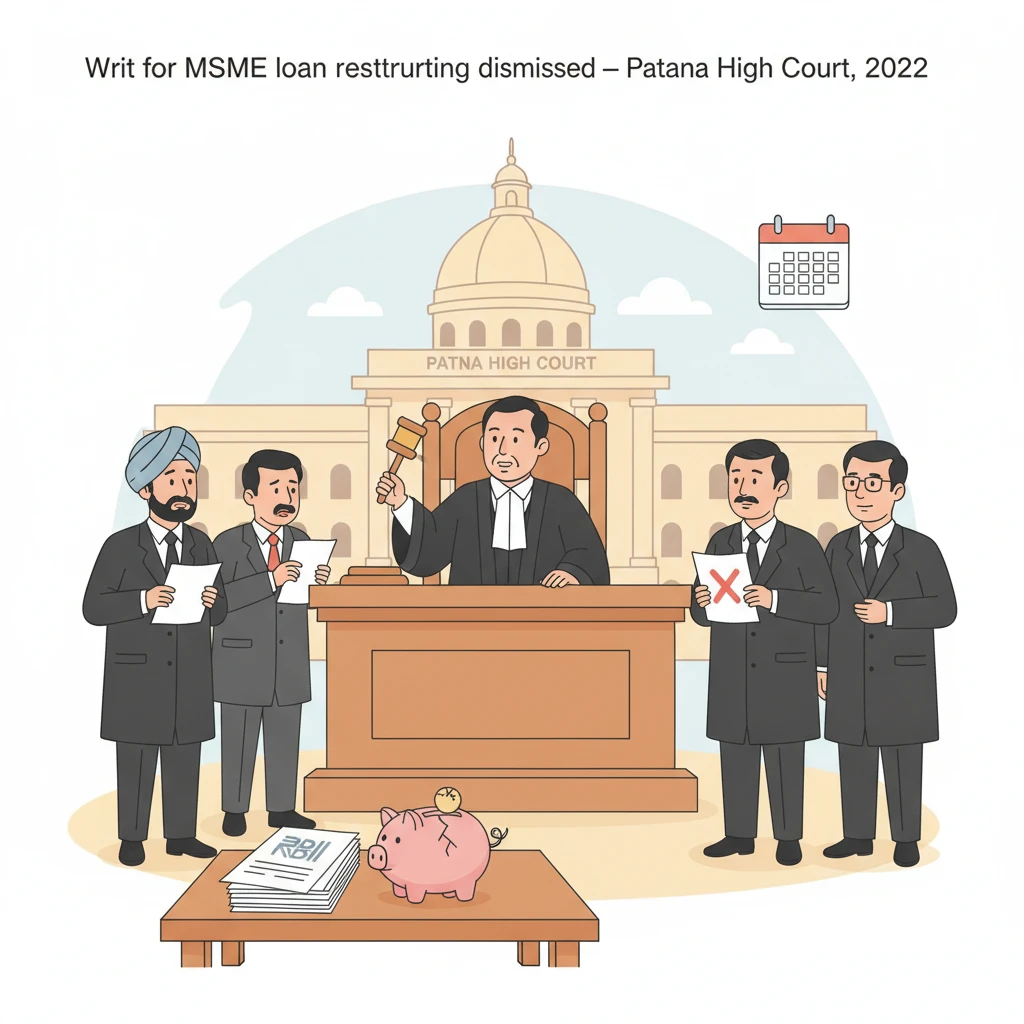
Case Background
The petitioner is a private company which had taken term loan and cash credit facilities from the respondent Bank, now Union Bank of India after amalgamation. According to the petitioner, the Bank did not sanction adequate working capital and also delayed disbursement. Because of this, the petitioner claimed that its unit ran into financial trouble and it became difficult to repay the loan installments.
To deal with this situation, the petitioner sought restructuring of its loan account. The basis of this request was a communication of the Reserve Bank of India (RBI) dated 1 January 2019. That communication reiterated earlier RBI circulars regarding restructuring of advances to Micro, Small and Medium Enterprises (MSME).
The petitioner applied to the Bank for restructuring by relying on this RBI communication. However, by a letter dated 10 February 2020, the Bank rejected the petitioner’s request. The petitioner then approached the Patna High Court under Article 226 of the Constitution of India, filing Civil Writ Jurisdiction Case No. 7863 of 2021.
In the writ petition, the company asked for quashing of the Bank’s rejection letter dated 10.02.2020. It also requested a direction to the Bank to consider and accept its proposal for restructuring of its debt as per the RBI guidelines.
Meanwhile, even before the rejection of the restructuring request, the Bank had already started recovery steps under the Securitisation and Reconstruction of Financial Assets and Enforcement of Securities Interest Act, 2002 (SARFAESI Act). The Bank had initiated SARFAESI action on 17.06.2019 to recover its dues from the petitioner.
The petitioner itself admitted before the High Court that it had challenged those SARFAESI proceedings before the Debt Recovery Tribunal (DRT), Patna, by filing an application under Section 17 of the SARFAESI Act. According to the submission of the petitioner’s counsel, the DRT later set aside the Bank’s recovery action on 29.09.2021.
What the Court Examined and Decided
The Patna High Court heard learned counsel for the petitioner as well as counsel for the Bank through video conference, due to COVID-19 restrictions. The core question before the Court was whether it should interfere with the Bank’s refusal to restructure the petitioner’s loan and whether it should direct the Bank to grant restructuring benefits under the RBI’s 01.01.2019 communication.
The petitioner’s counsel argued that the RBI communications have statutory force and are binding on all banks. Therefore, once the petitioner applied for restructuring under the RBI guidelines for MSMEs, the Bank was bound to consider and allow restructuring of the loan account. The grievance was that the Bank did not grant this facility despite RBI directions.
The Court first examined the RBI communication dated 01.01.2019. After a careful perusal, the Bench observed that the enforceability of that circular depends on fulfillment of several specific conditions mentioned in it. The circular does not give an automatic or unconditional right to restructuring in every case of financial difficulty faced by an MSME borrower.
The High Court then looked at the factual situation in this case. It noted that the Bank had already taken steps for recovery under the SARFAESI Act on 17.06.2019, well before the rejection of the restructuring request on 10.02.2020. Thus, on the date when the Bank refused restructuring, the petitioner’s account was already under SARFAESI proceedings.
It was also undisputed that the petitioner had filed an application under Section 17 of the SARFAESI Act before the DRT, Patna, challenging those recovery measures. That SARFAESI appeal was pending as on 10.02.2020.
In this backdrop, the Court required the petitioner to show from the RBI guidelines that restructuring benefits are available even for accounts where recovery proceedings under SARFAESI are already initiated and are pending, and where the borrower is contesting those actions before the DRT.
The Court recorded that the petitioner failed to point out any such provision in the RBI communication or guidelines. There was nothing produced to show that accounts already under SARFAESI proceedings, and under challenge before the DRT, were still eligible for restructuring as a matter of right.
On this admitted factual position, the Court concluded that, as on the date of rejection of restructuring (10.02.2020), the petitioner’s account was already subject to recovery under the SARFAESI Act. Therefore, even on this ground alone, the petitioner could not establish that it was entitled to claim restructuring of loan repayments under the RBI communication dated 01.01.2019.
The Bench then turned to a broader and more practical aspect. It emphasized that grant or refusal of restructuring of loan accounts is essentially a matter of fiscal prudence. Banks must take such decisions after assessing commercial and financial considerations.
The Court underlined that a bank cannot be expected to grant restructuring “merely for the asking” by any borrower. Restructuring is a discretionary commercial measure. It depends on multiple factors including the financial status and viability of the project, the adequacy and status of collateral security, and the past repayment profile and conduct of the borrower.
These are all detailed factual and financial issues. They often involve disputed questions of fact requiring evidence and deeper examination. The Court held that such matters cannot be effectively assessed in a writ proceeding under Article 226 of the Constitution.
In other words, the High Court stressed that a writ court is not the proper forum to re-evaluate commercial decisions of banks about restructuring, especially where issues of financial viability, securities and borrower conduct are disputed and complex.
On these legal and factual considerations, the Court declined to interfere with the Bank’s decision dated 10.02.2020 rejecting restructuring. It held that no case was made out for issuing a direction to the Bank to restructure the petitioner’s loan account.
The Court went further to comment on the nature of the writ petition. It observed that the proceeding was “thoroughly misconceived” because, for the reasons already discussed, no enforceable legal claim had been shown by the petitioner.
The Bench noted that the real disputes between the parties regarding the loan, alleged lapses by the Bank, and financial issues remain to be adjudicated through appropriate civil remedies. Without entering into the merits of those disputes, the Court described the writ petition as nothing short of a “luxurious litigation” initiated by the petitioner.
As a result, the Court considered it appropriate to impose a cost of Rs. 2,000/- on the petitioner. This amount was directed to be paid to the Patna High Court Legal Services Authority. The writ petition was ultimately dismissed.
Why This Judgment Matters
This decision is significant for borrowers, especially MSME units facing financial stress, who look to RBI restructuring schemes as a lifeline. The Patna High Court has made it clear that RBI circulars on restructuring do not automatically guarantee relief in every case.
Once a bank has already started recovery under the SARFAESI Act, and those actions are under challenge before the DRT, borrowers cannot assume that they still have a right to force the bank to restructure the loan through a writ petition.
The judgment also underscores that courts will generally not interfere with a bank’s commercial judgment on restructuring. Questions like whether a business is still viable, what is the value of security, and how the borrower has behaved in the past are commercial and factual matters. These are for banks and, where necessary, civil courts or tribunals to examine, not for the High Court in a writ proceeding.
For MSMEs and other borrowers, the case is a reminder to act early and engage with the bank before matters reach the stage of SARFAESI recovery. It also signals that using writ jurisdiction as a pressure tactic against banks, without a clear legal right, may attract costs.
Legal Issues and Answers
- Issue: Can a borrower compel a bank through a writ petition to restructure its loan account under the RBI’s 01.01.2019 MSME restructuring communication, when SARFAESI recovery action has already been initiated and is pending before the DRT?
Answer: No. The Patna High Court held that the petitioner failed to show that the RBI guidelines allow restructuring for accounts already under SARFAESI proceedings and that restructuring decisions, based on financial and factual considerations, are not suitable for interference under Article 226. - Issue: Is restructuring of loan accounts a matter of legal entitlement or bank discretion?
Answer: The Court held that restructuring is a matter of fiscal prudence and bank discretion, dependent on various financial parameters. Banks are not required to grant restructuring merely because a borrower asks for it. - Issue: Was the writ petition maintainable on the facts presented?
Answer: The Court found that no enforceable claim was made out and termed the writ petition thoroughly misconceived, dismissing it with costs.
Cases Cited by the Court
- The judgment does not mention or rely upon any reported precedents. The Court decided the matter on the basis of the RBI communication dated 01.01.2019, the SARFAESI proceedings, and general principles regarding writ jurisdiction and bank discretion.
Case Details
Case Number: Civil Writ Jurisdiction Case No. 7863 of 2021
Case Title: M/s Maksi Agro Cool Chains Pvt. Ltd. vs. Union Bank of India & Ors.
Citation: 2022 (2) PLJR 66
Court: High Court of Judicature at Patna
Coram: Hon’ble Mr. Justice Chakradhari Sharan Singh and Hon’ble Mr. Justice Madhuresh Prasad
Date of Judgment: 16-02-2022
Advocates:
- For the Petitioner: Mr. Arbind Kumar Jha, Advocate; Ms. Jyoti Prakash, Advocate
- For the Respondent Bank: Mr. Kumar Alok, Advocate
Nature of the Case: Writ petition under Article 226 of the Constitution of India seeking quashing of rejection of loan restructuring request and direction to grant restructuring.
Link to the Judgment: Click here to access the official judgment of the Patna High Court
If you found this explanation helpful and wish to stay informed about how legal developments may affect your rights in Bihar, you may consider following Samvida Law Associates for more updates.







