

Case Background
The petitioners were working as Assistant Professors on contract in various Government Engineering Colleges in Bihar under the Department of Science and Technology.
Their appointments trace back to an advertisement dated 26.05.2012. This advertisement invited online applications for contractual appointments to vacant posts of Professors, Associate Professors and Assistant Professors in Engineering Colleges, as well as Lecturers and Heads of Department in Government Polytechnics in Engineering, Non-Engineering and Humanities streams.
The advertisement clearly stated that reservation rules applicable in the State of Bihar would apply to this recruitment process. The petitioners applied under this advertisement and were engaged as contractual teachers.
There was no dispute before the Court about the petitioners’ eligibility for their posts. Their contracts were extended year by year up to 2018.
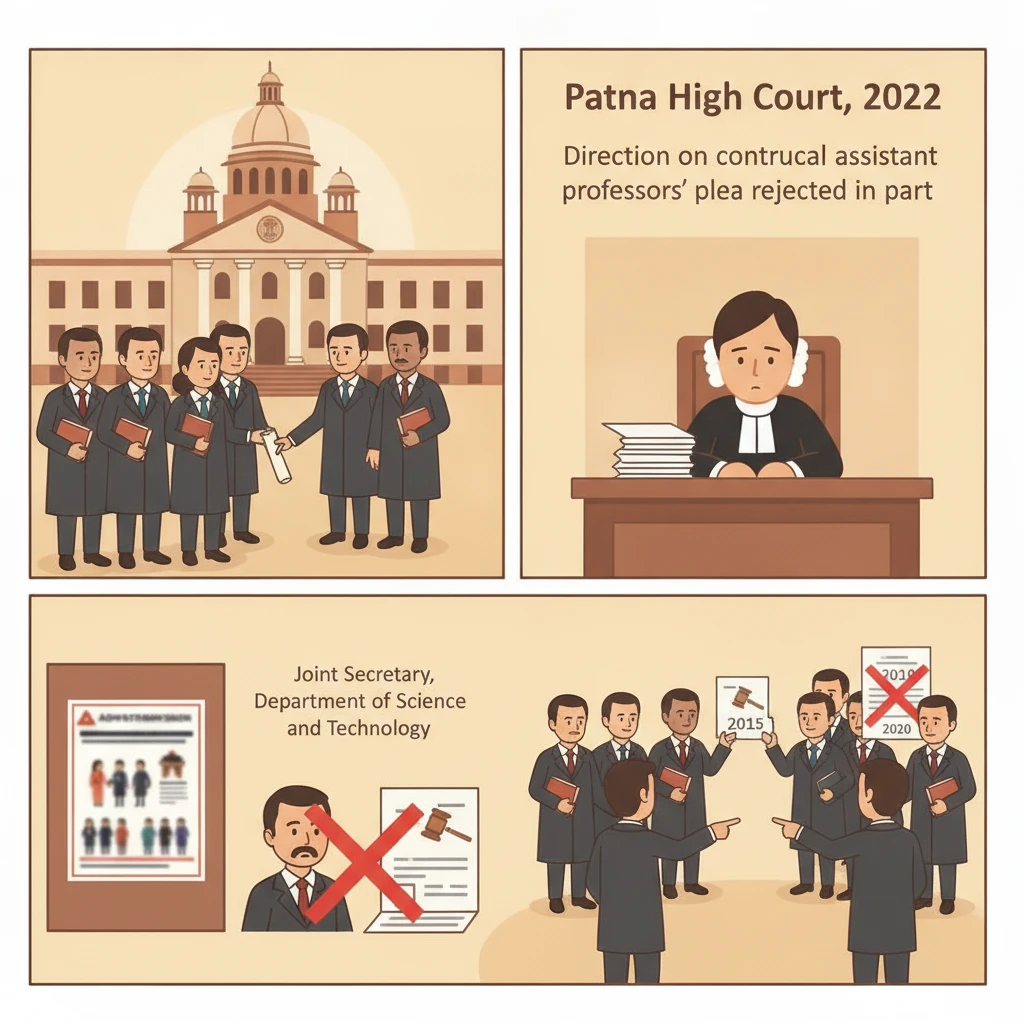
On 23.01.2020, the Joint Secretary, Department of Science and Technology, issued Memo No. 256. This memo declared that the petitioners’ appointments as Assistant Professors were in conflict with the rules of reservation, and therefore their contractual appointments were terminated. This decision affected eleven petitioners.
Aggrieved, the petitioners filed this writ petition before the Patna High Court seeking to set aside Memo No. 256 dated 23.01.2020 and to secure extension of their services as Assistant Professors beyond that date.
What the Court Examined and Decided
The Patna High Court, through Hon’ble Mr. Justice Ashutosh Kumar, heard arguments from both sides. The core dispute was whether the government could discontinue these contractual engagements on the ground of reservation rules and whether the petitioners were being treated unfairly as compared to similar contractual teachers.
The petitioners’ counsel first emphasised that their initial appointments were made through a proper process. The 2012 advertisement had openly stated that Bihar’s reservation rules would apply, and the State had selected them accordingly. Therefore, they argued, their appointments could not suddenly be called “in conflict with the rules of reservation.”
The Court recorded that there was no challenge to their eligibility. The only issue raised by the State was that continuing them on contract would now run contrary to the reservation policy.
The petitioners’ lawyer pointed to subsequent developments. In 2019, the State initiated a process to make regular appointments on the posts of Assistant Professors in various Government Engineering Colleges of Bihar in Engineering and Humanities streams. However, that selection process was set aside by the Patna High Court in C.W.J.C. No. 9152 of 2019. As a result, regular recruitment could not go ahead.
According to the petitioners, a fresh process started again in 2020, but it had not been concluded by the time of this judgment, and it covered only some subjects. Thus, they argued, there was still a continuing need for their services.
To support their plea for continuation, the petitioners relied on a policy exercise of the State itself. In 2015, a High Level Committee was constituted by a Resolution of the General Administration Department. This Committee was asked to make recommendations on contractual services in various departments of the Government of Bihar, including the Department of Science and Technology.
The Committee’s report, with respect to the Department of Science and Technology, stated that appointments made prior to 2012 did not follow reservation rules, but contractual appointments made after 2012 were in accordance with reservation rules. Since the petitioners were appointed in 2013, they argued that it should be presumed that their appointments were in line with reservation rules.
Following this, another Resolution dated 17.09.2018 was issued, in which most of the Committee’s recommendations were accepted by the Government. In the same transaction, the Department of Science and Technology allowed twenty six contractual appointees, also appointed under this system, to continue on contract. However, the same benefit was not extended to the eleven petitioners.
On this point, the petitioners claimed discrimination. They said there was no valid reason to allow twenty six similarly placed contractual teachers to continue while terminating only the eleven petitioners.
The Department’s stand, as recorded in the judgment, was that those twenty six persons had initially been appointed against unreserved category seats. The petitioners, on the other hand, were appointed against reserved category seats, which at that time had no suitable reserved category candidates. Therefore, they were appointed as general category candidates against reserved posts on a temporary contractual basis.
The petitioners attacked this distinction. They argued that their discontinuation could not be justified on the ground that their appointments were not in accordance with reservation rules. They also argued that the “carry-forward” principle used in reservation—where unfilled reserved posts are carried forward to the next recruitment year—could not be applied to contractual employees like them.
They further asserted that the authorities should have considered their competence and satisfactory service. They had worked since 2013, and there was no urgent necessity to discontinue them before the new recruitment process was completed.
The Court examined the nature of their appointment. It held that the initial contractual engagement of the petitioners was not outside the reservation framework. From the terms of the 2012 advertisement and the facts, the Court noted that the petitioners were engaged against vacant reserved posts because there were no suitable candidates in the relevant reserved categories at that time.
This situation continued for five years. Before any fresh advertisement for regular appointments could be implemented, the petitioners were discontinued, though others were continued.
On the legal argument about the carry-forward rule and contractual employment, the Court rejected the petitioners’ contention. The Court explained that the carry-forward principle relates to the number of posts vis-à-vis the vacancies each year. It does not depend on whether a person has been contractually appointed or not.
The Court clarified that this principle has no bearing on any contractual appointment of general category candidates against reserved seats when no suitable reserved category candidate is available. It noted that precisely for this reason the petitioners’ appointment was kept contractual and not made permanent.
The Court observed that under the 2012 advertisement scheme, all such engagements were clearly contractual for one year, with provision for renewal.
However, on the issue of differential treatment between the eleven petitioners and the twenty six other contractual appointees, the Court accepted that the petitioners had a point. The Court stated that until the fresh recruitment process is completed in accordance with reservation rules, there should not have been discrimination between these two groups.
According to the Court, even the twenty six continued appointees had no right to stay indefinitely in post. The Department or Government would ultimately have to conduct a regular selection process for all such posts. But if the Department had allowed them to continue on contract, there was no clear reason for picking out only the petitioners for discontinuation before completion of the new recruitment process.
Despite recognising this unfairness, the Court did not itself order reinstatement or continuation of the petitioners. Instead, it issued a limited direction. The Court held that, in the circumstances, the appropriate course was for the petitioners to make a representation to the Principal Secretary, Department of Science and Technology, Government of Bihar.
The Court directed that, if such a representation is filed within thirty days, clearly asking that they be allowed to continue on contractual engagement till completion of the fresh recruitment process, the Principal Secretary must look into the matter. The Secretary has to consider the feasibility, relevant rules and the facts and then take a decision within six weeks thereafter, preferably by a formal order. That order must be communicated to the petitioners.
With these observations and directions, the writ petition was disposed of. The Court did not quash Memo No. 256 dated 23.01.2020, nor did it itself order immediate continuation or regularisation of the petitioners’ services.
Why This Judgment Matters
This judgment matters for contractual teachers and other contractual government employees in Bihar, especially those working in government educational institutions.
First, the Patna High Court clearly recognised that contract appointments made against reserved posts, due to non-availability of reserved category candidates, are still tied to the overall reservation scheme. They remain temporary in nature until a regular recruitment process is completed.
Second, the Court noted that the Government cannot lightly pick and choose among similarly placed contractual employees. If some are being continued on contract, the Government must have a clear and reasonable basis to discontinue others.
Third, instead of directly granting continuation, the Court laid down a practical route for affected contractual employees: make a detailed representation to the competent authority, who is then bound to consider it in a time-bound manner and issue a reasoned order.
For ordinary readers, this judgment shows that while courts may not always restore contractual employment, they can insist that the Government act fairly and transparently and respond to grievances within a fixed time.
Legal Issues and Answers
- Issue: Can contractual Assistant Professors appointed against reserved posts be discontinued on the ground of reservation rules and carry-forward policy, despite having served for several years?
Answer: Yes, the Court held their contractual appointments were always subject to the reservation framework and the carry-forward principle, and their engagement was rightly kept non-permanent. - Issue: Was it permissible for the Government to continue twenty six similarly placed contractual appointees while discontinuing the eleven petitioners before completion of a fresh recruitment process?
Answer: The Court found substance in the grievance of unequal treatment and directed that the petitioners’ request for continuation till the new recruitment is completed be reconsidered by the Principal Secretary in a time-bound manner. - Issue: What relief should contractual employees get when their discontinuation appears unfair but their appointment has no claim to regularisation?
Answer: The Court declined to grant direct continuation or regularisation but directed a time-bound decision by the competent authority on the petitioners’ representation.
Cases Cited by the Court
- The judgment notes that an earlier recruitment process for regular appointment of Assistant Professors was set aside by the Patna High Court in C.W.J.C. No. 9152 of 2019. No other case law is expressly relied upon in the text.
Case Details
Case Number: Civil Writ Jurisdiction Case No. 5826 of 2020
Case Title: Dr. Manoj Kumar Singh & Ors. v. The State of Bihar & Ors.
Coram: Hon’ble Mr. Justice Ashutosh Kumar
Citation: 2022 (1) PLJR 849
Advocates: For the petitioners: Mr. Kumar Kaushik, Advocate. For the respondents/State: Mr. Satya Vrat, AC to GP-10.
Nature of the Case: Writ petition under Civil Writ Jurisdiction challenging termination of contractual engagement as Assistant Professors in Government Engineering Colleges and seeking continuation/extension of service.
Link to Judgment: Patna High Court Judgment – CWJC No. 5826 of 2020
If you found this explanation helpful and wish to stay informed about how legal developments may affect your rights in Bihar, you may consider following Samvida Law Associates for more updates.







