

Case Background
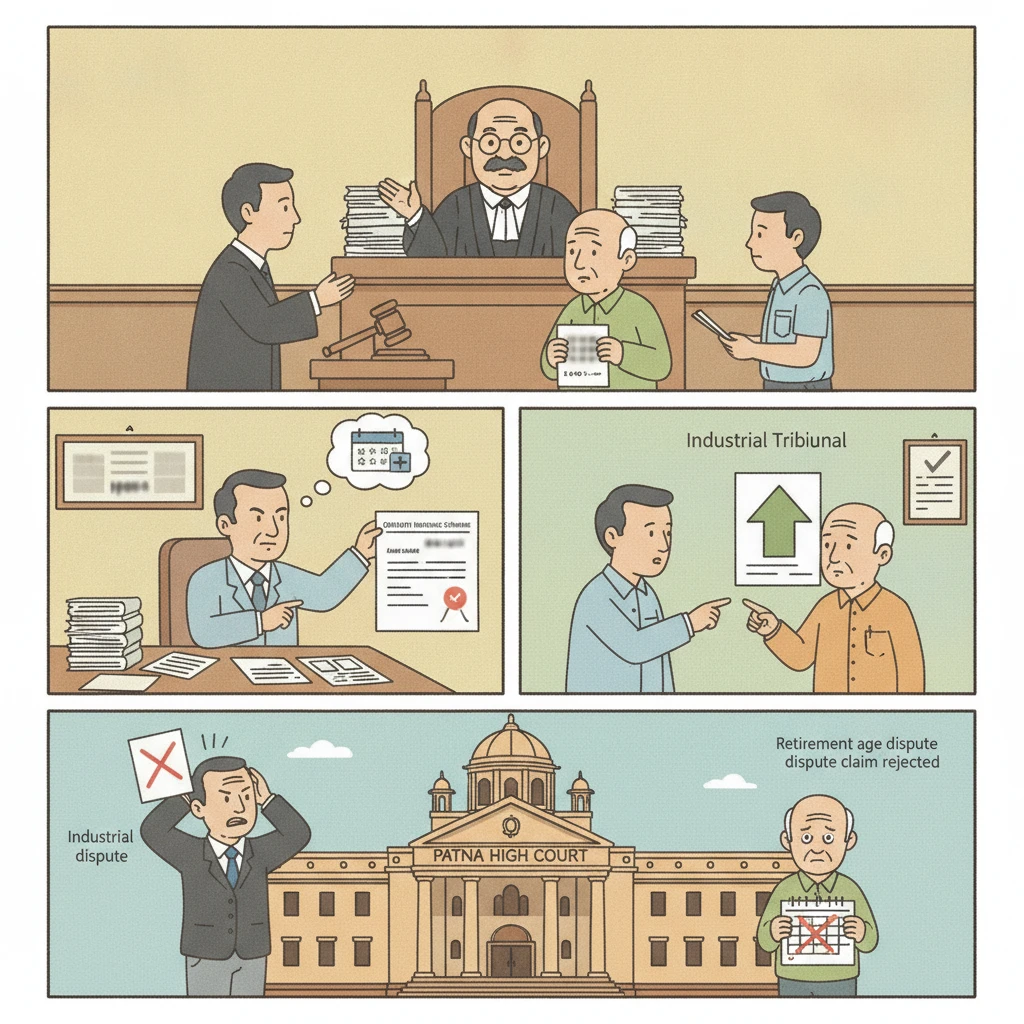
The matter came before the Patna High Court as Letters Patent Appeal No. 1225 of 2017. The appellant was a long-serving employee of Shree Baidyanath Ayurved Bhawan Private Limited at Patna. Over the years, he worked as a Law Officer and also edited a pictorial magazine of the organisation.
At the time of joining service, while filling his nomination form on 06.11.1970, he declared his date of birth as 05.01.1945. This date governed his service records for decades.
As he approached the age of 60 years, he raised a dispute over his date of birth. On 09.01.2004, he wrote to the management asking that his date of birth be changed. He relied on a copy of his Admit Card issued by the Bihar School Examination Board, Patna, where his date of birth was mentioned as 05.01.1951. However, he did not submit his Matriculation Certificate along with this request, and the certificate was not produced even later.
While the management was considering his request, it noticed another discrepancy. In the documents relating to the Gratuity Insurance Scheme, his date of birth was recorded as 27.01.1947 instead of 05.01.1945. The reason for this change could not be clearly ascertained.
To avoid further controversy, the management accepted the date of birth noted in the gratuity papers, 27.01.1947, although it was later than the original 1945 entry. It calculated his retirement by treating 27.01.1947 as his date of birth, effectively giving him two extra years of service beyond the original declaration.
The appellant was not satisfied. He approached the Industrial Tribunal, Patna, through Reference Case No. 36 of 2007. The specific question referred for adjudication was whether the management’s action in retiring him was justified in view of his claimed date of birth 05.01.1951, as per the school examination admit card.
The Industrial Tribunal passed an Award on 05.02.2014 in his favour. This Award was then challenged by the employer, described in the proceedings as respondent 2nd set, before the Patna High Court in Civil Writ Jurisdiction Case No. 8999 of 2014.
On 02.08.2017, a learned single judge of the Patna High Court set aside the Tribunal’s Award. The employee then filed the present Letters Patent Appeal, questioning the single judge’s decision. The Division Bench, comprising Hon’ble Mr. Justice Ashutosh Kumar and Hon’ble Mr. Justice Anjani Kumar Sharan, heard the appeal and delivered judgment on 22.03.2022.
What the Court Examined and Decided
The Division Bench first noted the core challenge. The Industrial Tribunal’s Award, which had accepted the employee’s claim regarding his date of birth and retirement, had already been set aside by the single judge. The question was whether that interference was correct in law and on facts.
The employer had put forward several grounds before the single judge to attack the Tribunal’s Award. The main argument was that the very Reference to the Industrial Tribunal was bad because the issue was not an “industrial dispute” but only an individual dispute over retirement age and date of birth.
It was also argued that the employee could not be treated as a “workman” under the Industrial Disputes Act, 1947. He had served as a Law Officer of the company and was the editor of a pictorial magazine published by the organisation. According to the management, these duties were managerial and professional, not the kind of manual, technical, operational, clerical or similar work usually associated with a workman under the Act.
Another important point raised was the timing of the dispute. The employee had declared his date of birth as 05.01.1945 in 1970. He sought to change it only in 2004, roughly 34 years later and just before his expected superannuation, which raised doubts about the genuineness of the claim.
The learned single judge examined the evidence in detail. The judge took note of:
First, the original declaration of date of birth as 05.01.1945 in 1970 at the time of filling the nomination form.
Second, the letter dated 09.01.2004 from the employee asking for change of date of birth based on the admit card showing 05.01.1951, but without any supporting Matriculation Certificate.
Third, the discovery that the gratuity insurance documents recorded his date of birth as 27.01.1947, different from the earlier entry.
The single judge observed that it was unclear whether the gratuity entry was a mere mistake or whether there was any collusion or manipulation to create doubt regarding the original date of birth. However, the management, taking a lenient view, accepted this later date of birth of 27.01.1947 and allowed him to continue till he attained 60 years calculated from that date. This gave him two more years in service, beyond what the original 1945 date would have allowed.
Even after getting this benefit, the employee approached the Industrial Tribunal, insisting on recognition of yet another date of birth, 05.01.1951, which would have extended his service even further.
The single judge then considered two legal questions. One, whether the appellant was a “workman” under the Industrial Disputes Act. Two, whether the dispute that went to the Tribunal was an “industrial dispute” or only an individual grievance.
On the first question, the judge held that the appellant could not be treated as a workman. His role as Law Officer, dealing with legal matters of the company, and as editor of a pictorial magazine, was of a managerial and professional nature. Such functions are not covered under the definition of workman under the Industrial Disputes Act. Therefore, treating him as a workman by the Tribunal was wrong.
On the second question, the judge focused on whether his individual dispute about date of birth had been converted into an industrial dispute through proper support of other employees or a union. The Tribunal had relied on a settlement dated 12.02.2007 between the management and five office bearers of the union to hold that the dispute had become an industrial dispute.
The single judge held that this reliance was misplaced. To classify an individual dispute as an industrial dispute, there must be proper sponsorship or support from the union or a sizeable group of workmen at the time of reference. The judge referred to Supreme Court decisions in The Bombay Union of Journalist and Others v. The Hindu, Bombay (AIR 1963 SC 318) and The Rajasthan State Road Transport Corporation and Another v. Krishna Kant (AIR 1995 SC 1715). These cases laid down that, on the date of reference, the dispute must be taken up by the union or an appreciable number of workmen of the same employer.
Applying this test, the single judge found that there was no adequate evidence to show that any appreciable number of workmen had supported the reference dated 16.10.2007. Therefore, the dispute remained a purely individual grievance.
Because the appellant was not a workman and because his dispute was not an industrial dispute, the single judge concluded that the reference itself was wrongly made. Consequently, any decision by the Tribunal on that reference was legally flawed.
In the Letters Patent Appeal, the Division Bench reviewed these findings. The Bench agreed that the nature of the appellant’s duties as Law Officer and magazine editor fell in the category of managerial work. Therefore, he could not be treated as an industrial workman.
The Bench also noted that there was no reliable material to justify changing his date of birth from the original 1945 entry. The management’s acceptance of 1947 based on the gratuity papers was already a generous step that benefited him. The Court observed that retiring him on the basis of the 1947 date did not put him in any “disadvantageous position”.
Finding no error in the reasoning adopted by the single judge, the Division Bench held that the reference was “absolutely flawed” and that there were no materials to justify shifting the date of birth to 1951 as claimed by the appellant.
Accordingly, the Court dismissed the Letters Patent Appeal as having no merit, and did so without imposing costs.
Why This Judgment Matters
This judgment is important for employees and employers facing disputes over date of birth and retirement age, especially in private companies and organised establishments.
First, it shows that once an employee has declared a date of birth at the time of joining service and has accepted it for many years, it is very difficult to change it just before retirement. Late challenges, without clear and convincing documentary proof like a Matriculation Certificate, are unlikely to succeed.
Second, it clarifies that not every dispute with an employer can be treated as an industrial dispute. Only those who fall within the legal definition of “workman”, and whose disputes are properly taken up by a union or an appreciable number of co-workers at the time of reference, can use the machinery of industrial dispute adjudication.
Third, it sends a message that courts will not encourage repeated attempts to extend service by shifting claimed dates of birth from one year to another without solid basis. Where the employer has already taken a reasonable and even generous view, courts may treat that as sufficient and decline further relief.
For workers and employees in Bihar, particularly those in non-manual or managerial roles, this Patna High Court decision underlines the importance of accurate initial declarations and timely objections, and it limits the scope of industrial dispute remedies in purely personal service matters.
Legal Issues and Answers
- Issue: Was the dispute regarding the appellant’s date of birth and retirement an industrial dispute capable of reference to the Industrial Tribunal?
- Answer: No. The Court held it was only an individual dispute, as there was no adequate sponsorship by a union or appreciable number of workmen on the date of reference.
- Issue: Could the appellant be treated as a “workman” under the Industrial Disputes Act, 1947?
- Answer: No. His duties as Law Officer and editor of a pictorial magazine were managerial in nature, so he did not fall within the category of an industrial workman.
- Issue: Was there any valid basis to shift his date of birth from the originally declared 05.01.1945 to 05.01.1951 for the purpose of extending his service?
- Answer: No. The Court found no reliable material to justify such a change and noted that acceptance of the 27.01.1947 date in gratuity papers had already given him an extra two years of service.
Cases Cited by the Court
- The Bombay Union of Journalist and Others v. The Hindu, Bombay; AIR 1963 SC 318
- The Rajasthan State Road Transport Corporation and Another v. Krishna Kant; AIR 1995 SC 1715
Case Details
Case Number: Letters Patent Appeal No. 1225 of 2017 in Civil Writ Jurisdiction Case No. 8999 of 2014; arising out of Reference Case No. 36 of 2007 and Award dated 05.02.2014 of the Industrial Tribunal, Patna.
Case Title: Bimal Chandra Jha v. The State of Bihar & Shree Baidyanath Ayurved Bhawan Private Limited
Coram: Hon’ble Mr. Justice Ashutosh Kumar and Hon’ble Mr. Justice Anjani Kumar Sharan
Citation: 2022(2) PLJR 43
Advocates: For the appellant – Mr. Lallan Kumar, Advocate. For the State – Mr. Rohitab Das, Advocate. For respondent no. 2 (Shree Baidyanath Ayurved Bhawan Private Limited) – Mr. Alok Kumar Sinha, Advocate; Mr. Indrajeet Bhushan, Advocate; Mr. Manish Kumar, Advocate.
Nature of the case: Letters Patent Appeal against a single judge’s writ judgment setting aside an Industrial Tribunal Award concerning retirement age and date of birth, and the character of the dispute as an industrial dispute.
Link to the Judgment: https://patnahighcourt.gov.in/viewjudgment/MyMxMjI1IzIwMTcjMSNO-e–ak1–f8Ff1ZNc8=
If you found this explanation helpful and wish to stay informed about how legal developments may affect your rights in Bihar, you may consider following Samvida Law Associates for more updates.







