

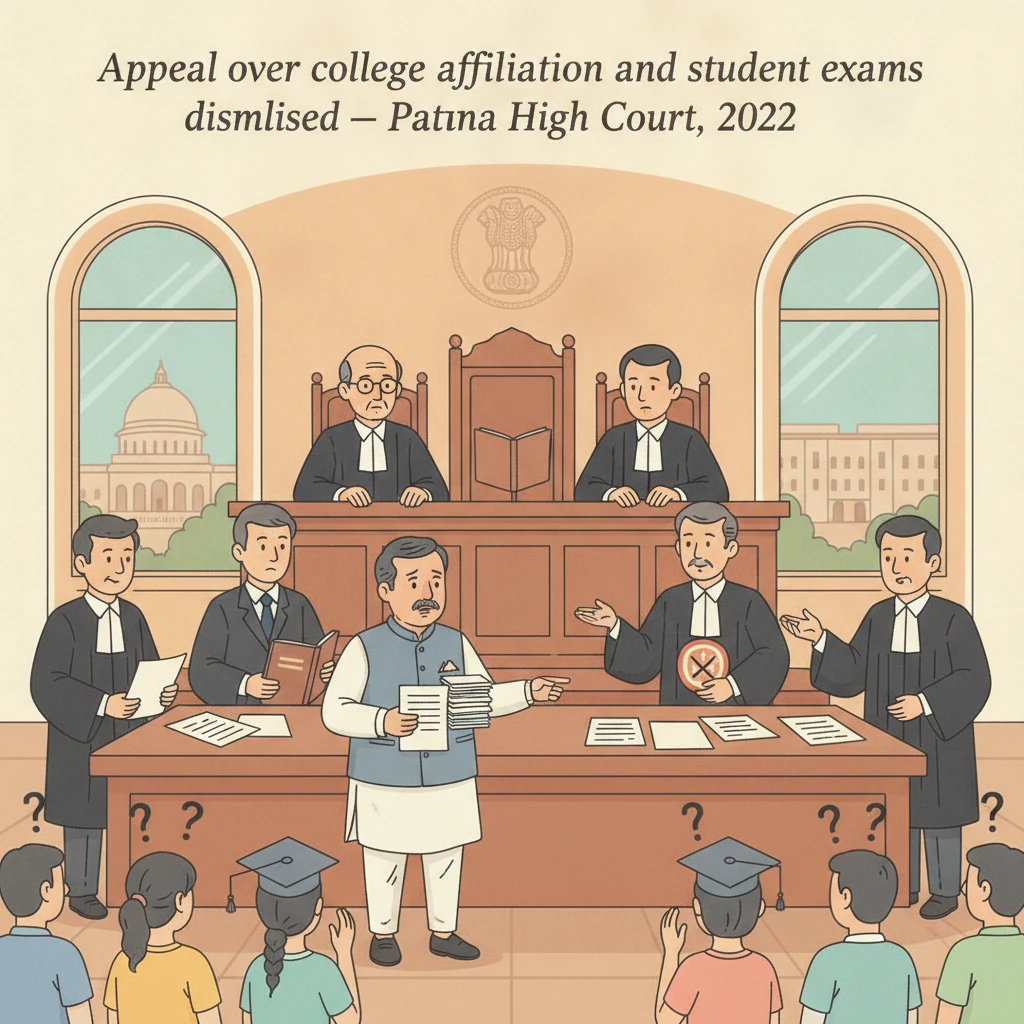
Case Background
The appellant was the Principal of Adarsh Champaran Degree Mahavidyalay, Kotwa, East Champaran. He had earlier filed a writ petition before the Patna High Court. In that writ, he asked for a direction to B.R.A. Bihar University, Muzaffarpur to grant affiliation to the college.
The request for affiliation was for Bachelor degree courses in Arts, Science and Commerce. The college wanted affiliation for the academic session 2016–2019 onwards. The appellant claimed that the college had fulfilled all the requirements for affiliation under the Bihar State Universities Act and the Statutes and Regulations framed under that Act.
Before the writ court, another request was also made. The appellant suggested that, while the university was still deciding on affiliation, students of the college should be allowed to appear in the university examinations. This was pleaded on the ground that students’ careers should not be put at risk.
The writ court was also told that in an earlier case, Mahavir Upadhyay Memorial Degree College, Dhaka, East Champaran vs The State of Bihar & Ors. (C.W.J.C. No. 10023 of 2012), the Patna High Court had held that the university could not withhold affiliation if a college had fulfilled all the necessary criteria.
After considering the matter, the learned single judge allowed the writ petition. The judge directed the university to expedite its consideration of the college’s application for affiliation and to take a decision at the earliest. The judge further clarified that a decision had to be taken without delay if the college satisfied the university that all pointed-out defects had been rectified. A specific timeline was also given to the university to take a final decision.
However, the single judge did not accept the request that students who had already enrolled with the college, expecting affiliation, be permitted to appear in the university examinations. Against this limited rejection, the Principal filed a Letters Patent Appeal before a Division Bench of the Patna High Court.
What the Court Examined and Decided
The Division Bench consisted of Hon’ble Mr. Justice Ashutosh Kumar and Hon’ble Mr. Justice Anjani Kumar Sharan. The oral judgment was delivered on 08-03-2022 by Hon’ble Mr. Justice Ashutosh Kumar.
The Court heard Ms. Nivedita Nirvikar, Senior Advocate for the appellant, counsel for the State of Bihar, counsel for B.R.A. Bihar University, and counsel for the University Grants Commission. The appeal was against the order of the single judge in Civil Writ Jurisdiction Case No. 17936 of 2017.
The appellant’s main grievance in the appeal was not against the direction for speedy decision on affiliation. Instead, the grievance was that the learned single judge had refused to direct the university to allow the college’s students to sit in the university examinations, even though affiliation was still pending.
The Division Bench examined the order of the single judge. It noted that the single judge had already granted substantial relief by directing the university to consider and decide the college’s affiliation application expeditiously, within a given timeline. The Bench did not find fault with this part of the order.
The Bench then turned to the limited grievance of the appellant about student participation in examinations. The Court observed that it was “otherwise also, not permissible to order as such.” This means that, in law, such a direction could not be given in the situation at hand.
The Court gave a crucial reason for this conclusion. It stated clearly that the college in question could not have taken admissions of students without an appropriate order of affiliation from the university. In simple terms, unless the university had already granted affiliation, the college had no right to admit students to courses that would lead to university examinations.
Because the college had admitted students even before obtaining affiliation, the Court was not prepared to protect those admissions by allowing the students to appear in university exams. The Bench held that the single judge was right in declining to give such a direction.
During the hearing of the appeal, another development was brought to the attention of the Division Bench. The Court was informed that a contempt petition had been filed earlier because the university had not complied with the single judge’s order within time. In that contempt case, notices had been issued to the university and other respondents to show cause. The Court recorded that this contempt petition was reportedly disposed of on 11-12-2021.
Further, Ms. Nivedita Nirvikar, Senior Advocate for the appellant, informed the Bench that by the time of the appeal hearing, the university had granted affiliation to the college. However, this affiliation was only for the session 2021–2024, and only for a lesser number of subjects than the number for which the college had originally applied.
The Division Bench considered this information carefully. It held that if the appellant was aggrieved by this later decision of the university — granting limited affiliation for a later session and fewer subjects — the appellant was free to challenge that specific decision in appropriate proceedings.
However, the Court made it clear that such a later grievance about the scope or timing of affiliation could not be used as a ground to attack the earlier order passed by the single judge in 2017. The appeal before the Bench was only against that single judge order, not against the new decision of the university granting partial affiliation from 2021–2024.
Therefore, the Bench confined itself to examining whether the single judge’s order suffered from any legal error. It concluded that there was no reason for the appellant to challenge the order of the single judge. The direction to the university to decide on affiliation expeditiously had already been beneficial to the college. The refusal to allow unaffiliated students to sit in examinations was, in the Division Bench’s view, legally correct.
On this reasoning, the Court held that there was no merit in the Letters Patent Appeal. The appeal was accordingly dismissed. No further directions were given regarding the students or the later affiliation decision of the university, leaving the appellant to seek separate legal remedies, if so advised.
Why This Judgment Matters
This judgment has important practical consequences for private colleges and for students in Bihar.
First, it reinforces that a college cannot legally admit students to degree courses tied to a university unless the college has already received proper affiliation. If a college admits students without such affiliation, courts may refuse to rescue those admissions later by ordering the university to allow such students in examinations.
Second, the judgment shows how the Patna High Court balances student hardship with legal rules. Even though the Court was aware that students’ careers might suffer, it still refused relief where the college itself had acted without authority.
Third, it clarifies that if a university later grants limited or delayed affiliation, any grievance about that later decision must be raised through a fresh, proper legal challenge. Such grievances cannot be mixed into an appeal against an earlier order which dealt mainly with the process of considering affiliation.
For principals, management of private colleges, and parents, this decision underscores the need to check affiliation status carefully before starting courses or taking admission.
Legal Issues and Answers
-
Issue: Can students of a college which has not yet been granted university affiliation be allowed by court order to appear in the university examinations?
Answer: No. The Patna High Court held that such a direction is not permissible, especially when the college has admitted students without any prior affiliation order. -
Issue: Was there any legal error in the single judge’s order directing the university to decide the affiliation application expeditiously, while refusing to allow students to sit in exams?
Answer: No. The Division Bench found no ground to interfere and upheld the single judge’s order in full. -
Issue: Can dissatisfaction with a later, partial grant of affiliation (for a different session and fewer subjects) be used to challenge the earlier single judge order?
Answer: No. The Court held that any such grievance must be challenged separately; it cannot justify disturbing the earlier order.
Cases Cited by the Court
- Mahavir Upadhyay Memorial Degree College, Dhaka, East Champaran vs The State of Bihar & Ors., C.W.J.C. No. 10023 of 2012 (referred to for the principle that affiliation cannot be withheld if all criteria are met).
Case Details
Case Number: Letters Patent Appeal No. 1733 of 2018 in Civil Writ Jurisdiction Case No. 17936 of 2017
Case Title: Abhishek Kumar vs The State of Bihar & Ors.
Coram: Hon’ble Mr. Justice Ashutosh Kumar and Hon’ble Mr. Justice Anjani Kumar Sharan
Citation: 2022(2) PLJR 14
Date of Judgment: 08-03-2022
Advocates:
- For the Appellant: Ms. Nivedita Nirvikar, Senior Advocate
- For the State of Bihar: Mr. Shashi Shekhar Tiwari, Advocate
- For Respondent University (B.R.A. Bihar University, Muzaffarpur): Mr. Indrajesh Kumar, Advocate
- For Respondent UGC: Mr. Amarendra Nath Verma, Advocate
Nature of the Case: Letters Patent Appeal arising out of a writ petition (civil) regarding grant of university affiliation to a degree college.
Link to the Judgment: https://patnahighcourt.gov.in/viewjudgment/MyMxNzMzIzIwMTgjMSNO-S–am1–BDITXuLcQ=
If you found this explanation helpful and wish to stay informed about how legal developments may affect your rights in Bihar, you may consider following Samvida Law Associates for more updates.







