

Case Background
The case arose from a dispute between a faculty member of Bihar Agriculture University, Sabour, and the University itself.
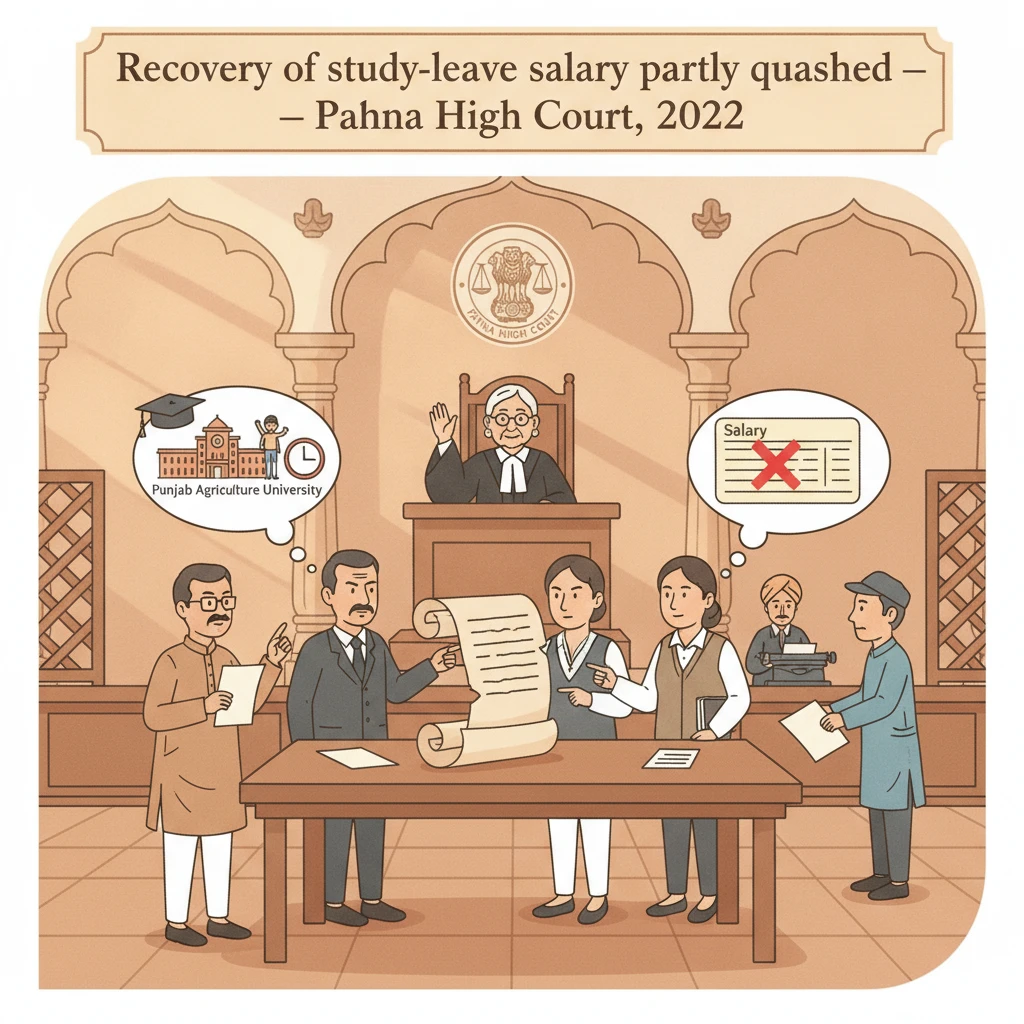
The petitioner was working as Assistant Professor-cum-Junior Scientist. Under the University’s Faculty Development Programme, he was allowed study-leave with full pay for three years from 20.01.2015 to 19.01.2018 to pursue a Ph.D. at Punjab Agriculture University, Ludhiana. He enrolled in the Ph.D. programme on 06.01.2015.
Because he could not finish the Ph.D. within these three years, the petitioner requested more time. The University extended his study-leave by one more year. Overall, he remained on leave for about four and a half years.
Before going on leave, on 06.12.2014, the petitioner executed an agreement bond in favour of the University. In it, he promised to serve the University for five years after returning from study-leave. The bond also contained clauses about refunding training or leave salary and paying fixed damages of Rs. 10,000/- in certain situations.
When the Ph.D. still did not get completed even after extension, the University started recovering the full salary paid during study-leave. It ordered deduction of 25% from his monthly salary after he rejoined duty. Aggrieved by this ongoing recovery, the petitioner approached the Patna High Court in a writ petition.
What the Court Examined and Decided
The Patna High Court, through Hon’ble Mr. Justice Ashutosh Kumar, heard both sides and closely examined the bond terms, the University’s Faculty Development Programme (F.D.P.) regulations, and guidelines on study-leave.
The petitioner argued that the core promise in his bond was to serve the University for five years after coming back from study-leave. According to him, this was fulfilled in substance because he had already rejoined service and had no intention of leaving the University for another job.
He accepted that the bond did talk about refunding leave salary and other expenses if he failed in the course, left it incomplete, or had unsatisfactory conduct. But he said this was tied to the overall promise that the University should get the benefit of his higher qualification and services, not to treat the bond as a punishment or forfeiture clause.
The petitioner further submitted that non-completion of his Ph.D. was not entirely his fault. He claimed there was non-cooperation from Punjab Agriculture University and from the Co-Investigator nominated by Bihar Agriculture University. Because the Co-Investigator could not accompany him for the viva-voce on the fixed date, he could neither submit his thesis nor appear in the viva-voce. Therefore, he contended, it could not be said that he had wilfully breached the bond or misused the study-leave.
On this basis he challenged the deduction of 25% of his monthly salary as recovery of the full salary paid during the entire study-leave period.
On the other hand, counsel for the University relied on the Faculty Development Programme scheme. He said that under the F.D.P., a faculty member must secure admission in a reputed university and is entitled to three years’ study-leave with full pay. In exceptional cases, one more year can be granted, but total leave cannot exceed four years. Extension beyond three years depends on the availability of earned leave; if no earned leave is available, the teacher has to go on leave without pay.
The University argued that the petitioner did not complete his Ph.D. even after three years and extension. In spite of this, he continued to draw full salary while on leave. The University decided not to terminate his services but to recover the salary paid during study-leave by deducting 25% from his monthly pay. According to the University, this was consistent with the F.D.P. rules and the bond executed by the petitioner.
After considering these positions, the Court first looked at the factual aspect of the petitioner’s conduct. It noted that the petitioner had almost completed his Ph.D. except for submission of the dissertation and appearance in the viva-voce. The Court found that there was no prima facie deliberate intention on his part to delay completion or to remain on study-leave unnecessarily.
In such a situation, the Court held that the bond could not be read “as if it were a forfeiture Bond”. In other words, the bond was not meant to be a tool to automatically take away salary merely because the course was not finished in time.
The Court then examined the Academic Council’s guidelines on study-leave. These guidelines clearly provided:
• A faculty member could be granted study-leave with full pay for three years.
• Extension for one further year could be given only to the extent of earned leave in the teacher’s account; if there was no earned leave, that additional period had to be treated as leave without pay.
• No leave could be sanctioned beyond four years.
The Court also looked at the Faculty Development Programme regulation dealing with bonds. This regulation stated that a faculty member proceeding on study-leave for pursuing Ph.D. must execute a bond to serve the University for five years after completing the Ph.D. In case of breach of this bond, he would be liable to refund the salary paid during study-leave.
From this, the Court drew two important conclusions.
First, the bond requirement was clearly linked only to the promise of serving the University for five years after completion of Ph.D. The Academic Council’s advisory did not require a separate bond promising to complete the Ph.D. within any fixed time. Therefore, when the petitioner’s bond added conditions about course completion and other matters, those clauses went beyond what the University’s own guidelines had contemplated.
Second, the real purpose of the bond was to secure the University’s benefit from the teacher’s enhanced qualification. It was not primarily to forfeit salary for delay or non-completion, especially when there was no evidence of bad faith or misuse of leave.
The Court agreed with the petitioner’s counsel that the additional stipulations in the bond should be treated as reinforcing the promise to return and serve with the higher degree, and not as harsh forfeiture clauses.
Turning to the financial consequences, the Court applied the University’s own rules on study-leave. It held that for the first three years of study-leave with full pay, no deductions were permissible, even though the Ph.D. was not completed. Those years were fully covered by the sanctioned rule of three years with pay.
For the fourth year, the Court directed that it must be treated strictly as per the rules: to the extent the petitioner had earned leave in his account, that period would be counted as earned leave with pay. If he did not have sufficient earned leave for some part of that year, that remaining period had to be treated as leave without pay. For any period beyond four years, he was to be considered without pay.
On this basis, the High Court set aside the University’s earlier orders (Annexures 1, 2 and 3) which had ordered recovery of salary by deducting 25% each month.
The Court directed the University to make a fresh calculation following the above principles. If any amount was still found due from the petitioner after applying these rules, the University was asked to “consider either relaxing/condoning the same or recovering it from the petitioner by yet softer installment”, suggesting perhaps only 5% of monthly salary till recovery.
The Court further directed the petitioner to place a copy of the order before the Vice-Chancellor. Within 60 days of receiving the order, the Vice-Chancellor must consider whether, as per rules, the recovery could be fully condoned. If not, recovery should follow the softer terms indicated by the Court.
Additionally, the Court observed that, on the petitioner’s request, it would be appropriate for the Vice-Chancellor to communicate with Punjab Agriculture University, Ludhiana. The purpose would be to secure cooperation for early submission of the petitioner’s dissertation and viva-voce so that his training could be completed. During this process, the petitioner was to continue in service and not be on further study-leave.
With these directions and observations, the writ petition was disposed of.
Why This Judgment Matters
This judgment is important for teachers and other employees who take study-leave for higher education under schemes like the Faculty Development Programme.
The Patna High Court made it clear that a bond for study-leave should not automatically become a punishment tool to take back salary if the course is not finished in time, especially when the employee has returned and is serving the institution.
The Court insisted that universities must follow their own rules about paid and unpaid study-leave. The first three years of sanctioned full-pay leave cannot be casually reopened and recovered later.
The judgment also protects employees from harsh recovery measures. Even where some amount may technically be due, the authority has been advised to consider relaxation or at least reduce the burden by smaller instalments.
Finally, the Court encouraged the University to help the teacher complete his Ph.D. by coordinating with the external institution, instead of only focusing on recovery. This is significant for many faculty members who depend on institutional support to complete research degrees.
Legal Issues and Answers
Issue: Can the University recover full study-leave salary by deducting 25% of the petitioner’s monthly pay because he did not complete his Ph.D. within the leave period?
Answer: No. The High Court held that salary for the first three years of sanctioned full-pay study-leave cannot be recovered. For the fourth year, pay status must follow earned-leave rules, and any remaining recoverable amount must be reconsidered for possible condonation or softer recovery.
Issue: How should the study-leave bond under the Faculty Development Programme be interpreted when the Ph.D. remains incomplete?
Answer: The bond is primarily a promise to serve the University for five years after return from study-leave, not a forfeiture bond. It must be read in line with the Academic Council’s guidelines, which require a bond only for service commitment, not for strict time-bound completion of the course.
Issue: What is the correct treatment of extended study-leave beyond three years under the University’s rules?
Answer: Extension up to a fourth year can be granted only to the extent of available earned leave; otherwise, it is leave without pay. No leave can be sanctioned beyond four years, and any pay during such extra period must be adjusted accordingly.
Cases Cited by the Court
- No earlier judicial decisions have been cited or relied upon in this judgment.
Case Details
Case Number: Civil Writ Jurisdiction Case No. 743 of 2021
Case Title: Manoj Kumar v. The Bihar Agriculture University & Ors.
Citation: 2022 (1) PLJR 852
Court: High Court of Judicature at Patna
Coram: Hon’ble Mr. Justice Ashutosh Kumar
Date of Judgment: 01.02.2022
Advocates:
- For the petitioner: Mr. Rupak Kumar, Advocate
- For the respondent/University: Mr. Sriram Krishna, Advocate
Nature of the Case: Writ petition (challenge to recovery of salary and enforcement of study-leave bond under Faculty Development Programme)
Link to Judgment: Click here to view the official Patna High Court judgment
If you found this explanation helpful and wish to stay informed about
how legal developments may affect your rights in Bihar,
you may consider following Samvida Law Associates for more updates.







