

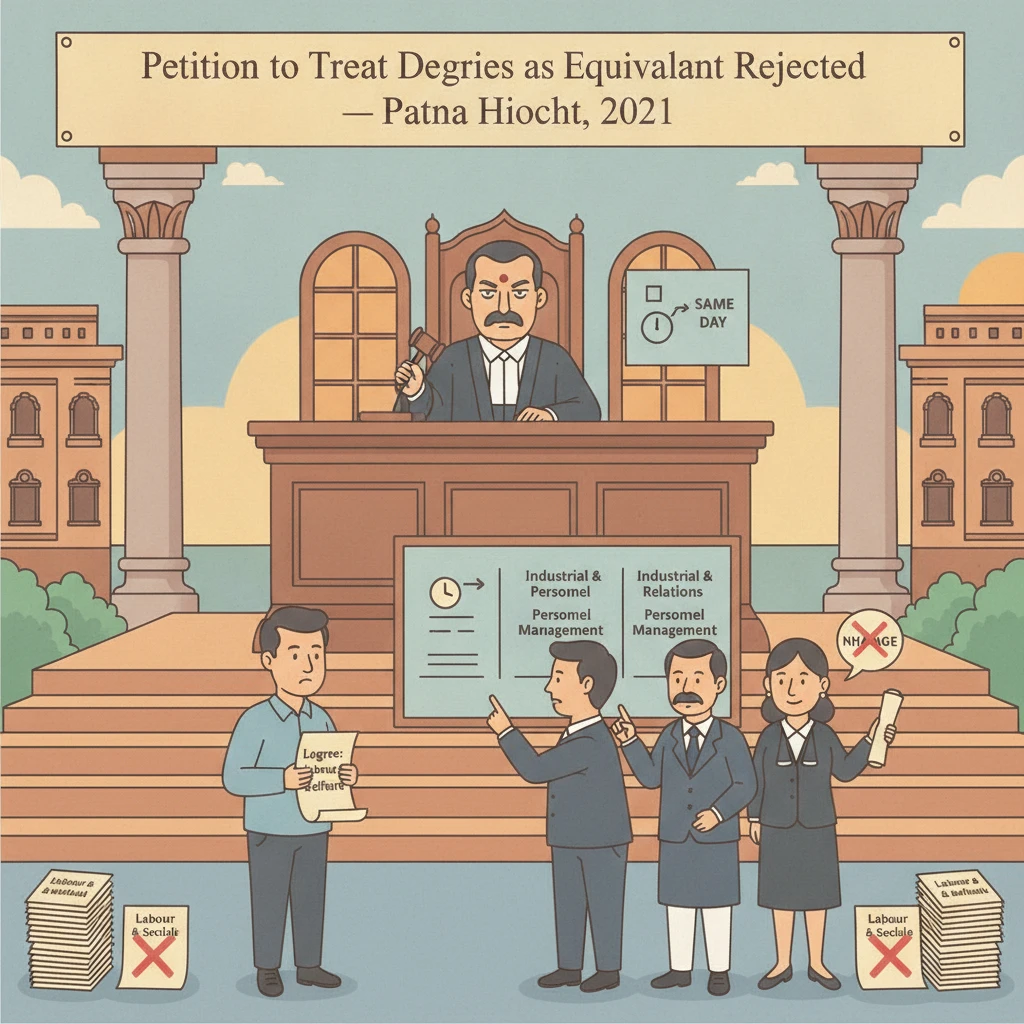
Case Background
This case arose from a recruitment process for Assistant Professors in Bihar. In 2014, the Bihar Public Service Commission (B.P.S.C.) issued advertisements inviting applications to fill vacancies in various university subjects.
The petitioner, a 50-year-old resident of Bhagalpur district, claimed to be qualified for the post of Assistant Professor in the subject “Industrial Relations and Personnel Management”. He had completed a post-graduate degree from Tilka Manjhi Bhagalpur University in the subject “Labour and Social Welfare”.
According to the petition, he applied in response to Advertisement No. 63 of 2014, which was specifically for the subject “Industrial Relations and Personnel Management”. However, his degree was not accepted as the required qualification and he was treated as ineligible.
An opportunity was given to him to object to this decision. He raised his objection, asking that his degree in Labour and Social Welfare be treated as equivalent to Industrial Relations and Personnel Management. Despite this, the B.P.S.C. rejected his claim, holding that his subject did not match the advertised subject.
Feeling aggrieved, he approached the Patna High Court in Civil Writ Jurisdiction Case No. 7766 of 2020, seeking directions mainly against the B.P.S.C. and the State authorities.
What the Court Examined and Decided
The Patna High Court, through Hon’ble Mr. Justice Ashutosh Kumar, heard arguments from all sides. Counsel represented the petitioner, the State, the B.P.S.C., and Tilka Manjhi Bhagalpur University.
The core relief sought by the petitioner was a direction to treat his Labour and Social Welfare (L.S.W.) degree as equivalent to Industrial Relations and Personnel Management (I.R.P.M.) for the purpose of the 2014 recruitment to Assistant Professor posts.
The petitioner’s counsel argued that the University from which he obtained his degree had later issued a notification changing the name of the subject “Labour and Social Welfare” to “Industrial Relations and Personnel Management”. On this basis, he claimed that his qualification should be treated as if it were in I.R.P.M.
The Court examined the recruitment advertisements that were brought on record as Annexure-9. This document showed that, in 2014, three different but related subjects were advertised separately:
- Advertisement No. 62 of 2014 – “Industrial and Personnel Management”
- Advertisement No. 63 of 2014 – “Industrial Relations and Personnel Management”
- Advertisement No. 64 of 2014 – “Labour and Social Welfare”
From this, the Court noted that the recruitment authority had consciously treated these three as separate subjects. Each subject had its own advertisement and posts.
Counsel for the B.P.S.C. pointed out that, although some papers or topics in these subjects might overlap, this did not erase the distinction between the subjects for recruitment purposes. He submitted that eligibility must be based strictly on the subject mentioned in the advertisement and the degree actually held by the candidate.
He further emphasised that all posts in all three subjects were to be filled through the appointment process as advertised. Therefore, a candidate’s degree in one subject could not be automatically treated as sufficient for a different subject merely because there were overlapping papers.
The Court also looked at how the B.P.S.C. had handled objections during the recruitment. The record showed that when the petitioner raised his objection about eligibility, the B.P.S.C. sought a clarification from the State Government.
The Government replied that the conditions of the recruitment process should not be changed “under any condition” because doing so would give rise to litigation. This meant that the authorities were not prepared to alter or reinterpret the eligibility criteria after the advertisement had been issued.
The judgment also notes another incident from the recruitment process. One candidate, who had applied for all three subjects and was found eligible in each, requested that all the interviews be held on the same day so that she could attend them conveniently. Even this logistical request was turned down. The Court referred to this to show that the authorities were maintaining a strict, rule-bound approach and were not changing the process for individual convenience.
Returning to the petitioner’s main argument, his counsel relied heavily on the University notification that changed the name of the subject. The petitioner claimed that since “Labour and Social Welfare” had been renamed “Industrial Relations and Personnel Management”, his degree should be treated as I.R.P.M. for all purposes.
The Court examined the University’s notification carefully. It found that the change in nomenclature was made effective from the “1996–1998” period. In simple terms, the name of the subject was changed only for students of batches covered by those years and after.
Crucially, the Court recorded that the petitioner had obtained his post-graduate degree from the University in the year 1995. This was before the effective period of the name change. Therefore, at the time he studied and passed the course, the subject was officially “Labour and Social Welfare”, not “Industrial Relations and Personnel Management”.
On these facts, the Court held that the petitioner could not claim to be an eligible candidate in the discipline of Industrial Relations and Personnel Management. His degree remained, in law, a degree in Labour and Social Welfare, and the later change of name could not retrospectively alter his qualification.
The Court then looked into the pleadings themselves. It noted that there was no specific pleading in the writ petition stating that the petitioner had not applied under the subject “Labour and Social Welfare” and had instead only applied under the subject “Industrial Relations and Personnel Management”.
Similarly, the counter affidavit filed by the B.P.S.C. did not clearly state this aspect either. So, on the written record before the Court, it was not even firmly established that the petitioner had avoided applying under the L.S.W. advertisement.
More importantly, the Court highlighted that the petitioner had never actually challenged the B.P.S.C.’s decision that refused to treat his subject as I.R.P.M. He did not file a writ to set aside that specific decision. Instead, in the present case, he only sought a direction to the authorities to treat Labour and Social Welfare and Industrial Relations and Personnel Management as “one and same”.
This was a crucial flaw. The Court essentially observed that he bypassed the proper course of challenging the rejection order and came only with a general prayer to equate two distinct subjects for recruitment, contrary to the advertisement.
In the final analysis, the Court concluded that, because the petitioner’s post-graduate degree was obtained in 1995 in the subject “Labour and Social Welfare”, and at that time the subject was not known as Industrial Relations and Personnel Management, he did not have any legal basis to insist on being treated as qualified in the I.R.P.M. discipline.
Accordingly, the Court held that he had no case to pursue and dismissed the writ petition.
Why This Judgment Matters
This judgment is important for candidates applying to government and university posts in Bihar and elsewhere. It underlines that the Patna High Court will insist on strict compliance with the subject and qualification details mentioned in recruitment advertisements.
Even if two courses appear similar or share many papers, they will not automatically be treated as equivalent unless the recruitment rules or authorities specifically say so. A later change in the name of a course may also not help if the candidate completed the course before that change took effect.
The judgment also shows that courts are slow to interfere with recruitment conditions once the selection process has started. Authorities are not expected to change eligibility terms mid-way, as that can create unequal treatment and further disputes.
For job seekers, the lesson is clear: check the exact subject, degree title, and effective dates of any university notification. If your degree title does not match the advertised requirement, your application can be rejected even if the syllabus overlaps.
Legal Issues and Answers
Issue: Can a candidate with a post-graduate degree in “Labour and Social Welfare” obtained in 1995 insist that it be treated as equivalent to “Industrial Relations and Personnel Management” for a 2014 Assistant Professor recruitment?
Answer: No. The Court held that the three subjects were separately advertised, the petitioner’s degree was formally in Labour and Social Welfare, and the later change of nomenclature did not apply to his 1995 degree. Therefore, he was not eligible in the I.R.P.M. discipline.
Issue: Can the Court direct recruitment authorities to treat two distinct subjects as the same, contrary to the original advertisement terms?
Answer: No. The Court declined to interfere with the recruitment conditions, particularly when the State had clarified that the terms of the process should not be changed, and when the petitioner had not properly challenged the B.P.S.C.’s rejection decision.
Cases Cited by the Court
- No prior judicial decisions or case law have been cited or relied upon in this judgment.
Case Details
Case Number: Civil Writ Jurisdiction Case No. 7766 of 2020
Case Title: Dilip Kumar Choudhary v. The State of Bihar & Ors.
Coram: Hon’ble Mr. Justice Ashutosh Kumar
Citation: 2022 (1) PLJR 17
Advocates:
For the petitioner: Mr. Navjot Yeshu, Advocate
For the State of Bihar: Mr. Ram Vinay Prasad, AC to GA-12
For the Bihar Public Service Commission: Mr. Sanjay Pandey, Advocate; Mr. Nishant Kumar Jha, Advocate
For Tilka Manjhi Bhagalpur University: Ms. Rekha Prasad, Advocate
Nature of the Case: Writ petition under civil writ jurisdiction challenging non-recognition of degree as equivalent for recruitment eligibility and seeking direction to treat two academic subjects as the same.
Link to Judgment: Patna High Court Judgment – CWJC No. 7766 of 2020
If you found this explanation helpful and wish to stay informed about
how legal developments may affect your rights in Bihar,
you may consider following Samvida Law Associates for more updates.







