

Case Background
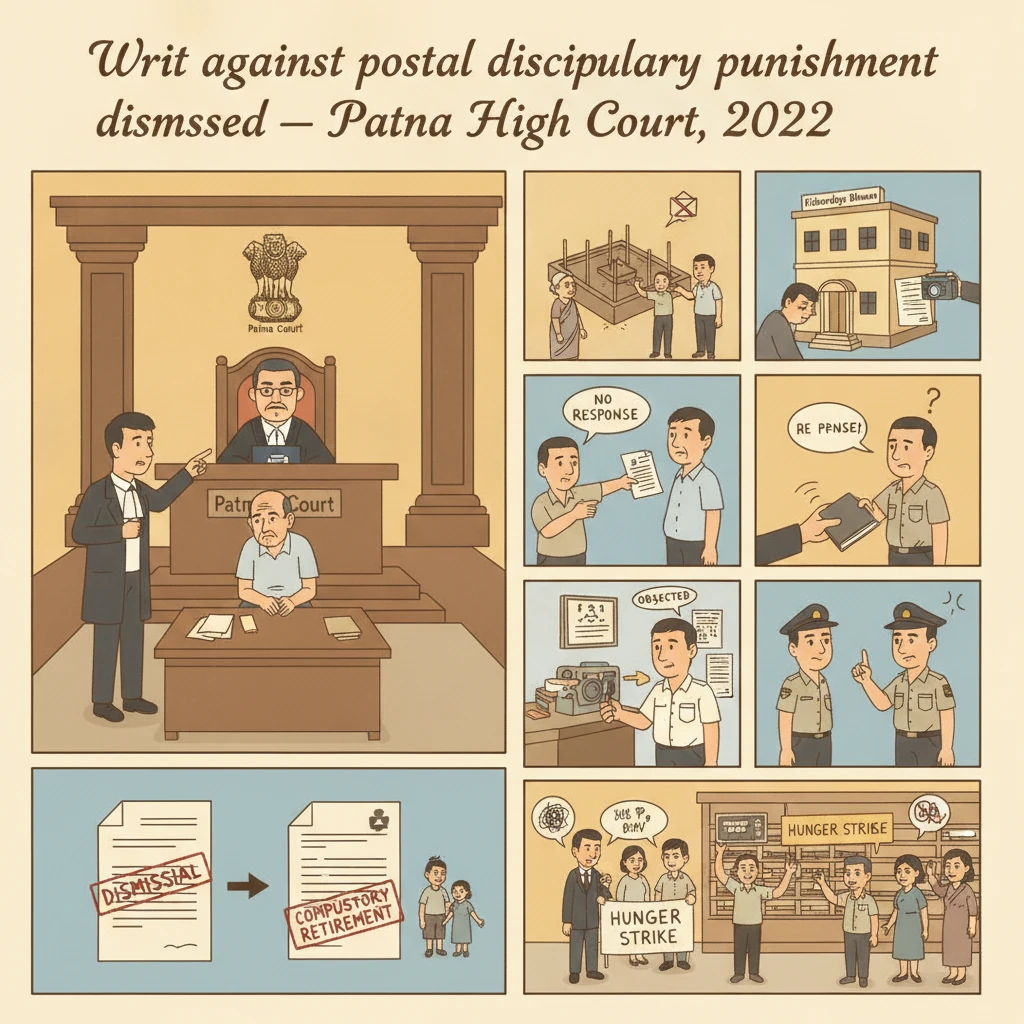
The petitioner was a Sorting Assistant in the Railway Mail Service (RMS) ‘U’ Division at Muzaffarpur under the Department of Posts. A departmental charge-sheet under Rule 14 of the Central Civil Services (Classification, Control and Appeal) Rules, 1965 was issued against him. Six articles of charge were framed, covering alleged violations of the Central Civil Services (Conduct) Rules, 1964 and Postal Manual provisions.
The charges included purchase of land in the name of his mother without prior intimation to the department, construction of a double storied house on that land without permission, alleged unauthorised custody and leakage of official correspondence to the press, misbehaviour in an office over his service book, misuse of a service telephone coupled with obstruction of a superior officer, and participation in a hunger strike with alleged use of filthy and unparliamentary language and giving press statements.
The Enquiry Officer held charges 1, 2 and 6 proved, charge 5 partly proved, and charges 3 and 4 not proved. The Disciplinary Authority disagreed with the findings on charges 3, 4 and 5 and concluded that all six charges stood proved. After giving the petitioner opportunity to respond to the tentative notes of disagreement (which he did not utilise), the Disciplinary Authority imposed the penalty of dismissal from service by order dated 04.09.2000.
The petitioner filed a departmental appeal. The Appellate Authority upheld the findings but considered the punishment of dismissal too severe in light of his family commitments. By order dated 16.02.2001, the penalty was modified from dismissal to compulsory retirement.
The petitioner then filed a revision before the Member (P), Postal Services Board (Revisional Authority). After analysing the evidence, the Revisional Authority held charges 1, 2 and 6 proved, charges 4 and 5 partly proved, and charge 3 not proved. By order dated 20.09.2001, the Revisional Authority further modified the punishment to reduction in pay by three stages for three years with cumulative effect. The petitioner was reinstated in service.
After reinstatement, the department issued a show-cause on how to treat the intervening period from 04.09.2000 (dismissal) to 11.10.2001 (reinstatement). By order dated 13.03.2002, the Revisional Authority directed that for this period the petitioner would be paid pay and allowances equivalent to the subsistence allowance earlier paid, and that the period would count as duty only for pension purposes.
The petitioner approached the Central Administrative Tribunal, Patna Bench, in O.A. No. 33 of 2003, challenging the original dismissal, the appellate order of compulsory retirement, the revisional order of 20.09.2001, the order dated 13.03.2002 regarding intervening period, and the consequential pay fixation. On 23.04.2010 the Tribunal dismissed the Original Application, upholding the revisional order and the treatment of the intervening period.
Against the Tribunal’s decision, the petitioner filed Civil Writ Jurisdiction Case No. 4417 of 2011 before the Patna High Court under Article 226 of the Constitution, leading to the present judgment dated 17.01.2022.
What the Court Examined and Decided
The Patna High Court first noted that the facts regarding the departmental proceedings were undisputed. The central attack in the writ was on the legality of the disciplinary process and on whether some of the charges amounted to misconduct.
The petitioner argued that he had been an active union leader. According to him, he was elected as Circle Secretary of the National Union of RMS Mail Guard, Class IV Employees, Bihar Circle in 1990 and continued till September 1999. He had complained about the functioning of one Superintendent of RMS ‘U’ Division, Muzaffarpur (Jamadar Singh) and a criminal case was also instituted against that officer.
The petitioner claimed that, out of vengeance, this officer initiated the disciplinary proceedings in an arbitrary and mala fide manner. He also said he had requested for appointment of an ad hoc disciplinary authority in place of that Superintendent, but his request was not accepted. This, according to him, violated the principle that no person should be a judge in his own cause.
On the substance of the charges, counsel for the petitioner focused mainly on charges 1 and 2. He submitted that purchase of land in the name of the petitioner’s widow mother and construction of a house on that land could not amount to misconduct attracting departmental action, especially when the land, according to him, was bought from the mother’s own funds received as death-cum-retirement benefits of the petitioner’s father.
To support the plea of bias and violation of natural justice, reliance was placed on several Supreme Court decisions including Arjun Chaubey v. Union of India (AIR 1984 SC 1356), A.L. Kalra v. The Project and Equipment Corporation of India Ltd. (AIR 1984 SC 1361), E.S. Reddi v. Chief Secretary, Government of A.P. (1987) 3 SCC 258, Maharashtra State Board of Secondary and Higher Secondary Education v. K.S. Gandhi (1991) 2 SCC 716, and a Patna High Court decision in Bihar State Electricity Board v. Raghbendra Prasad, 2011(1) PLJR 242.
On the other side, counsel for the Union of India argued that there was no violation of natural justice or breach of rules. The findings were based on evidence led in the enquiry. The High Court, sitting in judicial review, could not re-appreciate that evidence or act as an appellate forum. He submitted that the Tribunal and the departmental authorities had applied their minds and their conclusions were not perverse.
The High Court then examined the key charges and the way they had been dealt with by the departmental authorities.
On charge 1, the Court recounted that the allegation was purchase of a plot measuring 1 katha 1 dhur in the name of the petitioner’s widow mother on 31.01.1978 without prior knowledge of the prescribed authority, in violation of Rule 18(2) of the CCS (Conduct) Rules, 1964 and Rule 3(i)(iii) (conduct unbecoming of a government servant). The Court noted the petitioner’s argument that the land was purchased out of his mother’s own funds received as death-cum-retirement benefits.
The Court referred to Rule 18(2), which mandates that a government servant shall not acquire or dispose of immovable property in his own name or in the name of any member of his family except with previous knowledge of the prescribed authority. It also referred to Rule 2(c), which defines “family” to include persons related by blood or marriage and wholly dependent on the government servant. The Court observed that the petitioner’s own appointment was on compassionate grounds after his father’s death, and it was not his case that his mother was not wholly dependent on him.
On that basis, the Court held that purchase of land in the mother’s name, without prior intimation, clearly fell within Rule 18(2). It found that the disciplinary and appellate authorities had discussed charge 1 with reference to evidence, and their finding that the rule was breached could not be said to be perverse.
Regarding charge 2, which concerned construction of a double storied building “Kishoralaya Bhawan” on the said land without prior knowledge of the prescribed authority and failure to reply to a departmental letter seeking information, the Court again found that the facts were essentially admitted. The petitioner had not informed the authority of the construction. The Court held that the findings on charge 2 were also not perverse and were supported by materials on record.
The Court did not discuss charge 3 in detail because the Revisional Authority had finally held that charge not proved.
For charge 4, initially held “not proved” by the Enquiry Officer, the Revisional Authority had partially accepted it. This charge involved the petitioner allegedly snatching his service book from an accountant, writing “objected” under his signature without authority, and causing disruption in the office.
The Revisional Authority found, on the materials, that at least the part relating to the petitioner writing “objected” in the service book stood established. It termed his conduct unwarranted and held that if he had any grievance about pay fixation he should have taken it up with higher authorities properly. The High Court accepted this appreciation as reasonable.
On charge 5, relating to an unauthorised visit to the office of the Superintendent, attempted misuse of the service telephone and obstruction of the Superintendent in discharge of duty, the Revisional Authority held the charge partly proved but made it clear that the petitioner’s contention of concoction was untenable. It was established that he had visited the office on the relevant date. Again, the High Court found that the Revisional Authority had discussed the evidence and its conclusions were not perverse.
Charge 6 concerned participation in a hunger strike organised by a joint action committee of some service unions in front of the office of the Superintendent, raising filthy slogans with a loudspeaker, using unparliamentary words against officers and staff, disrupting work, and giving press statements that appeared in daily newspapers. This was treated as an act subversive of discipline and harmful to public interest. The Enquiry Officer, Disciplinary Authority, Appellate Authority and Revisional Authority had all concurrently held charge 6 proved. The High Court saw no material to term this concurrent finding perverse.
The Court then turned to the allegation of bias and mala fides. It highlighted that although the petitioner made serious allegations against the Superintendent who initiated the proceedings, he had not impleaded that person as a party before the Tribunal. Such allegations in absence of the concerned person were not sustainable.
The Court carefully distinguished the Supreme Court’s decision in Arjun Chaubey, where the disciplinary authority himself was the main complainant and had dispensed with a regular enquiry by invoking a special rule, thus judging his own cause. In contrast, in the present case, a full-fledged departmental enquiry was held, witnesses were examined, and evidence was led. There was no material to show any procedural lapse or denial of opportunity. Moreover, the Appellate and Revisional Authorities, against whom no mala fides were alleged, had independently evaluated the evidence and adjusted the punishment.
The High Court noted that the Tribunal had considered the parties’ pleadings and submissions and had upheld the revisional order, observing that the Revisional Authority had passed a detailed, fair order and imposed a lesser and reasonable penalty of reduction in pay by three stages for three years with cumulative effect.
The writ petition, the Court observed, took essentially one ground against the Tribunal: that it erred in presuming there was no violation of natural justice merely because the Revisional Authority had reduced the punishment. No other substantial grounds were raised to challenge the Tribunal’s findings.
The High Court then restated the settled law on the limited scope of judicial review in disciplinary matters under Article 226. Relying on precedents including Railway Board v. Niranjan Singh (1969) 1 SCC 502 and Union of India v. P. Gunasekaran (2015) 2 SCC 610, it emphasised that a High Court cannot act as a second court of first appeal, re-appreciate evidence, assess adequacy of evidence, or interfere with findings of fact if there is some legal evidence to support them and the enquiry is conducted in accordance with law.
The judgment quoted at length from P. Gunasekaran, listing what a writ court may examine—such as competence of the enquiry authority, observance of procedure, adherence to natural justice, absence of extraneous considerations, and the presence of at least some evidence—and what it must avoid, such as reassessing evidence or questioning proportionality of punishment unless it shocks the conscience.
The Court also referred to later decisions applying the same principles: Central Industrial Security Force v. Abrar Ali (2017) 4 SCC 507, State of Karnataka v. N. Gangaraj (2020) 3 SCC 423, Director General of Police, Railway Protection Force v. Rajendra Kumar Dubey, 2020 SCC OnLine SC 954, and Union of India v. Dalbir Singh, 2021 SCC OnLine SC 768. These authorities reinforced that re-appreciation of evidence in judicial review is impermissible and that interference is justified only in cases of “no evidence” or serious legal infirmity.
Applying these standards, the Patna High Court held that the findings of the Disciplinary Authority, Appellate Authority and Revisional Authority were all based on evidence, there was due application of mind, and no perversity was shown. The Tribunal’s decision to uphold the revisional order therefore did not warrant interference.
On the separate issue of treatment of the intervening period from 04.09.2000 to 11.10.2001, the Court upheld the Revisional Authority’s order dated 13.03.2002. It noted that the absence from duty was regularised as duty only for pensionary purposes, with pay and allowances restricted to the level of subsistence allowance earlier paid. The Court found no illegality in this arrangement.
In conclusion, the Patna High Court held that there was no merit in the writ petition. It dismissed the application and made no order as to costs.
Why This Judgment Matters
This judgment is important for government and postal employees facing departmental enquiries. It shows that courts will rarely interfere with disciplinary findings if a proper enquiry has been held, evidence has been recorded, and appeal and revision have been considered.
The Patna High Court made it clear that even if an employee feels a superior officer is biased, such an allegation must be properly pleaded, supported by facts, and the officer must be made a party. Mere assertions of mala fides, without more, will not set aside an enquiry.
The judgment also highlights that failure to inform the department about purchase of property or construction in the name of a dependent family member can amount to misconduct under Rule 18 of the CCS (Conduct) Rules. Union leaders and ordinary employees alike are subject to these conduct rules.
For those challenging departmental punishments through writ petitions, this decision reminds that the High Court will not re-weigh evidence or substitute its own view for that of departmental authorities unless there is clear illegality or “no evidence”.
Legal Issues and Answers
-
Issue: Whether the disciplinary proceedings and punishment against the postal employee were vitiated by bias, mala fides or violation of principles of natural justice.
Answer: No. The Court held that a full enquiry was conducted in accordance with rules, the employee had opportunity to defend, and independent appellate and revisional authorities considered the matter. Allegations of mala fides were unsupported, especially as the officer allegedly biased was not impleaded. -
Issue: Whether purchase of land and construction of a house in the name of the employee’s widow mother without prior intimation could constitute misconduct under Rule 18(2) of the CCS (Conduct) Rules.
Answer: Yes. The Court held that the mother was a dependent family member within Rule 2(c), and acquisition and construction without previous knowledge of the prescribed authority clearly breached Rule 18(2), justifying disciplinary action. -
Issue: Whether the Patna High Court, in writ jurisdiction, could re-appreciate evidence and interfere with findings and punishment confirmed by the Tribunal.
Answer: No. Following Supreme Court precedents, the Court held its role is limited to checking legality, procedure and presence of some evidence. As there was legal evidence, no procedural violation and no perversity, interference was unwarranted.
Cases Cited by the Court
- Arjun Chaubey v. Union of India and others, AIR 1984 SC 1356
- Railway Board v. Niranjan Singh, (1969) 1 SCC 502
- Union of India and others v. P. Gunasekaran, (2015) 2 SCC 610
- Central Industrial Security Force and others v. Abrar Ali, (2017) 4 SCC 507
- State of Karnataka and another v. N. Gangaraj, (2020) 3 SCC 423
- State of A.P. v. S. Sree Rama Rao, AIR 1963 SC 1723
- B.C. Chaturvedi v. Union of India and others, (1995) 6 SCC 749
- High Court of Judicature at Bombay v. Shashikant S. Patil, (2000) 1 SCC 416
- State Bank of Bikaner and Jaipur v. Nemi Chand Nalwaya, (2011) 4 SCC 584
- Director General of Police, Railway Protection Force and others v. Rajendra Kumar Dubey, 2020 SCC OnLine SC 954
- Union of India and others v. Dalbir Singh, 2021 SCC OnLine SC 768
- A.L. Kalra v. The Project and Equipment Corporation of India Ltd., AIR 1984 SC 1361 (distinguished)
- E.S. Reddi v. Chief Secretary, Government of A.P. and another, (1987) 3 SCC 258 (distinguished)
- Maharashtra State Board of Secondary and Higher Secondary Education v. K.S. Gandhi and others, (1991) 2 SCC 716 (distinguished)
- Bihar State Electricity Board v. Raghbendra Prasad, 2011(1) PLJR 242 (distinguished)
Case Details
Case Number: Civil Writ Jurisdiction Case No. 4417 of 2011
Case Title: Arun Kumar Shukla v. Union of India & Others
Court: High Court of Judicature at Patna
Judgment Date: 17.01.2022
Coram: Hon’ble Mr. Justice Chakradhari Sharan Singh; Hon’ble Mr. Justice Madhuresh Prasad
Citation: 2022(1) PLJR 599
Advocates:
- For the Petitioner: Mr. Chakrapani, Advocate; Mr. Dipak Kumar, Advocate
- For the Respondents: Mr. Praveen Kumar Sinha, Senior Panel Counsel; Mr. Radhika Raman, Central Government Counsel
Nature of the Case: Writ petition under Article 226 of the Constitution challenging Central Administrative Tribunal order arising from departmental disciplinary proceedings (reduction in pay and treatment of intervening period of service).
Link to Judgment: Click here to read the full judgment of the Patna High Court
If you found this explanation helpful and wish to stay informed about
how legal developments may affect your rights in Bihar,
you may consider following Samvida Law Associates for more updates.







