

Case Background
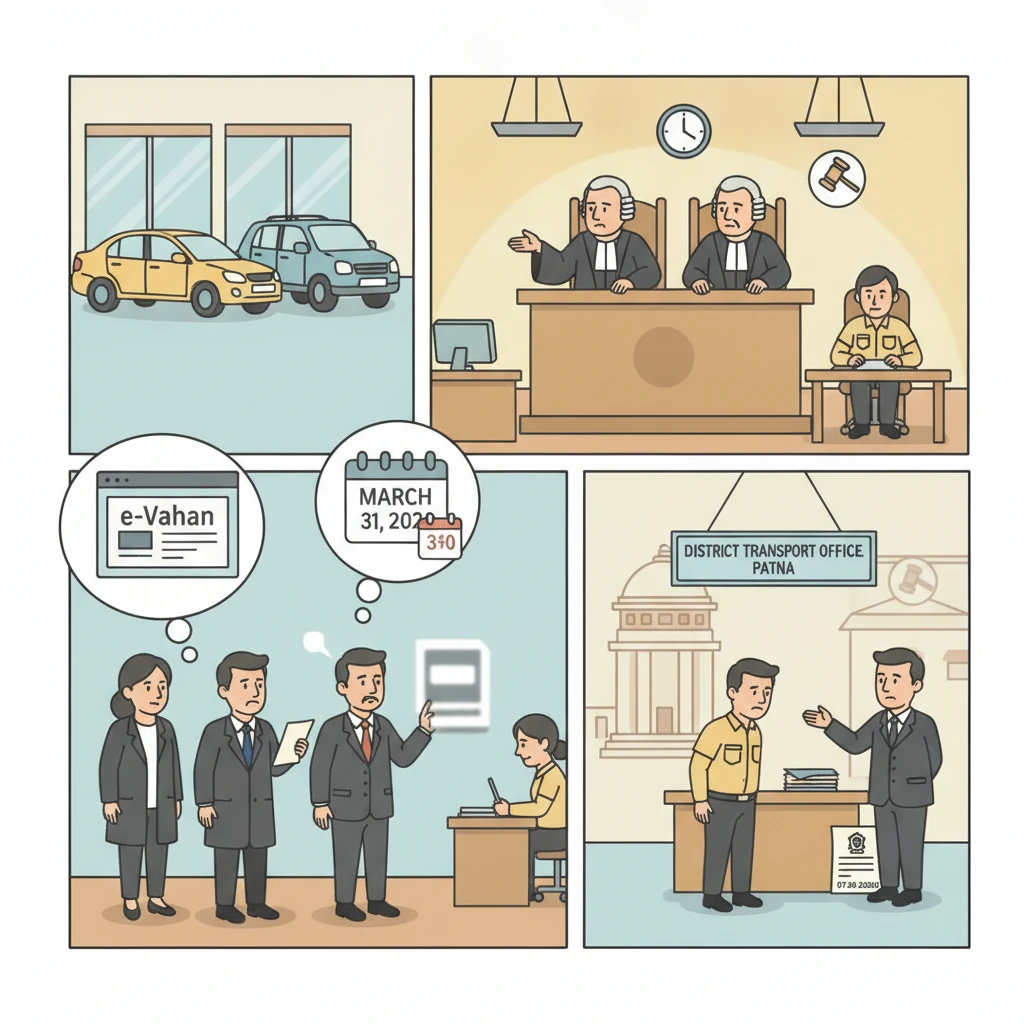
The petitioner is a private limited company engaged in the sale and purchase of two-wheeler and four-wheeler vehicles. It is an authorised distributor for Honda Motors (India) Private Limited.
According to the petition, the company buys vehicles from the manufacturer by paying the full price and becomes their absolute owner. It then sells these vehicles to customers and also runs an authorised service centre with support from the manufacturer.
Under Section 39 of the Motor Vehicles Act, 1988, no motor vehicle can be driven in a public place unless it is registered and carries a valid registration certificate. Therefore, after each sale, the vehicle needs to be registered in accordance with the Act.
The petitioner’s case is linked to the transition from Bharat Stage IV (BS-IV) to Bharat Stage VI (BS-VI) emission norms. In M.C. Mehta vs. Union of India, the Supreme Court had, by order dated 24.10.2018, imposed a ban on sale and registration of BS-IV vehicles with effect from 01.04.2020.
Due to the Covid-19 pandemic, a national lockdown was imposed from 24.03.2020. On 27.03.2020, in the same M.C. Mehta proceedings, the Supreme Court allowed registration of vehicles sold up to 30.04.2020, except in Delhi and NCR where sale and registration of BS-IV vehicles was not allowed.
On 31.07.2020, the Supreme Court again considered the issue. It noticed that a large number of transactions had taken place during the lockdown between dealers. The Court viewed these dealer-to-dealer sales with suspicion and directed authorities across India not to register BS-IV vehicles, treating many such transactions as attempts to misuse its earlier order.
In this backdrop, the petitioner purchased four BS-IV vehicles from Honda Motors. Two of these were sold to customers. The other two were retained by the petitioner for its own use, by effecting a sale in favour of the petitioner-company itself.
The petitioner says that for all four vehicles, it deposited the required fees and taxes for registration, which were accepted by the transport authorities. The necessary documents were also uploaded on the e-Vahan portal on or before 31.03.2020, the cut-off date fixed by the Supreme Court. However, because of the lockdown, registration could not actually be completed.
While the petitioner awaited registration, the Transport Department, Government of Bihar, issued directions to District Transport Officers to comply with the Supreme Court’s order dated 13.08.2020 in M.C. Mehta. Later, on 07.09.2020, another departmental communication was issued regarding registration of BS-IV vehicles in line with the same Supreme Court order.
The petitioner relied strongly on this 07.09.2020 communication, claiming it reflected the correct implementation of the Supreme Court’s directions and did not mention any bar on registering vehicles in the name of companies or firms.
However, by communication dated 23.11.2020, the District Transport Officer, Patna (respondent no. 4) refused to register the two BS-IV vehicles which the petitioner had sought to register in its own name. This order became the subject of challenge in Civil Writ Jurisdiction Case No. 5060 of 2021 before the Patna High Court.
What the Court Examined and Decided
The petitioner asked the Court to quash the communication dated 23.11.2020 issued by the District Transport Officer, Patna. It further sought a mandamus directing the authorities to register the two remaining BS-IV vehicles in the company’s name and to issue registration certificates.
The impugned order dated 23.11.2020, written in Hindi, clearly stated that as per instructions issued by the Transport Department in light of the Supreme Court’s directions, no registration could be done where sale documents showed transfer from one dealer to another or from a dealer to its own name. Applying this, the officer concluded that the two vehicles in question could not be registered.
The petitioner’s core argument was simple. It claimed that all four vehicles were covered by the Supreme Court’s relaxation for BS-IV vehicles whose sale details and fees had been uploaded on the e-Vahan portal prior to the cut-off date. Since the fees and taxes were paid and the applications uploaded before 31.03.2020, the rejection of registration for the last two vehicles was alleged to be arbitrary and contrary to the Supreme Court’s orders.
The petitioner emphasised the departmental communication dated 07.09.2020. It argued that unlike the earlier communication, this one did not bar registration of vehicles in the name of any company, firm, or organisation. Therefore, according to the petitioner, once the technical conditions laid down by the Supreme Court were met (uploading on e-Vahan and payment before the cut-off date), the authorities were obliged to register all four vehicles, including those being registered in the petitioner’s own name.
The State, through its counsel, took the opposite stand. It relied on the actual text of the Supreme Court’s order dated 13.08.2020 in M.C. Mehta. In the very first paragraph of that order, the Supreme Court had recorded concern that a very large number of transactions had occurred during the lockdown “inter se dealers”. The Court held that such transactions could not be recognised as genuine sales for the purpose of registration.
The Supreme Court expressly disallowed registration of vehicles on the basis of such dealer-to-dealer transactions. It described them as not being sales to customers and as an attempt to misuse the Court’s earlier order. The apex Court therefore barred registration of vehicles sold between dealers during the lockdown period.
The State argued that the petitioner’s own case showed that the two disputed vehicles had been “sold” by the dealer (petitioner) to itself, again as a dealer. This was squarely a transaction “inter se dealers” within the meaning of the Supreme Court’s order. Therefore, the registering authority was bound by the Supreme Court’s directions not to register such vehicles.
The petitioner sought support from another portion of the same 13.08.2020 order. In that later part, the Supreme Court noted that there were many sales uploaded on the e-Vahan portal, some with temporary registrations, which could not be finally registered during the lockdown. For these, the Court allowed registration of vehicles “which could not be registered during lockdown in the month of March, 2020 and for no other reason”.
According to the petitioner, its case fell exactly within this relaxation: the sales had been uploaded, fees paid, and only the formal registration process was held up due to lockdown.
The Patna High Court closely read the Supreme Court’s orders. It held that the relaxation in the later part of the 13.08.2020 order was meant for genuine sales to customers, not for dealer-to-dealer transfers. The Supreme Court had separately and clearly barred registration of vehicles covered by transactions between dealers during the lockdown.
The High Court then examined a subsequent order of the Supreme Court dated 30.11.2021 in M.C. Mehta. In that order, the Supreme Court reiterated that no registration of BS-IV vehicles could be made without its permission and clarified how pending matters should be dealt with.
The 30.11.2021 order stated that sales of vehicles uploaded on the e-Vahan portal before 31.03.2020 could be registered by transport authorities only if temporary or permanent registration had been granted before that date. It further directed the authorities to carefully scrutinise the records to ensure that the sales were genuine and had taken place prior to 31.03.2020.
The Patna High Court interpreted this as casting a duty on the registering authority to distinguish genuine customer sales from non-genuine dealer-to-dealer transactions. The earlier 13.08.2020 order had already declared that transactions between dealers, which were not sales to customers, were “not genuine”.
Applying these principles, the Court noted a crucial factual aspect. Out of the four BS-IV vehicles, the two vehicles actually sold by the petitioner to customers had been duly registered. The remaining two vehicles, which the petitioner sold to itself and wanted to register in its own name, were refused registration.
The Court held that the grievance of the petitioner concerned only these two self-purchase vehicles. Such a transaction amounted clearly to a sale “inter se dealers” and therefore fell into the category that the Supreme Court had treated as non-genuine and barred from registration.
As a High Court, it was bound to follow the Supreme Court’s directions. Since the apex Court had specifically prohibited registration of vehicles sold between dealers during the lockdown, the Patna High Court found no legal flaw in the District Transport Officer’s refusal.
The Court thus concluded that the communication dated 23.11.2020 rejecting registration of the two vehicles was valid and in strict conformity with the Supreme Court’s orders. The writ petition was held to be devoid of merit and was dismissed.
Why This Judgment Matters
This judgment is important for vehicle dealers and buyers dealing with old BS-IV stock around the time of the Covid-19 lockdown and the shift to BS-VI norms.
It confirms that dealers cannot use self-sale or dealer-to-dealer transfers during the lockdown period to secure registration of BS-IV vehicles. Even if fees were paid and details uploaded on the e-Vahan portal, such transactions will be treated as non-genuine if they are not clear sales to actual customers.
For ordinary buyers, the decision shows that genuine customer purchases, made and uploaded on the portal before the cut-off date, can still be protected, as seen from the registration of the two vehicles sold to customers.
For authorities, the judgment reinforces their duty to follow the Supreme Court’s directions strictly and to scrutinise records for genuineness before granting registration to BS-IV vehicles.
Legal Issues and Answers
Issue: Whether the District Transport Officer was wrong in refusing to register two BS-IV vehicles in the dealer-petitioner’s own name, despite payment of fees and uploading of documents before 31.03.2020.
Answer: No. The Patna High Court held that the transactions were between dealers during the lockdown period and, as per the Supreme Court’s orders in M.C. Mehta, such transactions are not genuine and cannot result in registration.
Issue: Whether the later part of the Supreme Court’s order dated 13.08.2020, allowing registration of vehicles uploaded on the e-Vahan portal, applied to the petitioner’s dealer-to-dealer transactions.
Answer: No. The High Court held that this relaxation applies only to genuine sales to customers whose registration was delayed due to lockdown, not to dealer-to-dealer or self-purchase transactions.
Cases Cited by the Court
- M.C. Mehta vs. Union of India, Writ Petition (Civil) No. 13029 of 1985 – Supreme Court orders dated 24.10.2018, 27.03.2020, 31.07.2020, 13.08.2020 and 30.11.2021 were referred to and relied upon.
Case Details
Case Number: Civil Writ Jurisdiction Case No. 5060 of 2021
Case Title: M/s Kumar Distributors Pvt. Ltd. vs. The State of Bihar & Ors.
Citation: 2022 (1) PLJR 686
Court: High Court of Judicature at Patna
Coram: Hon’ble Mr. Justice Chakradhari Sharan Singh and Hon’ble Mr. Justice Madhuresh Prasad
Date of Judgment: 22.02.2022
Advocates:
- For the petitioner: Mr. Akashdeep, Mr. Shyameshwar Kumar Singh
- For the respondents: Mr. Rakesh Prabhat (AC to SC 21)
Nature of the Case: Writ petition under civil writ jurisdiction challenging refusal of vehicle registration and seeking mandamus for registration.
Link to Judgment: View full judgment on Patna High Court website
If you found this explanation helpful and wish to stay informed about
how legal developments may affect your rights in Bihar,
you may consider following Samvida Law Associates for more updates.







