

Case Background
The petitioner is a sugar manufacturing company operating a sugar factory at Harinagar in the district of West Champaran, Bihar.
The State Government issued a Resolution dated 12.09.2006 announcing an incentive scheme for establishment and development of sugar and sugar-based industries in Bihar. This incentive scheme promised various benefits to new sugar mills, sugarcane-based industries and to expansion projects of existing mills.
Under this scheme, Clause 4(k)(ii) granted exemption from administrative charges on molasses for five years to new distilleries and ethanol units being established, and also to capacity expansion of existing distilleries and ethanol units. Clause 5(x) and Clause 5(N) provided that the period of benefit would start from the date when commercial production actually began.
On 24.07.2007, guidelines were issued by the Sugar Industries Department to implement this incentive scheme. Clause 6 of these guidelines made it clear that a separate notification about exemption from administrative charges on molasses would be issued by the Excise Department and action would be taken in accordance with that notification.
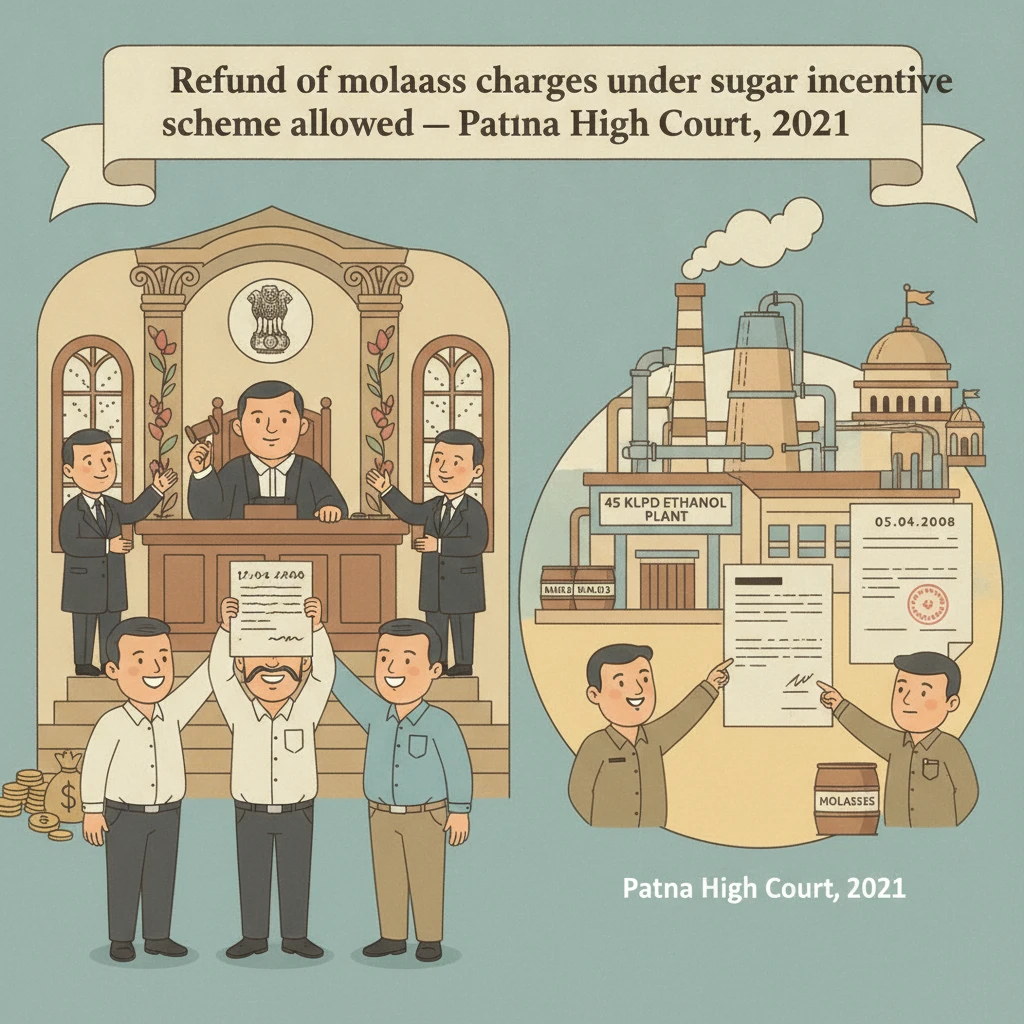
Acting on the incentive scheme, the petitioner set up a new 45 KLPD ethanol/distillery plant within its factory premises. The new plant was commissioned for trial on 05.03.2008. Commercial production started from 05.04.2008.
Meanwhile, under Clause 6 of the guidelines, the Department of Registration, Excise and Prohibition issued a notification dated 11.09.2008 under Section 8(A) of the Bihar Molasses (Control) Act, 1947. This notification granted full exemption from administrative charges on all grades of molasses for new distillery/ethanol plants and for expansion of existing plants. It clearly stated that the exemption would be applicable for five years from the date of commercial production of the new or expanded plant.
The petitioner claimed exemption from administrative charges on molasses used in its new ethanol/distillery unit for five years from 05.04.2008, the date of commercial production. However, exemption was granted only from 01.07.2008 onwards. Administrative charges already paid for the period from 05.04.2008 to 30.06.2008 were not refunded.
As a result, the petitioner approached the Patna High Court in Civil Writ Jurisdiction Case No. 6658 of 2011, seeking refund of Rs. 37,51,350/- paid as administrative charges on molasses for the period 05.04.2008 to 30.06.2008, along with consequential reliefs.
What the Court Examined and Decided
The division bench heard counsel for the petitioner and the State. The central dispute was narrow but important: from which date should the exemption from administrative charges on molasses be reckoned when a new distillery/ethanol plant is set up under the sugar industry incentive scheme?
The petitioner’s stand was straightforward. According to the incentive policy dated 12.09.2006, the implementation guidelines dated 24.07.2007, and the Excise notification dated 11.09.2008, exemption was for five years “from the date of commercial production” of the new distillery/ethanol plant.
It was admitted on all sides that commercial production of the petitioner’s new plant began on 05.04.2008. It was also admitted that the incentive scheme had already been declared on 12.09.2006, and the guidelines were issued on 24.07.2007. The petitioner argued that once commercial production started within the life of the scheme, exemption must run from that date for five years, irrespective of the later date of the Excise notification.
The petitioner further pointed out that after 30.06.2008, the Excise Department itself extended exemption to it. This showed that the petitioner’s eligibility under the scheme was not in dispute. Only the starting date of benefit was being artificially restricted, causing financial loss for the initial period of production.
The State, through the Excise authorities (respondent Nos. 4 to 7), opposed the claim. It relied heavily on Clause 6 of the guidelines of 24.07.2007, arguing that exemption could apply only from the date of the Excise notification, i.e., 11.09.2008. According to the State, because the notification could not operate retrospectively, the petitioner could not claim exemption for any period before 11.09.2008, which would include 05.04.2008 to 30.06.2008.
The Court carefully examined the incentive scheme, the guidelines and the notification. It noted that all three documents consistently provided that exemption from administrative charges on molasses would run for five years from the date of commercial production of the new or expanded distillery/ethanol unit.
The Court found that the petitioner had established the new plant after issuance of the incentive policy dated 12.09.2006, and began commercial production on 05.04.2008. Notification under Clause 6 of the guidelines was indeed issued later, on 11.09.2008. However, this timing could not cut down or postpone the benefit expressly promised by the policy and by the notification itself.
The Court held that the stand of the Excise Department was unsustainable in law. Once the policy and notification both stated that exemption runs from the date of commercial production, the authorities in the Department of Registration, Excise and Prohibition could not restrict the benefit to some later date on the plea that their notification lacked retrospective effect.
The bench observed that the new plant was set up “in view of” the incentive policy under the 12.09.2006 Resolution. The fact that the Excise notification lagged behind by nearly two years and came after commercial production had started could not be used to deny the incentive that formed the very basis of the investment decision.
The Court then turned to another important aspect: Clause 11(kha) of the implementation guidelines issued on 24.07.2007. This clause clearly stated that in case of any dispute arising under the incentive package, the decision of the Principal Secretary, Department of Sugarcane Industry, would be final.
In light of this, the Court examined the counter affidavit filed by respondent Nos. 2 and 3, namely the Principal Secretary, Sugarcane Industries Department, Bihar, Patna, and the Commissioner-cum-Secretary, Cane Development Department, Bihar, Patna. In paragraphs 12, 13 and 14 of this affidavit, these authorities fully supported the petitioner’s entitlement.
The Sugarcane Industries Department stated that the petitioner had informed, through letter dated 10.02.2010, that it had established the ethanol production unit encouraged by the incentive package declared through Resolution No. 1433 dated 12.09.2006, and had commenced commercial production on 05.04.2008.
The same Department acknowledged that although the Excise Department issued its notification only on 11.09.2008, the incentive package had been declared in 2006 itself. To “rectify this position”, the Sugarcane Industries Department recommended that the Excise notification be treated as effective from the date of issuance of the incentive Resolution dated 12.09.2006, and that Harinagar Sugar Mill should get exemption from the date of commencement of commercial production, i.e., 05.04.2008.
Paragraph 14 of the affidavit reiterated that Clause 11 of the guidelines made the decision of the Principal Secretary, Sugarcane Industry final in case of any dispute, and clarified that the relevant letters were approved by the Principal Secretary.
On this basis, the Court held that once the competent authority designated by the guidelines had taken a clear decision in favour of the petitioner’s entitlement, the Excise Department was bound to acknowledge and give effect to that decision.
The bench went further and recorded that the Excise Department’s refusal to grant exemption from the date of commencement of commercial production actually frustrated the very object and intent of the State Government’s incentive scheme for sugarcane and sugar-based industries in Bihar.
The Court rejected the “bogey of retrospectivity” raised by the Excise Department. The notification dated 11.09.2008 itself said that exemption of administrative charges on molasses would be applicable for five years from the date of commercial production of new distillery/ethanol plants. Applying this language to the petitioner, the benefit had to start on 05.04.2008.
The bench described the State’s stand, based on the Excise Department’s opposition, as “unfounded and unsustainable” and called the present litigation “most baseless and undesirable”. It noted that for over 13 years the petitioner was deprived of the refund which was clearly due under the incentive scheme, while the State unjustifiably retained the amount.
The Court held that this amounted to unjust enrichment of the State and was clearly unjustified, especially in the face of the Principal Secretary, Sugarcane Industry, acknowledging the petitioner’s entitlement on affidavit.
Ultimately, the Court allowed the writ petition. It directed the authorities to refund Rs. 37,51,350/-, being the administrative charges collected for the period from 05.04.2008 to 30.06.2008, along with interest at the varying bank rate of interest applicable during this period on fixed deposits.
The Court observed that the case was a glaring example of baseless litigation generated by the Excise Department, causing loss to the State exchequer through needless legal proceedings and undermining the State Government’s own incentive policy.
Although the Court was tempted to impose costs for this conduct, it refrained from doing so. Instead, it directed that the refund with interest be paid along with a calculation chart showing the computation of the amount, within three months from the date of receipt or production of a copy of the order.
Why This Judgment Matters
This judgment is significant for industries that invest based on government incentive schemes, particularly in Bihar’s sugarcane and sugar-based sectors. It makes clear that when a policy promises benefits from the date of commercial production, the Government cannot later cut down those benefits on the basis of internal delays in issuing departmental notifications.
The Patna High Court has also underlined that where guidelines name a particular authority as final decision-maker in case of disputes, other departments of the State must respect that decision. In this case, the Sugarcane Industries Department supported the mill’s claim, yet the Excise Department continued to resist. The Court has rejected such inter-departmental resistance.
Practically, the ruling protects investors from being punished because of bureaucratic delay. It confirms that the State cannot unjustly retain money collected in violation of its own incentive schemes, and may be required to refund such amounts with interest even after many years.
For other businesses considering setting up ethanol or distillery units under similar schemes, this decision reinforces that the terms of the scheme and the date of commercial production are crucial, and that courts will step in where departments wrongly deny promised benefits.
Legal Issues and Answers
- Issue: Whether the petitioner’s new ethanol/distillery plant was entitled to exemption from administrative charges on molasses from the actual date of commercial production (05.04.2008), despite the Excise notification being issued later on 11.09.2008.
Answer: Yes. The Court held that under the incentive policy, guidelines and notification, exemption was for five years from the date of commercial production, and the Excise Department could not deny this benefit for the period 05.04.2008 to 30.06.2008. - Issue: Whether the Excise Department could ignore the decision of the Principal Secretary, Sugarcane Industries Department, who was designated as the final authority under the guidelines, and still oppose the petitioner’s claim.
Answer: No. The Court held that Clause 11 of the guidelines made the Principal Secretary’s decision final in case of disputes, and the Excise Department was bound to acknowledge and act upon that decision. - Issue: Whether the State was justified in retaining administrative charges collected during the disputed period under the incentive scheme.
Answer: No. The Court found the State’s retention of Rs. 37,51,350/- to be unjustified enrichment based on an unfounded and unsustainable stand, and ordered refund with applicable bank interest.
Cases Cited by the Court
- The judgment does not refer to or rely upon any previous case law. No prior cases are cited in the text.
Case Details
Case Number: Civil Writ Jurisdiction Case No. 6658 of 2011
Case Title: Harinagar Sugar Mill Ltd. vs. The State of Bihar & Ors.
Citation: 2022(1) PLJR 345
Court: High Court of Judicature at Patna
Coram: Hon’ble Mr. Justice Chakradhari Sharan Singh; Hon’ble Mr. Justice Madhuresh Prasad
Date of Judgment: 23.12.2021
Advocates: Mr. Ramesh Kumar Agrawal, Advocate for the petitioner; Mr. Vikash Kumar, SC-11 for the respondents
Nature of the Case: Writ petition (civil) challenging denial of exemption/refund of administrative charges on molasses under State incentive scheme for sugarcane and sugar-based industries.
Statute/Provision Involved: Section 8(A) of the Bihar Molasses (Control) Act, 1947; State Government Resolution dated 12.09.2006 on incentive scheme; implementation guidelines dated 24.07.2007; Excise Department notification dated 11.09.2008.
Link to Full Judgment: Read the full judgment on the Patna High Court website
If you found this explanation helpful and wish to stay informed about
how legal developments may affect your rights in Bihar,
you may consider following Samvida Law Associates for more updates.







