

Case Background
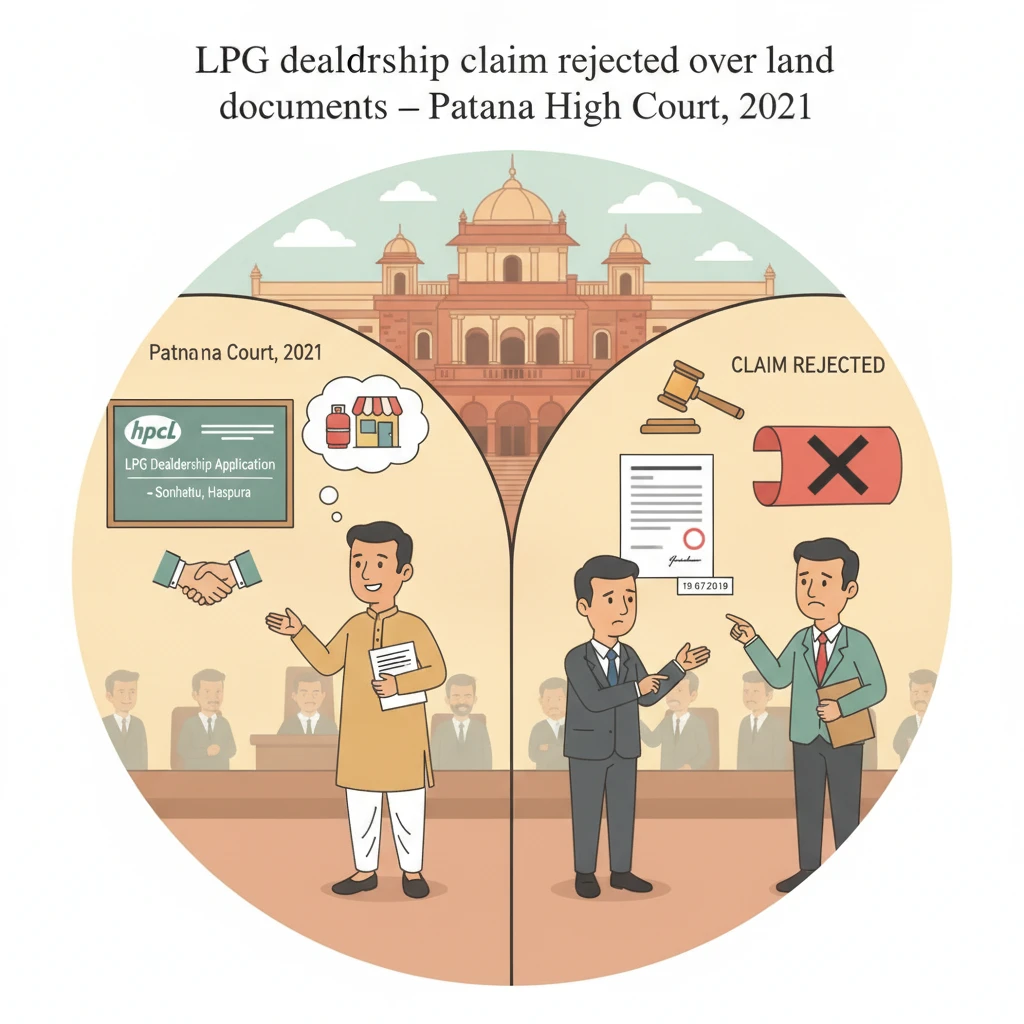
The dispute arose from a public advertisement issued by Hindustan Petroleum Corporation Ltd. (HPCL) on 17.06.2017 and 18.06.2017. The advertisement invited applications for an LPG distributorship for village Sonhathu, under Haspura Block in Aurangabad district.
The petitioner applied on 13.07.2017 under the Scheduled Caste category. A draw of lots was held on 21.12.2017, in which the petitioner was initially unsuccessful.
Later, HPCL conducted a re-draw on 22.06.2019. This time, the petitioner was successful and was selected for the LPG distributorship at the advertised rural location. Following this, the petitioner was called upon to deposit an amount equivalent to 10% of the security deposit (Rs. 20,000) and submit documents for field verification of credentials (FVC). The petitioner complied on 28.06.2019.
During field verification, HPCL found a major problem with the land offered by the petitioner for the showroom. The land did not fall within the advertised village, which was a basic eligibility requirement under the Unified Guidelines for selection of LPG distributors.
On 01.07.2019, HPCL wrote to the petitioner. For the first time, it communicated that the offered showroom land was outside the advertised village. Relying on Clause 18 of the Unified Guidelines, HPCL gave the petitioner an opportunity to provide an alternate plot, subject to strict conditions, including ownership and registration requirements.
In response, the petitioner, by letter dated 17.07.2019, offered another plot and submitted a lease deed executed on a stamp paper of Rs. 1000, dated 11.07.2017. This deed, however, was not registered.
On 19.07.2019, the Chief Regional Manager, HPCL, issued the impugned letter. He informed the petitioner that the unregistered lease deed did not meet the eligibility conditions of the Unified Guidelines, and therefore could not be accepted. At the same time, HPCL granted a last opportunity to offer another alternate land within 15 days, meeting all criteria including registration.
The petitioner did not provide any new registered lease deed within the time given. Instead, he filed the present writ petition in the Patna High Court seeking to quash the letter dated 19.07.2019 and for a direction to HPCL to accept the alternate plot already offered on 17.07.2019.
What the Court Examined and Decided
The Patna High Court, sitting through video conferencing due to the COVID-19 pandemic, examined whether the petitioner fulfilled the mandatory eligibility conditions under the Unified Guidelines for selection of LPG distributors (June 2017).
The core controversy was narrow: could HPCL insist that the alternate land be supported by a registered lease deed that existed on or before the last date of application, and could it reject an unregistered lease deed?
The petitioner’s counsel placed reliance on several clauses of the Unified Guidelines. He highlighted Clause 8, particularly sub-clause (j), dealing with showroom requirements and the opportunity to offer alternate land. The relevant part of Clause 8(j) (as reproduced in the judgment) provides that where the land initially offered for godown or showroom does not meet eligibility at FVC stage, the selected candidate can be given one opportunity of 15 days to offer alternate land, provided that such land is owned by the applicant or eligible family members as on the last date of submission of applications.
The petitioner further relied on Clause 18(b), which deals with the field verification process. This clause allows consideration of alternate land if the land originally mentioned in the application fails eligibility requirements, but only where the applicant has alternate land in his or family members’ names with the date of registration of sale or lease on or before the last date for submission of the application.
In addition, the petitioner cited Clause 1(w) of the Unified Guidelines, which defines “Ownership” or “Own” in relation to godown or showroom. Under this clause, an applicant may either have direct ownership or a registered lease deed for a minimum of 15 years. The lease may commence any day from the date of advertisement up to the last date of submission, or even prior to advertisement, but must be valid for at least 15 years from the date of advertisement.
The petitioner argued that clauses 1(w), 8(j) and 18(b) were in conflict with each other. According to him, Clause 18(b), which speaks about the date of registration being on or before the last date for submission of application, was not mandatory and therefore not binding. He contended that as long as he could furnish a lease deed which commenced before the last date of submission of application, the subsequent registration date should not matter.
The petitioner relied on the Supreme Court decision in K. Vinod Kumar v. S. Palanisamy (2003) 10 SCC 681. He reproduced paragraph 8 of that decision to show that, in some cases, furnishing particulars of land at the time of application could be treated as directory, and that the suitability of land could be demonstrated even after selection. He also referred to Section 47 of the Registration Act, 1908 to argue that registration is only an authentication step and that rights may relate back to an earlier agreed date.
To reinforce his challenge, the petitioner cited a Division Bench judgment of the Calcutta High Court in Chhanda Koley v. Bharat Petroleum Corporation Ltd., contending that relaxation of eligibility conditions was not permissible and that HPCL’s insistence on registration date was arbitrary.
HPCL’s counsel, on the other hand, presented a detailed response based squarely on the text of the Unified Guidelines and the advertisement. He explained that the original advertisement of 17.06.2017 had 18.07.2017 as the last date for applying. The petitioner, fully aware of the terms, applied for the location at village Sonhathu under the SC category.
After the petitioner was selected in the re-draw on 22.06.2019 and deposited Rs. 20,000 on 28.06.2019 as per Rule 17, the FVC process revealed that the land initially offered for the showroom did not fall within the advertised location. Under Clause 8(j), this failure to provide land in the exact advertised village was a clear disqualification.
Therefore, HPCL, by letter dated 01.07.2019, extended the one-time option under Clause 18(b) to offer alternate land, subject to the same ownership and registration requirements that applied to the original land.
The petitioner offered land through an unregistered lease deed dated 11.07.2017 for a 15-year period. HPCL pointed out that the Unified Guidelines required a registered lease deed. Because the lease was unregistered, HPCL held it did not qualify as “ownership” within the meaning of Clause 1(w). HPCL noted that the guidelines were explicit and unambiguous: the candidate must possess registered title or a registered lease for at least 15 years, commencing within the defined window.
As per HPCL, these requirements applied equally to alternate land offered at the FVC stage. Therefore, by letter dated 19.07.2019, HPCL rejected the unregistered lease deed but still granted a final 15-day period to offer another alternate land that fulfilled all criteria. When the petitioner did not avail of this opportunity, HPCL processed the candidature for cancellation.
During the pendency of the writ petition, HPCL cancelled the petitioner’s candidature and, under Clause 26(b) of the Unified Guidelines, forfeited the Rs. 20,000 deposit by letter dated 25.09.2019, communicated on 26.09.2019.
HPCL also relied on a Division Bench judgment of the Patna High Court reported in 2012 (2) PLJR 783, M/s Indian Oil Corporation Limited v. Raj Kumar Jha. In that decision, the Court emphasised that public sector oil companies, being “State” under Article 12 of the Constitution, must act fairly and uniformly. Once standards are laid down in the advertisement, they must be followed without variation, and any deviation would lead to subjective and discriminatory decision-making. Strict adherence to the eligibility conditions was held to be the best way to avoid discrimination.
After hearing both sides, the Patna High Court framed the key question: whether the petitioner had complied with the eligibility conditions prescribed under Clause 18(b), Clause 1(w) and Clause 8(j) of the Unified Guidelines.
The Court observed that these clauses clearly required a candidate to either own the property or have a registered lease deed for a minimum of 15 years, commencing between the date of advertisement and the last date of submission of applications (or earlier, but valid for at least 15 years from the advertisement). The Court noted that the petitioner had admittedly failed to produce any registered lease deed, even after being granted adequate opportunity.
In that situation, the Court held that HPCL had rightly rejected the unregistered lease deed. It found the rejection in line with Clause 1(w) and Clause 18(b) of the Unified Guidelines. The Court also remarked that the petitioner had “unnecessarily made the simple issue complex” by raising irrelevant and ambiguous legal arguments.
On the precedents cited by the petitioner, the Court noted that the Calcutta High Court judgment in Chhanda Koley was actually against the petitioner’s stand. The Calcutta decision held that eligibility conditions could not be relaxed where the candidate did not have compliant land as on the last date of application. Thus, it supported the principle of strict adherence to guidelines.
The Supreme Court decision in K. Vinod Kumar was held to be distinguishable. In the present case, despite being given a fair chance to offer alternate land, the petitioner still did not furnish a registered lease deed, so the mandatory condition remained unmet.
The Patna High Court endorsed the law laid down in Raj Kumar Jha’s case: once a standard is set in the advertisement and guidelines, the Corporation must strictly follow it. Any alteration would amount to a subjective approach and could invite discrimination.
Ultimately, the Court concluded that the writ petition was “thoroughly misconceived” and dismissed it. As a result, HPCL’s cancellation of the petitioner’s candidature and forfeiture of the deposited amount remain in force.
Why This Judgment Matters
This judgment sends a strong signal to applicants for LPG distributorships and other public sector opportunities. The Court has made it clear that eligibility conditions in advertisements and guidelines are not flexible suggestions. They are binding rules.
Applicants cannot rely on unregistered documents or incomplete paperwork and hope to cure defects later through litigation. Where guidelines insist on a registered lease deed, an unregistered deed will not be treated as ownership.
The decision also protects other competing candidates. By insisting that HPCL follow the Unified Guidelines strictly, the Court ensures that no one gets a special relaxation. Everyone has to meet the same standards as on the relevant dates.
For people in rural areas hoping for LPG distributorships, this case underlines the importance of carefully reading the advertisement and ensuring that land documents, ownership, and registration are fully compliant before applying.
Legal Issues and Answers
-
Issue: Whether the petitioner satisfied the mandatory land ownership and registration requirements under Clauses 1(w), 8(j) and 18(b) of the Unified Guidelines for selection of LPG distributors.
Answer: No. The petitioner could not produce a registered lease deed meeting the specified conditions. Therefore, HPCL lawfully rejected his candidature. -
Issue: Whether HPCL could insist that alternate land offered at the FVC stage must also comply with the same registration cut-off and ownership requirements as the original land.
Answer: Yes. The Court held that the conditions applied equally to alternate land, and HPCL was bound to follow the Unified Guidelines without relaxation. -
Issue: Whether HPCL’s rejection of the unregistered lease deed and cancellation of candidature was arbitrary or violated any legal right of the petitioner.
Answer: No. The Court found the action consistent with the Guidelines and earlier judicial precedent, and therefore neither arbitrary nor illegal.
Cases Cited by the Court
- K. Vinod Kumar v. S. Palanisamy & Ors., (2003) 10 SCC 681 (distinguished)
- Chhanda Koley v. Bharat Petroleum Corporation Ltd. & Ors., CAN No. 809/2018, judgment dated 13.09.2018 (Calcutta High Court) (held to go against petitioner’s argument)
- M/s Indian Oil Corporation Limited v. Raj Kumar Jha, 2012 (2) PLJR 783 (Patna High Court, Division Bench) (relied upon)
Case Details
Case Number: Civil Writ Jurisdiction Case No. 16575 of 2019
Case Title: Narottam Raj v. Hindustan Petroleum Corporation Ltd. & Anr.
Citation: 2022 (1) PLJR 352
Court: High Court of Judicature at Patna
Coram: Hon’ble Mr. Justice Mohit Kumar Shah
Date of Judgment: 24.12.2021
For the Petitioner: Mr. Gautam Kumar Kejriwal, Advocate
For the Respondents: Mr. Neeraj Kumar Gupta, Advocate
Nature of the Case: Writ petition (civil) challenging rejection of LPG distributorship candidature and refusal to accept alternate land
Impugned Communication: Letter dated 19.07.2019 issued by Chief Regional Manager, HPCL, Patna Regional Office
Link to Judgment: Click here to access the Patna High Court judgment
If you found this explanation helpful and wish to stay informed about
how legal developments may affect your rights in Bihar,
you may consider following Samvida Law Associates for more updates.







