

Case Background
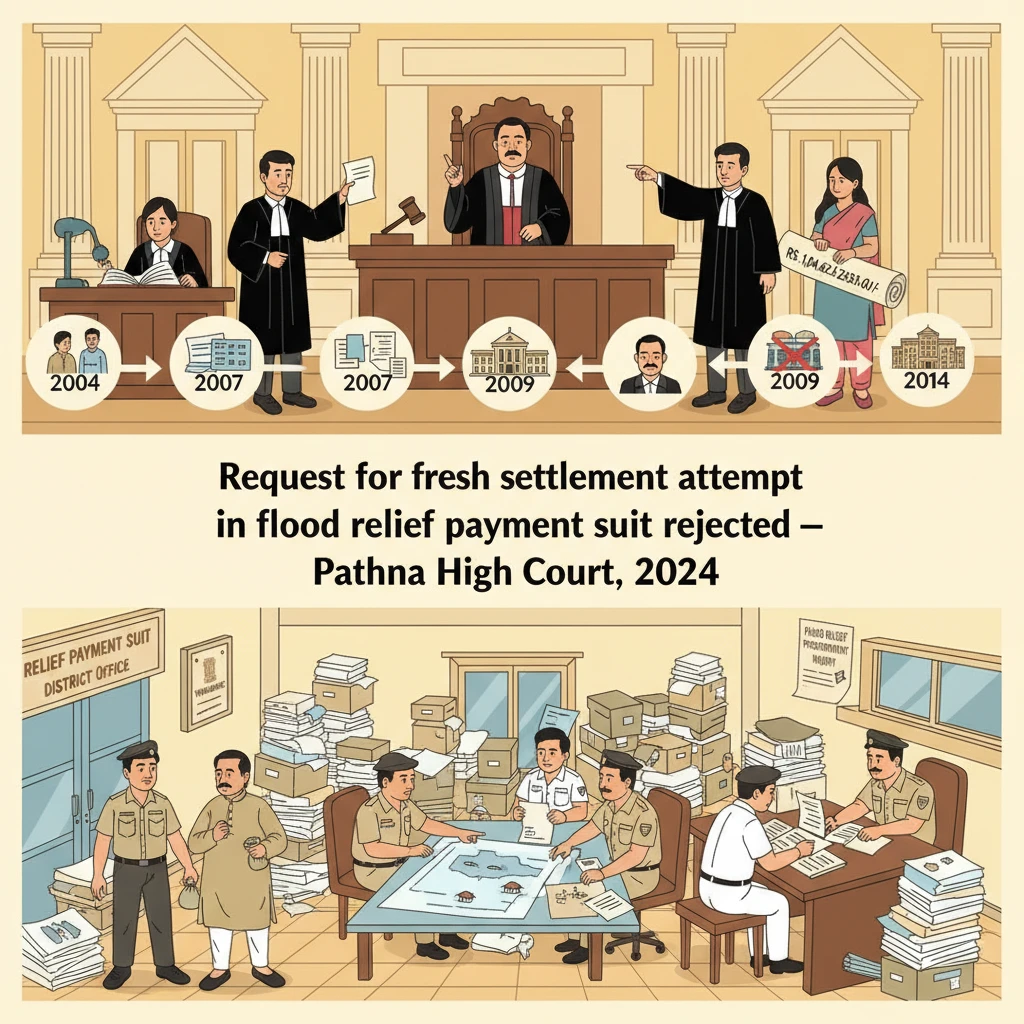
The dispute arises from supplies of foodgrains and other flood relief materials in North Bihar during the devastating floods of 2004. According to the petitioners, one is a proprietorship firm and the other is its proprietor. They claim to have supplied various materials during the flood operation.
The petitioners filed Title Suit No. 5743 of 2014 before the Sub Judge-IV, Patna Sadar. In this civil suit, they claimed that an amount of Rs. 30,97,08,762/- remained due to them towards supplies, along with interest at 18% per annum for delayed payment from the date of supply till the date of filing of the suit.
On this basis, they calculated the total amount allegedly due, including interest till 16.12.2014, at Rs. 1,04,62,52,033.60/-, and also claimed further 18% interest till final adjudication. In short, they asked for a very large money decree against the State and other public authorities.
The background also includes earlier litigation. When disputes about payment and alleged irregularities first arose, the Government conducted an inquiry. It was found that during the 2004 flood operation, materials worth Rs. 7,34,17,863.50/- had been supplied against an advance of Rs. 17.80 crores. Petitioner no. 2 was taken into custody.
The petitioners then approached the Patna High Court in CWJC No. 11974 of 2007. By order dated 28.07.2008, a learned Single Judge directed the Chief Secretary to constitute a team of officials from the concerned departments, including the vigilance department, to scrutinise all papers and come to a concrete finding regarding work done, payment made and payment due, within six months.
Alleging non-compliance with this order, the petitioner filed MJC No. 467 of 2009, a contempt petition. This was disposed of on 29.07.2009, giving liberty to challenge the committee’s decision before an appropriate forum. The petitioner approached the Supreme Court in Special Leave to Appeal (Civil) No. 22759 of 2009, but later withdrew it on 30.11.2009.
The petitioner again moved the High Court in CWJC No. 3332 of 2010. This writ was dismissed on 13.03.2012. An intra-court appeal, LPA No. 594 of 2012, against that dismissal was also withdrawn on 24.09.2013. Thereafter, the petitioners chose to file the present civil suit for recovery of money.
In the suit, the State and other defendants filed a written statement completely disputing the claim. They said the tender for flood relief materials was given to Bihar State Small Industries Corporation Ltd. (BSSICL), a State Government unit, and there was no contract with the petitioners at all. According to the defence, any payment received by the petitioners was liable to be recovered, and two certificate cases were also initiated for that purpose.
After pleadings, the trial court referred the matter for mediation under Section 89 of the Code of Civil Procedure. However, the mediation failed due to non-appearance and non-cooperation of the defendants.
The petitioners then sought early disposal of the suit by filing CWJC No. 24085 of 2018 before the Patna High Court. On 01.02.2023, the Court directed the trial court to dispose of the suit preferably within one year.
As the trial still did not progress, the petitioners again approached the High Court in Civil Miscellaneous Jurisdiction No. 1107 of 2023. On 10.11.2023, a coordinate Bench directed the Sub Judge-IV, Patna Sadar to dispose of all interim applications within one month. Thereafter, the trial court proceeded to frame issues and called upon the plaintiffs to lead evidence.
At this stage, on 11.01.2024, the petitioners moved an application under Order XXVII Rule 5B of the Code of Civil Procedure, asking the trial court to invoke its duty to assist the parties in arriving at a settlement with the Government.
On 16.01.2024, the Sub Judge-IV, Patna Sadar rejected this application. Challenging that order, the petitioners filed the present Civil Miscellaneous Jurisdiction No. 177 of 2024 under Article 227 of the Constitution before the Patna High Court.
What the Court Examined and Decided
The core question before the Patna High Court was narrow. It was not deciding the money claim itself, or whether the petitioners had a valid contract. It had to decide only whether the trial court was wrong in refusing to again send the case for settlement under Order XXVII Rule 5B of the Code.
Order XXVII Rule 5B deals with the duty of courts in suits where the Government or a public officer is a party. Sub-rule (1) says that in such cases, it shall be the duty of the court, in the first instance, to make every endeavour, where possible consistent with the nature and circumstances of the case, to assist the parties in arriving at a settlement.
Sub-rule (2) provides that at any stage, if it appears to the court that there is a reasonable possibility of a settlement, it may adjourn the proceedings to enable attempts to be made to effect such a settlement. Sub-rule (3) clarifies that this is in addition to other powers to adjourn proceedings.
The petitioners argued that these provisions created a mandatory duty on the court. They said the trial court wrongly assumed that, since mediation under Section 89 had earlier failed, any fresh effort would be only a delay tactic.
They pointed out that in the earlier mediation, Government officials had not properly appeared, and therefore no real attempt at settlement had taken place. They insisted that the court should now take active responsibility, summon a responsible Government officer with decision-making power, and try to bring about a reasonable settlement.
The petitioners relied on two Supreme Court judgments: Haryana State & Anr. v. Gram Panchayat Village Kalehari, (2016) 11 SCC 374, and Mohan Kumar v. State of Madhya Pradesh & Ors., (2017) 4 SCC 92. According to them, these decisions clarified that courts must make efforts under Order XXVII Rule 5B before finally deciding cases involving the Government.
The State respondents opposed the petition strongly. They described the suit as frivolous and based on fraud. According to them, tenders for relief materials in Sitamarhi district in June 2004 were opened on 20.06.2004 and the tender of Bihar State Small Industries Corporation Ltd. was accepted.
The State’s stand was that the petitioners had no contract at all. Instead, they allegedly committed fraud by impersonating BSSICL, tampering with tender papers, supplying materials in the name of BSSICL, and getting payments made not to the official BSSICL account but to the account of “Baba Satya Sai Enterprises Corporation Limited”. A sum of Rs. 17.80 crores was allegedly credited there, which should have gone to BSSICL.
Once this alleged fraud came to light, Vigilance P.S. Case No. 08 of 2005 was lodged and petitioner no. 2 was sent to jail. The State also argued that the petitioner had already lost up to the Supreme Court in related matters, including the withdrawal of SLP No. 22759 of 2009, and had concealed material facts.
They maintained that there was no possibility of any settlement, especially when the petitioners had, according to them, supported their case on false and fraudulent documents. In their view, the fresh application under Order XXVII Rule 5B, made only after the stage of plaintiff’s evidence was reached and after several earlier litigations, was a tactic to prolong the suit.
Justice Arun Kumar Jha examined the language of Order XXVII Rule 5B closely. On sub-rule (1), the Court held that while there is a duty cast on the court to make an endeavour to assist in settlement, this is not a blanket or unconditional duty. The text itself states that such endeavour is to be made “in the first instance” and only “where it is possible to do so consistently with the nature and circumstances of the case”.
In this suit, the trial court had already referred the matter for mediation under Section 89 of the Code at an earlier stage. That amounted to the “first instance” attempt contemplated by sub-rule (1). Therefore, the requirement under sub-rule (1) had been satisfied.
Turning to sub-rule (2), the Court noted that this clause is also qualified. Settlement efforts at any later stage are to be made only “if it appears to the court that there is a reasonable possibility of a settlement between the parties”. The Court emphasised that it is not a “carte blanche” mandating the court to push for settlement in every case merely because the Government is a party.
The judgment explained that settlement requires mutuality and a meeting of minds. There must be some common ground between the parties. If there is complete denial of the claim or serious allegations like fraud and impersonation, the possibility of settlement may be minimal or non-existent. In such situations, forcing settlement attempts would be purposeless and only delay the trial.
Applying this understanding to the facts, the Court observed that the State had completely denied the petitioners’ claim. More than that, a criminal vigilance case alleging fraud and impersonation was on record. In these circumstances, the Court asked, where was the scope for any common ground between the parties?
The Court also noted that the suit had already reached the stage of plaintiff’s evidence. The initial stage of the suit had passed, and mediation had already been tried once and failed. For later stages, the statute leaves it to the discretion of the court to adjourn proceedings for settlement attempts only when there is a reasonable possibility of success.
If the court does not see such a reasonable possibility, there is no legal duty on it to adjourn the matter again or initiate further settlement proceedings. Therefore, the trial court had not abdicated any duty by refusing the petitioners’ request.
On the Supreme Court judgments cited by the petitioners, the Patna High Court held that they were distinguishable. Referring to State of Orissa v. Sudhansu Sekhar Misra, AIR 1968 SC 647, Ambica Quarry Works v. State of Gujarat, (1987) 1 SCC 213, and Bharat Petroleum Corporation Ltd. v. N.R. Vairamani, (2004) 8 SCC 579, the Court reiterated that a decision is only an authority for what it actually decides, and its ratio must be read in the context of its own facts.
The High Court concluded that the facts of the present case – complete denial of liability, serious allegations of fraud, and a failed earlier mediation – were different from the situations in the Supreme Court cases relied upon. Hence, those authorities could not compel a different view.
Ultimately, the Patna High Court held that the trial court had committed no error of jurisdiction. The impugned order dated 16.01.2024 in Title Suit No. 5743 of 2014 was found to be correct and proper in the circumstances. Consequently, the civil miscellaneous petition under Article 227 was dismissed and the trial court’s order was affirmed.
Why This Judgment Matters
This judgment is important for anyone who sues the Government or public officials and hopes for a court-driven settlement. It explains that the Patna High Court will not force repeated settlement exercises when the record shows no realistic chance of compromise.
For contractors, suppliers and small businesses, it shows that merely pointing to Order XXVII Rule 5B is not enough. The court will look at the nature of the dispute, the stand of the Government, and whether any common ground exists.
Where the State completely denies liability and alleges fraud, courts may treat the case as one that needs full trial, not compromise efforts. At the same time, the judgment confirms that an initial attempt at settlement, such as mediation under Section 89, can satisfy the “first instance” duty under Rule 5B(1).
Practically, this decision signals that litigants cannot use repeated settlement requests as a tool to delay suits already fixed for evidence, especially after higher courts have ordered early disposal.
Legal Issues and Answers
Issue: Was the trial court wrong in refusing to again invoke Order XXVII Rule 5B of the Code of Civil Procedure and attempt a settlement between the petitioners and the State?
Answer: No. The Patna High Court held that the trial court had already made an initial settlement effort through mediation, and given the complete denial of the claim and serious fraud allegations, there was no reasonable possibility of settlement. Therefore, no further duty arose to adjourn the suit for compromise.
Cases Cited by the Court
- Haryana State & Anr. v. Gram Panchayat Village Kalehari, (2016) 11 SCC 374 – cited by petitioners; held distinguishable.
- Mohan Kumar v. State of Madhya Pradesh & Ors., (2017) 4 SCC 92 – cited by petitioners; held distinguishable.
- State of Orissa v. Sudhansu Sekhar Misra, AIR 1968 SC 647 – relied on for principle that a decision is authority only for what it decides.
- Ambica Quarry Works v. State of Gujarat, (1987) 1 SCC 213 – relied on to stress that ratio must be read in the background of case facts.
- Bharat Petroleum Corporation Ltd. & Anr. v. N.R. Vairamani & Anr., (2004) 8 SCC 579 – relied on to caution against treating judgments like mathematical theorems.
Case Details
Case Number: Civil Miscellaneous Jurisdiction No. 177 of 2024
Case Title: M/s Santosh Printing Press & Anr. v. The State of Bihar & Ors.
Coram: Hon’ble Mr. Justice Arun Kumar Jha
Citation: 2024 (4) PLJR 689
Advocates for Petitioners: Mr. Santosh Kumar, Advocate; Mr. Sanjeev Ranjan, Advocate; Mr. Prafulla Ranjan Tiwary, Advocate; Mr. Madhunendra Sharma, Advocate; Ms. Aastha Ananya, Advocate
Advocates for Respondents: Mr. Mujtabaul Haque, G.P.-12; Mr. Manish Kumar, A.C. to G.P.-12
Nature of the Case: Civil miscellaneous petition under Article 227 of the Constitution challenging an interlocutory order in a money recovery title suit, concerning refusal to initiate settlement under Order XXVII Rule 5B of the Code of Civil Procedure.
Link to Judgment: Full text of Patna High Court judgment
If you found this explanation helpful and wish to stay informed about
how legal developments may affect your rights in Bihar,
you may consider following Samvida Law Associates for more updates.







