

Case Background
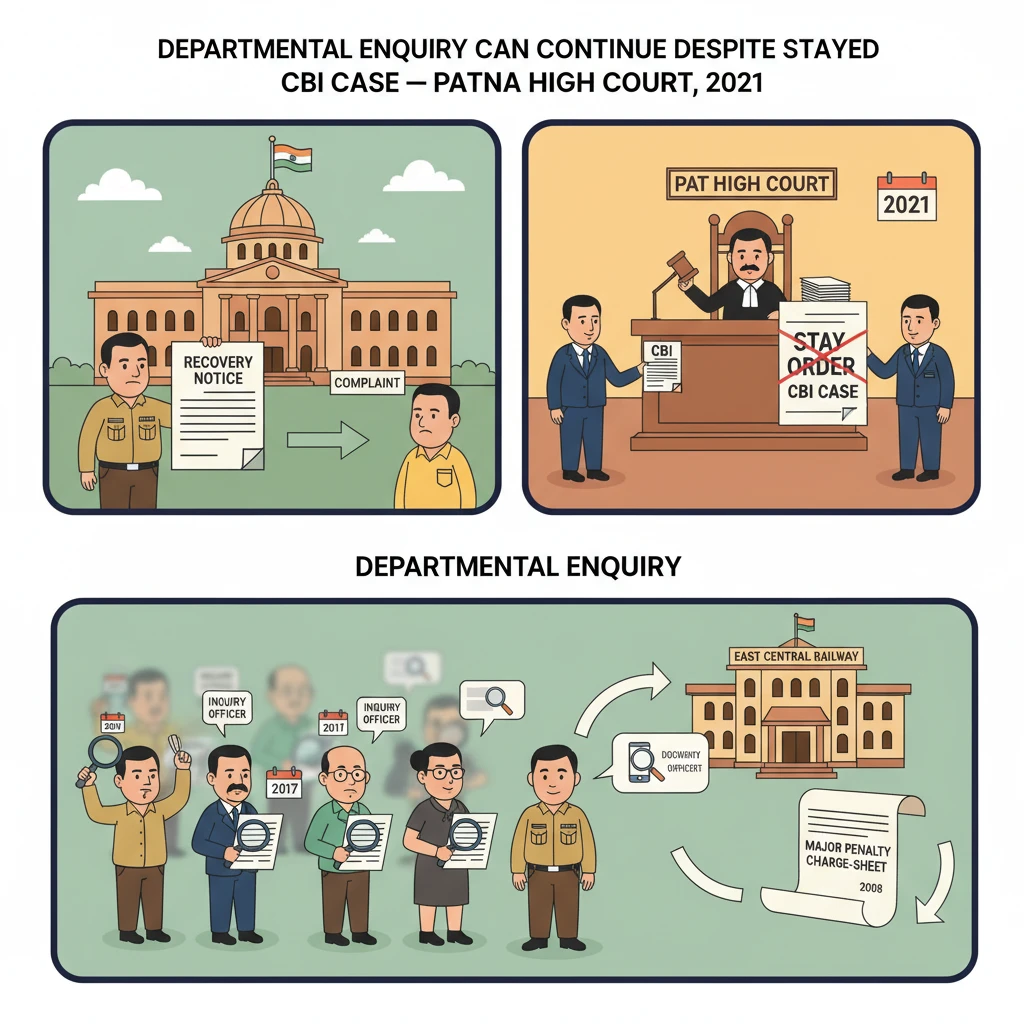
The petitioner is a senior officer of the Indian Railways. He joined the Indian Railway Service as a Mechanical Engineer after clearing the Indian Engineering Services examination and was posted in East Central Railway on 13.06.2005.
According to the petitioner, while working in the Railways he detected that an erroneous agreement in favour of a contractor, one Sri Anand Raj, had led to excess payment of about Rs. 16 lakhs under a vehicle contract. He claims that he initiated steps for recovery, and that after due procedure around Rs. 34 lakhs was ultimately recovered from the contractor.
The petitioner alleges that, annoyed by this recovery, the contractor, in connivance with the CBI, filed a complaint against him on 15.05.2007, accusing him of demanding a bribe. The matter was entrusted to a CBI Inspector, who submitted a verification report. On this basis an FIR was lodged, and the petitioner was arrested and sent to judicial custody. He later obtained bail from the Patna High Court in Cr. Misc. No. 27616 of 2007.
On 30.07.2008, the CBI filed a charge-sheet before the CBI court. By order dated 09.08.2008, that court refused to take cognizance for want of pre-trap and post-trap memoranda. However, on 11.09.2008, the CBI court took cognizance after the CBI supplied such memoranda. The petitioner claims these documents were concocted.
He challenged the order taking cognizance in Cr. Misc. No. 8861 of 2009, which was dismissed with liberty to seek discharge before the trial court. His discharge petition was rejected on 20.02.2013. He then filed Cr. Misc. No. 14016 of 2013 seeking quashing of the FIR. In that proceeding, by order dated 23.06.2016, the Patna High Court stayed further proceedings in the CBI Special Case No. 08 of 2007 arising out of R.C. No. 12(A) of 2007 and admitted the matter for hearing.
In the meantime, on 19.12.2008, respondent no. 2 (the General Manager, East Central Railway) issued a major penalty charge-sheet against the petitioner on the same set of allegations. The petitioner repeatedly asked for supply of certain documents, especially the CBI verification report and mobile/phone numbers allegedly used in the demand and acceptance of bribe. He sent representations dated 06.08.2009, 29.10.2009 and 25.01.2010, but these documents were not supplied.
Several Inquiry Officers were appointed and replaced over the years. The first Inquiry Officer was appointed on 15.05.2010. Thereafter, from 2011 to 2017, at least five more Inquiry Officers were changed. Some held a few hearings or preliminary enquiries; others were replaced before conducting any effective enquiry.
Even as Inquiry Officers changed, the requested CBI-related documents were not given to the petitioner. On 07.12.2017, the then Inquiry Officer held a preliminary enquiry. The petitioner again requested the same documents from respondents no. 2 and 3, but instead of supplying them, the next date of enquiry was fixed for 10.01.2018.
Feeling aggrieved, the petitioner approached the Central Administrative Tribunal, Patna Bench, by filing O.A. No. 050/77/2018. His main plea was that since the High Court had already stayed the criminal proceedings in Cr. Misc. No. 14016 of 2013, the departmental enquiry on the same allegations ought to be stayed.
On 18.01.2018, the Tribunal directed the petitioner to file a representation before the Disciplinary Authority for stay of the departmental proceedings in light of the High Court’s stay of the criminal case. The petitioner filed a detailed representation on 25.01.2018. On 15.02.2018, the Tribunal directed the Railway’s counsel to take instructions on that representation.
On 27.03.2018, acting on the petitioner’s representation, the Disciplinary Authority (respondent no. 2) passed an order staying the departmental enquiry till the outcome of the criminal case. Based on this order, the petitioner withdrew O.A. No. 050/77/2018.
More than a year later, on 16.05.2019, the Disciplinary Authority issued another order directing the Inquiry Officer to proceed with the departmental enquiry, thereby vacating the earlier stay.
The petitioner challenged this fresh order before the Tribunal again through O.A. No. 00595 of 2019, in which interim stay was granted on 07.06.2019. However, by final order dated 16.02.2021, the Tribunal rejected his claim and permitted the departmental enquiry to go on. It is this Tribunal order and the underlying order dated 16.05.2019 which were assailed before the Patna High Court in Civil Writ Jurisdiction Case No. 9204 of 2021.
What the Court Examined and Decided
The central question before the Patna High Court was narrow but important: could the Disciplinary Authority, having once stayed the departmental enquiry on 27.03.2018, later resume it by the order dated 16.05.2019 without any power of review or revision expressly provided in the service rules?
The petitioner argued that the Disciplinary Authority acts as a quasi-judicial authority in disciplinary matters. Once he passes an order, he becomes functus officio, meaning his authority over that matter is exhausted. He cannot withdraw, alter or review his own earlier order unless a specific statutory provision permits such review.
To support this, the petitioner relied on three judgments:
First, a Patna High Court decision in Union of India v. Smt. Pushpa Rani, 2017 (4) PLJR 739. There, it was held that if the punishment has already been fixed or advised by another authority, there is no occasion for the disciplinary authority to apply an independent mind.
Second, the Supreme Court decision in SBI v. S.N. Goyal, (2008) 2 SCC (L & S) 678, which discusses when an authority becomes functus officio after passing a quasi-judicial order.
Third, a Full Bench decision of the Patna High Court in Nand Kumar Thakur v. State of Bihar, 2014 (4) PLJR 210 (FB), which held that no court, tribunal or quasi-judicial authority has inherent power to review its own order. Review or revision can be exercised only if the law expressly provides such power, except for correcting accidental, typographical or clerical errors.
On facts, the petitioner emphasised that the stay of departmental proceedings was granted in compliance with judicial orders of the Tribunal, and that the later order resuming enquiry was based on advice of the Central Vigilance Commission (CVC), not on an independent judicial mind. He also complained of long delay, multiple changes of Inquiry Officers and non-supply of important defence documents, arguing that his promotions were being negatively affected.
The Railways, on the other hand, contended that the allegation of bribery was grave and it was vital to conclude the departmental enquiry without further delay. They argued that the petitioner was trying to block the enquiry by repeatedly seeking stay, even though there is no absolute legal bar on holding departmental and criminal proceedings simultaneously.
The respondents pointed out that under Rule 25 and Rule 25A of the Railway Servants (Discipline & Appeal) Rules, 1968, revisional or review powers are available only after a final order imposing penalty has been issued by the Disciplinary Authority and affirmed by the Appellate Authority. Those provisions do not apply here, because no final order had been passed; only the enquiry process was being managed.
They submitted that orders dated 27.03.2018 (granting stay) and 16.05.2019 (resuming enquiry) were not quasi-judicial decisions but administrative orders regulating the conduct of the enquiry. Such interim, administrative decisions do not make the authority functus officio.
The respondents also argued that the Tribunal had rightly held, in para 14 of its order dated 16.02.2021, that these orders were administrative in nature. Both orders were communicated through the Deputy CPO/Gaz, GM(P) office, East Central Railway, in a format typical of administrative communications.
To support their stand that departmental and criminal proceedings can run together, the Railways referred to Supreme Court decisions in State of Rajasthan v. B.K. Meena, (1996) 6 SCC 417; State Bank of India v. Neelam Nag, (2016) 9 SCC 491; and Stanzen Toyotetsu India (P) Ltd. v. Girish, (2014) 1 SCC (L & S) 641.
The High Court first examined whether the petitioner’s precedents applied. It held that Union of India v. Pushpa Rani was not applicable because the CVC, by Circular No. 814/2018 dated 31.07.2018, had issued guidelines that simultaneous proceedings (departmental and criminal) could run together. This circular relied on Supreme Court judgments and Department of Personnel & Training guidelines. Acting on this, the Disciplinary Authority vacated the stay, which was different from the situation in Pushpa Rani.
Similarly, SBI v. S.N. Goyal was held inapplicable because, in the petitioner’s case, the Disciplinary Authority had not yet passed any final order in the departmental enquiry. The orders dated 27.03.2018 and 16.05.2019 were described as administrative, not quasi-judicial.
The Full Bench decision in Nand Kumar Thakur was also distinguished on the same basis: the Disciplinary Authority had not delivered a final decision on guilt or punishment; he had merely passed an interim order about staying and then resuming the enquiry.
The Court then discussed the law on simultaneous departmental and criminal proceedings. It quoted at length from A.P. SRTC v. Mohd. Yousuf Miya, (1997) 2 SCC 699, explaining that departmental enquiries and criminal prosecutions serve different purposes. Criminal law protects society by punishing offences; departmental proceedings maintain discipline and efficiency in service. The standard of proof and rules of evidence differ significantly between the two.
Relying on Karnataka SRTC v. M.G. Vittal Rao, (2012) 1 SCC 442, the Court recited four key principles: there is no legal bar to simultaneous proceedings; stay of departmental enquiry is justified only to protect the employee’s defence in complex cases; such stays should not be used to delay enquiries; and normally, departmental proceedings can go on even when a criminal trial is pending, except in rare cases where facts and evidence are identical and complex.
The Court further cited Capt. M. Paul Anthony v. Bharat Gold Mines Ltd., (1999) 3 SCC 679, where the Supreme Court held that departmental and criminal proceedings may proceed together, and that even if a departmental proceeding was earlier stayed because of a pending criminal case, it can be resumed if the criminal trial does not move ahead or is unduly delayed.
Applying these principles, the High Court noted that in the present case the criminal trial had been stayed since 23.06.2016, and therefore was not progressing. In such a scenario, as already recognised in M. Paul Anthony, the departmental enquiry could validly be resumed.
The Court then analysed the concept of functus officio in the context of disciplinary proceedings. It explained that a departmental enquiry begins with the service of a charge memo and ends only with the final award of punishment or exoneration or dropping of charges. Throughout this period, the Disciplinary Authority must take numerous decisions at different stages—such as appointing or changing an Inquiry Officer or Presenting Officer, or ordering a de novo enquiry.
If, every time such interim decisions were taken, the Disciplinary Authority became functus officio, it would be impossible to manage the enquiry. In the instant case itself, six Inquiry Officers had already been changed. Such interim management decisions could not be treated as final quasi-judicial decisions.
The Court held that only a final order awarding punishment or exoneration can render the Disciplinary Authority functus officio. Orders to stay or resume departmental proceedings are merely administrative steps and are not an exercise of quasi-judicial power.
The Court also noted that the only valid basis to seek stay of departmental proceedings is where continuation of the enquiry would prejudice the defence of the employee in the criminal case, and that too usually in cases involving complicated questions of law and fact. Such a plea cannot be allowed to indefinitely delay disciplinary proceedings.
The Court observed that criminal and departmental proceedings are entirely different. In criminal law, the prosecution must prove guilt beyond reasonable doubt; in disciplinary proceedings, findings are based on preponderance of probability under service rules. It further observed that even acquittal in a criminal case on the same set of charges does not automatically shield a delinquent employee from departmental action.
After considering the facts, documents and legal principles, the Court concluded that the Disciplinary Authority’s order dated 16.05.2019, directing the Inquiry Officer to proceed with the enquiry, was legal. Consequently, it upheld the Tribunal’s order dated 16.02.2021 rejecting the petitioner’s claim. The writ petition was dismissed.
Why This Judgment Matters
This judgment has practical importance for government and public sector employees, especially those in Railways, who face both departmental action and criminal cases on similar facts.
First, it clarifies that once a criminal case is stayed or delayed, employees cannot rely on that stay to indefinitely block departmental enquiries. The employer can resume the enquiry to maintain discipline and decide the service fate of the officer.
Second, it explains that not every order by a Disciplinary Authority is a quasi-judicial order. Interim decisions like staying or restarting an enquiry are seen as administrative. Therefore, they can be changed if circumstances require, without invoking special review powers.
Third, the ruling reinforces Supreme Court law that departmental and criminal proceedings serve different purposes, involve different standards of proof, and can generally continue together. Only in rare, complex cases, and for genuine protection of the employee’s criminal defence, can a stay of departmental proceedings be justified.
For employees and unions, this means that long-pending criminal cases or stays from criminal courts do not automatically freeze departmental matters. For departments, it provides legal backing to complete enquiries promptly rather than waiting indefinitely for criminal trials.
Legal Issues and Answers
-
Issue: Can a Disciplinary Authority who has stayed a departmental enquiry later resume the enquiry without a specific statutory power of review, or is he functus officio after the first order?
Answer: The Patna High Court held that orders staying or resuming departmental proceedings are administrative and interim, not final quasi-judicial orders. The Disciplinary Authority does not become functus officio by passing such orders and can validly resume the enquiry. -
Issue: Must a departmental enquiry be kept in abeyance when a criminal case on similar allegations is pending and has been stayed by the High Court?
Answer: No. Relying on Supreme Court precedents, the Court held that there is no legal bar to simultaneous proceedings. Where the criminal case is stayed or delayed, the departmental enquiry can be resumed and taken to conclusion, unless continuing it would seriously prejudice the employee’s defence in a complex criminal case. -
Issue: Are the precedents on lack of power of review by quasi-judicial authorities applicable to interim orders like the stay and resumption of departmental proceedings in this case?
Answer: The Court held they are not applicable. Those precedents concern review of final quasi-judicial decisions on guilt or punishment, whereas here only interim, administrative orders regulating the enquiry were involved.
Cases Cited by the Court
- A.P. State Road Transport Corporation v. Mohd. Yousuf Miya, (1997) 2 SCC 699 : 1997 SCC (L & S) 548
- Karnataka State Road Transport Corporation v. M.G. Vittal Rao, (2012) 1 SCC 442 : (2012) 1 SCC (L & S) 171
- Capt. M. Paul Anthony v. Bharat Gold Mines Ltd., (1999) 3 SCC 679 : 1999 SCC (L & S) 810
- State of Rajasthan v. B.K. Meena and others, (1996) 6 SCC 417
- State Bank of India and others v. Neelam Nag and another, (2016) 9 SCC 491
- Stanzen Toyotetsu India (P) Ltd. v. Girish, (2014) 1 SCC (L & S) 641
- Union of India v. Smt. Pushpa Rani, 2017 (4) PLJR 739
- SBI v. S.N. Goyal, (2008) 2 SCC (L & S) 678
- Nand Kumar Thakur v. State of Bihar and others, 2014 (4) PLJR 210 (FB)
Case Details
Case Number: Civil Writ Jurisdiction Case No. 9204 of 2021
Case Title: Ugrasen v. Union of India & Anr.
Coram: Hon’ble Mr. Justice Vikash Jain and Hon’ble Mr. Justice Anjani Kumar Sharan
Citation: 2022 (1) PLJR 19
Date of Judgment: 02.12.2021
Advocates:
- For the petitioner: Mr. M.P. Dixit, Advocate; Mr. S.K. Dixit, Advocate; Mr. Sanjay Kumar Choubey, Advocate; Ms. Swastika, Advocate
- For the respondents: Dr. Anand Kumar, Advocate
Nature of the Case: Writ petition (civil) challenging an order of the Central Administrative Tribunal and the Disciplinary Authority’s decision to resume departmental enquiry.
Link to the Judgment: Click here to read the full judgment on the Patna High Court website
If you found this explanation helpful and wish to stay informed about
how legal developments may affect your rights in Bihar,
you may consider following Samvida Law Associates for more updates.







