
Case Background
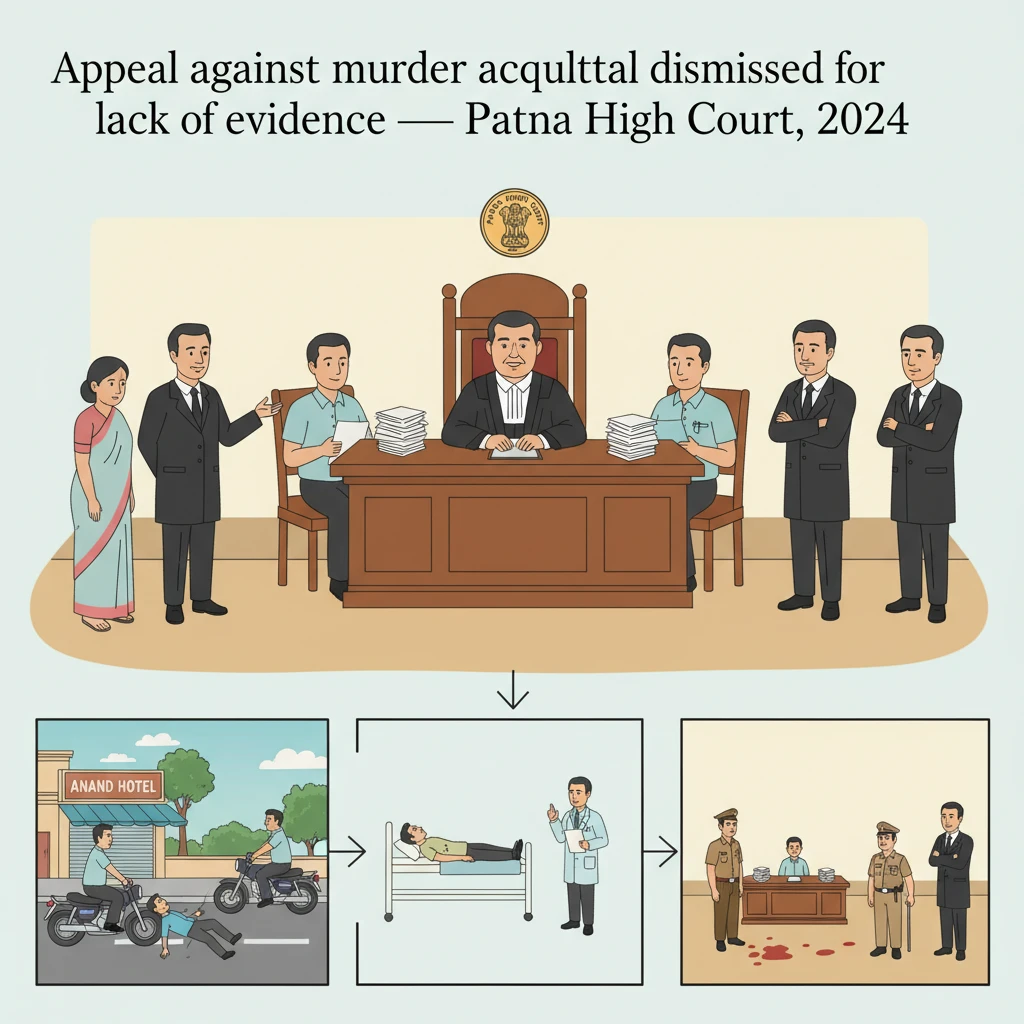
The case arises from the shooting of Ajay Kumar Yadav, a partner in a gas agency at Motihari in East Champaran district. On the date of the incident in 2015, he was returning home from the agency on a motorcycle.
According to the first version recorded in the fardbeyan, the manager of Krishna Gas Agency, Rajesh Kumar Srivastava, was following the deceased on another motorcycle. Near the lane of Anand Hotel, he heard a gunshot and saw the deceased fall from his motorcycle, bleeding from his body. A local petrol pump owner, Sanjay Singh, then took the injured man to the nearest hospital, where his family soon arrived.
On the same day, an FIR was registered as Chhatauni P.S. Case No. 69 of 2015. Initially, offences under Sections 307 and 326/34 of the Indian Penal Code and Section 27 of the Arms Act were recorded. After the victim later died, the case proceeded as a murder case.
The appellant in this criminal appeal is the wife of the deceased. She is the informant and alleged that three private respondents, who were connected with the gas agency, had conspired to get her husband killed by hiring professional killers.
After investigation, different Investigating Officers filed charge-sheets. Some other accused were charge-sheeted first. Later, a charge-sheet was also filed against the three private respondents under Sections 302 and 120(B) of the Indian Penal Code and Section 27 of the Arms Act. As the offences were triable exclusively by the Court of Session, the Chief Judicial Magistrate committed the case under Section 209 of the Code of Criminal Procedure.
The Sessions Trial No. 754 of 2016 (CIS No. 6861 of 2016) was conducted before the Additional Sessions Judge-V, East Champaran at Motihari. The prosecution examined twelve witnesses, including the manager, family members, friends, doctors and Investigating Officers. After recording the statements of the accused under Section 313 of the Code of Criminal Procedure, the trial court acquitted the three private respondents on 12.02.2024.
Aggrieved by this acquittal, the widow filed the present criminal appeal (DB) No. 409 of 2024 before the Patna High Court under the proviso to Section 372 of the Code.
What the Court Examined and Decided
The Division Bench of the Patna High Court, comprising Hon’ble Mr. Justice Vipul M. Pancholi and Hon’ble Mr. Justice Ramesh Chand Malviya, heard the appeal. The oral judgment was delivered by Hon’ble Mr. Justice Ramesh Chand Malviya on 28.08.2024.
The appellant’s counsel argued that the three private respondents, along with other accused persons, had hatched a conspiracy to murder the deceased. It was alleged that the private respondents were the main conspirators and assailants, and that they hired professional killers to execute the murder.
The appellant’s case was that Opposite Party No. 2 was the partner of the deceased in a gas agency. According to the prosecution witnesses, his sons (Opposite Party Nos. 3 and 4) later began to interfere in the day-to-day business of the agency. They were alleged to have started illegal black-marketing of gas cylinders. The deceased reportedly objected to these activities. The appellant claimed that, due to this objection, Opposite Party Nos. 2 to 4 decided to eliminate him and hired criminals for that purpose.
It was also contended on behalf of the appellant that confessional statements of other accused persons before the police supported this version. The appellant’s side further submitted that Call Detail Records (CDR) collected during investigation showed that four lakh rupees had been paid for the murder, and that deposition of witnesses supported the prosecution case.
The High Court carefully examined the evidence of the twelve prosecution witnesses as summarised in the judgment.
PW-1, the manager Rajesh Kumar Srivastava, was projected as the eyewitness. In his examination-in-chief, he stated that near Anand Hotel he heard a gunshot and saw the deceased fall from his motorcycle. However, in cross-examination, he admitted that he did not see who fired the shot. He also said there was no dispute between the deceased and Opposite Party No. 2. He confirmed that at the time of giving fardbeyan, only the father-in-law of the deceased was present, and the wife and brother were not there.
PW-2, the deceased’s father-in-law, stated in examination-in-chief that the gas agency had been run jointly by the deceased and Opposite Party No. 2 as partners for about 20 years and that they had good relations earlier. According to him, Opposite Party No. 2 later started black-marketing of gas and, due to the deceased’s objection, Opposite Party Nos. 2 to 4 hatched a plan to kill him. However, in cross-examination, he admitted that he got information about the death of the deceased through a newspaper, indicating he was not present at the scene or at the hospital at the crucial time.
PW-3 stated that he saw a gathering near Anand Hotel after the deceased was shot and spoke about the relationship between the deceased and Opposite Party No. 2. But in cross-examination he admitted that he did not see any blood spot at the place of occurrence and had no knowledge about the deceased’s motorcycle.
PW-4, the deceased’s brother, gave evidence about disputes in the gas agency. He stated that the sons of Opposite Party No. 2 had begun to interfere in the business and were doing black-marketing of gas. He said that on 08.04.2014 at about 7 p.m., the deceased called him and informed him that Mithilesh Kumar Rai and Rajiv Kumar Rai and some unknown persons were moving around the gas agency. Later he was informed that his brother had sustained a gunshot injury and was admitted in Rahmania Hospital, and that he later died in Patna. He accused Opposite Party Nos. 2 to 4 of hiring criminals to commit the murder. However, he too was not an eyewitness to the shooting.
PW-5, a friend of the deceased, stated only that there was a dispute between the deceased and Opposite Party No. 2 and that Opposite Party Nos. 2 to 4 were planning to grab the gas agency and kill the deceased. PW-6 similarly spoke about interference by Opposite Party Nos. 2 to 4 in the gas agency business and alleged that they had murdered the deceased by hiring criminals. Both were not eye witnesses.
PW-7, Dr. Tabrez Aziz, described the injuries found when he examined the injured person at 10.05 p.m. on 08.04.2015 at a hospital in East Champaran. He recorded entry and exit wounds on the skull and opined that the injuries were caused by a firearm within six hours prior to examination. In cross-examination, he admitted that he did not receive any written police requisition, that the colour of the injuries was not mentioned, and that there was no signature or thumb impression of the injured on the injury report.
PW-8, the wife of the deceased and appellant in this case, was not an eyewitness. She spoke about disputes between her husband and Opposite Party No. 2, alleged interference by Opposite Party Nos. 3 and 4 in the gas agency, illegal black marketing, and a panchayati held to resolve the dispute.
PW-9, Dr. Pankaj Kumar of the FMD Department, PMCH, Patna, conducted post-mortem on 15.04.2015. He found ante-mortem injuries including a firearm entry and exit wound on the scalp, surgical trephining over the skull, and sub-dural haematoma with lacerated brain matter. He opined that death occurred 6 to 24 hours prior to the post-mortem and that the cause of death was head injury caused by firearm violence. In cross-examination, he said the dead body came from Udyan Hospital with bandages and that details of treatment duration, age of haematoma, or colour of injuries were not recorded in the post-mortem report.
PW-10, Subodh Kumar, an SHO, stated that he took over investigation on 30.06.2015 and submitted charge-sheet against some other accused (Ravi Kumar Sahani, Sudama Sahani, Rajan Sahani, Krishna Yadav and Chandan Ram). He said he obtained CDR of the mobile number of Girja Nandan Rai but “found no clue.” He also stated that he found no evidence of black marketing of gas cylinders, and that there was no interference by Girja Nandan Rai and his sons in the gas agency.
PW-11, the third Investigating Officer, stated only that he filed charge-sheet against the present private respondents on 27.04.2016 under Sections 302, 120(B) IPC and Section 27 of the Arms Act.
PW-12, Dhananjay Kumar, the first Investigating Officer, narrated that he went to Rahmania Hospital and then to the spot near Anand Hotel, where he found blood stains. He arrested accused Ravi Sahani and Sudama Sahani and recorded their confessional statements. He collected the inquest report and seized some clothes of the deceased. In cross-examination, he admitted that although a mobile phone was recovered from accused Ravi Sahani, he did not obtain CDR of that mobile. He further stated that he did not take CDR of phones of accused Ravi Kumar, Krishna Yadav and Sudama Sahani to link them with the private respondents. Importantly, he said that accused Girja Nandan Rai and his two sons had not made any interference in the gas agency business, and that no complaint by the deceased had been received against them.
After reviewing all this material, the High Court held that Opposite Party Nos. 2 to 4 had been dragged into the case only on the basis of confessional statements of other accused persons and general allegations made by related and interested witnesses.
The Court noted that PW-1, the only person present near the spot at the time of occurrence, clearly stated that he had not seen who fired the shot. Thus, there was no direct eyewitness connecting the private respondents to the shooting. The Court found that the prosecution failed to establish any direct nexus between Opposite Party Nos. 2 to 4 and the alleged occurrence.
The Bench also observed that the trial court had already discussed the evidence and given detailed reasons for acquitting the private respondents. On reappreciation, the High Court found no error or perversity in that reasoning.
Therefore, the Court concluded that Opposite Party Nos. 2 to 4 could not be held guilty merely on the basis of confessional statements of co-accused and the statements of witnesses which did not establish their involvement. Finding no ground to interfere with the judgment of acquittal dated 12.02.2024, the Division Bench dismissed the appeal at the admission stage itself.
Why This Judgment Matters
This judgment is important for families of victims who seek to challenge acquittals in serious offences like murder. The Patna High Court has made it clear that even in a grave case, an appeal cannot succeed unless there is clear and reliable evidence connecting the accused with the crime.
The Court emphasised that suspicion, even if strong, is not enough. Confessional statements of other accused before the police, and general allegations about business disputes, cannot take the place of solid proof like direct eyewitness account or strong circumstantial links.
For those involved in business disputes, the judgment shows that mere quarrels or allegations of black marketing do not automatically prove conspiracy to murder. The prosecution must still show direct involvement through admissible evidence.
For investigators and prosecutors, the case highlights the need to collect proper electronic and documentary evidence, like CDRs with clear analysis, and to ensure that such material actually links different accused persons. Failure to do so can weaken the case and allow an acquittal to stand, even at the appellate stage.
Legal Issues and Answers
- Issue: Whether the acquittal of Opposite Party Nos. 2 to 4 in the murder case of the gas agency partner should be set aside in appeal under Section 372 of the Code of Criminal Procedure.
Answer: No. The Patna High Court held that there was no direct evidence connecting them with the murder, and that they had been implicated mainly on the basis of confessional statements of co-accused and general allegations, so the acquittal could not be interfered with. - Issue: Whether confessional statements of co-accused persons and statements of interested witnesses, without corroboration, are sufficient to convict alleged conspirators.
Answer: No. The Court found that such material, without direct or reliable circumstantial evidence showing a nexus with the offence, is insufficient to hold the accused guilty. - Issue: Whether the High Court should reappreciate evidence to overturn an order of acquittal when the trial court’s view is reasonably possible on the record.
Answer: The Court affirmed that where the trial court’s reasoning is based on proper appreciation of evidence and is not perverse, the High Court will not interfere and the acquittal will stand.
Cases Cited by the Court
- The judgment text does not mention or rely upon any decided case law. No prior judgments are cited.
Case Details
Case Number: Criminal Appeal (DB) No. 409 of 2024; arising out of Chhatauni P.S. Case No. 69 of 2015, District East Champaran
Case Title: Kaushalaya Devi v. The State of Bihar & Ors.
Citation: 2024 (4) PLJR 201
Coram: Hon’ble Mr. Justice Vipul M. Pancholi and Hon’ble Mr. Justice Ramesh Chand Malviya
Advocates:
- For the Appellant (informant/wife of deceased): Mr. Akashdeep, Advocate; Mr. Shyameshwar Kumar Singh, Advocate
- For the State: Mr. Bipin Kumar, APP
- For Opposite Party Nos. 2 to 4 (private respondents): Mr. Sanjay Kumar, Advocate; Ms. Sangeeta Kumari, Advocate
Nature of the Case: Victim’s criminal appeal (under Section 372 of the Code of Criminal Procedure) against judgment and order of acquittal dated 12.02.2024 passed by the Additional Sessions Judge-V, East Champaran, Motihari, in Sessions Trial No. 754 of 2016 (CIS No. 6861 of 2016), relating to offences under Sections 302 and 120(B) of the Indian Penal Code and Section 27 of the Arms Act.
Link to Judgment: Click here to read the full Patna High Court judgment
If you found this explanation helpful and wish to stay informed about
how legal developments may affect your rights in Bihar,
you may consider following Samvida Law Associates for more updates.







