

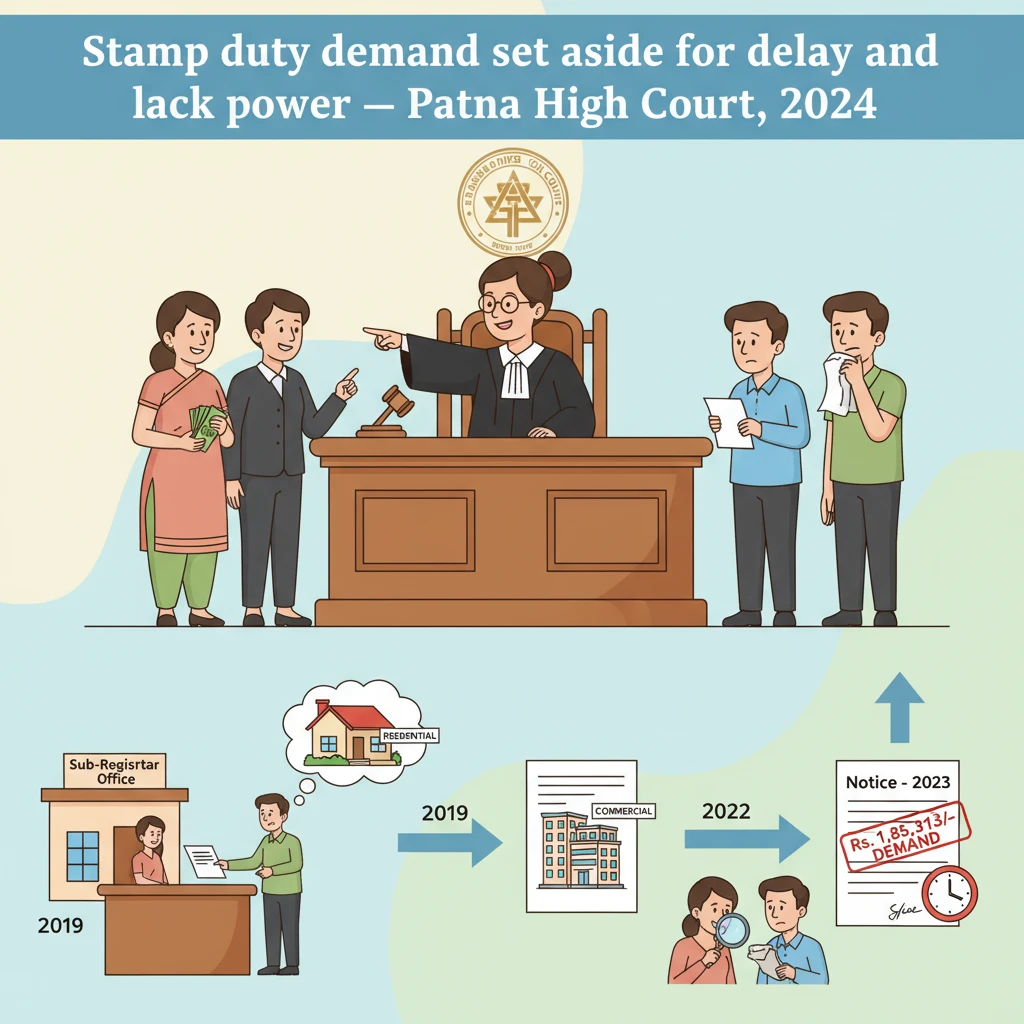
A land buyer challenged an order asking her to pay extra stamp duty and penalty years after her sale deed was registered.
The Patna High Court held that the registration office had no legal power to reopen the case after such delay.
The Court quashed the demand and allowed the writ petition.
The State cannot now recover the alleged deficit stamp duty from this purchaser on that transaction.
Case Background
The petitioner is a purchaser of a small piece of land measuring 10 dhur in Saran district. The land is described as part of Khata No. 271, Plot No. 334, situated at Mohalla Chhota Telpa, Ward No. 36, Holding No. 931.
Her sale deed was registered on 31.08.2019. At the time of registration, she paid the stamp duty and registration charges as calculated then. In the document, she mentioned the land category and the structure on it as “residential”.
For more than three years after registration, nothing adverse appears to have happened. Then, acting on a spot verification, the office of the District Sub-Registrar, Saran at Chapra, took the view that the actual category of the land was different from what was stated in the deed.
On 20.02.2022, this information was sent to the department. Based on this, the District Sub-Registrar referred the matter on 09.05.2022 to the Assistant Inspector General, Registration, Saran Division (respondent no. 4). On this reference, Stamp Case No. 41 of 2022 was started.
In this stamp case, the Assistant Inspector General passed an order dated 09.07.2022. He held that there was deficit stamp duty of Rs. 1,38,046/- and imposed a penalty of Rs. 13,805/-, raising a total demand of Rs. 1,51,851/- against the petitioner.
Later, on 11.11.2023, the petitioner received a notice referring to this order and asking her to deposit an even higher amount of Rs. 1,85,313/- within seven days. The notice stated that the land category should have been treated as “fit for commercial use” and not “residential”.
Feeling aggrieved, the purchaser approached the Patna High Court under its civil writ jurisdiction, seeking to quash the order dated 09.07.2022 and the resulting demand.
What the Court Examined and Decided
The writ petition came up before Hon’ble Mr. Justice Mohit Kumar Shah. The main question was whether the stamp authorities could legally reopen a concluded registration and demand extra stamp duty and penalty after more than two and a half years.
The petitioner’s counsel made two central arguments. First, he submitted that the order dated 09.07.2022 in Stamp Case No. 41 of 2022 had been passed ex parte, meaning behind the petitioner’s back and without issuing her any notice. Secondly, he argued that the very initiation of the proceeding and the reference by the District Sub-Registrar were illegal in terms of Section 47-A of the Indian Stamp Act, 1899 as applicable in Bihar.
He drew the Court’s attention specifically to Section 47-A(1) of the Act. This provision deals with the situation where, while registering an instrument like a sale deed, the registering officer feels that the land classification or the measurement of the structure is wrong, or that the market value mentioned is lower than the Guideline Register of Estimated Minimum Value.
Under Section 47-A(1), the law says that in such a situation, the registering officer “shall refer such instrument before registering it to the Collector” for determination of the proper market value and proper duty payable. The key phrase is “before registering it”. The petitioner stressed that this power is confined to the stage before registration is completed.
In her case, the sale deed had already been registered on 31.08.2019. The District Sub-Registrar made his reference only on 09.05.2022. This was clearly after the registration and after a long delay of more than two and a half years. Therefore, according to the petitioner, the reference itself was outside the authority given by Section 47-A(1) and was void.
To support this interpretation, the petitioner relied on earlier judgments of the Patna High Court. The first was a Division Bench decision in The State of Bihar and others v. Smt. Tetra Devi, reported in 2018 (3) PLJR 136.
In Tetra Devi, the Division Bench had examined similar issues. It held that if the Collector acts on his own (suo motu) about deficiency of stamp duty, he must do so within two years from the date of registration. Where the Sub-Registrar wants to act at the time of registration, he must follow Rules 9 and 10 and cannot make recommendations long after registration, especially when no reference was made at the time of registration itself.
The Division Bench concluded that proceedings started after a long delay suffered from “patent illegality”. The petitioner argued that this reasoning applied squarely to her case.
The second decision relied upon was a co-ordinate Bench judgment in Shahnaz Begam v. The State of Bihar & Ors., reported in 2018 (2) PLJR 293. In that case, the Court had held that the registering authority can refer the matter to the Collector “only before registering it” under Section 47-A(1).
Shahnaz Begam also discussed Section 47-A(3), which gives the Collector a separate power. Under sub-section (3), the Collector may, on his own, within two years from the date of registration, call for and examine an instrument not already referred under sub-section (1). If he finds that the market value has not been properly set forth, he can determine the correct market value and duty. However, this must be done within two years.
In Shahnaz Begam, the Court found that the reference had been made only after registration and beyond the framework permitted by Section 47-A(1). The proceedings were held to be against the statute and were quashed.
On the other side, the State’s counsel argued that spot verification had revealed a mismatch between the land category stated in the deed and the actual position. This discrepancy was informed to the department on 20.02.2022. Following this, the District Sub-Registrar, Saran at Chapra, sent the reference on 09.05.2022 to the Assistant Inspector General, who then initiated Stamp Case No. 41 of 2022 and passed the order dated 09.07.2022 demanding Rs. 1,51,851/- towards deficit stamp duty and penalty.
After hearing both sides and examining the records, the Court focused on two legal aspects: the timing of the reference and the authority to act after registration.
First, the Court noted that there was no dispute on dates. The sale deed had been registered on 31.08.2019. The District Sub-Registrar (respondent no. 5) referred the matter to the Assistant Inspector General (respondent no. 4) only on 09.05.2022. This meant the reference was made after the registration and after more than two and a half years.
Referring to Section 47-A(1) of the Indian Stamp Act, 1899, the Court held that the District Sub-Registrar had no jurisdiction or authority to refer the matter after such a lapse of time. Under this provision, he could have made a reference only before registering the instrument if he had doubts about classification, measurement or market value. Since that did not happen at the time of registration, a later reference under Section 47-A(1) was legally impermissible.
The Court found that the present case was squarely covered by the earlier decision in Shahnaz Begam.
Secondly, the Court examined whether anything could be saved under Section 47-A(3). It observed that if any proceeding was to be started after registration, that could only be done by the Collector or Assistant Inspector General, acting on their own, within two years from the date of registration. They could then call for and examine the instrument to check correctness of market value and duty.
However, in the present case, even this route was not available. The proceedings had been initiated after more than two and a half years from 31.08.2019. Therefore, they were beyond the two-year outer limit set by Section 47-A(3). On this ground also, no proceeding could have been validly initiated against the petitioner to recover deficit stamp duty.
In the result, the Court held that the actions of both the District Sub-Registrar (respondent no. 5) and the Assistant Inspector General, Registration (respondent no. 4) were “not only arbitrary and perverse, but also against the mandate of Section 47-A of the Act, 1899”.
Consequently, the Court quashed the impugned order dated 09.07.2022 passed by the Assistant Inspector General, Registration, Tirhut Division, Saran. With this, the demand for deficit stamp duty and penalty against the petitioner collapsed.
The writ petition was allowed. No further directions were recorded against the petitioner in relation to this stamp duty dispute.
Why This Judgment Matters
This judgment is important for ordinary land buyers in Bihar who fear unexpected government demands years after their sale deed is registered.
The Patna High Court has made it clear that the Sub-Registrar cannot wake up long after registration and send a reference under Section 47-A(1). His power to doubt the valuation must be exercised before registration, not years later.
The Court has also underlined the strict time limit of two years for the Collector or Assistant Inspector General to act on their own under Section 47-A(3). After two years from registration, they cannot legally reopen the question of market value and stamp duty for that document.
This gives some certainty to buyers and sellers. Once the deed is properly registered and two years have passed, parties can be more confident that the stamp duty issue will not suddenly be reopened, unless some other law specifically applies.
Legal Issues and Answers
- Issue: Can the District Sub-Registrar refer a registered sale deed to the Assistant Inspector General under Section 47-A(1) of the Indian Stamp Act, 1899 more than two and a half years after registration, alleging wrong land category and undervaluation?
Answer: No. Section 47-A(1) permits such reference only before registering the instrument. A post-registration reference after such delay is without jurisdiction and illegal. - Issue: Can proceedings for deficit stamp duty on a registered instrument be initiated after more than two years from the date of registration under Section 47-A(3)?
Answer: No. Under Section 47-A(3), the Collector or Assistant Inspector General can act suo motu only within two years of registration. A proceeding started after that period is barred and cannot be sustained. - Issue: Was the demand of Rs. 1,51,851/- towards deficit stamp duty and penalty sustainable against the petitioner on the facts of this case?
Answer: No. The Patna High Court held that the actions of respondent nos. 4 and 5 were arbitrary, perverse and contrary to Section 47-A. The impugned order dated 09.07.2022 was quashed and the writ petition allowed.
Cases Cited by the Court
- 2018 (3) PLJR 136 – The State of Bihar and others v. Smt. Tetra Devi
- 2018 (2) PLJR 293 – Shahnaz Begam v. The State of Bihar & Ors.
Case Details
Case Number: Civil Writ Jurisdiction Case No. 698 of 2024
Case Title: Raj Kumari Devi v. The State of Bihar & Ors.
Citation: 2024 (4) PLJR 53
Court: High Court of Judicature at Patna
Coram: Hon’ble Mr. Justice Mohit Kumar Shah
Date of Judgment: 22.08.2024
Advocates:
- For the petitioner: Mr. Koshalendra Rai, Advocate
- For the respondents: Mr. Vikas Kumar, SC-11; Mr. Rewti Kant Raman, J.C. to SC-11
Nature of the Case: Writ petition challenging order in stamp case demanding deficit stamp duty and penalty under Section 47-A of the Indian Stamp Act, 1899.
Impugned Order: Order dated 09.07.2022 passed by the Assistant Inspector General, Registration, Saran Division in Stamp Case No. 41 of 2022, directing payment of Rs. 1,51,851/- towards deficit stamp duty and penalty.
Final Outcome: Impugned order quashed; writ petition allowed.
Link to Judgment: Patna High Court Judgment in CWJC No. 698 of 2024
If you found this explanation helpful and wish to stay informed about
how legal developments may affect your rights in Bihar,
you may consider following Samvida Law Associates for more updates.







