

Case Background
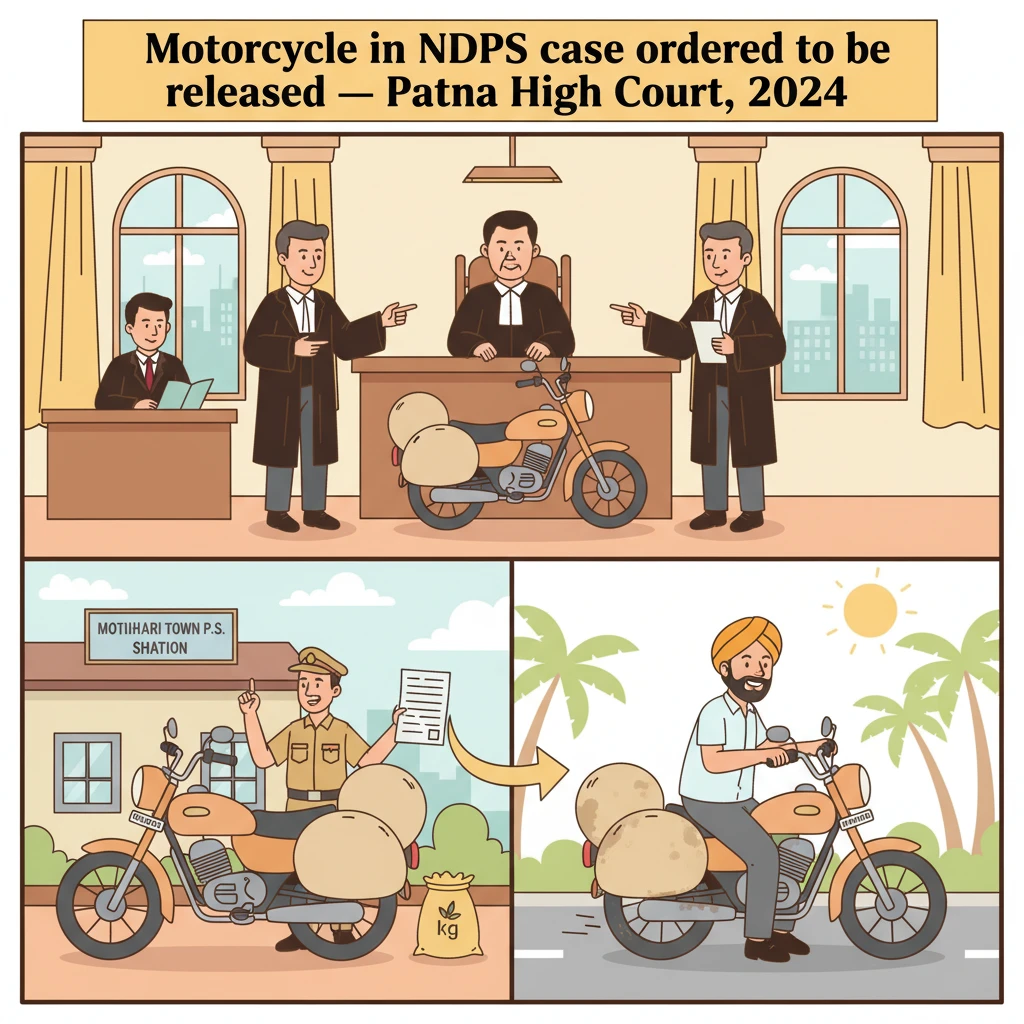
The case arises from Motihari (Town) P.S. Case No. 445 of 2015, East Champaran. In this case, 1 kg of ganja was allegedly recovered from the dickey of a motorcycle bearing registration number BR-22E-4163.
The motorcycle belongs to the petitioner. An NDPS case (NDPS Case No. 32 of 2015) was registered for offences punishable under Sections 20 and 22 of the NDPS Act read with Section 120B of the Indian Penal Code against the petitioner and a co-accused.
The motorcycle was seized in the criminal case. The petitioner moved the Sessions Judge-cum-Special NDPS Court, Motihari, seeking release of the motorcycle in his favour during the pendency of the case.
The police opposed the application, claiming that the motorcycle was liable to confiscation under Section 60 of the NDPS Act. Accepting this stand, the Special Court, by order dated 29.09.2015, rejected the application for release of the seized motorcycle.
The petitioner then approached the Patna High Court under Section 482 of the Code of Criminal Procedure, 1973 (CrPC), challenging the Special Court’s refusal and seeking release of the motorcycle.
What the Court Examined and Decided
The Court noted first that the criminal case was still under investigation. As per the counter affidavit filed by the police, the case against the petitioner was found to be true, but charge-sheet had not been submitted because the petitioner had not been arrested.
The ownership of the motorcycle by the petitioner was not in dispute. The question before the High Court was not about guilt or innocence in the NDPS case but about the legality of keeping the motorcycle seized without releasing it to the owner.
The petitioner’s counsel argued that the Special NDPS Court had misunderstood the law. According to him, release of a vehicle to its owner during investigation, inquiry, or trial does not affect the merits of the criminal case.
He submitted that even if a vehicle is liable to confiscation under the NDPS Act, this is no ground to refuse interim custody to the rightful owner till the case is finally decided. Otherwise, the vehicle remains parked for years, gets damaged and turns into scrap, which benefits nobody and wastes national resources.
The petitioner’s side stressed that courts can impose conditions to ensure that the vehicle is produced whenever needed during investigation, inquiry, trial, or confiscation proceedings. Therefore, the outright rejection of the application for interim release was said to be legally unsustainable.
On the other hand, the learned APP for the State defended the Special Court’s order. He submitted that since the motorcycle was used in the commission of an NDPS offence, it was liable to confiscation under Section 60 of the NDPS Act.
The State argued that there is no provision in the NDPS Act for interim release of vehicles and that Sections 451 and 457 CrPC, which normally deal with custody of seized property, do not apply to Special Courts under the NDPS Act.
In light of these rival stands, the High Court framed two clear legal questions:
First, whether the confiscation provisions in Sections 60 and 63 of the NDPS Act can be a ground to refuse interim release of a vehicle to its rightful owner during investigation, inquiry, trial, or confiscation proceedings.
Second, whether a Special NDPS Court has jurisdiction to pass interim orders releasing vehicles to the rightful owner during the pendency of such proceedings and, if so, what considerations should guide such orders.
The Court then undertook a detailed reading of the relevant statutory provisions.
Section 60 of the NDPS Act deals with liability of illicit drugs, substances, articles, and conveyances (like vehicles) to confiscation when an NDPS offence has been committed. Sub-sections (1) and (2) cover the drugs and related articles.
Importantly, Section 60(3) states that any animal or conveyance used in carrying narcotic drugs or psychotropic substances is liable to confiscation unless the owner proves that it was used without his knowledge or connivance and that he and his agents took all reasonable precautions against such use.
From this, the Court drew a key point: a vehicle can be confiscated only if, after due process, the owner fails to show that he neither knew of nor allowed its illegal use and that he took reasonable care to prevent such misuse.
The Court then considered Section 63 of the NDPS Act, which lays down the procedure for confiscation. Under Section 63(1), at the time of trial of offences under the Act, whether the accused is convicted, acquitted, or discharged, the Court must decide whether any seized article is liable to confiscation under Sections 60, 61, or 62.
Thus, the decision on confiscation is to be taken by the Special Court, and that too only after the stage of conviction, acquittal, or discharge. Confiscation is not to be decided by the police or by a drugs disposal committee on their own.
Section 63(2) further provides that even if the offender is not known or cannot be found, the Court may still inquire into and decide the liability of the article to confiscation. But no order of confiscation can be made until one month has passed from the date of seizure, and without hearing any person who may claim a right over the property and the evidence he produces.
From Sections 60 and 63 read together, the Court concluded that the Special NDPS Court alone decides whether a vehicle is to be confiscated, after giving any claimant an opportunity to show his right and to prove lack of knowledge or connivance.
The Court then turned to Section 52A of the NDPS Act, which deals with disposal of seized narcotic drugs, psychotropic substances, controlled substances, and conveyances. This section empowers the Central Government to frame a procedure for quick disposal, in view of issues like hazardous nature and storage constraints.
The Central Government had issued Standing Orders 1/88, 2/88, and 1/89, later superseded by notifications dated 10.05.2007, 26.03.2013, and 16.01.2015. The 1988 Standing Orders had required court approval for disposal of seized drugs and conveyances.
However, the 2015 Notification changed the position and provided for pre-trial disposal of contraband and conveyances based on inventory and certification by a Magistrate. There was no express requirement of prior approval from the Special Court.
The High Court carefully read this notification along with Sections 60 and 63. It held that the notification cannot be read in isolation. Since Sections 60 and 63 give a right to the owner to be heard on confiscation, pre-trial disposal of a vehicle is permissible under the notification only if nobody claims the vehicle or seeks interim release under those sections.
If anybody comes forward claiming the vehicle and seeking its release, the Special Court must hear him, decide whether the vehicle is liable to confiscation, and act accordingly. If the claimant proves that he is the rightful owner and the vehicle was used without his knowledge or connivance and he took precautions, the vehicle cannot be confiscated or disposed of by the State.
The Court stated that this legal position is not altered even by the Supreme Court’s judgment in Mohan Lal v. Union of India, (2016) 3 SCC 379, which gave directions about handling and disposal of seized contraband drugs to prevent their re-circulation.
The Court recognised that Sections 60 and 63 do not themselves provide for interim release of vehicles during the pendency of trial or confiscation proceedings. To address whether interim release is still possible, the Court looked at Section 36C of the NDPS Act.
Section 36C says that, save as otherwise provided in the NDPS Act, the provisions of the CrPC apply to proceedings before a Special Court, and for such purposes the Special Court is deemed to be a Court of Session. Section 5 CrPC also preserves the application of CrPC to special laws where there is no contrary provision.
On this basis, the Court held that Chapter XXXIV of the CrPC, which includes Sections 451 to 459 relating to custody and disposal of property, applies to NDPS Special Courts so long as it does not conflict with the special Act.
Sections 451 and 457 CrPC are particularly relevant. Section 451 allows a criminal court, during inquiry or trial, to pass orders for proper custody of any property produced before it, and even to sell or dispose of property that is subject to speedy and natural decay.
Section 457 covers the stage of investigation. When property is seized by the police and reported to a Magistrate but not yet produced in court during inquiry or trial, the Magistrate may make orders about its disposal or delivery to the person entitled to possession, or regarding its custody and production.
The Court also referred to the Supreme Court’s landmark judgment in Sunderbhai Ambalal Desai v. State of Gujarat, (2002) 10 SCC 283. In that case, the Supreme Court emphasised that it is pointless to keep seized vehicles in police stations for long periods; such vehicles should be released on suitable bonds and securities to avoid wastage and decay.
Another recent judgment of the Patna High Court, Bhola Singh v. State of Bihar, 2024 SCC OnLine Pat 855, was cited. There, this Court had already held that NDPS Special Courts have power to grant interim custody of seized vehicles to the rightful owner, and that confiscation provisions or seriousness of allegations are not valid reasons to refuse such interim relief.
The Court also referred to several High Court decisions from Karnataka, Chhattisgarh, Punjab and Haryana, Uttarakhand, West Bengal, Madhya Pradesh, and Tripura, all supporting the view that seized vehicles in NDPS cases can be released on interim custody to the owner subject to conditions.
Applying this legal framework to the present case, the Court found that:
One, the motorcycle was seized due to alleged recovery of 1 kg of ganja from its dickey and the case was still under investigation.
Two, the petitioner’s ownership of the motorcycle was not disputed.
Three, there was no case by the police that the seizure had not been reported to a Magistrate. Therefore, the situation was covered by Section 457 CrPC, and the Special NDPS Court had the power to pass orders on interim custody.
Four, mere liability to confiscation under Section 60 NDPS Act was not a bar to grant interim custody of the motorcycle to the petitioner.
Accordingly, the Patna High Court held that the Special Court’s order rejecting release was legally unsustainable. It set aside the impugned order and directed that the motorcycle be released to the petitioner, subject to strict conditions.
These conditions included furnishing a bank guarantee of Rs. 25,000 before the trial court, producing the vehicle before the court whenever required during investigation, inquiry, trial, or confiscation proceedings, not alienating or altering the vehicle, not using it for any offence, and ensuring proper photographing and noting of engine and chassis numbers before release.
With these directions, the criminal miscellaneous petition was allowed.
Why This Judgment Matters
This judgment is important for vehicle owners whose vehicles are seized in NDPS cases in Bihar.
It clearly states that even if a vehicle is alleged to have been used for transporting contraband and may ultimately be liable to confiscation, courts can and should consider releasing it to the rightful owner on interim custody, with safeguards.
The Patna High Court confirms that NDPS Special Courts can use Sections 451 and 457 CrPC to pass such interim orders. This is particularly relevant where investigations drag on and vehicles lie unused for years in police stations or godowns.
For ordinary citizens, this means that if their vehicle is seized, they may approach the Special NDPS Court and seek interim release, showing ownership and offering to abide by suitable conditions. The Court cannot deny release only by pointing to confiscation provisions or seriousness of allegations.
At the same time, the judgment balances the interests of justice by insisting on bank guarantees, undertakings to produce the vehicle, and documentation like photographs and noting of engine and chassis numbers. This protects the trial and possible confiscation proceedings.
Legal Issues and Answers
- Issue: Can the possibility of confiscation under Sections 60 and 63 of the NDPS Act be used to refuse interim release of a seized vehicle to its rightful owner during investigation, inquiry, trial, or confiscation proceedings?
Answer: No. The Patna High Court held that confiscation provisions or seriousness of allegations are not grounds to refuse interim custody to the rightful owner. Confiscation is decided later by the Special Court, after giving the owner a chance to prove lack of knowledge or connivance. - Issue: Does a Special Court under the NDPS Act have jurisdiction to order interim release of a seized vehicle, and what law governs such orders?
Answer: Yes. By virtue of Section 36C NDPS Act and Section 5 CrPC, the provisions of the CrPC apply. Sections 451 and 457 CrPC empower the Special Court to grant interim custody of seized vehicles to the person entitled to possession, subject to conditions, during investigation, inquiry, or trial. - Issue: In this particular case, was the petitioner entitled to interim release of the seized motorcycle?
Answer: Yes. Since the petitioner’s ownership of the motorcycle was undisputed, the case was at investigation stage, and the requirements of Section 457 CrPC were met, the High Court set aside the Special Court’s refusal and directed release of the motorcycle to the petitioner on specified conditions.
Cases Cited by the Court
- Sunderbhai Ambalal Desai v. State of Gujarat, (2002) 10 SCC 283
- Bhola Singh v. State of Bihar, 2024 SCC OnLine Pat 855; AIR ONLINE 2024 PAT 223; 2024 (1) BLJ 709; 2024 (1) PLJR 537
- Mohan Lal v. Union of India, (2016) 3 SCC 379
- Rathnamma v. State of Karnataka, CRL. P No. 3571 of 2021, decided on 17.06.2021 (Karnataka High Court)
- Tikeshwar Singh v. State of Chhattisgarh, 2020 SCC Online Chh 2473
- Tej Singh v. State of Haryana, 2020 SCC OnLine P&H 4679
- Gurbinder Singh v. State of Punjab, 2017 SCC OnLine P&H 16026
- Abhijeet Kumar v. State of Uttarakhand, 2019 SCC OnLine Utt 265
- Waish Ahmed v. The State of West Bengal, MANU/WB/0073/2019
- Aniul Haque v. State of West Bengal, 2015 SCC OnLine Cal 1612
- Tridip Mitra v. State of West Bengal, 2005 SCC OnLine Cal 551
- Manoj Kumar Pandey v. State of M.P., 2019 SCC OnLine MP 2315
- Sri Sankar Das v. The State of Tripura, Crl. Petn No. 9 of 2018, decided on 16.03.2018
Case Details
Case Number: Criminal Miscellaneous No. 18745 of 2016 (arising out of Motihari Town P.S. Case No. 445 of 2015; G.R. No. 3330 of 2015)
Case Title: Md. Hakim Khan @ Hakim Khan @ Md. Hatim Khan v. The State of Bihar
Coram: Hon’ble Mr. Justice Jitendra Kumar
Citation: 2024 (4) PLJR 40
Advocates: Mr. Dhirendra Kumar, Advocate for the petitioner; Mr. Ajit Kumar, APP for the State
Nature of the Case: Petition under Section 482 CrPC challenging order of Special NDPS Court refusing release of seized motorcycle and seeking interim custody of the vehicle
Date of Judgment: 23.08.2024
Court: High Court of Judicature at Patna
Link to Judgment: Click here to read the full judgment
If you found this explanation helpful and wish to stay informed about how legal developments may affect your rights in Bihar, you may consider following Samvida Law Associates for more updates.







