

Case Background
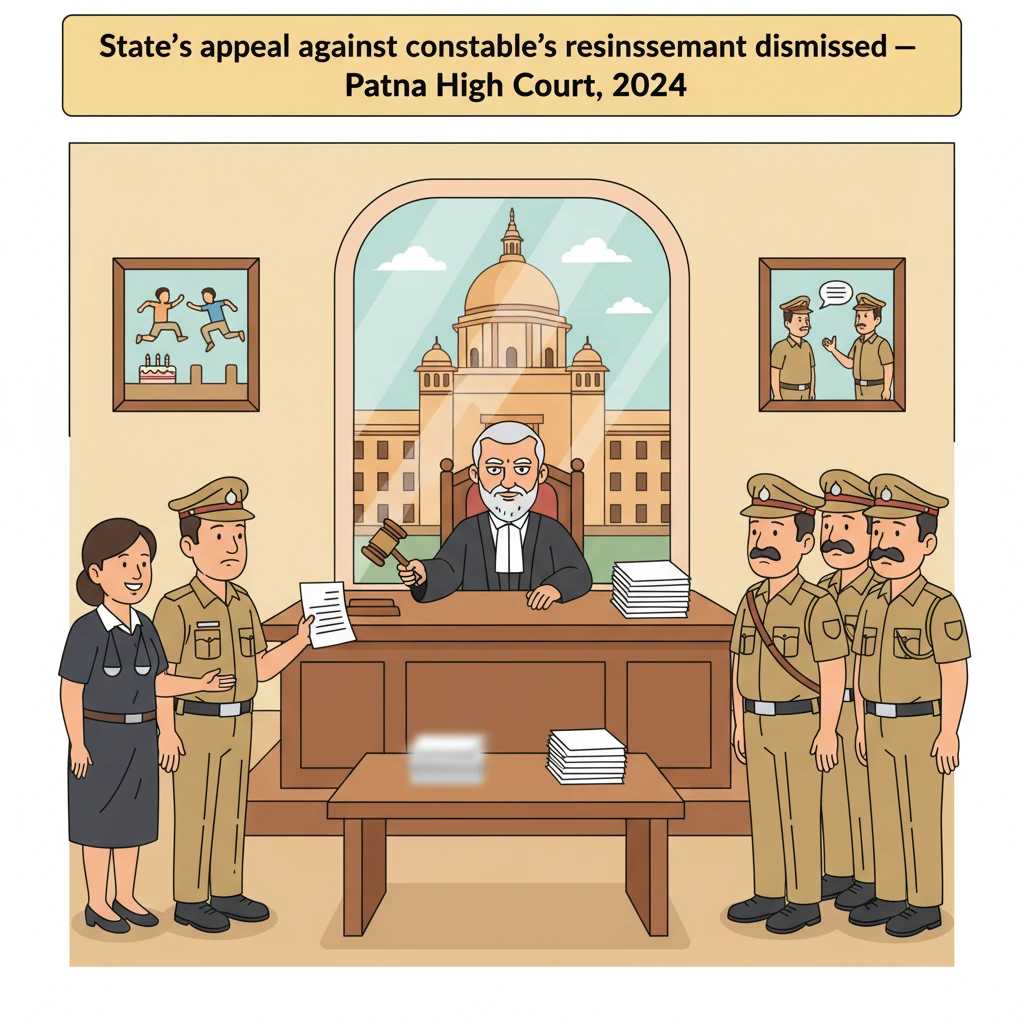
The case arises from disciplinary proceedings against a police constable posted under Bihar Military Police, now called Bihar Special Armed Police, in Muzaffarpur. He was accused of misconduct on the allegation that he celebrated a birthday party with a lady probationer constable.
A departmental enquiry was conducted against the constable. According to the State, he was dismissed from service by the appointing authority on the basis of evidence said to have been recorded in that enquiry. The dismissal order was later confirmed by the appellate and revisional authorities within the department.
The constable challenged his dismissal before the Patna High Court by filing Civil Writ Jurisdiction Case No. 2546 of 2023. A learned Single Judge examined the disciplinary record and found that there was “absolutely no valid evidence” led in the enquiry. On that basis, the Single Judge set aside the dismissal order.
Aggrieved by this, the State of Bihar and senior police authorities filed a Letters Patent Appeal (LPA No. 446 of 2024) before a Division Bench of the Patna High Court. The appeal was heard by a Bench comprising Hon’ble the Chief Justice and Hon’ble Mr. Justice Partha Sarthy. The judgment was delivered on 21.08.2024.
What the Court Examined and Decided
The Division Bench began by noting that the State’s appeal was directed against the Single Judge’s order which had already set aside the constable’s dismissal. The core question was whether the Single Judge was right in holding that there was no valid evidence to support the finding of misconduct and whether, instead of quashing the dismissal, the Single Judge ought to have remanded the matter for a fresh enquiry.
The alleged misconduct was simple but serious from the department’s point of view: the constable was said to have celebrated a birthday party together with a lady probationer constable. During this, they were allegedly seen together by some eye witnesses. To avoid detection, it was alleged, the constable and the probationer ran away from the party and jumped over the boundary wall of the venue.
The Single Judge had closely examined how the enquiry was conducted. Two officers who had conducted a preliminary enquiry were examined before the Enquiry Officer. They deposed about statements they had recorded from eye witnesses who, according to them, had seen the constable with the lady probationer at the party and had seen them run away and jump the boundary wall.
However, crucially, the eye witnesses themselves were never examined during the departmental enquiry. Only the officers conducting the preliminary enquiry were examined, and they spoke only about what others had told them. The Single Judge had therefore treated this material as mere hearsay and not valid evidence to prove misconduct.
The Division Bench agreed with this assessment. It held that, admittedly, a preliminary enquiry had been conducted, and only those who conducted it were later examined before the Enquiry Officer. Their depositions were limited to narrating statements made by other persons. Since those other persons, the actual eye witnesses, were not produced and examined, there was no direct or proper evidence of the alleged act of misconduct.
The Court clearly stated that such deposition was only hearsay evidence. On this basis, it concluded that there was indeed “no valid evidence regarding the allegation of misconduct.” Therefore, the dismissal based on such an enquiry could not be sustained.
Facing this situation, the learned Advocate General, appearing for the State, made a different request before the Division Bench. He argued that, even if the evidence led in the enquiry was found deficient, the appropriate course was not to uphold the Single Judge’s order outright but to remand the matter back to the Enquiry Officer. This would, in effect, give the department another opportunity to lead proper evidence and try to prove the charge again against the constable.
The Bench firmly rejected this prayer. It emphasised that the reason for which the Single Judge had interfered with the dismissal order was not some minor or technical defect in the conduct of the enquiry. Instead, the very foundation of the dismissal, namely valid evidence of misconduct, was missing.
The Court explained an important distinction. Remand may be appropriate when an employee’s dismissal is set aside because of a technical flaw, such as non-supply of the enquiry report or some violation of the principles of natural justice. In those situations, the enquiry can be resumed from the stage of defect, after curing it, so that the employee gets a fair and complete opportunity.
However, the present case was different. Here, an enquiry had already been carried out. The Department had a full opportunity to lead evidence through a properly constituted proceeding. It chose to examine only the officers involved in the preliminary enquiry and did not produce the actual eye witnesses. Because no valid evidence was led, the charge of misconduct could not be treated as proved. The Court held that, in such circumstances, the management cannot be allowed to correct its own mistake by seeking remand and then leading fresh evidence to try again to secure a finding of guilt.
To support this reasoning, the Division Bench referred to several Supreme Court decisions dealing with disciplinary enquiries and natural justice. It discussed Union of India v. Mohd. Ramzan Khan, (1991) 1 SCC 588 and ECIL v. B. Karunakar, (1993) 4 SCC 727. Those decisions concern the requirement of giving the employee a copy of the enquiry officer’s report so that he can make a representation before the disciplinary authority.
The Court explained that, after the 42nd Constitutional Amendment, the earlier requirement of issuing a separate show cause notice against the proposed punishment under Article 311(2) was removed. Some employers then argued that they no longer needed to supply the enquiry report to the delinquent employee. The Supreme Court, however, held in Mohd. Ramzan Khan and ECIL that whenever the enquiry officer is a person other than the disciplinary authority and finds the employee guilty of any charge, the employee is entitled to a copy of the enquiry report. Non-supply of such report amounts to violation of the principles of natural justice. In such cases, a remand may be ordered so that the report is supplied and an opportunity to make a representation is given.
By highlighting these judgments, the Division Bench showed that remand is a remedy meant to cure technical or procedural defects that cause prejudice to the employee, not to allow the employer to fill up gaps in evidence after the fact. The Court stressed that remand should not become a tool for “clearing up the lacuna” of a negligently conducted enquiry where no valid evidence was led.
The Court then turned to another Supreme Court authority, Union of India v. P. Gunasekaran, (2015) 2 SCC 610. It reproduced paragraphs 12 and 13 of that judgment, which lay down the limits of the High Court’s powers under Articles 226 and 227 in disciplinary matters.
In P. Gunasekaran, the Supreme Court cautioned that the High Court is not an appellate authority over disciplinary enquiries. It cannot reappreciate evidence like a court of first appeal. Instead, it can only check whether the enquiry was conducted by a competent authority, followed the prescribed procedure, respected principles of natural justice, and whether extraneous or irrelevant considerations affected the decision. One of the specific grounds on which interference is permitted is where “the finding of fact is based on no evidence.”
The Division Bench relied on this exact ground. It held that, from the record, there was no valid evidence to support the finding of misconduct. Therefore, the Single Judge was justified in interfering with the dismissal. The Court added that if, in every case where the department fails to lead valid evidence, the matter is remanded, it would be “offering a premium to the negligence” of the disciplinary authority and condoning the careless manner in which departmental enquiries are sometimes conducted.
The Court also recounted a settled principle of disciplinary law: the standard of proof in a departmental enquiry is the “preponderance of probability,” which is a lower standard than “beyond reasonable doubt” used in criminal trials. But even under this lower standard, there must still be some valid evidence. If there is no evidence at all, no conclusion of guilt can be drawn, and the employee cannot be punished on the basis of mere assumptions or unsupported findings.
Applying these principles to the case at hand, the Division Bench concluded that the disciplinary authority and the department already had their chance in a properly constituted enquiry. They chose not to present the actual eye witnesses and relied only on hearsay. That failure could not be corrected through a fresh opportunity.
Accordingly, the Court refused to accede to the Advocate General’s request for remand for the purpose of producing valid evidence now. It held that, since the punishment of dismissal was imposed without any valid evidence, the Single Judge was right in setting it aside. The Division Bench therefore agreed fully with the findings of the Single Judge and dismissed the Letters Patent Appeal in limine, meaning at the very threshold, without issuing notice or going into a detailed re-hearing on facts.
Why This Judgment Matters
This judgment is significant for government employees, especially police personnel and other uniformed services, who may face departmental action on the basis of weak or informal material. It makes clear that even in departmental enquiries, where the standard of proof is relaxed, some proper evidence must still be brought on record to justify a serious penalty like dismissal.
The Patna High Court draws a clear line between correcting technical mistakes and giving the department a second chance to patch up its own failure to produce evidence. If the enquiry is not properly handled and no valid evidence is led, the employer cannot later ask the Court to remand the matter just to fix those gaps.
For employees, this judgment shows that courts can and will interfere when findings are based on “no evidence,” even though they will not normally re-examine every detail of the enquiry. For disciplinary authorities, it is a reminder that they must take enquiries seriously, examine real witnesses, and follow proper procedure from the start.
Legal Issues and Answers
- Issue: Whether the disciplinary dismissal of the constable could stand when the departmental enquiry was based only on hearsay evidence, without examining the actual eye witnesses.
Answer: No. The Patna High Court held that there was no valid evidence of misconduct, so the dismissal could not be sustained. - Issue: Whether, in such a situation, the High Court should remand the matter to the Enquiry Officer to allow the department to lead fresh evidence.
Answer: No. The Court held that remand is appropriate only to cure technical defects or violations of natural justice, not to permit the employer to fill gaps in evidence after conducting a negligent enquiry. - Issue: Whether the Single Judge exceeded the limits of judicial review under Articles 226/227 by interfering in a disciplinary matter.
Answer: No. Relying on Union of India v. P. Gunasekaran, the Court held that interference is permissible where the finding of fact is based on no evidence, which was exactly the case here.
Cases Cited by the Court
- Union of India v. Mohd. Ramzan Khan, (1991) 1 SCC 588
- ECIL v. B. Karunakar, (1993) 4 SCC 727
- Union of India v. P. Gunasekaran, (2015) 2 SCC 610
Case Details
Case Number: Letters Patent Appeal No. 446 of 2024 in Civil Writ Jurisdiction Case No. 2546 of 2023
Case Title: The State of Bihar & Ors. v. Vikash Kumar @ Vikas Kumar
Citation: 2024 (4) PLJR 94
Coram: Hon’ble the Chief Justice K. Vinod Chandran and Hon’ble Mr. Justice Partha Sarthy
Advocates: For the appellants (State): Mr. P.K. Shahi, Advocate General; Mr. Nadeem Seraj, Government Pleader-5; Mr. Shahbaj Alam, Assistant Counsel to GP-5. For the respondent: Not specified in the judgment extract.
Nature of the Case: Letters Patent Appeal by the State against a Single Judge’s order allowing a writ petition and setting aside departmental dismissal of a constable.
Link to Judgment: Patna High Court Judgment in LPA No. 446 of 2024
If you found this explanation helpful and wish to stay informed about
how legal developments may affect your rights in Bihar,
you may consider following Samvida Law Associates for more updates.







